
Rhetorical Questions Worksheets
About These 15 Worksheets
Rhetorical questions might sound like regular questions, but they’re really clever little tricks in language that don’t expect an answer. They pop up in speeches, essays, and even casual conversations to add drama, persuasion, or a touch of humor. These worksheets turn what might seem like a “fancy writing skill” into approachable, hands-on practice that students can enjoy. By working through puzzles, quizzes, and creative prompts, learners see how these questions shape meaning and add flair to everyday communication.
This collection makes rhetorical questions less intimidating by presenting them in playful and interactive ways. Instead of memorizing definitions, students solve challenges, try out witty phrasing, and explore tone in context. The worksheets encourage kids to be both analytical and creative-spotting rhetorical questions in examples, then crafting some of their own. It’s a balance of recognition, practice, and experimentation that helps solidify the skill.
Beyond just grammar, these worksheets connect to real-world communication skills. Students learn how rhetorical questions show up in advertising, debates, and even friendly chats. The practice helps them understand not only how to recognize these devices, but also how to use them for persuasion or humor. By connecting language study to daily life, the worksheets make rhetorical questions feel practical, meaningful, and even a little fun.
Have a Look Inside Each Worksheet
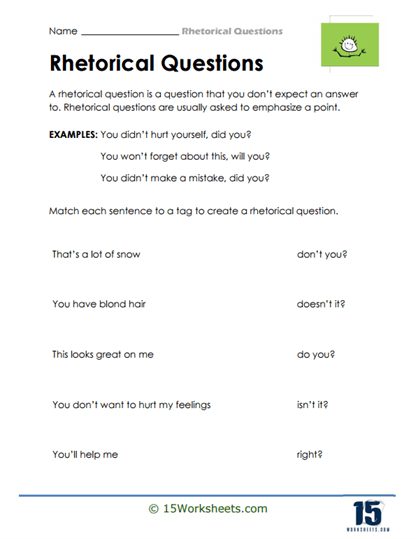
Tag Match
This worksheet helps students practice rhetorical questions by matching them with the most fitting responses. Learners sharpen their critical thinking while noticing how rhetorical devices add punch to dialogue. It feels like solving a mini puzzle that makes grammar more engaging. By the end, students can confidently tell when a question isn’t really meant to be answered.
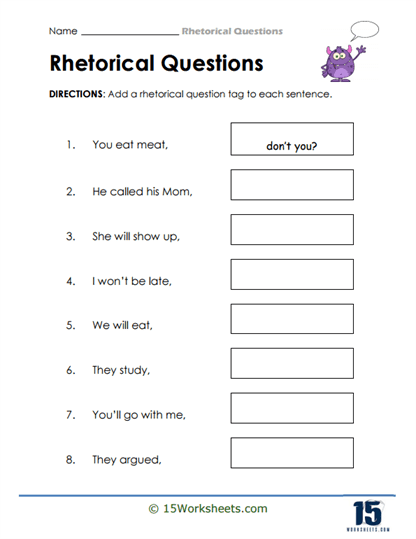
Tag Talk
Students get hands-on with question tags that turn regular statements into fun rhetorical tools. They practice attaching the right tag to match both meaning and tone. The activity keeps reading and speaking practice lively and interactive. It’s a playful way to see how rhetorical questions sneak into everyday talk.
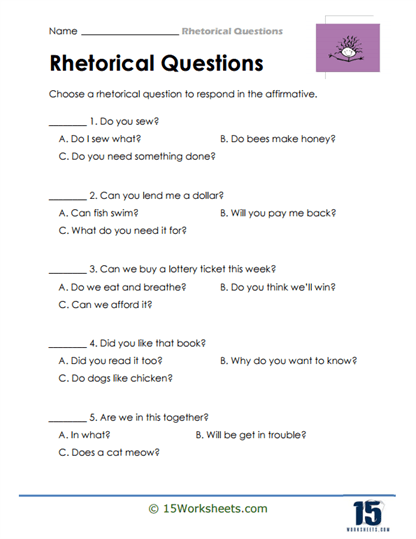
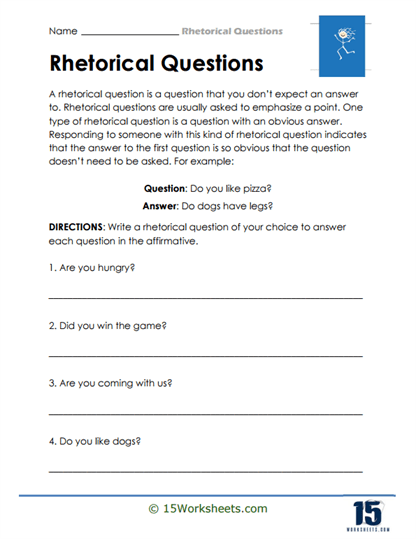
Affirmative Answers
This worksheet highlights why rhetorical questions often come with an implied “yes.” Students read examples and think through possible affirming responses. The task helps them understand tone, persuasion, and implied agreement. It shows how language can gently guide an audience to nod along.
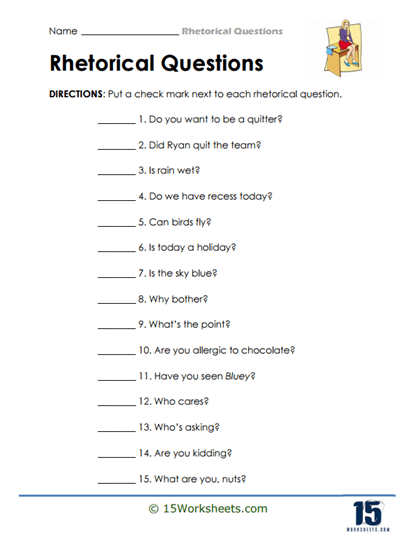
Quiz Quirks
In this sheet, students encounter quirky and exaggerated rhetorical questions. They explore humor, dramatic effect, and persuasive flair in action. The setup keeps things light while still digging into serious writing tools. Students learn that rhetorical devices can both persuade and entertain.
Puzzle Pursuit
This worksheet turns rhetorical questions into a puzzle-solving activity. Students pair up questions with matching situations for practice. The blend of logic and language keeps things fresh and fun. It’s a clever way to highlight how rhetorical questions spice up communication.
Tone Test
Here, learners explore how tone can flip the meaning of a rhetorical question. They’ll label examples as sarcastic, persuasive, humorous, or serious. The activity builds awareness that delivery matters as much as the words themselves. Students gain a richer sense of voice and context in communication.
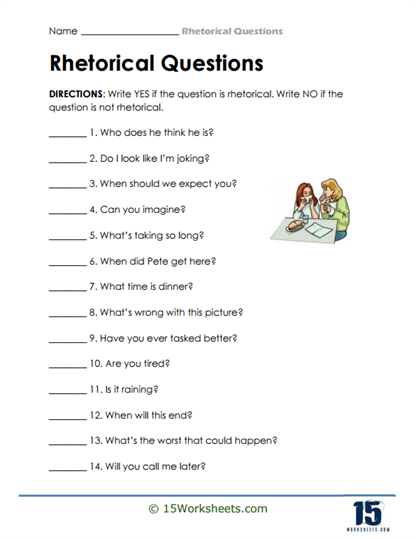
Question Quiz
This worksheet presents rhetorical questions in a quiz-style format. Students decide which questions expect answers and which are rhetorical. The challenge keeps engagement high while reinforcing recognition skills. It’s part grammar practice, part quick-thinking game.
Answer Affirmative
Students practice writing fitting affirmations to match rhetorical questions. The activity shows how such questions steer audiences toward agreement. They strengthen persuasive writing and speaking skills in the process. It’s a simple yet powerful way to see language influence at work.
Prompt Power
This worksheet digs into rhetorical questions as prompts in speeches and essays. Students identify how each one pushes the audience toward a certain perspective. The activity makes academic writing strategies more approachable. It also invites students to try using rhetorical devices in their own work.
Persuasion Pointers
Students practice spotting rhetorical questions as persuasive strategies. They’ll explore humor, exaggeration, and appeals to common sense. Each example shows how writers and speakers strengthen their arguments with questions. The activity builds skills students can apply in essays and debates.
Quiz Queries
This worksheet offers a rapid-fire quiz of rhetorical and literal questions. Students must quickly decide which is which. The brisk pace makes it fun and keeps learners on their toes. It’s a handy way to sharpen instincts for spotting rhetorical language.
Situation Sayings
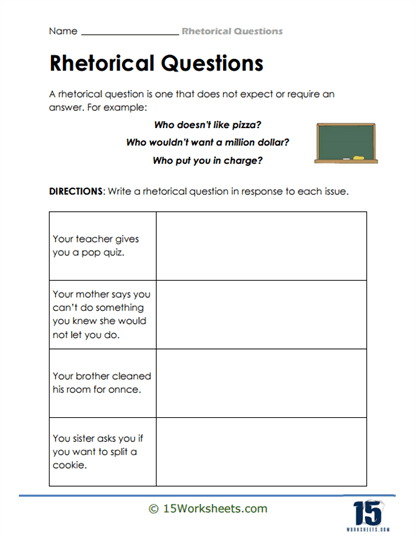
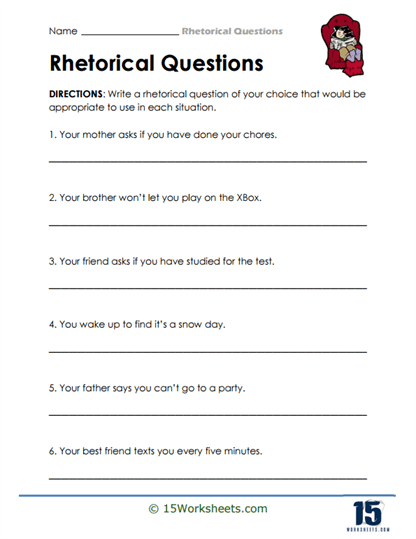
Students connect rhetorical questions with everyday situations. They’ll match language to real-life contexts, building interpretation skills. This activity shows that rhetoric isn’t just in essays-it’s all around us. It encourages students to think about how people actually use language in daily life.
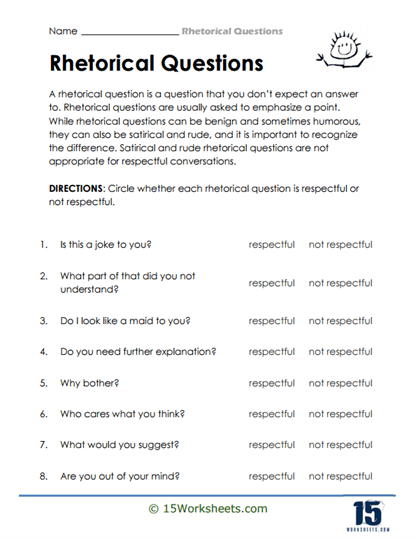
Polite Phrases
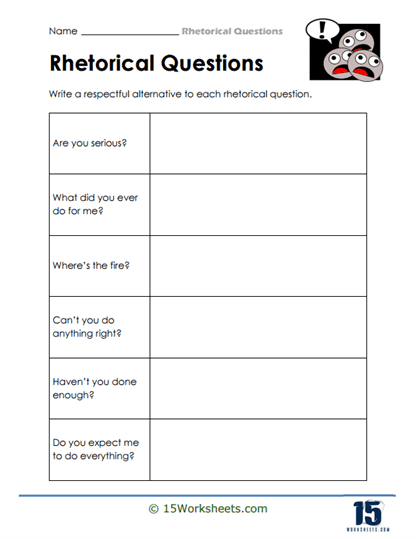
This worksheet explores how rhetorical questions can soften requests or statements politely. Students practice identifying and writing polite phrasing in different scenarios. The activity connects rhetoric with social interaction and courtesy. It shows how language can persuade gently while keeping things friendly.
Quip Questions
Students dive into witty rhetorical questions full of humor and wordplay. They’ll learn how quick, clever phrasing keeps an audience engaged. The activity highlights the entertaining side of rhetoric. It proves that good communication can be both smart and funny.
Question Craft
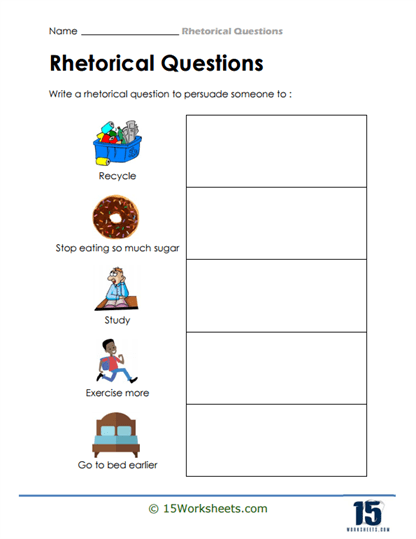
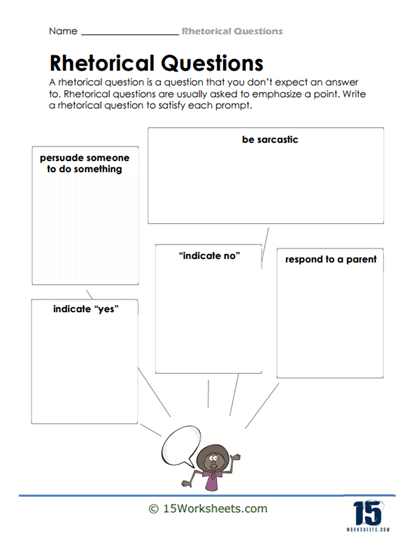
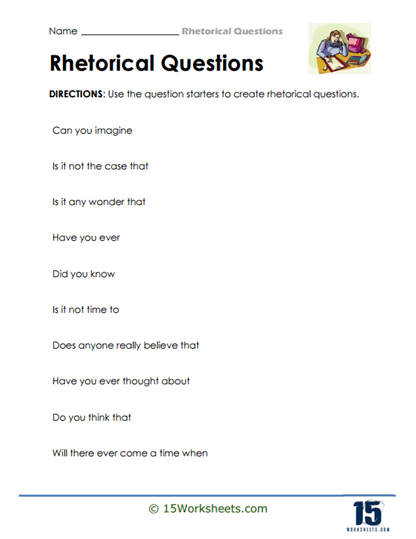
This worksheet challenges students to create their own rhetorical questions. They’ll practice shaping language to persuade, amuse, or emphasize a point. The task encourages creativity while reinforcing understanding of rhetorical purpose. By the end, students will have their own toolbox of crafted rhetorical gems.
What Are Rhetorical Questions?
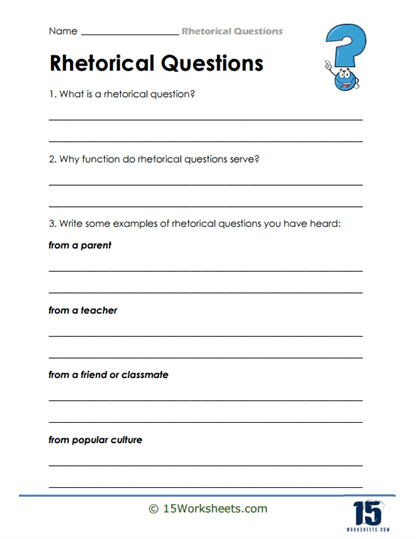
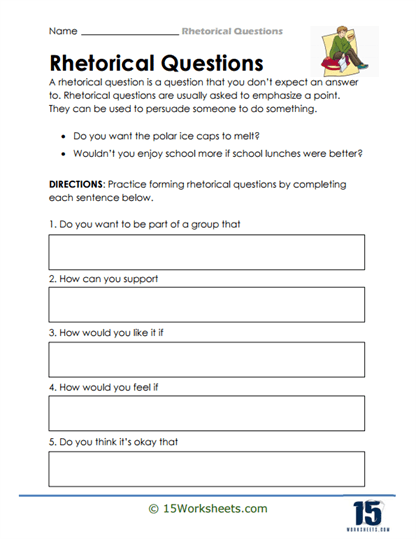
Rhetorical questions are questions posed by a speaker or writer that are not intended to require a response. Instead, they are used to make a point, provoke thought, or emphasize a particular idea. Unlike standard questions, which seek information or clarification, rhetorical questions often serve as a persuasive device or a means of highlighting the obvious. For example, the question “Isn’t it a bit late to start studying now?” is not meant to be answered; rather, it is intended to suggest that starting to study at the last minute is not wise.
The primary purpose of rhetorical questions is to engage the audience and encourage them to consider the topic at hand more deeply. By posing a rhetorical question, a speaker or writer invites the listener or reader to reflect on the issue, often leading them to the same conclusion the speaker has already reached. This technique is especially effective in persuasive writing and speeches, where the goal is to influence the audience’s thoughts or actions. Rhetorical questions can also serve to highlight the absurdity of a situation, as in the case of “Do pigs fly?”, which underscores the impossibility of the scenario being discussed.
Rhetorical questions are also powerful tools for emphasizing key points. By asking a question that implies its own answer, the speaker can underline the importance of an idea or argument. For example, “How could anyone believe that?” suggests disbelief and invites the audience to share in that incredulity. This technique is often used in arguments to reinforce the speaker’s position and to lead the audience to agree with their perspective. The implied answer in a rhetorical question often aligns with the speaker’s viewpoint, making it a subtle yet effective way to persuade.
Another important function of rhetorical questions is to engage the audience on an emotional level. By asking a question that resonates with the audience’s experiences or feelings, the speaker can create a connection that draws the audience in. For instance, “Don’t we all want to live in a safer world?” appeals to a common desire, making the audience more receptive to the speaker’s message. This emotional engagement can be a powerful way to build rapport and ensure that the audience is not just listening but also emotionally invested in the topic.