
A vs. An Worksheets
About These 15 Worksheets
Choosing between “a” and “an” seems simple at first, but English loves to toss in a few curveballs. These worksheets take the guesswork out by guiding students step-by-step through the rules, from the basics to the tricky exceptions. Instead of just memorizing “use ‘a’ before consonants and ‘an’ before vowels,” kids learn to focus on sounds, context, and meaning. With fun themes, pictures, and correction challenges, grammar starts to feel like a puzzle they can solve with confidence.
This collection offers a wide variety of activities to keep practice lively. Students fill in blanks, fix mistakes, match pictures, and even play mini grammar games. Some worksheets focus on speed and fluency, while others highlight deeper thinking about context and exceptions. The mix ensures that kids not only learn the rule but can also use it correctly in real sentences.
And the beauty of it all? These skills show up constantly in everyday language. Whether kids are writing about “a dog” they saw in the park, talking about “an apple” for lunch, or noticing that “an hour” doesn’t start with an “h” sound, the practice connects directly to daily life. By the end, students don’t just know the rule-they’re ready to use “a” and “an” naturally whenever they speak or write.
Have a Look Inside Each Worksheet
Essential Rules
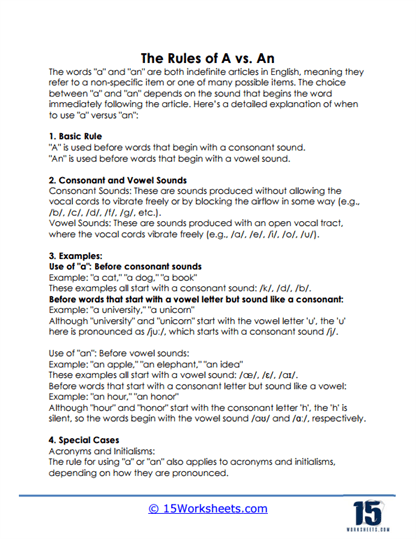
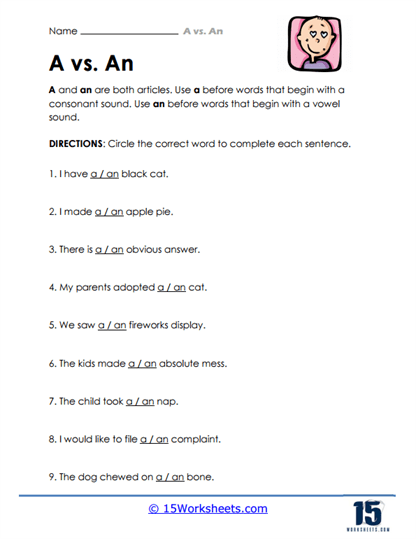
This worksheet introduces the basic rules for using “a” and “an” before words. Students practice spotting whether a word starts with a vowel sound or a consonant sound. Clear examples make the grammar easy to grasp. It’s a simple, friendly way to start mastering articles.
Fruits of Labor
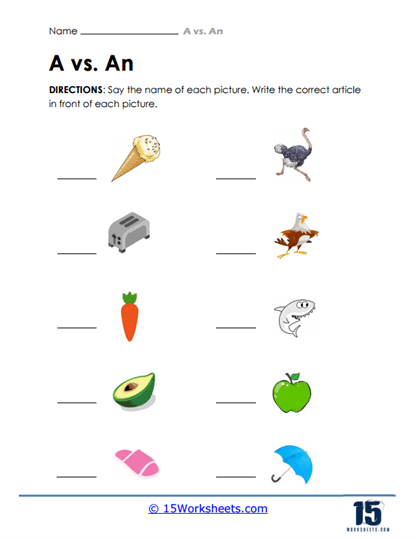
Learners decide whether to use “a” or “an” in sentences about fruits and food items. The fun theme keeps kids engaged while applying the grammar rule. It mixes vocabulary practice with article usage. Students get a tasty review of both language and food words.
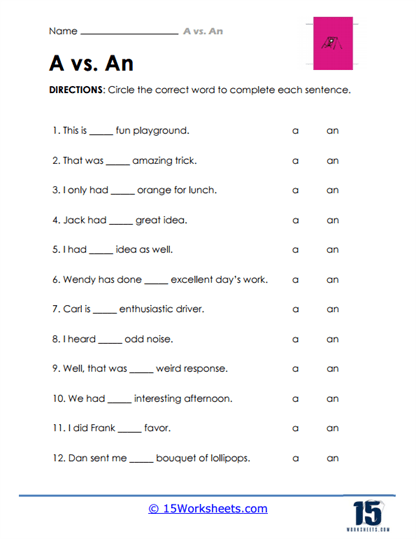
Mixed Match
This worksheet challenges kids to complete sentences with the correct article. The mix of different topics keeps practice varied and fresh. It reinforces quick decision-making between “a” and “an.” Learners sharpen their grammar skills with every sentence.
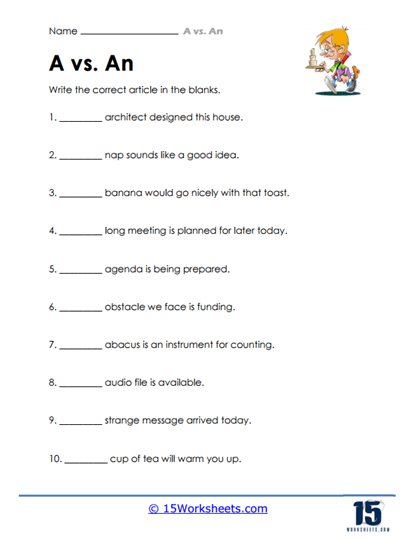
Complete Practice
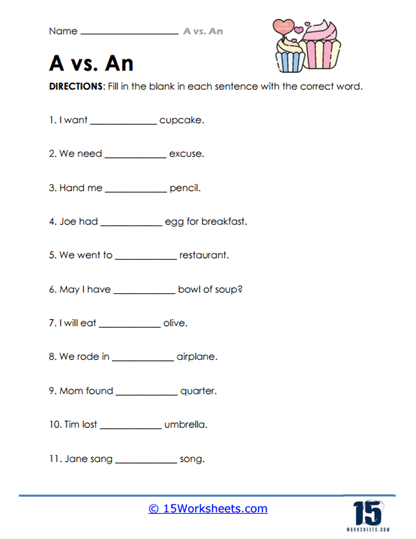
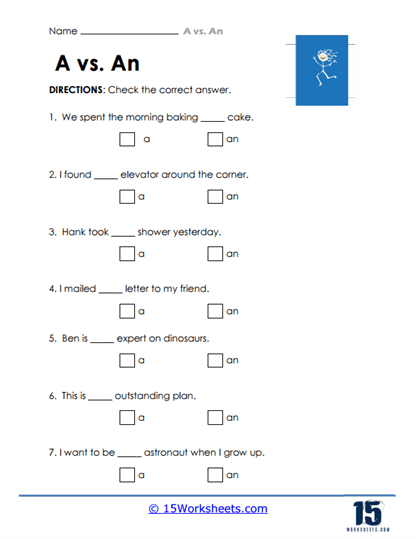
Students fill in blanks with “a” or “an” to finish short sentences. The activity gives repeated, no-fuss practice to build fluency. Simple, direct instructions make it great for independent work. It helps students get comfortable applying the article rule naturally.
What a Miss
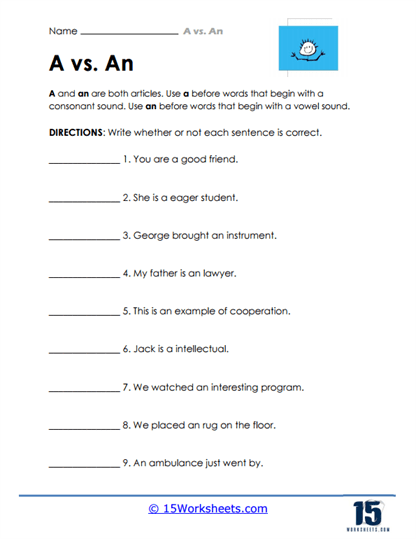
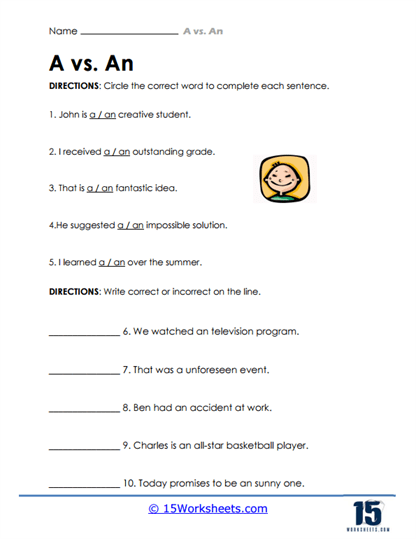
This worksheet focuses on spotting and correcting mistakes with “a” and “an.” Learners review sentences and fix the incorrect articles. It strengthens proofreading and grammar awareness. The challenge makes students more alert to common slip-ups.
The Insights
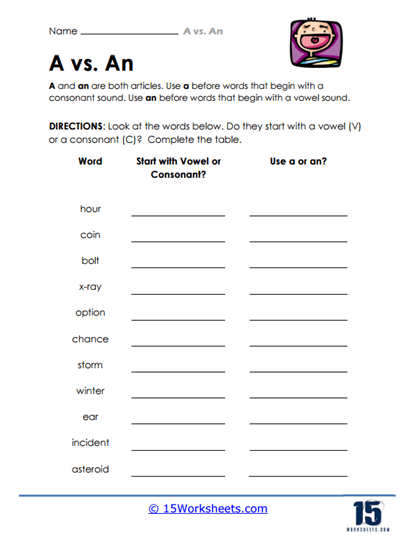
Students explore tricky examples where vowel sounds don’t always match vowel letters. Words like “hour” and “unicorn” help them think more deeply about the rules. This worksheet goes beyond basics to sharpen listening and reasoning. It gives learners valuable insights into how English really works.
Playful Articles
This worksheet uses games and lighthearted activities to reinforce article usage. Students complete sentences in a way that feels interactive and fun. The playful format keeps attention high. It makes grammar practice feel less like a drill and more like a game.
The Fixer
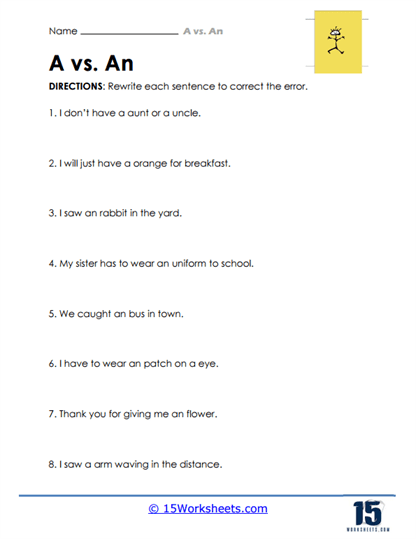
Here, learners act as “grammar fixers,” correcting sentences with the wrong articles. The editing role makes them more active in the learning process. It strengthens their sense of language accuracy. Students become grammar detectives solving little mistakes.
Switchoroo
This worksheet flips sentences by having kids switch incorrect articles with the correct ones. The back-and-forth practice keeps the activity lively. It improves editing skills while reinforcing the rule. Learners have fun while they fine-tune their grammar.
A/An Mastery
Students tackle a set of exercises designed to build confidence in article usage. The repeated, varied practice ensures the rule sticks. The mastery focus encourages accuracy and fluency. By the end, students feel like pros at choosing “a” or “an.”
Grammar Challenge
This worksheet presents article practice in the form of a mini challenge. Learners race through exercises that test their understanding. The challenge format adds a sense of excitement. It’s great for reviewing “a” and “an” in a fun way.
Perfect Explorer
Students explore different words and contexts where “a” or “an” might be tricky. The worksheet pushes them to think critically and apply the rule carefully. It mixes exploration with grammar learning. Kids become confident “explorers” of article usage.
Context Matters
This worksheet trains students to choose “a” or “an” by listening for the first sound, not just the first letter. They practice with real tricksters like “hour,” “unicorn,” and phrases where an adjective comes first (e.g., “an old umbrella”). Short scenarios show how meaning and surrounding words can change the correct article. Kids learn to make smart, context-based choices that stick.
A or An
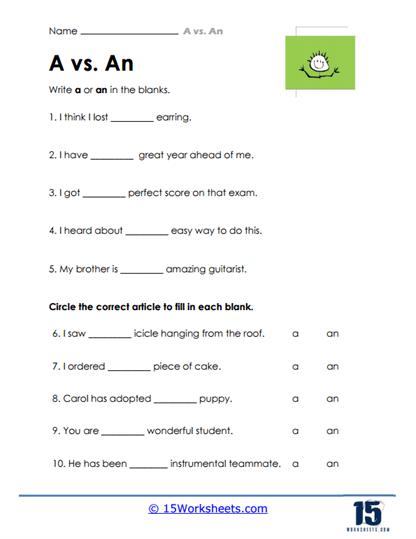
This is a straightforward fill-in-the-blank sheet focused on quick decisions between “a” and “an.” Students read a word or short phrase and choose the correct article based on the opening sound. The repetition builds automaticity and confidence. It’s simple, clean practice that helps the rule click.
Article Action
Learners race through mini challenges that mix sorting, fixing, and completing sentences with the right article. Fast-paced prompts keep attention high while reinforcing the vowel-sound rule. Occasional curveballs (like “a one-dollar coin” vs. “an owl”) build flexible thinking. It feels like a game, but the grammar gains are real.
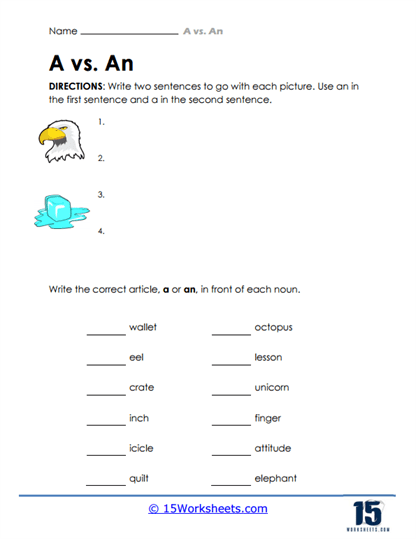
Picture Sentences
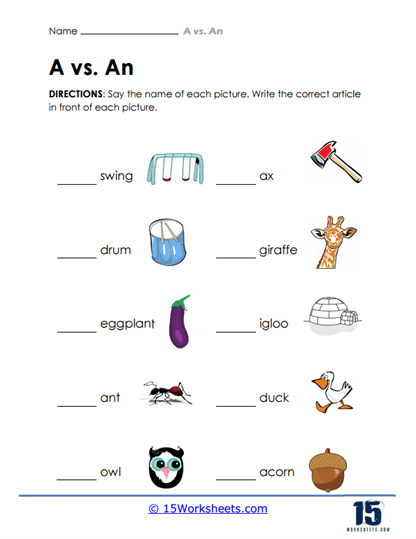
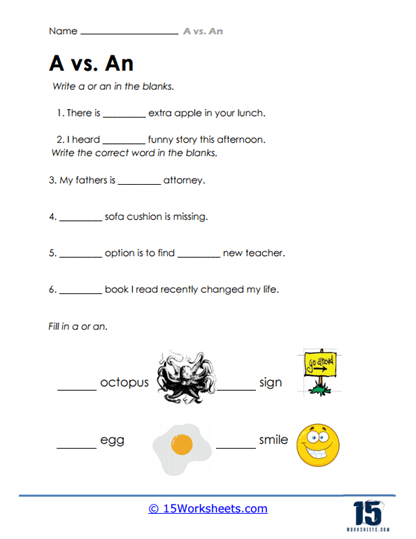
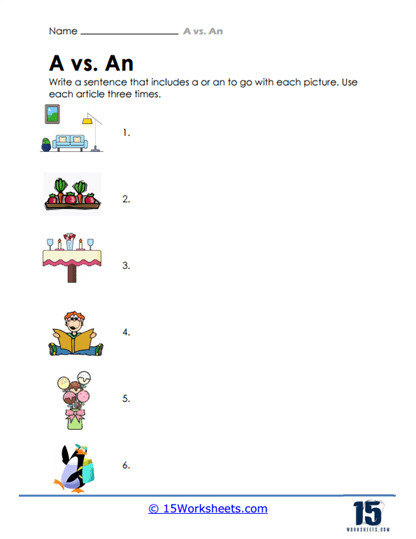
Students use pictures as clues to decide whether to write “a” or “an” before the noun. They then complete or compose short sentences, turning visuals into accurate grammar. The image support is great for emerging readers and multilingual learners. It blends vocabulary growth with rock-solid article practice.
Grammatically When To Use “A” or “An”
The decision to use “a” or “an” before a word in a sentence is determined by the sound that immediately follows the article, not necessarily the first letter of the next word. This rule hinges on whether the following sound is a vowel or a consonant sound.
Use “a” before words that begin with a consonant sound. Consonant sounds are made by blocking or restricting airflow with the tongue, teeth, or lips, and they typically include letters like b, c, d, g, k, p, and t. For example, you would say “a cat,” “a dog,” or “a book” because the words “cat,” “dog,” and “book” all start with a consonant sound. It is important to note that the focus here is on the sound rather than the letter itself. For instance, even though “university” begins with a vowel letter ‘u’, it starts with the consonant sound /ju:/, so we say “a university.”
On the other hand, use “an” before words that begin with a vowel sound. Vowel sounds occur when the vocal cords vibrate freely, without obstruction from the tongue, teeth, or lips. These sounds typically begin with the letters a, e, i, o, or u, such as in the words “apple,” “elephant,” or “umbrella.” Thus, you would say “an apple,” “an elephant,” and “an umbrella.” Again, the key is the sound; for example, the word “honor” begins with a silent ‘h’ and is pronounced with an initial vowel sound, so the correct usage is “an honor.”
There are also special cases where the spelling of a word can be misleading. For instance, the word “hour” begins with ‘h’, which is normally a consonant letter, but because the ‘h’ is silent, the word starts with the vowel sound /aʊ/. Therefore, we use “an hour” instead of “a hour.” Conversely, in words like “one” (as in “one apple”), the ‘o’ is pronounced as a consonant sound /w/, so we use “a one” rather than “an one.”
Another example that often confuses learners is the word “historic.” Depending on regional pronunciation, some people say “an historic event” because they do not pronounce the ‘h’ sound strongly, making it sound like it starts with a vowel. Others might say “a historic event” because they do pronounce the ‘h’, making it start with a consonant sound. Both can be correct depending on the pronunciation.