
Intensive Pronouns Worksheets

About These 15 Worksheet
The Intensive Pronouns worksheet collection provides a full, structured journey through one of grammar’s most overlooked but essential topics. Each worksheet builds from basic recognition to advanced application, helping students understand how intensive pronouns emphasize nouns and pronouns for clarity and expression. The activities include matching, rewriting, sentence building, and creative prompts that keep learners actively engaged while strengthening comprehension. Whether used in class or at home, the sequence supports step-by-step growth with a balance of structure and creativity.
As students progress through the collection, they gain a deeper awareness of grammatical function and sentence emphasis. The exercises cultivate both analytical and expressive language skills, improving accuracy, fluency, and editing ability. Learners not only identify and apply intensive pronouns correctly but also learn to use them naturally in speech and writing. By blending recognition, creativity, and practical grammar use, this series equips students with tools for stronger communication and more confident writing.
Detailed Descriptions Of These Worksheets
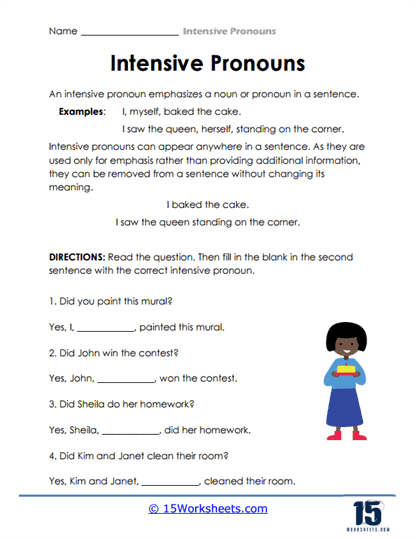
Pronoun Power
This introductory worksheet introduces the concept of intensive pronouns and their role in emphasizing nouns or pronouns. Learners complete guided fill-in-the-blank exercises that demonstrate how emphasis can be added or removed without changing meaning. The activity supports grammatical understanding and encourages students to apply the rule in context. It lays a strong foundation for identifying emphasis in writing.
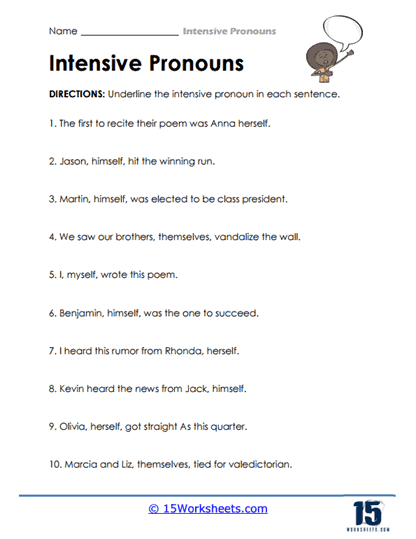
Emphasis Explorer
Students identify and underline intensive pronouns in a variety of sentences to reinforce pattern recognition and comprehension. Each example helps illustrate how emphasis works grammatically and stylistically. By analyzing sentence structures, learners become more attentive to word function and rhythm. The activity supports both reading fluency and grammatical precision.
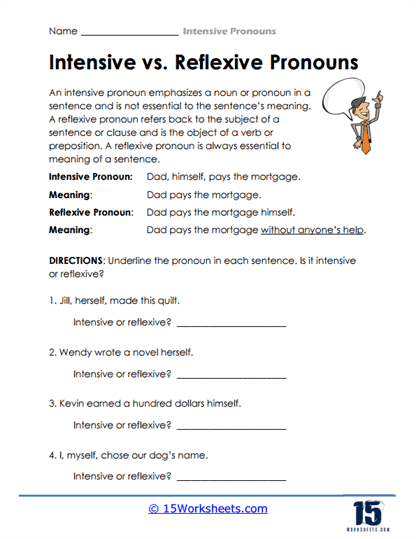
Pronoun Contrast
This worksheet challenges students to differentiate between intensive and reflexive pronouns through comparison exercises. Clear examples and guided analysis promote close reading and reasoning. Learners strengthen their grammar awareness and develop confidence distinguishing similar structures. The focus on subtle contrasts enhances both comprehension and writing accuracy.
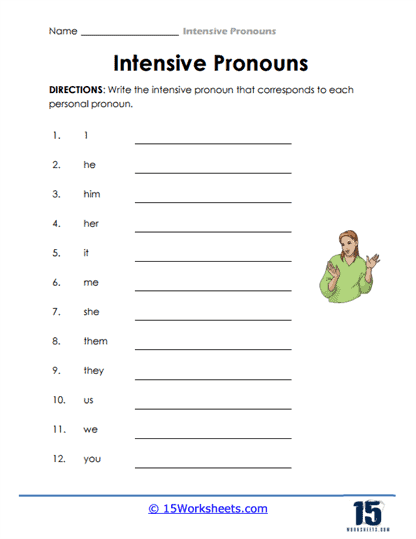
Pronoun Partner
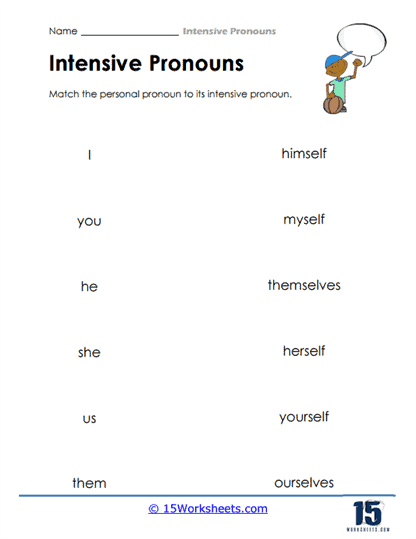
Students match personal pronouns with their intensive forms in this recall-based activity. The layout is visually organized, helping learners see relationships among pronoun types. By identifying consistent patterns, they improve memory and recognition of grammatical forms. The structured repetition encourages mastery through practice and pattern association.
Sentence Strengthener
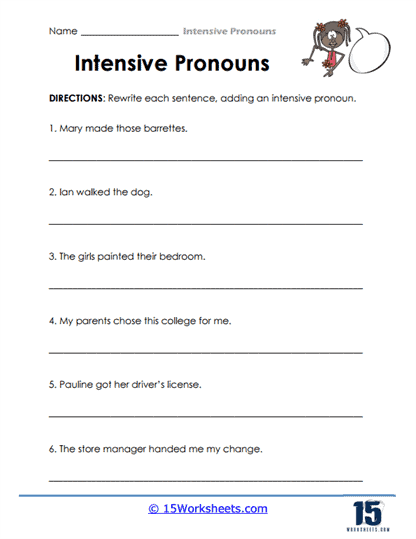
This writing task asks students to revise sentences by inserting an intensive pronoun for added emphasis. The exercise encourages stylistic experimentation while maintaining grammatical correctness. Learners practice varying tone and rhythm to improve sentence flow. It’s a practical, creative approach to applying grammar rules in real writing situations.
Proper Picker
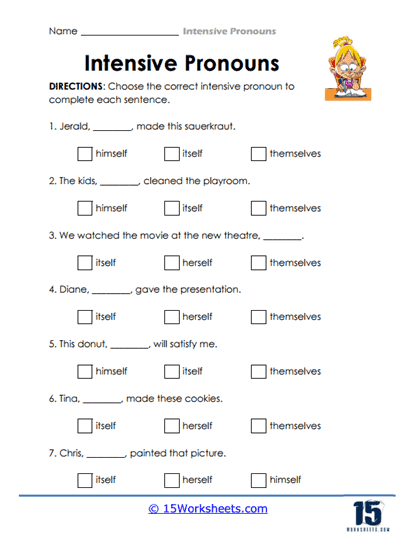
Through multiple-choice questions, students select the correct intensive pronoun for each sentence. The contextual choices help them focus on agreement and appropriate use. Quick decision-making builds confidence and reinforces grammatical intuition. The varied examples make this worksheet ideal for review or assessment.
Sentence Builder
Learners write original sentences featuring specific intensive pronouns like myself or themselves. The open-ended format promotes creativity and personal expression. It encourages students to demonstrate understanding through original examples. This writing task develops independence and fluency in applying grammar rules.
Question Creator
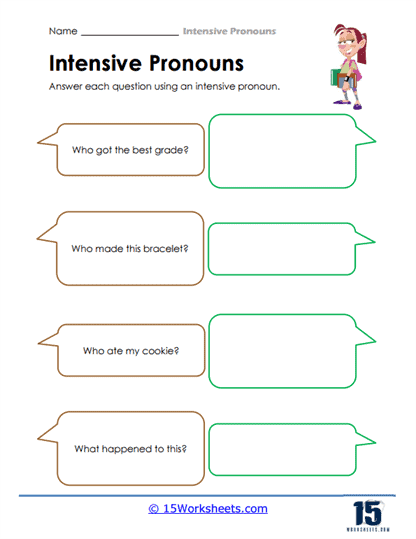
Students respond to open-ended prompts using intensive pronouns in full sentences. The conversational style supports natural grammar use and encourages expressive writing. Learners practice applying grammar in authentic contexts. The exercise builds confidence in both comprehension and communication.
Picture Pronouns
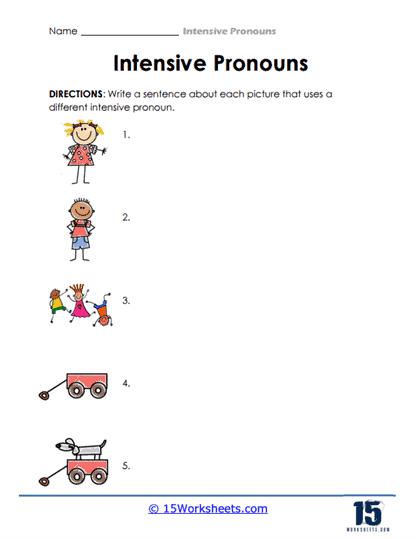
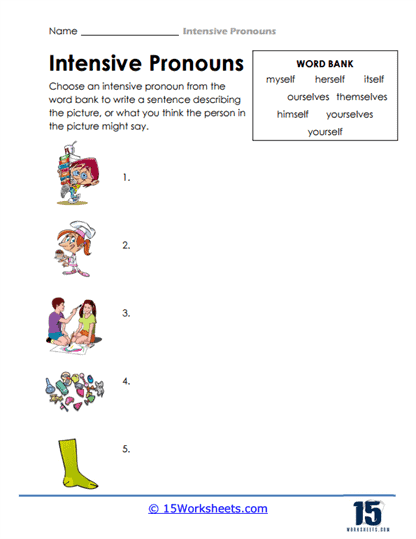
Each illustrated prompt invites students to write sentences using intensive pronouns inspired by what they see. The combination of visuals and writing deepens conceptual understanding. Learners connect imagery with grammar for a multi-sensory learning experience. This creative task supports engagement, expression, and retention.
Matching Minds
In this matching activity, students pair personal pronouns with their corresponding intensive forms. The task reinforces connections between pronoun types through active recall. Its clear structure supports accuracy and quick memory retrieval. This interactive format strengthens foundational grammar skills.
Sentence Completer
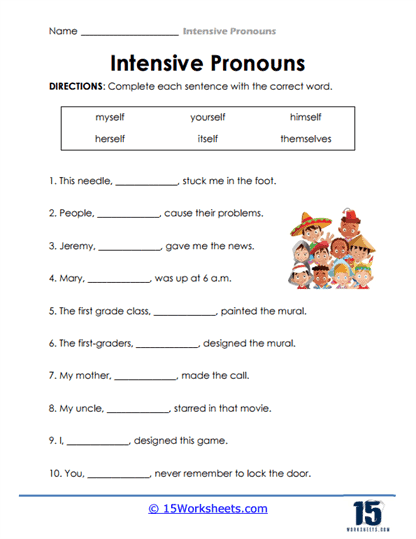
Using a word bank, students fill in blanks to complete sentences with the correct intensive pronouns. The varied examples promote context-based reasoning and careful reading. It’s an effective way to check understanding while reinforcing agreement rules. The activity combines comprehension, grammar, and writing practice in one task.
Picture Prompts
Learners craft sentences from illustrated scenes using intensive pronouns from a provided list. The colorful visuals inspire descriptive and imaginative writing. Students apply grammar knowledge while creating contextually accurate sentences. This blend of art and language builds both engagement and grammar fluency.
Personal Correspondence
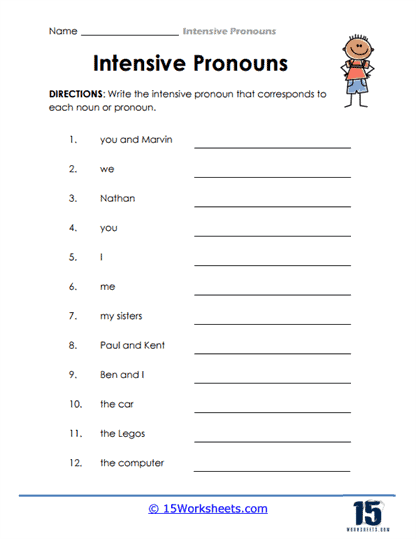
This worksheet connects nouns and personal pronouns to their matching intensive forms. Students observe structural relationships and strengthen recall through repetition. It’s a straightforward yet powerful practice for building consistency and accuracy. The focus on logical pairing supports both grammar mastery and editing skills.
Pronoun Identifier
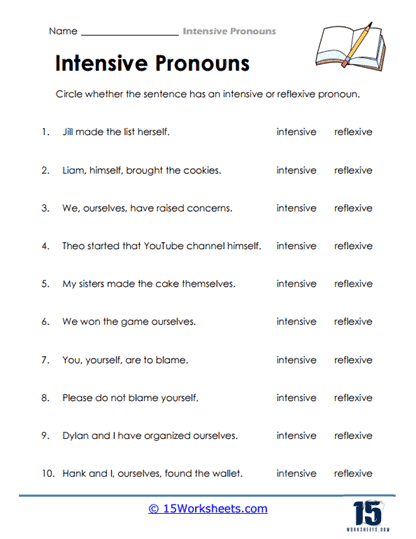
Students analyze sentences to determine whether each contains an intensive or reflexive pronoun. The examples require careful attention to meaning and structure. Learners enhance their grammatical judgment and reading comprehension simultaneously. It’s an excellent tool for practicing close reading with a grammar focus.
Creative Reflections
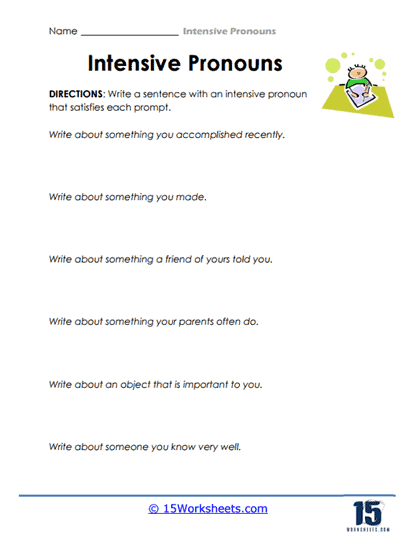
Through personal prompts, students write reflective sentences using intensive pronouns. The activity merges grammar with self-expression and creative thinking. Learners apply grammatical emphasis to meaningful, real-world topics. It fosters both confidence in writing and mastery of pronoun use.
Understanding Intensive Pronouns
In English grammar, intensive pronouns often confuse students because they look identical to reflexive pronouns, yet their role in a sentence is completely different. While reflexive pronouns reflect the action back onto the subject, intensive pronouns are used purely to emphasize the subject. In other words, they add force or focus to the statement, highlighting that the person or thing truly performed the action themselves.
Intensive pronouns are formed by adding -self or -selves to certain personal pronouns. The most common ones include myself, yourself, himself, herself, itself, ourselves, yourselves, and themselves. They are not necessary for the sentence to make sense – they simply make it stronger. For instance, if you say, “I baked the cake,” that’s perfectly fine. But if you say, “I myself baked the cake,” you’re emphasizing that you, and no one else, did the baking.
One easy way to identify an intensive pronoun is to remove it from the sentence and see if the sentence still makes sense. If it does, the pronoun is intensive; if it doesn’t, it’s reflexive. For example, “I cut myself while cooking” cannot lose myself without losing its meaning – that’s a reflexive pronoun. However, “I myself cooked dinner” works fine without myself, which tells us it’s being used for emphasis.
Examples of Intensive Pronouns
myself, yourself, himself, herself, itself, ourselves, yourselves, themselves
Examples of Intensive Pronouns in Sentences
I myself completed the entire project.
She herself prepared all the decorations.
The president himself made the announcement.
We ourselves cleaned the classroom after the party.
The dog itself opened the gate.
They themselves built the new playground.