
Predicate Adjectives Worksheets
All About These 15 Worksheets
Predicate adjectives live quietly in our sentences-those descriptive words that sit after linking verbs and give subjects a bit of personality. These worksheets don’t just teach the rule; they walk students gently from recognizing structure to crafting expressive, accurate language. Each activity is designed to build clarity and confidence, helping students feel their way toward understanding how these adjectives function.
The progression is thoughtful: beginning with simple identification, then inviting transformation, comparison, and finally creation. As students move from underlining and labeling to rewriting and inventing, they deepen both their analytical awareness and their creative voice.
In mastering predicate adjectives, students aren’t just learning grammar-they’re learning how to describe clearly, how to make statements feel complete, and how to choose words that reflect meaning precisely. It’s a small but powerful part of becoming a confident, expressive communicator.
Have a Look Inside Each Worksheet
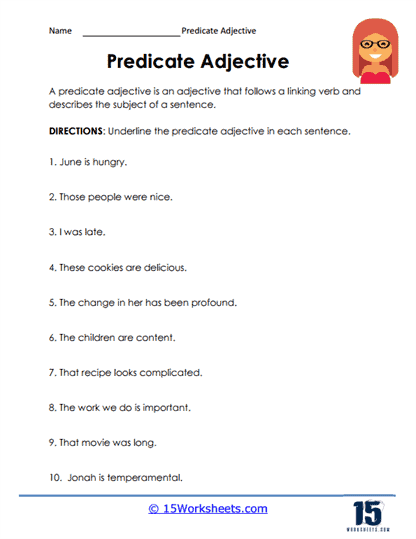
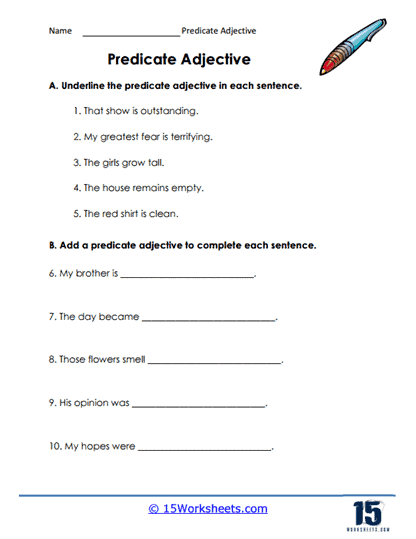
Spot and Underline
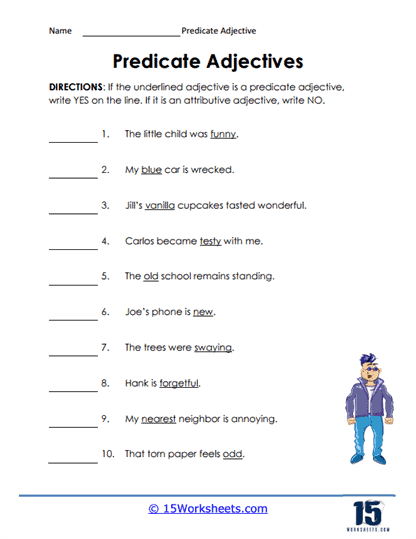
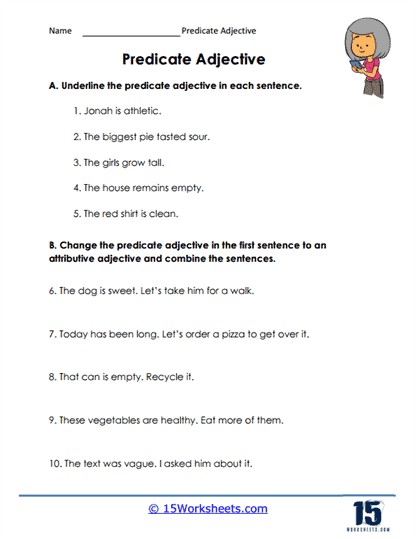
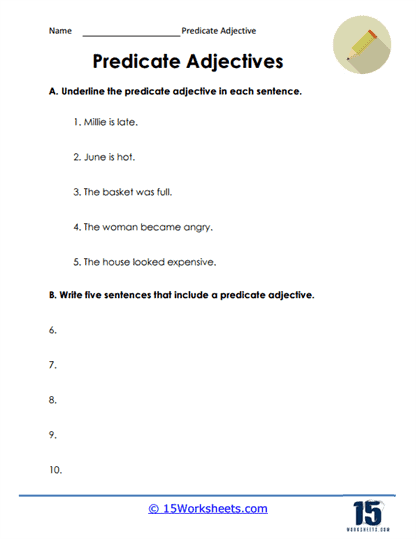
Students are invited to scan sentences and underline predicate adjectives-those descriptive words that come after a linking verb to tell us something about the subject. This simple exercise quietly sharpens their eye for sentence structure and helps them see how describing works in real, usable language.
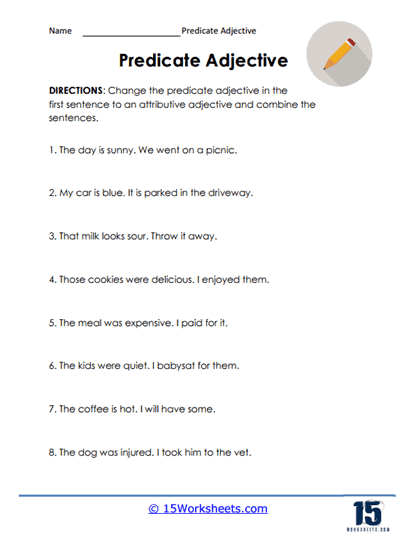
Replace and Fuse
Here, learners practice transforming sentences so that attributive descriptions (like “the cake is delicious”) become predicate adjectives (“the cake tastes delicious”). It encourages them to think about how word position influences sentence rhythm and emphasis, building a subtle awareness of tone.
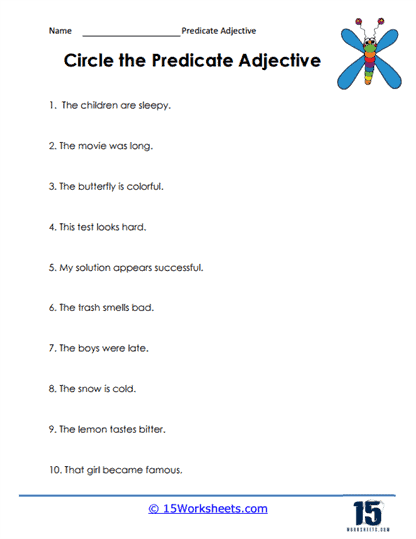
Find and Circle Them
Using passages or isolated sentences, students circle the predicate adjectives they spot. This task reinforces recognition skills-showing that these adjectives aren’t just nouns or subjects, but key descriptors that bring life to sentences.
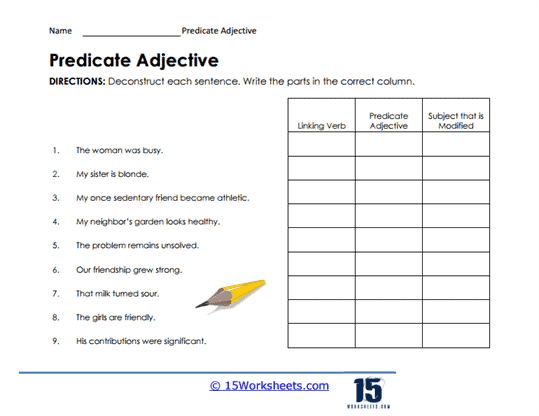
Deconstruction Challenge
Students dissect sentences to identify the link between subject, verb, and predicate adjective. It’s like grammar anatomy-encouraging thoughtful analysis of sentence parts and how they fit together.
Descriptive Dissection
This worksheet invites students to deepen the structure: strip it down, layer by layer, to see how the subject, linking verb, and adjective connect. It builds appreciation for how descriptive language is woven through structure-not just added on the side.
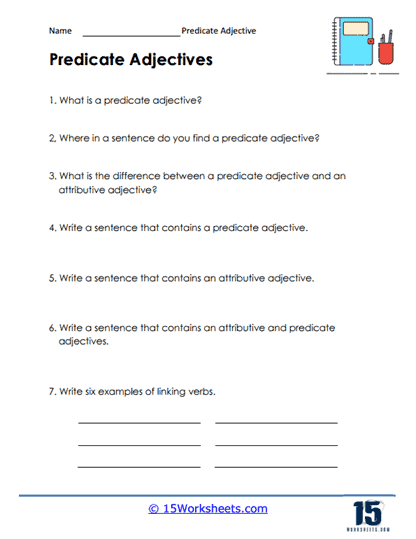
The Two Types
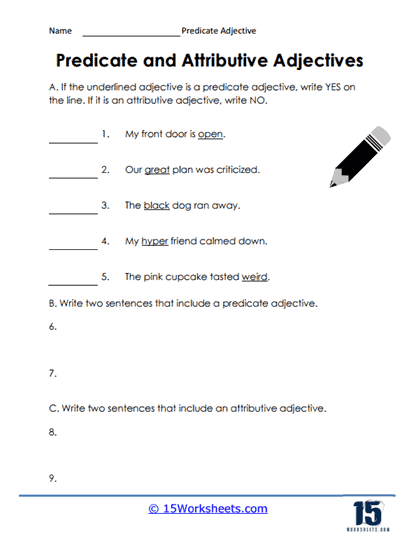
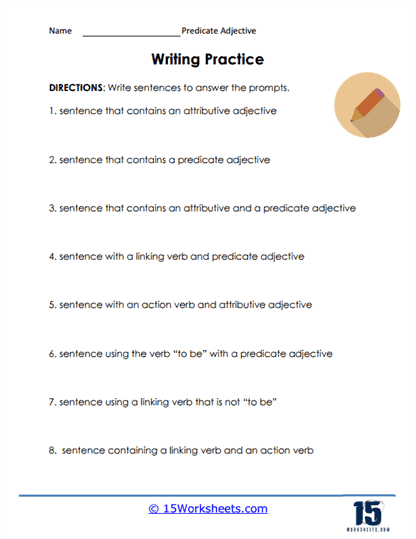
Learners explore the difference between attributive adjectives (those that sit in front of a noun) and predicate adjectives (those that come after a linking verb). The clarity of side-by-side examples helps the concept stick without confusion.
Label It
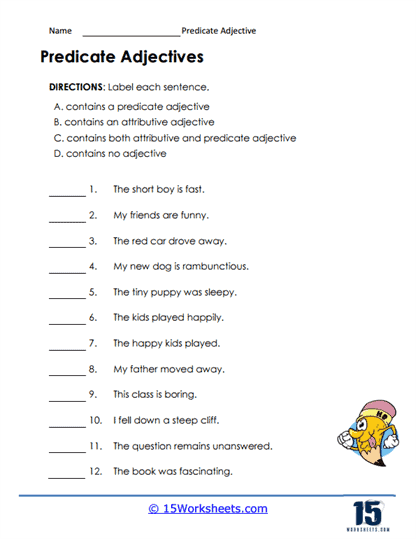
This activity gives students sentences where they label each component-subject, linking verb, predicate adjective-like a gentle grammar puzzle that reinforces structural understanding.
Identify and Transform
Here, students identify predicate adjectives and then rewrite sentences to swap structural positions-turning a phrase like “red car” into “the car is red,” and vice versa. It’s both analytical and creative, helping students understand flexibility in language.
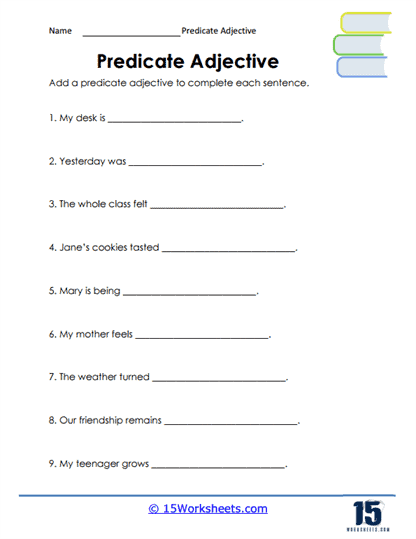
Grammar Enrichment
This worksheet encourages students to enrich plain sentences by adding predicate adjectives-deepening meaning and enhancing expression. The exercise prompts them to choose words thoughtfully, not just mechanically.
Ultimate Knowledge Quiz
A brief but comprehensive review, this quiz pulls together identification, transformation, and usage of predicate adjectives into one concise check-in.
Sentence Enrichment
Students enrich base sentences by inserting fitting predicate adjectives, practicing tone, clarity, and descriptiveness-all while keeping structure correct.
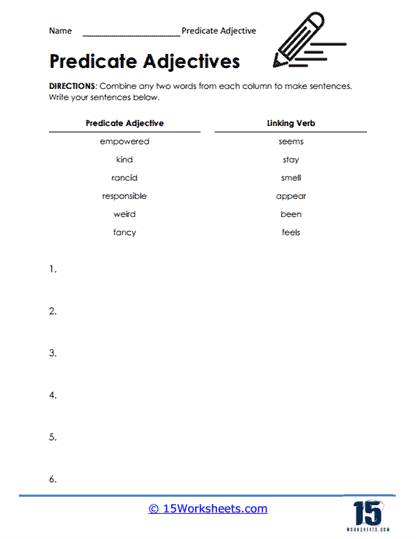
Word Pairing
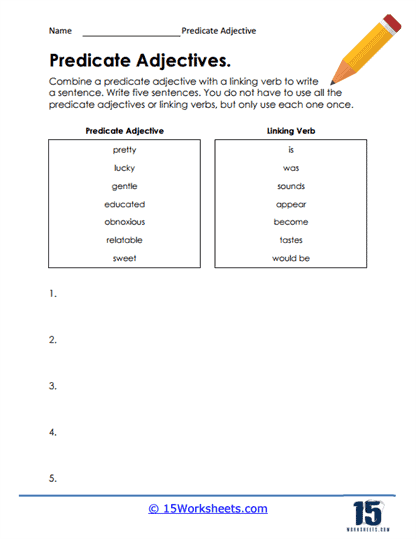
Matching sets of verbs with suitable predicate adjectives (like “seems tired” or “feels soft”) helps students build instinct for phrasing that sounds natural and accurate.
Building Dynamic Sentences
This encourages students to craft more dynamic sentences, intentionally weaving in predicate adjectives to enhance expression and imagery.
Vibrant Vocabulary
Focusing on word choice, learners select vivid predicate adjectives that bring plain sentences to life-making language more engaging and precise.
Writing with Predicate Adjectives
An open-ended, creative task where students write their own sentences or small passages using predicate adjectives, bridging structure with personal expression.
What Is A Predicate Adjective?
We use adjectives in sentences to describe a noun or pronoun. An adjective helps make sentences interesting and adds interest to common objects. For instance, nobody will buy or be impressed by a blanket, but a cozy and comfortable blanket provides the right push.
Adjectives fall into two main categories; describing adjectives and limiting adjectives. The predicate and attributive adjective fall into the describing category. Simply put, a predicate adjective is a word that defines or modifies a noun or pronoun. The major difference from other adjectives is that it appears after the subject or noun and pronoun of the sentence, for example, “my uncle was very poor.”
A sentence comprises two parts; a subject and a predicate. The subject is the who or what is doing something, whereas the predicate tells us what the subject is doing. The subject and the predicate are connected through a linking verb in a sentence. Before we move on, let’s see what linking verbs are.
What Are Linking Verbs?
A linking verb connects a verb with a describing word, noun, or pronoun. A linking verb includes all the versions of the “to be” and:
– Becomes
– Grows
– Seems
– Appears
– Sounds
– Keeps
– Remains
Remember, the verb to be and all its forms are true linking verbs, as the words listed above can be used as nouns. If you find any linking verbs before a noun describer, you have identified a linking verb.
Where To Use It In A Sentence
A predicate adjective is usually used at or near the end of the sentence, after a noun, or followed by a linking verb.
For example:
– She is very sick.
– The fabric is pink.
– I am late for work.
The bolded words are predicate adjectives used in different locations throughout the sentences.
Best Practices for Predicate Adjectives
When identifying predicate adjectives, the only thing to remember is that they are used with linking verbs. The sentence’s meaning will change if some verbs can or cannot be used as linking verbs.
For instance,
I read slow (incorrect)
I read slowly (correct)
In the above example, read is not a linking verb, and thus we use the adverb “slowly.”
Similarly,
My dog feels soft (correct)
My dog feels softly (incorrect)
Both sentences are grammatically correct in the above example but differ in meaning. Thus, when using linking verbs, first determine what you want your sentence to mean and then choose accordingly.
Examples: Below are some sentence examples using linking verbs and predicate adjectives;
– Barry seems drunk.
– My son is afraid of dogs.
– The weather appears nice.
– Sarah seems tired today.
– I feel dehydrated after the long run.
– My blanket feels soft.
Knowing the right sentence structure and linking verbs to use can improve your writing skills and help you create concise sentences. Many people confuse between adverbs and predicate adjectives. For instance, “I feel badly” is incorrect because it uses an adverb, but “I feel bad” is correct because of the use of predicate adjectives.