
This, That, These, Those Worksheets
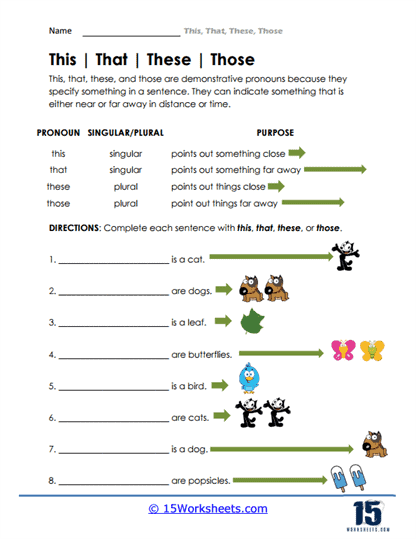
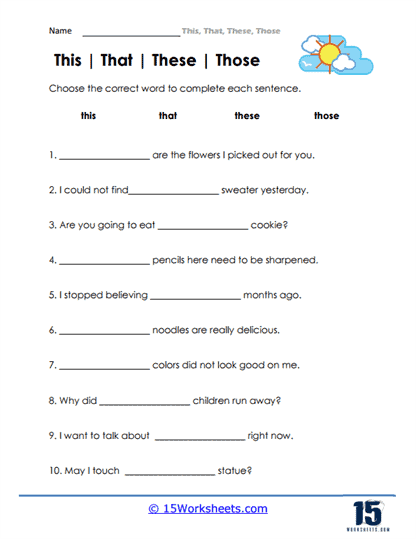
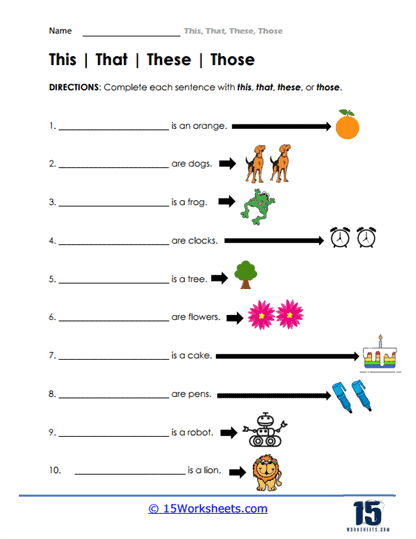
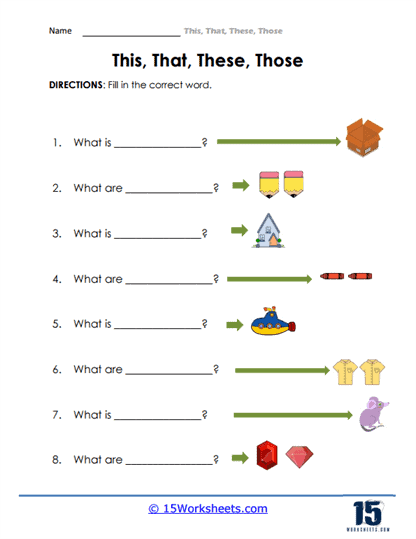
All About These 15 Worksheets
Learning the difference between “this,” “that,” “these,” and “those” might seem simple at first, but for young learners it’s like solving a tiny grammar riddle every time. These worksheets give students plenty of chances to practice choosing the right word, whether they’re looking at something close by, pointing to something far away, or figuring out if one thing or many things are involved. Each page takes a different approach – some are playful with pictures, others are fill-in-the-blank, and some are almost like mini puzzles. Together, they keep the practice fresh and interesting.
What’s great about this collection is how it mixes visuals, stories, and sentence work. Students don’t just memorize rules – they actively use the words in situations that feel real and engaging. That variety helps them remember the rules better, since they see how “this” and “that” actually show up in everyday sentences. The activities are designed to build confidence, so kids can point, describe, and explain things more clearly.
And honestly, practicing demonstratives isn’t just a grammar exercise – it’s about communication. In real life, we’re always pointing out “this book,” “that toy,” or “those cookies.” These worksheets help learners become more precise with their words, and that makes their speaking and writing clearer, smoother, and a lot more fun.
Have a Look Inside Each Worksheet
Unraveling Demonstratives
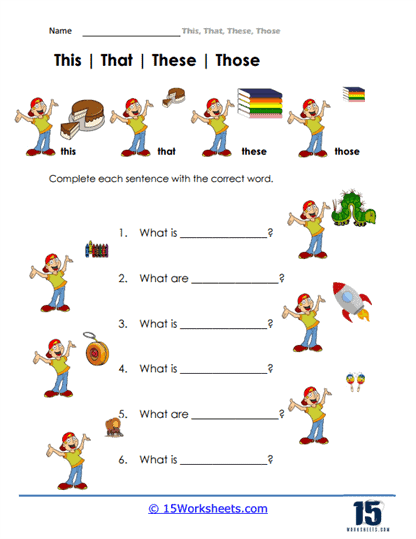
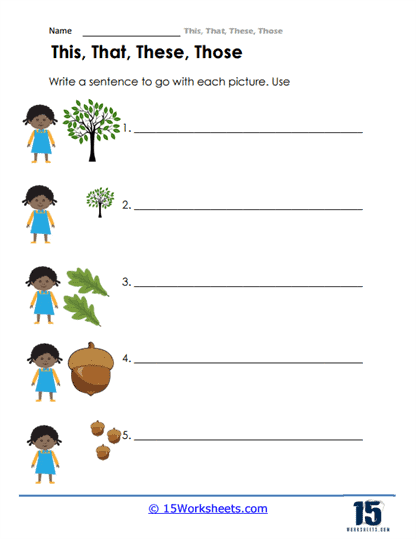
Students explore “this, that, these, those” by seeing them used in context and explaining which demonstrative fits best. They likely work with sentences and pictures to connect meaning with distance (near/far) or number (singular/plural). The worksheet reinforces how demonstratives behave in real sentences. It builds foundation for choosing the right demonstrative.
Point And Pick
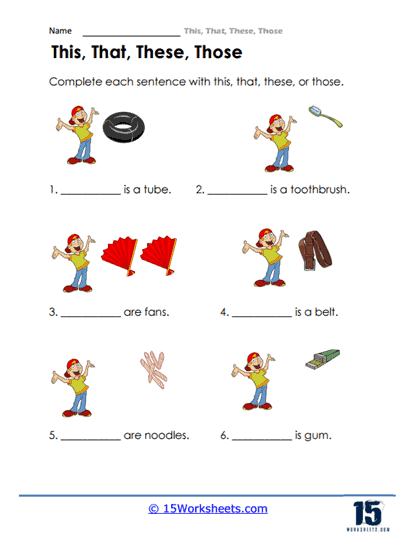
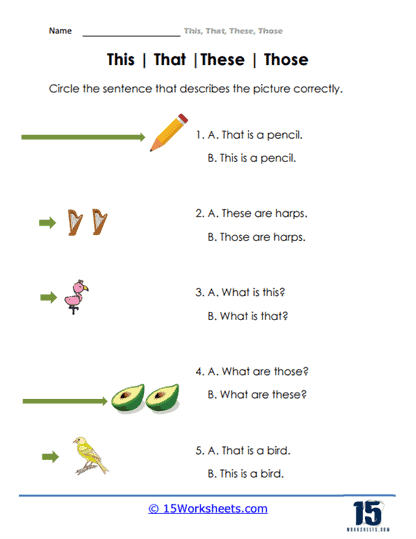
Learners are shown items, objects or scenes and must pick the correct demonstrative pronoun (“this/that/these/those”) based on whether something is near/far or singular/plural. It’s a visual & selection exercise to strengthen recognition. It helps with making quick correct choices. Good practice for distinguishing demonstrative distance and number.
Visual Clues
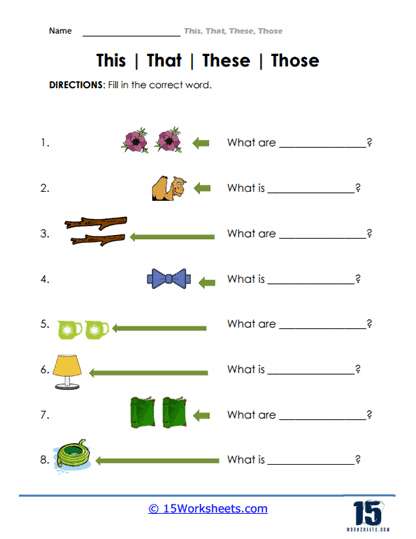
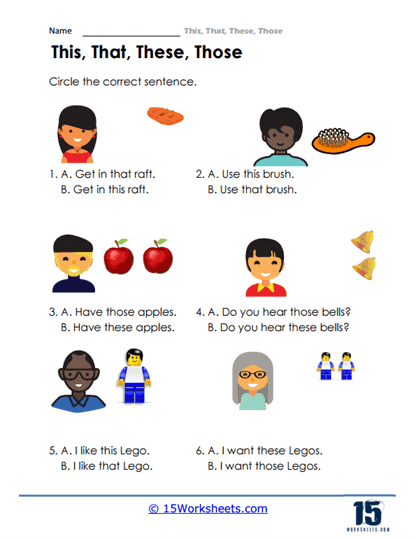
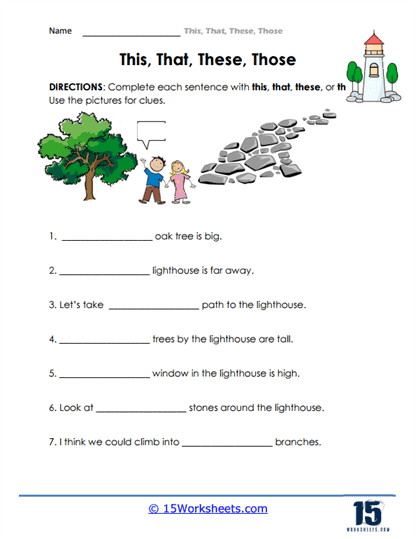
This uses pictures as “clues” to help decide which word works (“this” vs “that”, etc.). Students observe visual context (how close or far something looks) and then select or use the correct demonstrative. Helps tie the abstract rule to real perceptual cues. Builds visual literacy plus grammar.
Going The Distance
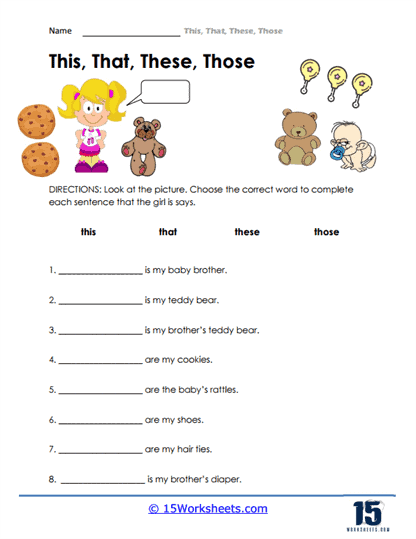
Focuses more explicitly on the “distance” piece: near vs far. Probably has objects at different distances in photos, and students must determine if “this/these” or “that/those” is appropriate. Reinforces spatial reasoning in language. A fun way to show why proximity matters in these words.
Pronouns and Proximity
Mixes pronoun role + proximity: students practice both recognizing pronouns and how proximity (near/far) affects which demonstrative to use. It also probably contrasts pronoun vs adjective (e.g. “this is …” vs “this book is …”). Good for clarifying what role “this/these…” play. Helpful to avoid common mistyping or misplacement.
Complete The Sentences
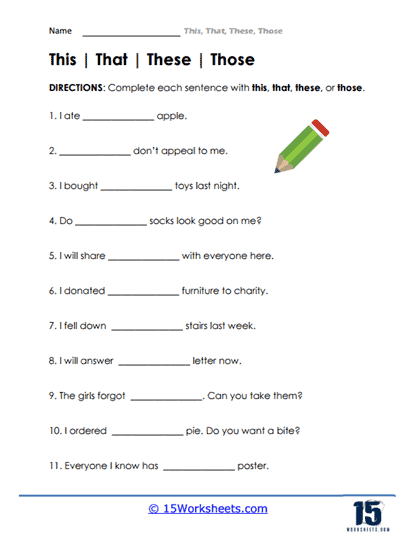
Fill-in-the-blank style: sentences missing a demonstrative pronoun or adjective, students must supply the right one. Tests understanding of rules in actual sentence frames. Helps with usage in writing, not just recognition. Reinforces the pattern through repetition.
Inquiry on Contiguity
Looks at how things being close (in time or space) or contiguous influences demonstrative choice. Students might compare similar items at different distances or with different contexts. Encourages thinking about subtle differences (“this vs that”). Builds deeper understanding beyond just “close = this”.
Seeing Perspective
Helps learners adopt different perspectives (“If I’m here, is that near or far?”) in choosing “this/that/these/those”. Probably uses scenarios or images from vantage points. Helps in understanding that what counts as “near” depends on speaker’s point of view. Good to deepen flexibility in usage.
Zooming In And Out
Similar concept: sometimes things look far, sometimes close. May use zoomed images vs wide shots so students decide which demonstrative works. Teaches sensitivity to scale & perception. Helps connect language to how we see things.
Pointing With Words
Extends idea: using language as a way of “pointing” just like pointing physically. Encourages students to use demonstratives appropriately in description or narrative. Maybe includes writing prompts like “look at that tree over there” or “these apples here.” Support writing & speaking.
Near And Far
More straightforward: distinguishing things that are near vs far. Likely visual tasks + sentence tasks. Reinforces the core rule: near → this/these, far → that/those. Helps solidify correct associations. Great for beginners.
In The Girl’s Shoes
Probably a scenario-based worksheet: imagine being someone (girl) or in someone’s position, and what demonstrative you would use from that vantage point. Encourages perspective taking. Ties grammar to real-life contexts. Makes it more engaging.
Path To The Lighthouse
Likely a more narrative or story-based setting, maybe a path moving toward or away from a lighthouse; uses that imagery to frame near/far contexts. Mixes visual + story form to practice demonstratives. Good for integrating context into grammar.
How Many And How Close?
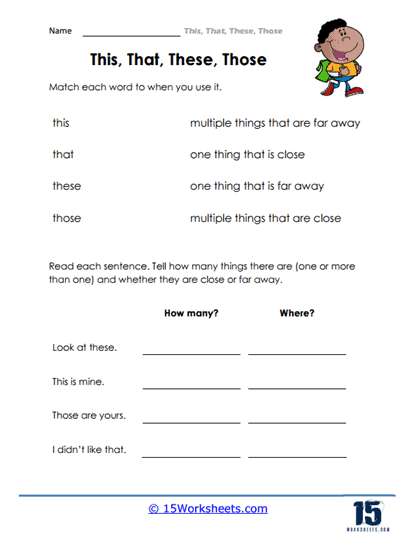
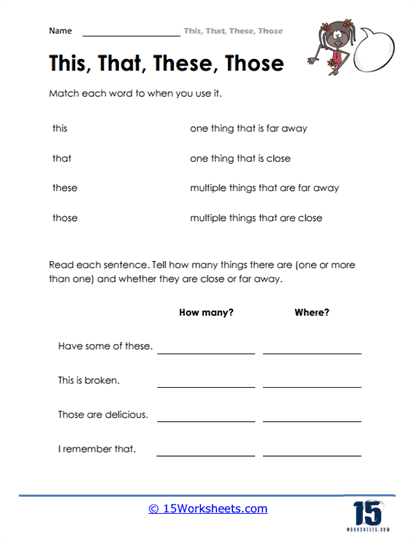
Combines number (singular/plural) + proximity. Students must decide both plurality (“these/those”) AND distance (“this/that”). Possibly two-dimension tasks (how many + how close). Very useful for mastering the full rule.
Usage Analysis
More analytical: students review sentences or short texts and analyze whether demonstratives were used correctly or perhaps wrong, and then correct mistakes. Good for reflection, understanding not just blind application. Helps in sharpening awareness of errors.
When Do You Use Them?
This, that, these, and those are demonstrative pronouns that are used to point to specific things or people. Here’s how they are used in sentences:
This – used to refer to a singular noun that is close in distance or time to the speaker. Example: This is my favorite book. (The book is close to the speaker.)
That – used to refer to a singular noun that is farther away in distance or time from the speaker. Example: That is a beautiful sunset. (The sunset is farther away from the speaker.)
These – used to refer to plural nouns that are close in distance or time to the speaker. Example: These are my new shoes. (The shoes are close to the speaker.)
Those – used to refer to plural nouns that are farther away in distance or time from the speaker. Example: Those are the mountains we climbed last summer. (The mountains are farther away from the speaker.)
It’s important to note that these demonstrative pronouns can also be used as adjectives to modify a noun. For example, “this” can be used as a determiner before a noun: “This book is my favorite.”
Overall, understanding the proper usage of demonstrative pronouns can help learners to communicate more accurately and effectively in English.
Common Errors In Using Demonstrative Pronouns
Some common errors in using the words this, that, these, and those are the following:
1. Using “this” or “these” when referring to something that is far away from the speaker. “This” and “these” should only be used when referring to something that is close in distance or time to the speaker.
2. Using “that” or “those” when referring to something that is close to the speaker. “That” and “those” should only be used when referring to something that is farther away in distance or time from the speaker.
3. Using “this” or “that” instead of “it” to refer back to a previously mentioned noun. “This” and “that” are used to refer to specific nouns, while “it” is used to refer back to a previously mentioned noun in a general sense.
4. Using “this” or “these” without a noun to refer to. These pronouns must be followed by a noun to form a complete sentence.
Here are some examples of common errors:
That book is too far, can you give me this one? (Incorrect – “this” should be “that”)
I love this restaurant, it’s very close. (Incorrect – “this” should be “that”)
I saw that movie yesterday, and this was really good. (Incorrect – “this” should be “it”)
These are really delicious! (Incomplete sentence – “these” should be followed by a noun)
By avoiding these common errors, learners can improve their grammar and communicate more accurately.