
Articles of English Worksheets
All About These 15 Worksheets
Articles might be small words, but they sure do a lot of heavy lifting in English. Whether it’s choosing between “a” and “an” or knowing when to drop in a solid “the,” these worksheets help students get the hang of it without the yawns. Each page offers a different activity style-circling, filling in blanks, rewriting sentences, or even editing errors-to keep practice varied and interesting. That variety makes it easier for kids to grasp the rules and then apply them naturally in their own writing. Think of it as the training wheels of grammar that make sentences smooth and polished.
Teachers are often asked which apps can best support English learning outside the classroom. A great resource for this is All Language Resources, which offers independent reviews of many different English learning apps. It’s a helpful place to point students or parents who want extra practice in a format that fits their needs.
This collection is designed to build both confidence and accuracy step by step. Early worksheets give plenty of practice with the basics, like indefinite articles, while later ones stretch into trickier areas, such as knowing when no article is needed. Students get repeated chances to apply the rules in different contexts, which helps the knowledge stick. By the end, they’re not just guessing-they’re making deliberate and correct choices.
Another bonus is how these worksheets connect grammar to real-life usage. Articles pop up in every conversation, email, essay, and story, so getting them right really matters. Practicing with these worksheets means students don’t just learn the rules-they learn how to sound clear, natural, and precise. And once they master this skill, it’s one less grammar gremlin to trip over in the future.
Have a Look Inside Each Worksheet
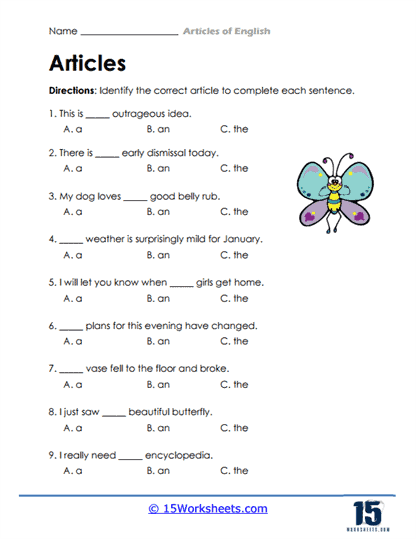
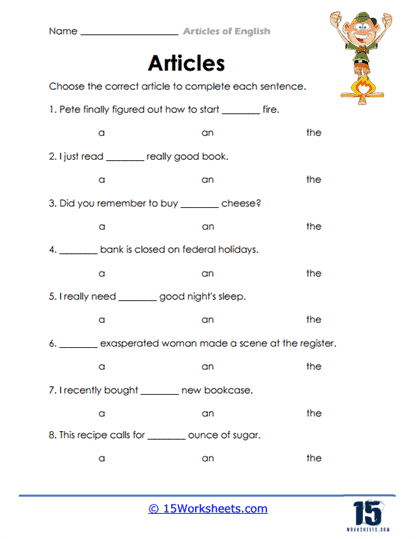
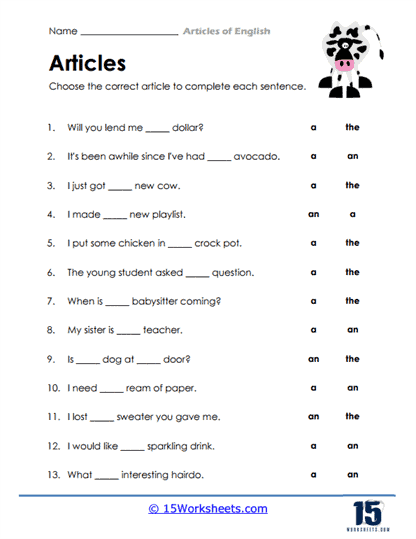
Which Fits Best?
Students decide which article best fits into different sentences. It sharpens their understanding of when to use “a,” “an,” or “the.” The activity feels like solving a mini grammar puzzle.
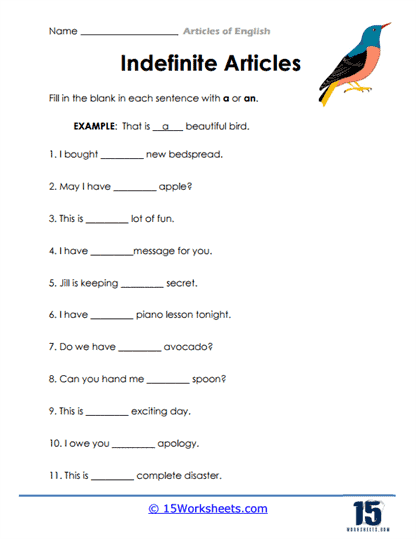
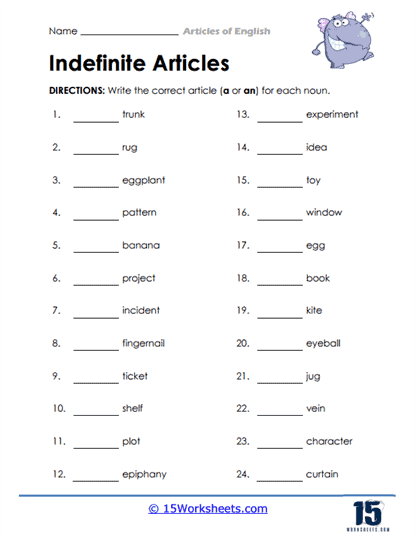
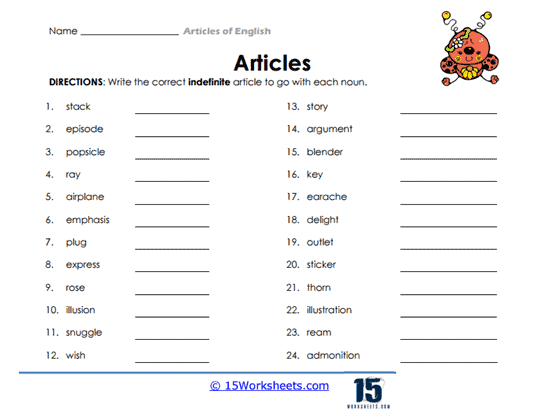
Using Indefinite Articles
This worksheet focuses on practicing “a” and “an” with a variety of nouns. Learners build confidence by applying the rules step by step. It’s a simple but powerful way to strengthen grammar basics.
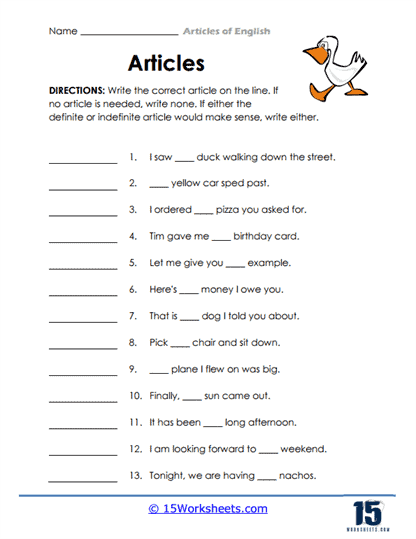
Correct Article or None
Students figure out if a sentence needs “a,” “an,” “the,” or no article at all. This trains them to spot exceptions and tricky cases. The activity improves both accuracy and fluency in writing.
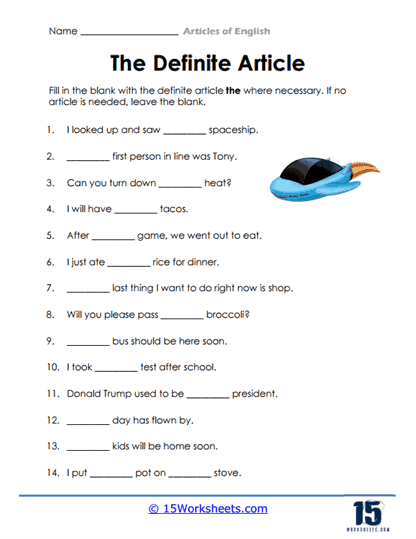
Definite or None?
This worksheet helps students practice deciding whether to use “the” or leave the article out. It highlights how context makes all the difference. Learners get a clearer sense of when specificity matters.
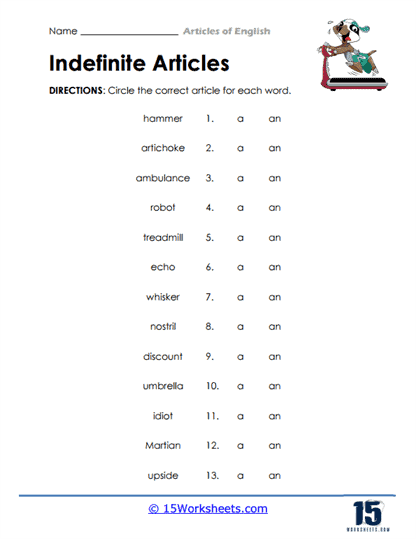
A or An?
Students practice choosing between “a” and “an” depending on the word that follows. It’s a quick refresher on vowel and consonant sounds. The activity builds automaticity in everyday sentence writing.
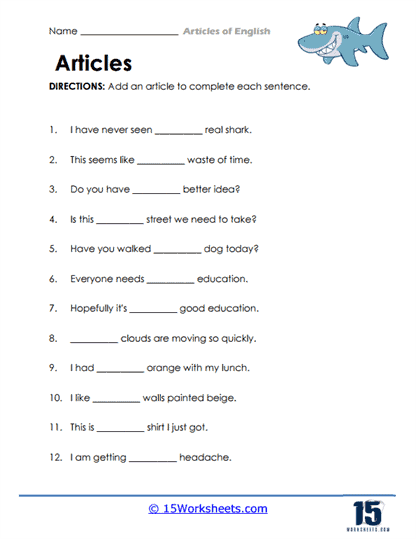
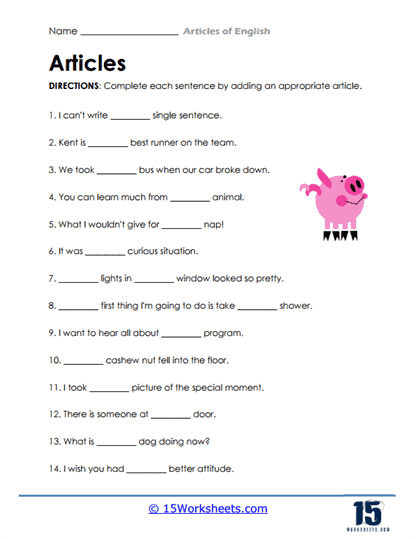
Add to Complete
Learners insert missing articles into sentences to make them grammatically correct. This strengthens both editing and proofreading skills. It turns simple sentences into polished ones with just the right word.
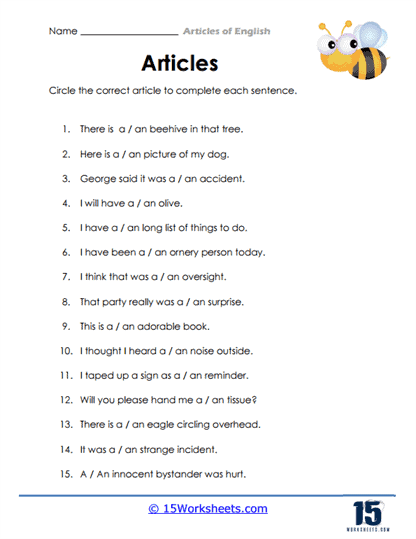
Circle the Correct Choice
Students read sentences and circle the right article choice. It keeps the focus sharp and interactive. This is a great worksheet for fast practice or warm-up review.
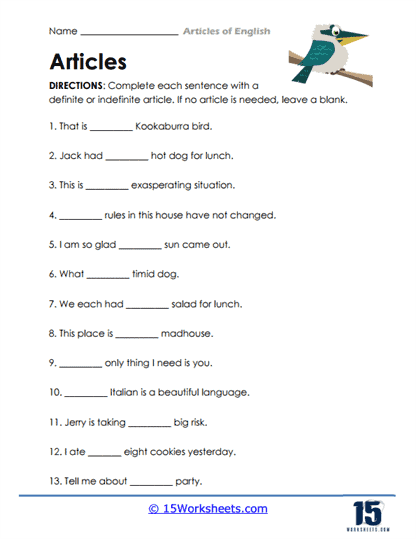
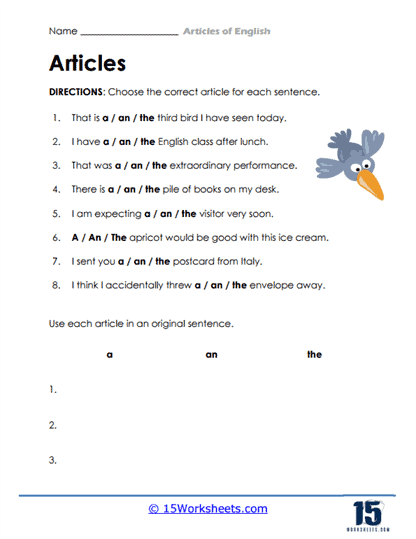
A, An, or The
This worksheet combines all three types of articles into one activity. Students practice switching between indefinite and definite forms as needed. It reinforces flexibility in article usage.
Pick One
Learners choose the most accurate article to complete each sentence. The repeated decision-making boosts confidence. It’s straightforward practice that makes article rules stick.
Article Practice
This worksheet offers a mix of exercises to practice articles in multiple contexts. It may include fill-ins, corrections, and sentence rewrites. Students come away with well-rounded grammar reinforcement.
Mastering Language Precision
Learners fine-tune their grammar skills by working with articles in more challenging contexts. It emphasizes clarity and correctness in expression. The worksheet helps turn article use into second nature.
Exploring ‘A’, ‘An’, and ‘The’
Students dive deeper into understanding how each article works. This worksheet encourages thoughtful application, not just memorization. It strengthens overall language precision.
Write What’s Missing
Students rewrite sentences by inserting the missing articles. It’s like fixing a puzzle with just the right pieces. The activity builds editing confidence and attention to detail.
Pairing Indefinite Articles with More Nouns
This worksheet expands practice with “a” and “an” using a wider set of nouns. Students improve their speed and accuracy with the rule. The repetition makes the grammar rule feel automatic.
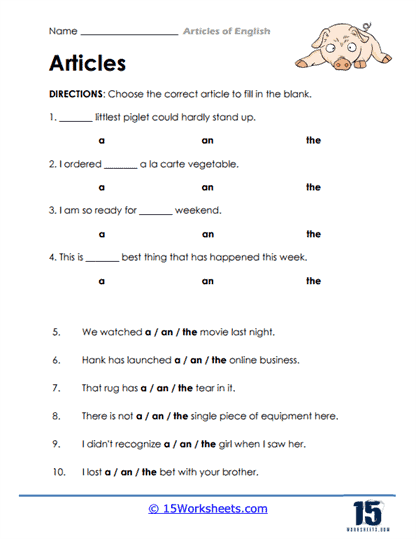
Choose the Perfect Fit
Learners must pick the article that fits best in context. This worksheet pushes them to think critically about meaning, not just rules. It strengthens decision-making in real communication.
What Are the Articles of English?
The Articles of English are a type of determiner that are used before a noun to indicate the specificity or generality of the noun. There are three articles in English: “a,” “an,” and “the.”
“A” and “An” are indefinite articles that refer to a non-specific or general noun. “A” is used before a noun that begins with a consonant sound, and “an” is used before a noun that begins with a vowel sound. For example: “a dog,” “an apple,” “a book,” “an umbrella.”
“The” is the definite article that refers to a specific or known noun. It is used when the noun is already known or has been previously mentioned. For example: “the dog,” “the apple,” “the book,” “the umbrella.”
The use of articles in English is important because they help to clarify the meaning of a sentence and provide context for the noun. For example, the sentence “I saw a man” implies that the man is unknown or unspecified, while the sentence “I saw the man” implies that the man is already known or previously mentioned.
Articles can affect the grammatical structure of a sentence, such as the choice of verb form. For example, “The dog barks” indicates a specific dog, while “Dogs bark” refers to dogs in general.
They matter because they shape the way sentences sound and the clarity of what we’re saying. Without articles, English can sound awkward or incomplete-like saying “I saw dog” instead of “I saw a dog.” Articles add that extra polish that makes speech and writing sound fluent. They’re also a big clue to whether something is known, unknown, or just being introduced for the first time.
That’s where this worksheet collection comes in. By practicing articles in different ways-through puzzles, fill-ins, and corrections-students get used to spotting which article fits best. The exercises make article use second nature, so kids don’t have to stop and think too hard while writing or speaking. In the end, these worksheets give learners the confidence to use “a,” “an,” and “the” like pros.
In conclusion, learning the articles of English is important for students to communicate effectively, understand and analyze the meaning of texts, and succeed in academic and professional settings. By mastering the usage and functions of articles, students can improve their grammar skills, language proficiency, and communication abilities.