
Tag Questions Worksheets
About These 15 Worksheets
These worksheets are designed to help students master how to use tag questions – the little question pieces we add to statements like “You’re coming, aren’t you?” – so that their English sounds natural and conversational. The tasks vary: completing tag questions, matching statements to tags, unscrambling, responding, dialogue building, etc., so learners see the full range of how tag questions work across contexts. By practicing both forming tags and responding to them, students build both accuracy and confidence.
Another important feature of this set is that it addresses polarity (positive vs. negative statements) and verb tense, so students must think carefully about how statements and tags relate. Whether the statement is affirmative or negative, or whether it’s in the present, past, etc., changes the tag. The variety of exercises lets students see those rules repeatedly in different forms, reinforcing recognition and helping avoid common mistakes.
These worksheets are especially helpful for moving beyond grammar drills into real communication. Students get to use tag questions in conversation, dialogue, or imagined speech, so the form feels useful, not just academic. That makes it more likely they’ll use tag questions naturally – in speaking, in writing, and in conversation – with better fluency, pronunciation, and comfort.
Have a Look Inside Each Worksheet
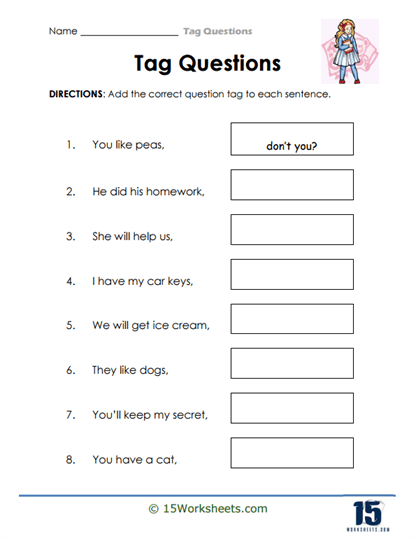
Pack Completer
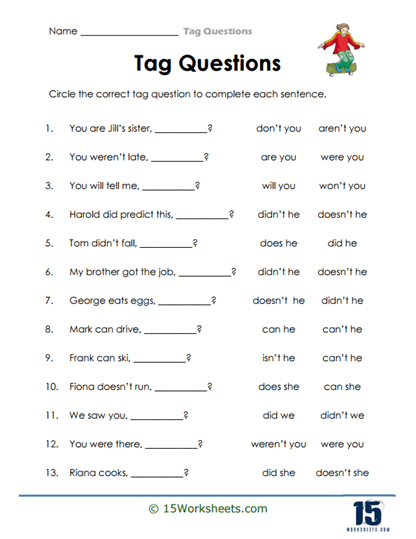
Students are given statements missing a tag question and must complete them correctly (e.g. “You like apples, ___?” → “don’t you?”). This helps them practice matching subjects, tenses, and polarity (positive/negative) in a straightforward way. Reinforces the structure and how to form tag questions properly.
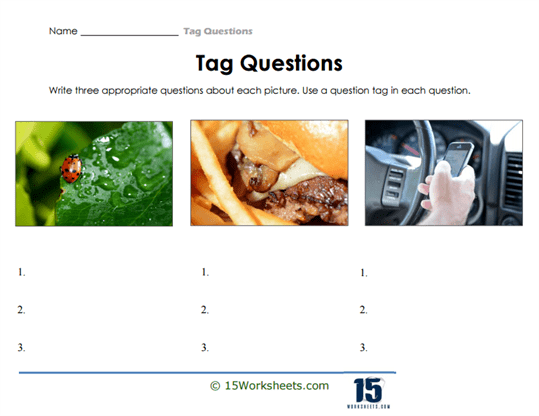
Visual Queries
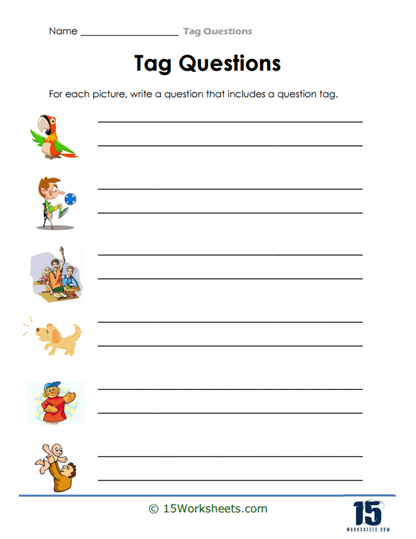
This worksheet uses pictures or visual cues to set up a scenario, and students must write the correct tag question that fits. The visuals help anchor the meaning so students see when tag questions are natural. Helps connect grammar to real-life situations and improve conversational usage.
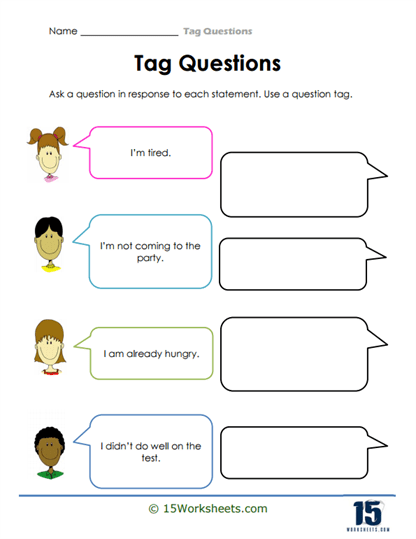
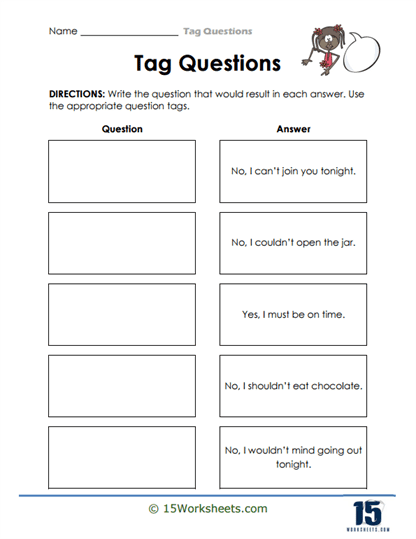
Tag Responses
Learners are given statements and possibly tag questions, and practice responding-affirmatively, negatively, or asking back. This builds fluency not only in forming tags, but in using them in dialogue. Encourages understanding of how tag questions function in real conversations.
Square Talk
This might involve dialogue boxes, or speaking turns, where students fill in the tag questions in conversation between characters in squares or frames. It’s a more conversational format. Helps students practice the interactive aspect of tag questions.
Venture Match
Sentences and tag questions are jumbled or paired and students match each statement with its correct tag. This reinforces recognition of correct tag forms. Good for visual discrimination and reinforcing matching skills.
Set Selector
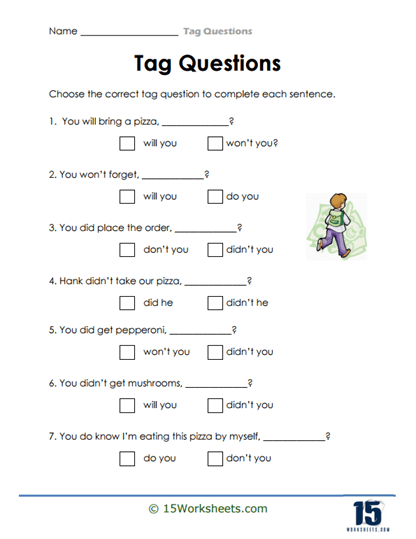
Students choose the correct tag question from multiple options to complete statements. This helps them distinguish between possible tags and select the grammatically correct one. Helpful for testing knowledge of verb usage, subject-verb agreement, and polarity.
Tag Jumble
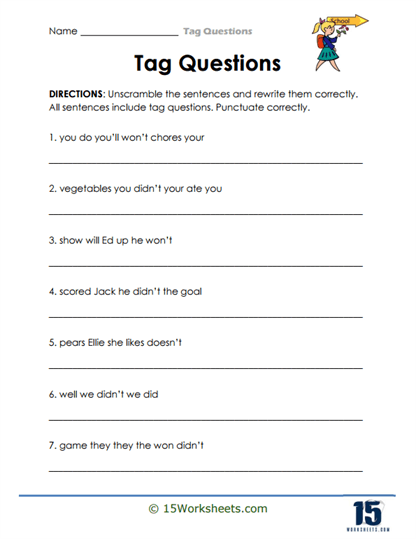
Words in tag questions or full sentences are scrambled; students must unscramble to form correct tag questions. This challenges both grammar and word order skills. Offers a more challenging way to solidify understanding.
Visual Tags
Combines visuals plus tag questions; students see scenes or images and write or choose an appropriate tag based on what the picture suggests. Helps learners connect content to grammar. Encourages thinking about context and nuance.
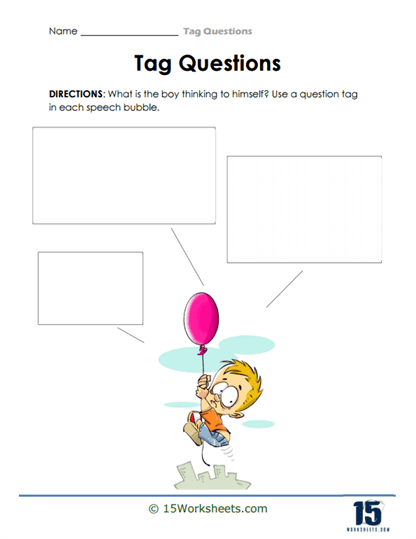
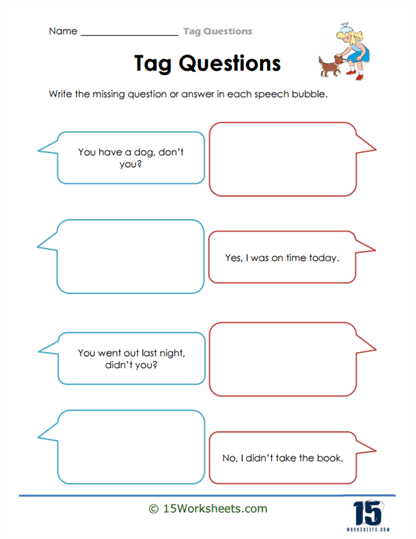
Bubble Thoughts
Speech or thought bubbles (in cartoons or drawings) prompt students to supply tag questions that characters might use or think. This adds imaginative/storytelling element which is engaging. Helps students see how tag questions appear in informal speech and internal monologue.
Response Match
Statements and tag question responses are paired, perhaps matching which response fits best with which statement. This helps students see how different tags work depending on statement form. Builds ability to think about how to respond in conversation.
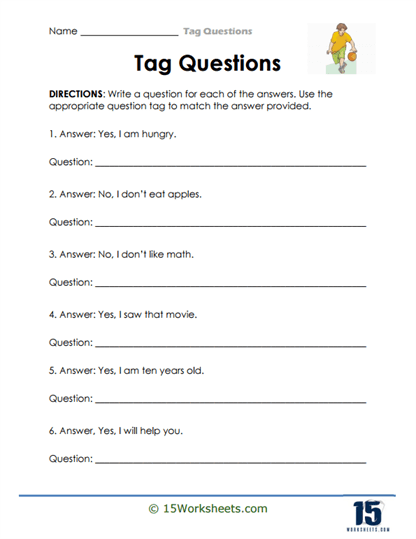
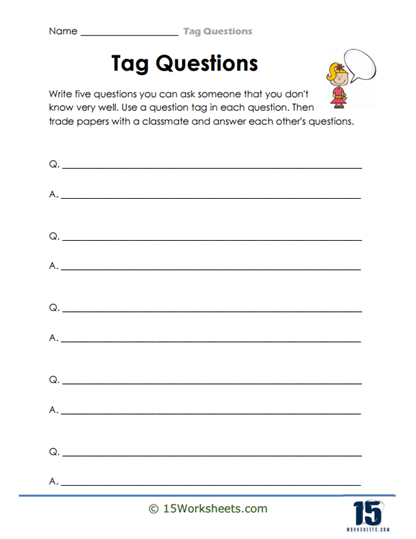
Question Creator
Students are given statements and are asked to write their own tag questions. This more open-ended task lets them apply the rules themselves rather than choose. Develops creativity and independent grammar application.
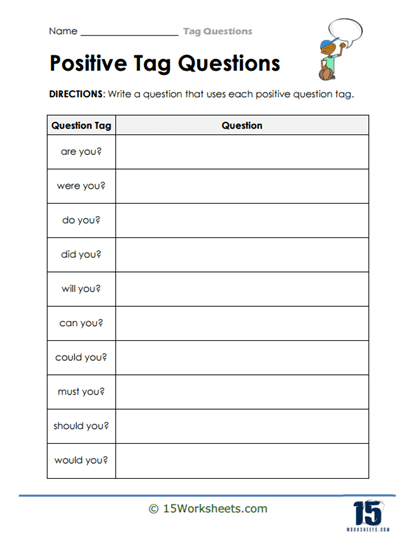
Affirmative Check
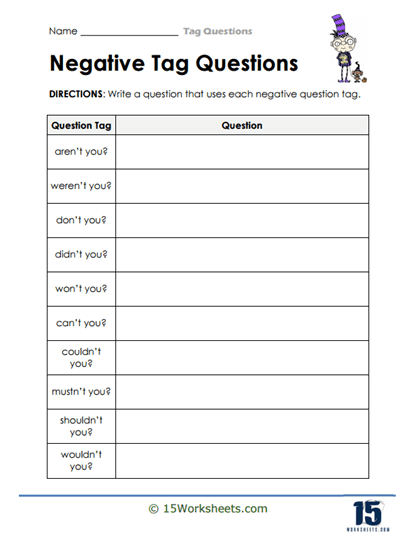
Focuses on statements that are positive (affirmative), and students must form the correct negative tag. For example, “You live here, ___?” → “don’t you?” This helps practice the rule that positive statements take negative tags (and vice versa). Reinforces polarity in tag questions.
Negative Twist
Here the statements are negative, and students must form the correct tag, which will be positive. For example, “She doesn’t like tea, ___?” → “does she?” This helps students understand how negative statements invert in tag questions. Adds challenge and deepens understanding.
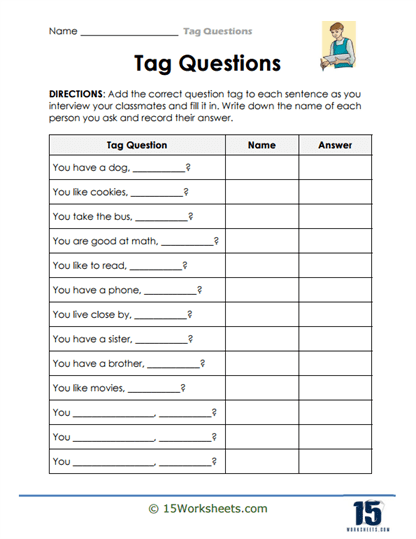
Dialogue Builder
Students build or complete dialogues between people using tag questions to make the conversation natural. Helps them see how tag questions keep conversation flowing. Good for speaking practice and understanding tone/context.
Conversation Starters
Prompts likely provide statements or situations and ask students to continue the conversation with tag questions. Encourages thinking about how tag questions can start or continue interactions. Useful for contextual, real-life speaking practice.
What Are Tag Questions?
Tag questions are a unique feature of the English language that blend a statement with a question to seek confirmation, agreement, or clarification from the listener. They are typically used at the end of a declarative sentence and consist of an auxiliary verb followed by a pronoun that corresponds to the subject of the statement. For example, in the sentence “You’re coming to the party, aren’t you?” the tag question “aren’t you?” follows the statement “You’re coming to the party” and prompts the listener to confirm or deny the information. This structure makes tag questions a versatile tool in both spoken and written communication, allowing the speaker to engage the listener directly.
One of the primary purposes of tag questions is to seek confirmation. When a speaker uses a tag question, they often expect the listener to agree with the statement made. For instance, saying “It’s cold today, isn’t it?” implies that the speaker believes it is cold and anticipates that the listener will confirm this belief. This use of tag questions helps to reinforce shared knowledge or perceptions between the speaker and listener, creating a sense of mutual understanding. In this way, tag questions can function as a conversational tool to verify information or ensure that both parties are on the same page.
Tag questions also serve a crucial role in softening statements, making them less assertive or confrontational. For example, instead of saying “You’re wrong,” which might come across as direct or harsh, a speaker might say, “You’re wrong, aren’t you?” The addition of the tag question makes the statement less forceful, giving the listener an opportunity to respond without feeling challenged. This use of tag questions can be particularly useful in sensitive situations where the speaker wants to avoid sounding too authoritative or blunt. By turning a statement into a question, the speaker allows room for dialogue and differing opinions.
In addition to seeking confirmation and softening statements, tag questions can be used to express uncertainty or invite discussion. When a speaker is unsure about something, they might use a tag question to solicit input from others. For example, “We should take the left turn here, shouldn’t we?” indicates that the speaker is not entirely confident and is looking for reassurance or guidance from the listener. This function of tag questions encourages interaction and collaboration, as it opens the floor for others to share their thoughts or knowledge.
Another important aspect of tag questions is their role in social dynamics. In conversational contexts, tag questions can help maintain the flow of dialogue by prompting responses and keeping the conversation active. For example, a simple statement like “You’ve been here before, haven’t you?” invites the listener to share their experience, thus continuing the exchange. This makes tag questions a valuable tool for fostering engagement and ensuring that conversations do not become one-sided. In group settings, tag questions can also help involve multiple participants, encouraging everyone to contribute to the discussion.
Tag questions can vary in form, depending on the tone and context. They can be either positive or negative, with the form often chosen based on the polarity of the main statement. For example, a positive statement (“You’re coming to the meeting”) is typically followed by a negative tag (“aren’t you?”), while a negative statement (“You’re not coming to the meeting”) is followed by a positive tag (“are you?”). This polarity switch is what makes tag questions effective in checking the accuracy or completeness of the information presented. Understanding how to properly form and use these different types of tag questions is essential for mastering their use in everyday language.