
Determiners Worksheets
All About These 15 Worksheets
Determiners are those little words-like this, many, my, or those-that sneak in before nouns and quietly tell us how much, whose, or which one. They may not get the spotlight like big, flashy verbs, but they’re the glue that makes sentences clear. This collection of worksheets takes that sometimes slippery concept and turns it into hands-on fun. From fill-in-the-blanks to picture prompts, each page makes determiners less intimidating and more like a useful tool in a student’s writing kit.
One thing that makes these worksheets especially effective is the variety of approaches. Some pages work like grammar puzzles where students pick the missing piece, while others feel like detective missions or quickfire challenges. This variety keeps kids from zoning out while giving them multiple ways to connect with the same core idea. Whether they’re choosing between “this” and “that,” circling possessives, or completing a “quantifier quest,” they’re building the same foundation of accuracy and fluency.
Beyond grammar drills, these worksheets help students become better readers and writers in real-world contexts. Imagine writing a story or giving directions without using the right determiners-things get confusing fast. Practicing here means kids can later explain clearly whether they mean that cookie or all the cookies, my backpack or the backpack. In other words, mastering determiners doesn’t just help them pass a quiz; it helps them be understood in everyday life.
Have a Look Inside Each Worksheet
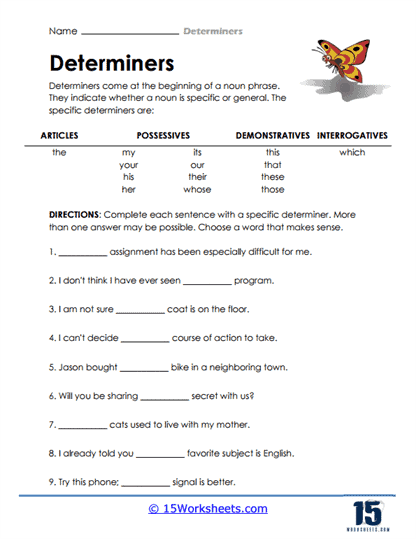
Selecting the Missing Piece
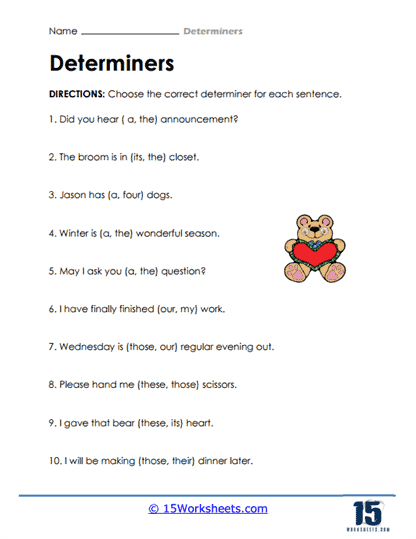
Students read sentences with gaps and choose the correct determiner to complete them. It feels like solving a puzzle where the missing word is the perfect “fit.” The activity helps learners connect determiners with sentence flow. This strengthens their ability to use the right word in context.
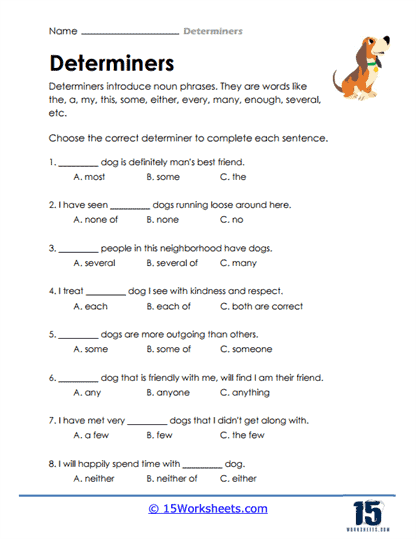
Choose The Right Word
Here kids pick the most suitable determiner from multiple choices. Each option forces them to think about number, ownership, or proximity. It’s a quick but powerful way to see how one word can change meaning. Learners sharpen their grammar instincts with each choice.
Decoding Noun Phrases
Students explore how determiners work inside longer noun phrases. They’ll break down sentences to spot the determiner and its partner noun. It’s like cracking a grammar code to reveal sentence structure. This builds awareness of how determiners anchor ideas in writing.
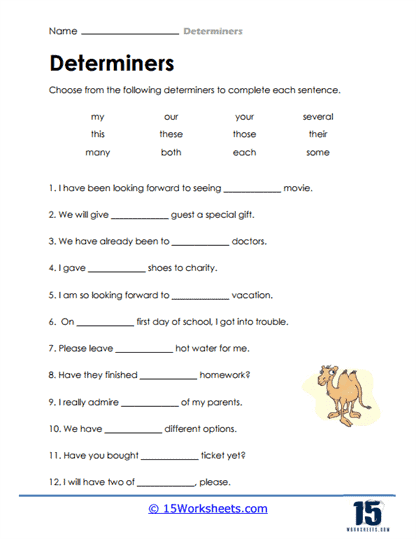
Filling the Sentence Blanks
This worksheet offers fill-in-the-blank sentences that need determiners. Kids supply missing words like “some,” “this,” or “my” to make the sentence complete. The repetition helps them see determiners as essential tools, not optional extras. By the end, they’re pros at plugging in the right word.
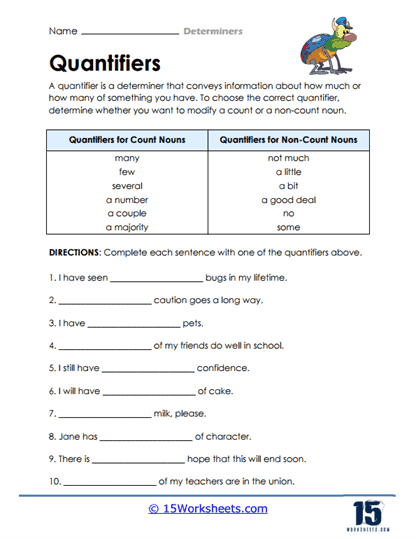
Quantifier Quest
Learners go on a grammar “quest” to match quantifiers with nouns. They’ll decide whether to use “much,” “many,” “few,” or “several.” The playful quest theme makes the task more engaging. It strengthens their sense of number and quantity in everyday English.
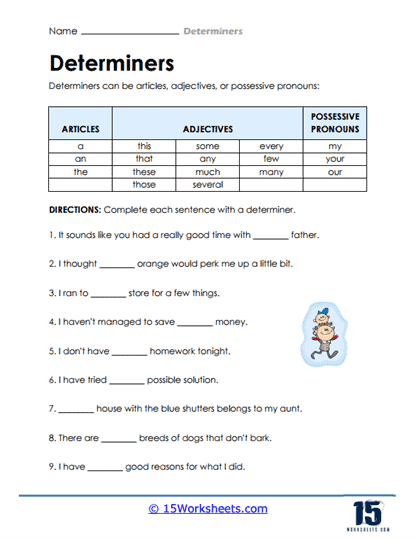
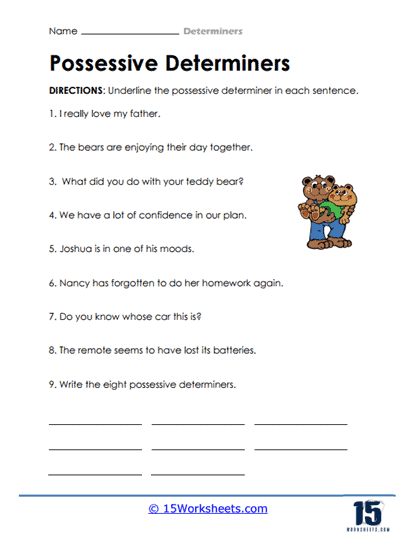
Identifying Possessives
This worksheet has students underline or highlight possessive determiners like “my,” “his,” and “their.” It’s like a treasure hunt for signs of ownership in a sentence. Each example reinforces how determiners connect nouns to people. Kids build clarity about who things belong to.
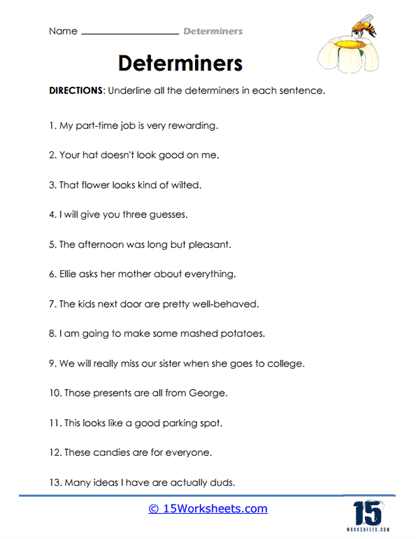
Determiner Detectives
Students take on the role of detectives, hunting for determiners in sample sentences. The detective theme makes grammar feel like a fun investigation. It builds observational skills while practicing accuracy. Learners come away more confident in spotting determiners quickly.
Ownership Express
This sheet focuses on determiners that show ownership. Learners match nouns with the correct possessive word. It’s like hopping on a fast train that always points to who owns what. The simple practice reinforces clarity and correctness in writing.
Determiners in Context
Students see determiners embedded in realistic sentences. They identify and sometimes replace the determiner with another that still works. This shows how context influences word choice. The activity builds flexibility and fluency with determiners.
This or That?
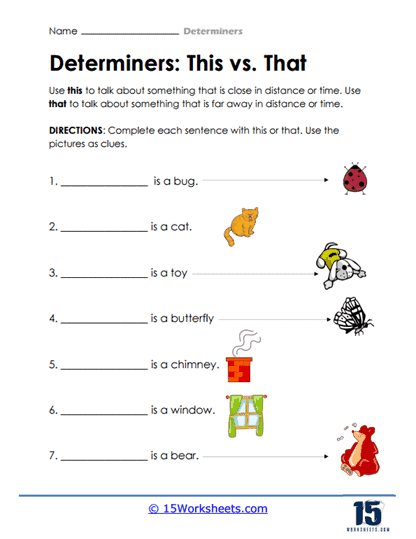
Learners choose between “this” and “that” to complete short sentences. The focus is on proximity-things near versus things far. It’s simple, visual, and easy for kids to grasp. They learn to pay attention to context clues when picking determiners.
Choosing This or These
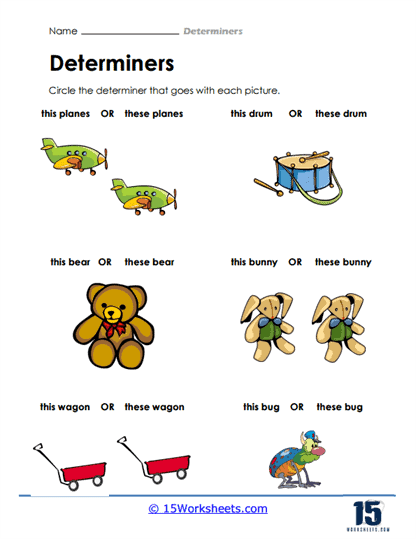
This worksheet has students practice singular versus plural demonstratives. They’ll pick “this” for one object and “these” for multiple. The activity emphasizes careful reading of number. Students gain accuracy in everyday expressions.
Proximity Mastery
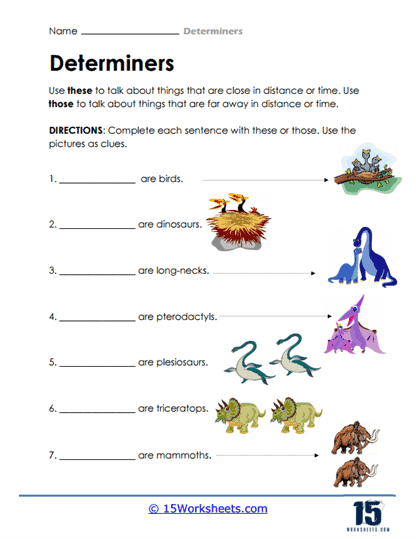
Students tackle sentences that test their use of “this,” “that,” “these,” and “those.” The goal is mastering determiners tied to distance and number. It’s like a mini mastery course for demonstratives. Learners leave with stronger confidence in using these everyday words.
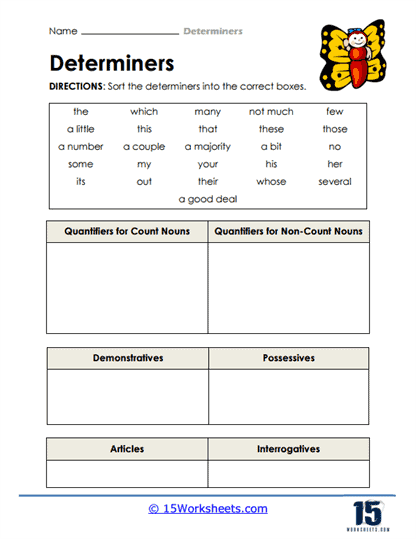
Sort These Out
This activity has kids sort words or sentences based on the determiner used. It feels like organizing a messy drawer until everything is in the right spot. Sorting makes patterns in grammar more visible. The practice supports categorization skills as well as grammar awareness.
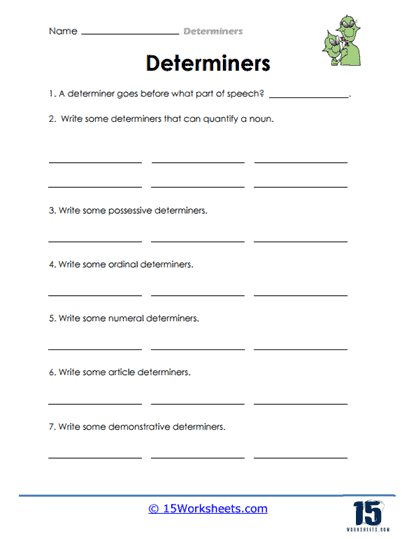
Determiners Challenge
A review-style worksheet that mixes different determiner types in one place. Students face a variety of questions that test accuracy and flexibility. The challenge format feels like a fun competition. It’s perfect for checking what they’ve learned so far.
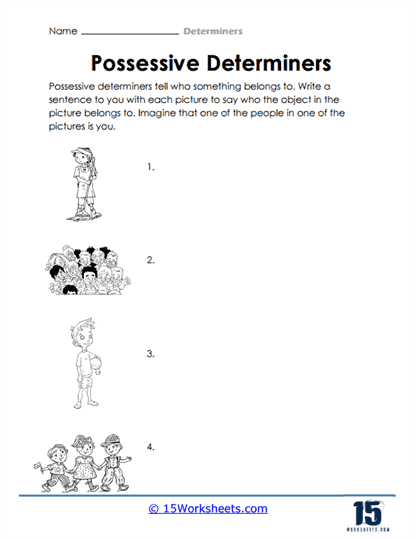
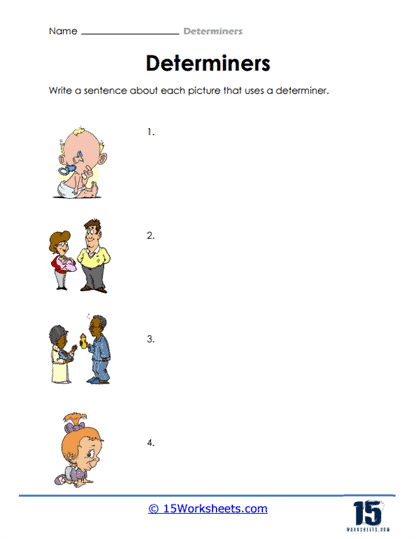
Picture Prompts
Students look at pictures and write sentences with determiners that fit the image. The visuals spark creativity and make grammar more concrete. It blends writing with observation skills. Kids learn that determiners aren’t just rules-they bring sentences to life.
What Are Determiners?
Determiners are words that are used before a noun to indicate the specificity or quantity of the noun. They are an important part of English grammar and can provide important information about the noun, such as whether it is specific or general, singular or plural, or possessive.
There are several types of determiners, including:
Articles – “a,” “an,” and “the.” “A” and “an” are used to indicate a non-specific noun, while “the” is used to indicate a specific noun.
Demonstrative determiners – “this,” “that,” “these,” and “those.” These are used to indicate the location of a noun in relation to the speaker.
Possessive determiners – “my,” “your,” “his,” “her,” “its,” “our,” and “their.” These are used to indicate ownership or possession of a noun.
Quantifiers – “some,” “any,” “many,” “few,” “several,” and “all.” These are used to indicate the quantity or amount of a noun.
Determiners are used in everyday conversation and writing to provide clarity and specificity in communication. Understanding and using determiners correctly is an important part of English grammar, and students should practice identifying and using them in their speaking and writing to improve their language proficiency.