
Prepositions of Time Worksheets
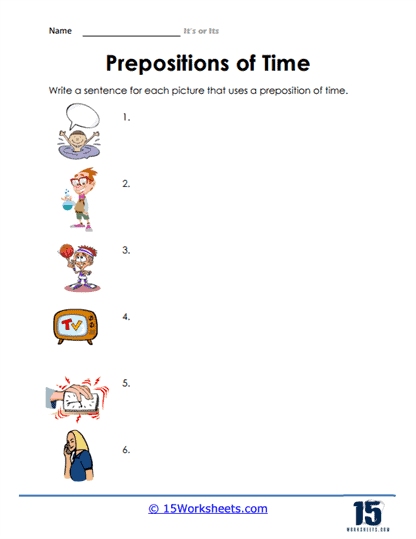
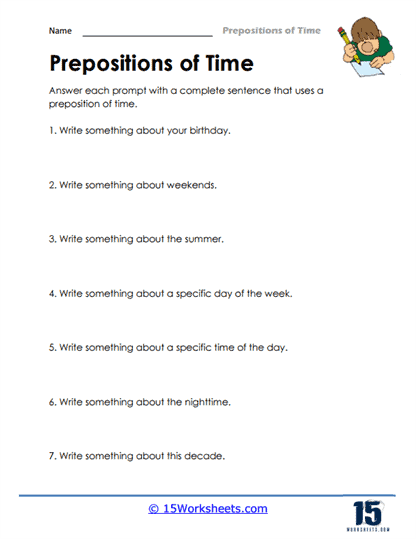
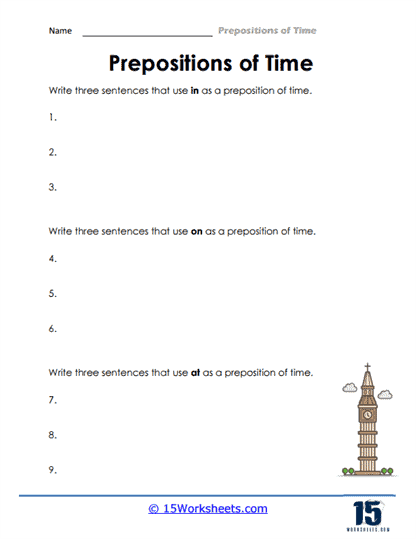
All About These 15 Worksheets
Prepositions of time may be small words, but they play a big role in helping us talk about when things happen. This collection of worksheets gives students plenty of practice with the most common ones-at, on, and in-along with trickier ones like since, until, and by. With activities ranging from basic drills to story-based exercises, kids get to see how these little words connect directly to everyday communication.
The worksheets are designed with variety to keep practice fresh. Some focus on filling in blanks with the right prepositions, while others use puzzles, storytelling, or personal schedules to show grammar in action. Learners work with contexts they recognize, like holidays, daily routines, and school timetables, making the lessons practical and easy to remember.
By the end of this collection, students don’t just know the rules-they can actually apply them in conversation and writing. Whether it’s planning events, describing routines, or telling stories, these worksheets help learners use prepositions of time naturally and accurately. It’s grammar that’s both useful and fun.
Have a Look Inside Each Worksheet
Telling Time
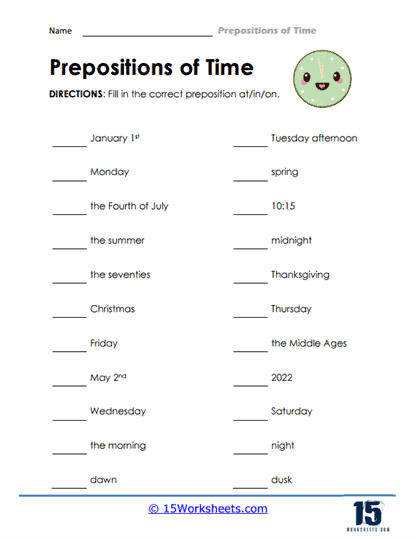
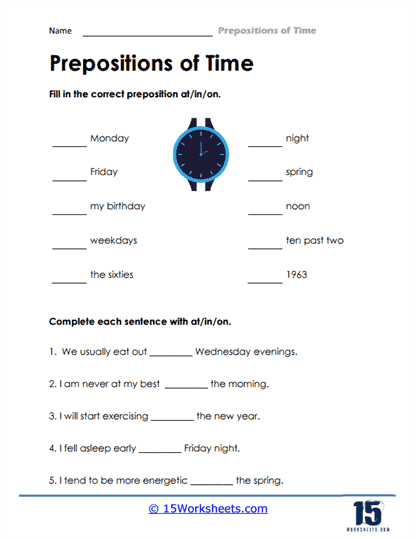
This worksheet helps students practice prepositions like at, on, and in while working with clock times. Learners match times to the correct expressions, such as “at 3 o’clock” or “in the morning.” It strengthens both grammar and time-telling skills. A perfect starting point for beginners.
Timing Matters
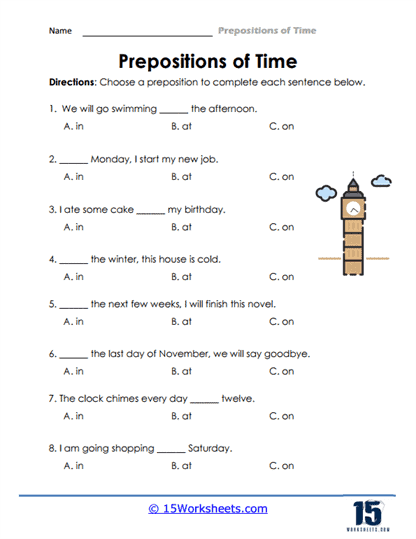
Students work through sentences that highlight how prepositions change meaning in time phrases. The worksheet encourages attention to detail with words like by, until, and since. It’s designed to show how small words make a big difference. A practical exercise for real-world usage.
The Right Fit
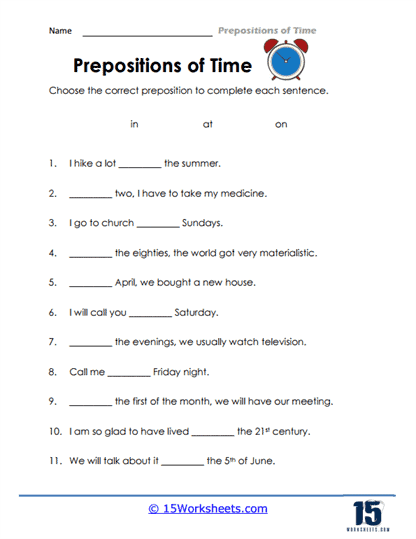
This worksheet challenges learners to choose the best preposition of time for each sentence. Options include common words like on Monday, in July, and at night. It builds accuracy and context awareness. A solid way to boost everyday grammar.
Holiday Moments
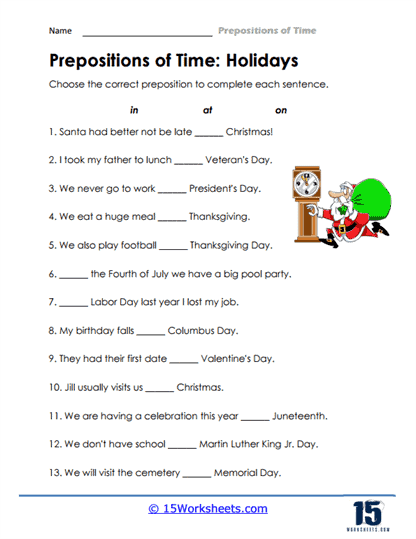
Students practice using prepositions of time in the context of holidays and celebrations. The worksheet makes examples relatable, like “on Christmas” or “in summer vacation.” It blends grammar with cultural moments kids recognize. A festive way to learn language.
Temporal Expressions
This worksheet emphasizes phrases that combine prepositions with time expressions. Students see patterns like “for two weeks” or “since last year.” It helps them understand both grammar and duration. A great bridge to more advanced usage.
Time’s Language
Learners explore different ways prepositions express timing and sequence. The worksheet encourages rewriting and comparison between phrases. It shows how prepositions create rhythm in communication. A thoughtful activity for growing writers.
Raccoon Adventures
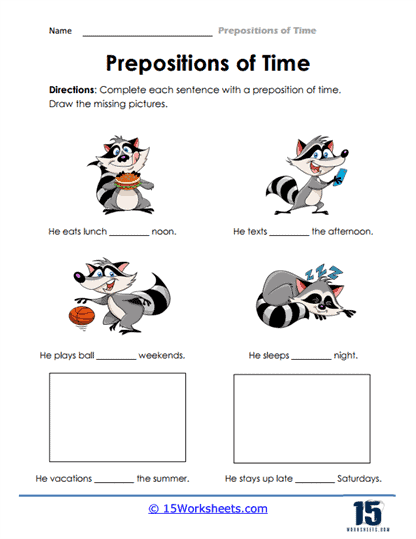
In this fun, story-based worksheet, students follow a raccoon’s daily routine while filling in prepositions of time. The narrative format makes grammar practice feel like a mini adventure. It strengthens comprehension as well as grammar. Perfect for keeping learners engaged.
From Dusk Until Dawn
This worksheet highlights prepositions that describe time spans. Students practice using from…to, until, and by in different contexts. It reinforces the idea of beginnings and endings in time. A clear way to show how language tracks events.
Crack The Code
Here, prepositions of time are built into a puzzle-like activity. Students use grammar knowledge to solve clues and complete sentences. It’s interactive and playful, turning practice into a game. A fun challenge that reinforces accuracy.
My Weekly Schedule
Students map out their weekly routines using prepositions of time. They’ll write about activities happening on Monday, at 7 a.m., or in the evening. The worksheet connects grammar to real life. Great for practicing both structure and self-expression.
Chrono Quest
This worksheet turns time prepositions into a quest-style activity. Learners complete sentences that move them forward in a journey. It mixes creativity with grammar reinforcement. A lively way to make repetition feel exciting.
My Habits
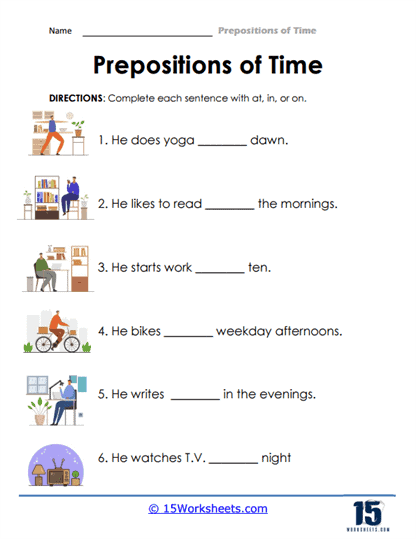
Students describe their daily habits with time expressions. The worksheet emphasizes everyday activities, like “I brush my teeth in the morning.” It helps learners see grammar as part of their routines. A practical and relatable practice tool.
What Are Prepositions of Time?
The words or groups of words that show the relationship between time, direction, and place to the other parts of a sentence are called prepositions.
Prepositions of time refer to the prepositions that indicate the time period of a certain incident or action. For example:
– I have to go to work every day at 9 AM.
– Her last exam is on Monday.
– This mall opened in 2017.
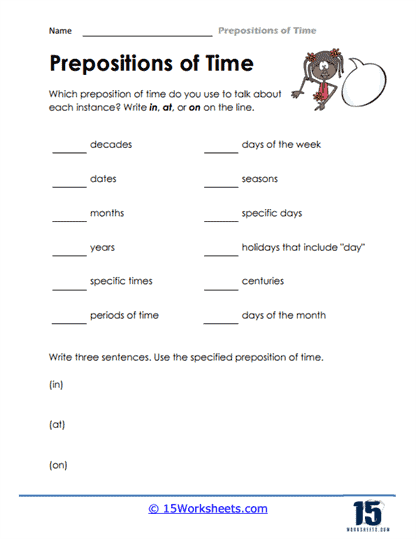
The prepositions in, on, and at are the basic prepositions of time, enabling us to understand when a particular action takes place.
Some commonly used prepositions of time include: in, on, at, until, to, from, since, for, before, after, by, and during. The prepositions of time describe the happenings in terms of the exact time, day of week, months, years, seasons, centuries, and more time frames. Improve your vocabulary and add fluency to your speech by looking at this detailed list of prepositions of time and how to use them in sentences.
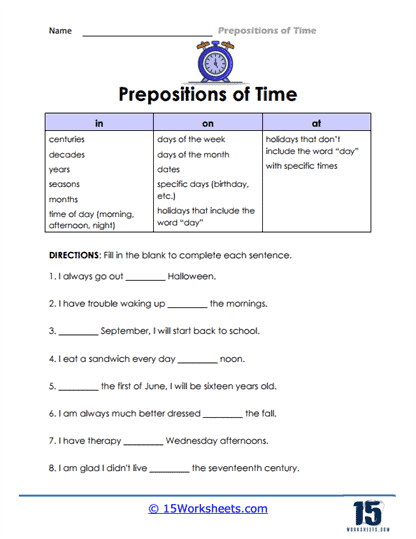
In: In shows the happenings in an infinite time frame. Be it months, years, seasons, or centuries. Common exceptions include in the morning, ten minutes, three years, etc.
Examples:
My grandfather was born in 1901.
I will avail my annual holidays in December.
We love going on a vacation in the summers.
On: The preposition On shows the actions happening on a specific day or date.
Examples:
We’ll meet the family on Sunday.
I have my doctor’s appointment on the 12th.
She’ll be at my place on the 4th of July.
At: At is used to indicate the exact time. At night and at the moment are a few exceptions.
Examples:
My shift starts at 11 AM.
We have to pick up the kids at 4 PM.
Why don’t you meet us at 11 PM?
From…to: From…to indicates a time frame with clear starting and ending periods.
Examples:
We have to accommodate the guests from Monday to Wednesday.
Rishabh worked at the bar from June to August.
My grandfather rests every day from 4 to 5:30 PM.
Until: Until describes a time or event with a specified or unspecified ending time.
Examples:
I refuse to sit down at the table until he apologizes.
The monsters will not stop until they’ve destroyed the whole village.
You will have to wait until everyone has said their piece.
Since: Since indicates an event that started in the past and is still continuing in the present.
Examples:
Alex hasn’t clocked in since yesterday.
She has been on pain meds since the surgery.
I have known Ben since he was in junior high.
For: For shows an amount of time in the settings of present, past, or future.
Examples:
She has been taking therapy for a long time.
The boys waited for six long years to see each other again.
She wants to stay with us for a week.
Before: Before shows the beginning or starting time of an event.
Examples:
Let’s head home before it starts to rain.
I hope she’s able to hold herself together before the guests arrive.
Should we leave before the teacher gets back?
After: After indicates the ending time of an event.
Examples:
She stopped wailing after her father picked her up.
The coach stopped shouting after the player hit him with the ball.
After the accident, Jamie was put on a liquid diet.
During: During indicates the entire time period of an action or an event.
Examples:
The whole class kept yawning during the boring presentation.
I might end up throttling the next person who disturbs me during my work.
Will you please stay quiet during the movie?
By: By indicates the extent of happening or ending of an event.
Examples:
I will be ready by 10 PM.
We have to be at the concert by 7 PM.
Will you please submit the assessment by noon?