
Verb Moods Worksheets
About These 15 Worksheets
Verb moods are all about the attitude a sentence takes-whether it’s stating a fact, giving a command, expressing a wish, or imagining a possibility. This collection of worksheets helps students practice identifying, comparing, and creating sentences in the indicative, imperative, subjunctive, and conditional moods. Instead of dry definitions, learners get hands-on practice with sorting, rewriting, and building sentences that show how mood shapes meaning.
Each worksheet brings a different angle: some focus on factual statements (indicative), others on giving directions (imperative), while others dive into wishful or hypothetical scenarios (subjunctive and conditional). The variety keeps practice fresh, blending drills with creative writing opportunities. By moving between recognition, correction, and original sentence creation, students develop both accuracy and flexibility with verb moods.
Most importantly, these worksheets show how verb moods connect to real-life communication. We use them constantly-whether we’re saying “It is raining” (indicative), “Close the window” (imperative), “I wish it were sunny” (subjunctive), or “If it rains, we’ll stay inside” (conditional). By practicing across moods, students learn how to shift tone, purpose, and meaning in their writing and speech.
Have a Look Inside Each Worksheet
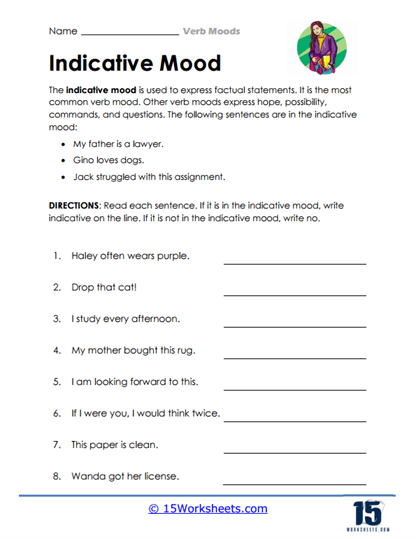
Fact Finder
Students identify indicative mood sentences that state facts. The activity trains them to spot straightforward statements. It reinforces recognition of the most common verb mood. Learners gain confidence in telling fact from fiction.
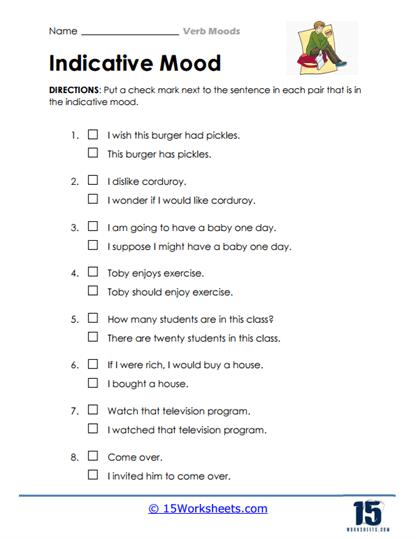
Fact Check
This worksheet asks learners to confirm or correct factual statements. It strengthens awareness of indicative mood. The activity connects grammar to real-world truth-checking. Students practice both accuracy and comprehension.
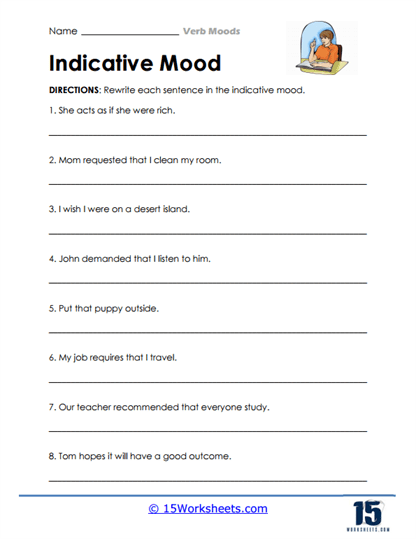
Statement Swap
Students transform indicative sentences into different moods. The exercise highlights how verb mood changes tone and meaning. It builds flexibility in sentence construction. Learners see grammar as more than just rules-it’s expression.
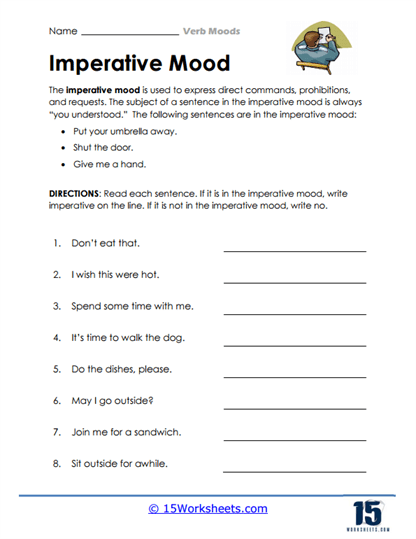
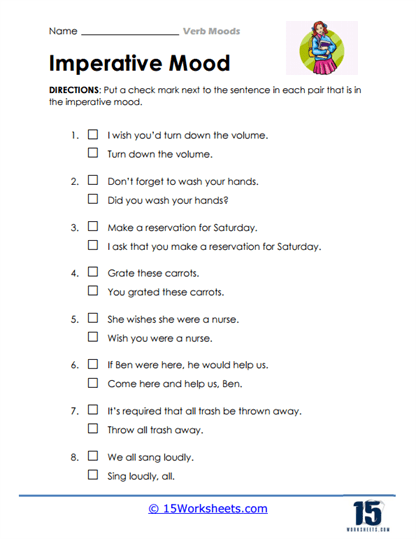
Directive Decisions
Here, students work with imperative mood sentences. They practice giving commands, directions, or advice. The activity reinforces the function of imperatives in communication. Learners explore how mood shapes purpose.
Command Check
This worksheet focuses on spotting and creating imperative sentences. Students learn to identify commands clearly. The activity makes practice feel practical and action-oriented. It’s perfect for everyday applications of grammar.
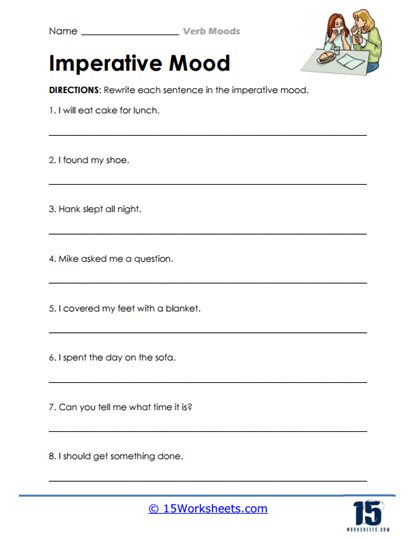
Command Sentences
Students build their own imperative sentences from prompts. The activity encourages creativity and precision. It shows how mood can express authority or guidance. Learners practice making direct statements.
Formal Choices
Here, students compare formal versus informal sentence moods. The worksheet emphasizes tone and appropriateness. Learners see how mood affects politeness and formality. It builds awareness of audience and context.
Directive Shift
Students transform regular statements into imperative sentences. The activity highlights how verb mood shifts intent. It reinforces flexibility in grammar use. Learners practice reworking sentences for different effects.
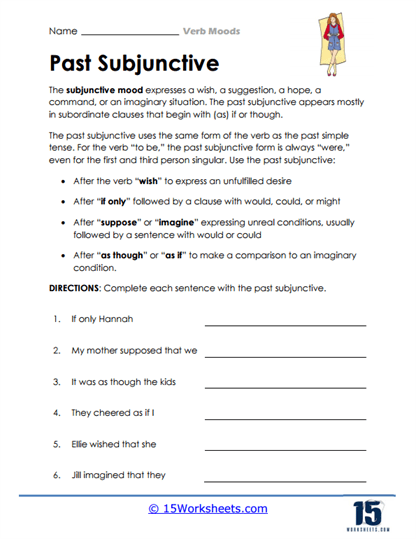
Wishful Thinking
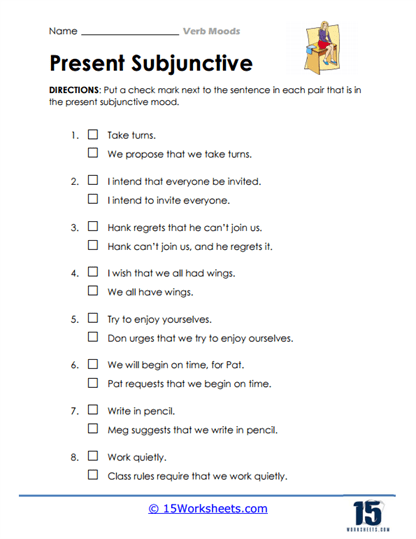
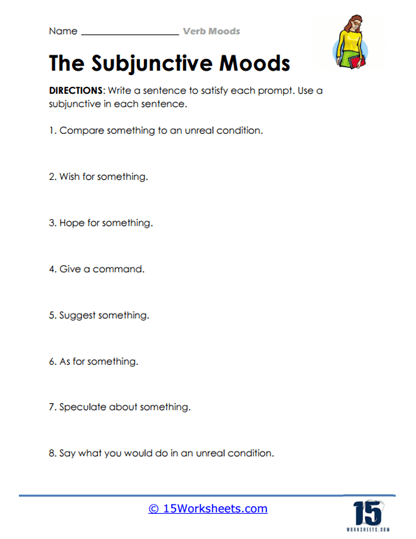
This worksheet explores subjunctive mood expressions of wishes. Students complete and create sentences like “I wish…” or “If only…” The activity ties grammar to emotions and imagination. It makes the subjunctive feel relevant and human.
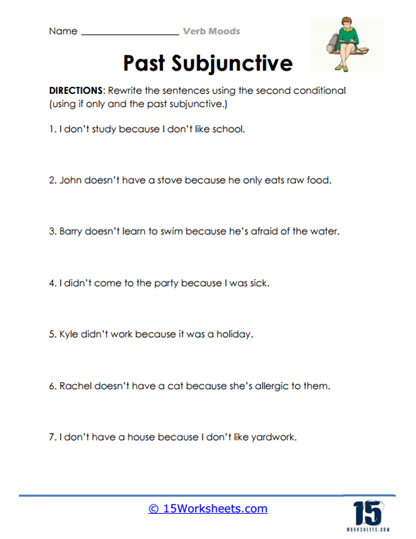
Alternate Outcomes
Students practice forming conditional mood sentences. They write “if… then…” style scenarios. The worksheet highlights cause-and-effect in grammar. Learners connect sentence mood to real-world possibilities.
Tense Tracker
This worksheet mixes moods with tense practice. Students track how verb mood interacts with past, present, and future. The activity reinforces multiple grammar skills at once. Learners see how time and mood combine.
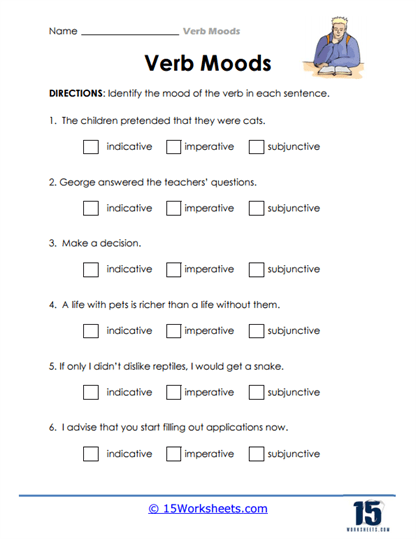
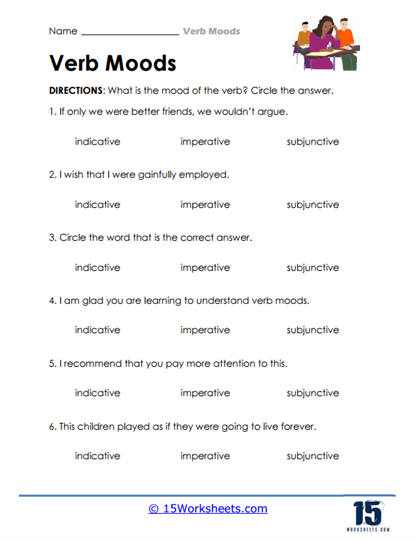
Mode Match
Students match sentences with the correct verb mood. The task builds recognition and categorization. It feels like a sorting challenge between indicative, imperative, subjunctive, and conditional. Learners sharpen their grammar instincts.
Wishes Granted
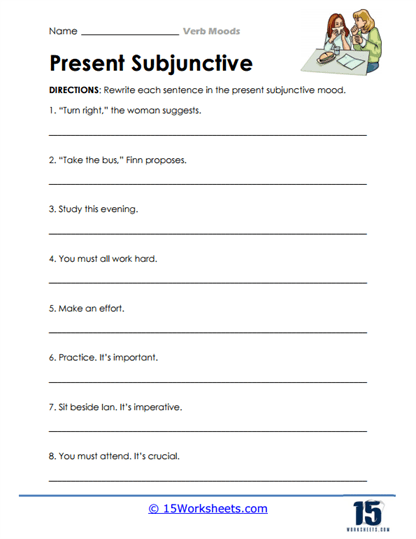
Here, learners create sentences showing wishes fulfilled in the subjunctive. The activity blends creativity with grammar. It emphasizes how verb moods express imagination. Students write their own hopeful or fanciful ideas.
Imagined Realms
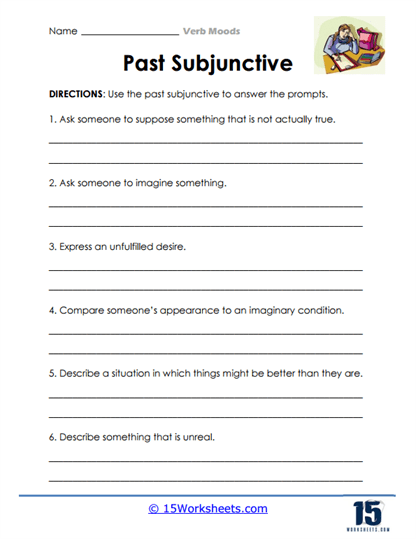
This worksheet dives deeper into subjunctive and conditional moods. Students craft sentences about unreal or hypothetical situations. It shows how mood creates storytelling possibilities. Learners see grammar as a tool for creativity.
Hypothetical Horizons
Students explore advanced conditional sentences. They imagine “what if” scenarios with complex grammar. The activity strengthens logical thinking and language skills. Learners gain fluency in expressing hypothetical outcomes.
What Are Verb Moods?
Verb moods are an essential aspect of English grammar that indicate the attitude or intent of the speaker or writer towards the action or state described by the verb. Essentially, verb moods help convey whether a statement is a fact, a command, a wish, a possibility, or a question. By using different verb moods, we can express various nuances in communication, which allows for more precise and effective language use.
The Indicative Mood
The most commonly used verb mood in English is the indicative mood. This mood is used to make factual statements, ask questions, or express opinions as facts. For example, sentences like “She walks to school every day,” “The sky is blue,” or “Do you understand the lesson?” are all in the indicative mood. The purpose of the indicative mood is to communicate information or state something that the speaker believes to be true. It is the default mood for most sentences because it deals with reality and objective facts.
The Imperative Mood
The imperative mood is used for issuing commands, making requests, or offering invitations. In this mood, the subject of the sentence is usually implied rather than explicitly stated, and the verb is in its base form. For example, in sentences like “Close the door,” “Please sit down,” or “Join us for dinner,” the speaker is directly addressing the listener and instructing them to do something. The imperative mood is vital in everyday communication because it enables us to give directions, make suggestions, or express desires in a concise and direct manner.
The Subjunctive Mood
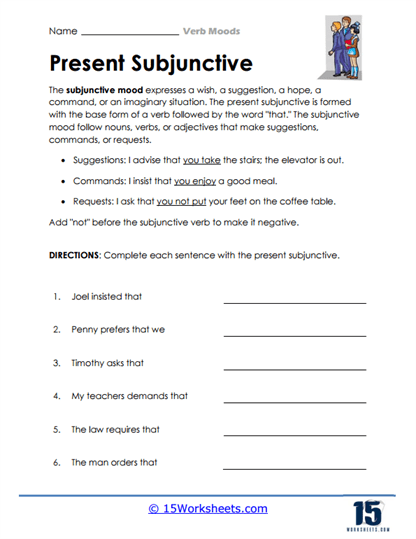
The subjunctive mood is less commonly used but equally important. It is typically employed to express wishes, hypothetical situations, demands, or conditions that are contrary to fact. For instance, in sentences like “I wish I were taller,” “If I were you, I would apologize,” or “It is essential that he be present at the meeting,” the subjunctive mood indicates that the speaker is discussing something that is not necessarily real or is uncertain. The subjunctive mood helps convey ideas that are speculative, imaginary, or desired, allowing for more complex expressions of thought.
The Role of Verb Moods in Communication
Verb moods play a critical role in shaping the meaning and intent of our sentences. By selecting the appropriate mood, speakers and writers can accurately reflect their intentions, whether they are stating a fact, giving a command, or expressing a wish. Understanding and using verb moods correctly enhances clarity and precision in communication, making it easier for listeners and readers to understand the speaker’s or writer’s true intent.