
Reciprocal Pronouns Worksheets
About These 15 Worksheets
Reciprocal pronouns may be small, but they play a big role in showing how people interact with one another. This collection of worksheets helps students practice using each other and one another to describe shared actions and relationships. From matching games to sentence rewrites, the activities show learners how these pronouns make writing smoother and more natural. The result is stronger grammar and clearer communication.
The set includes a wide variety of practice styles. Worksheets like Mutual Match and Match Mates give students structured pairings, while Mutual Moments and Shared Thoughts invite more creative writing. Themed sheets such as Grammar Galaxy keep things playful, while editing challenges like Pronoun Fix strengthen accuracy. This balance of fun and rigor means students stay engaged while still mastering the essentials.
By working through these activities, learners start to see how reciprocal pronouns show cooperation, understanding, and connection. They also recognize how these pronouns replace repetition and improve sentence flow. The practice goes beyond grammar drills – it encourages students to think about relationships and interactions in their writing. By the end, students won’t just know the rules – they’ll use reciprocal pronouns with confidence and purpose.
Have a Look Inside Each Worksheet
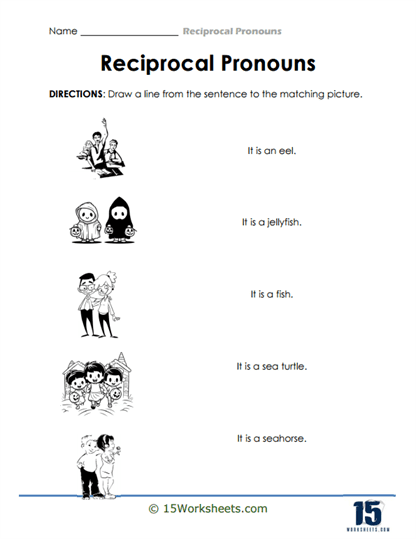
Mutual Match
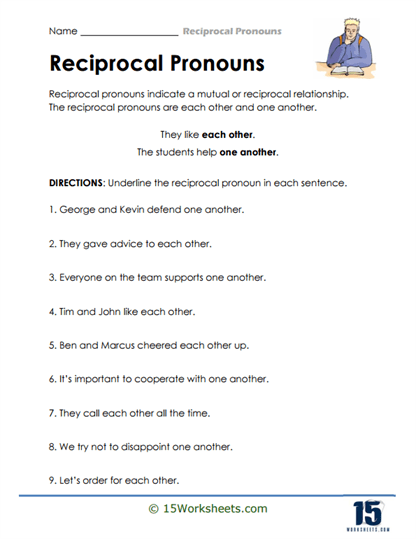
This worksheet introduces reciprocal pronouns like each other and one another through matching activities. Students connect subjects with the correct reciprocal phrase to show shared action. The activity highlights the idea of mutual exchange in grammar. It’s a clear, structured way to start practicing.
Grammar Galaxy
Students explore reciprocal pronouns in a space-themed worksheet that makes grammar feel adventurous. They practice inserting the correct pronoun into sentences about cosmic teamwork. The theme keeps learners engaged while reinforcing the idea of shared actions. It’s an imaginative way to build grammar fluency.
Expression Mix
This worksheet asks learners to choose the right reciprocal pronoun to complete various expressions. The activity blends vocabulary with grammar, showing how phrasing changes with pronoun use. Students see how these words help express relationships more clearly. It’s great for reinforcing context-based decision-making.
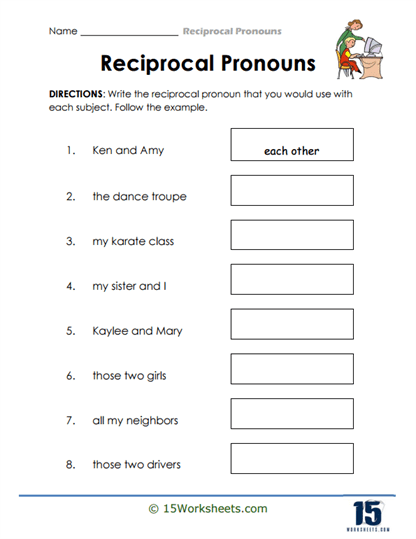
Dynamic Duos
Here, students focus on pairs of people or things doing actions together. They’ll practice rewriting sentences using reciprocal pronouns. The activity highlights how each other and one another make writing smoother. Learners see how pronouns replace repetition.
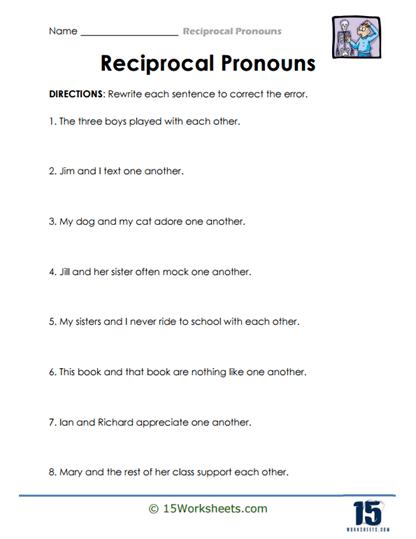
Pronoun Fix
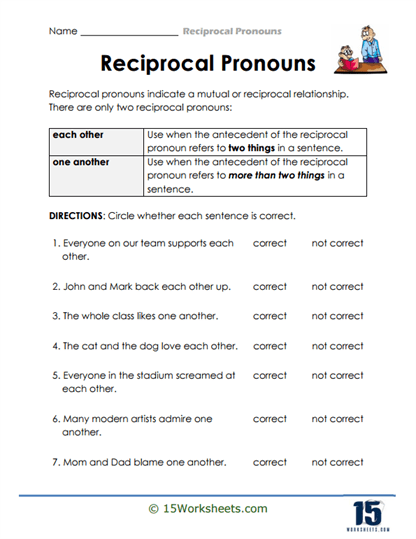
Students correct sentences that use reciprocal pronouns incorrectly. The editing challenge helps them spot and fix common mistakes. This activity sharpens accuracy and reinforces correct usage. It’s a practical way to test mastery.
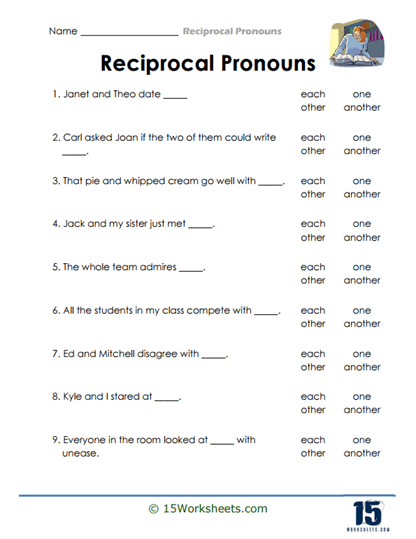
Reciprocal Choices
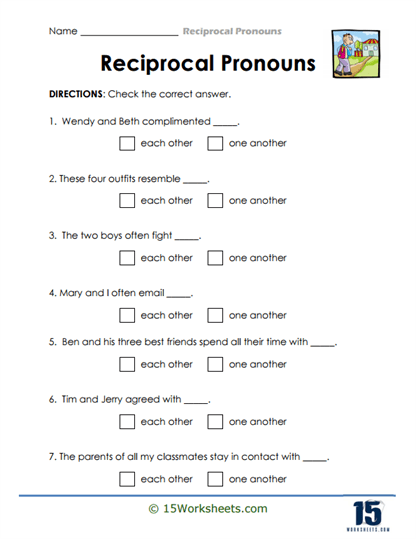
This worksheet presents multiple-choice questions where learners must select the correct reciprocal pronoun. The format makes practice quick and engaging. It emphasizes reading carefully and thinking critically about meaning. It’s perfect for review or assessment.
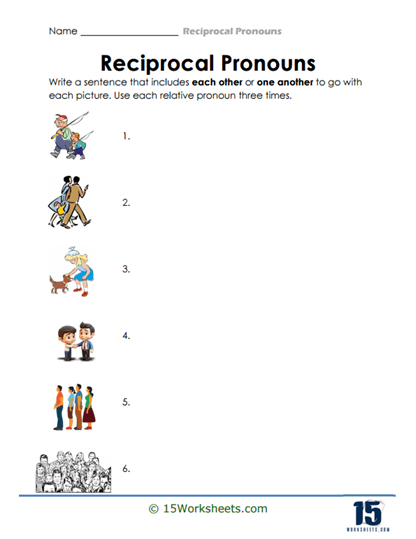
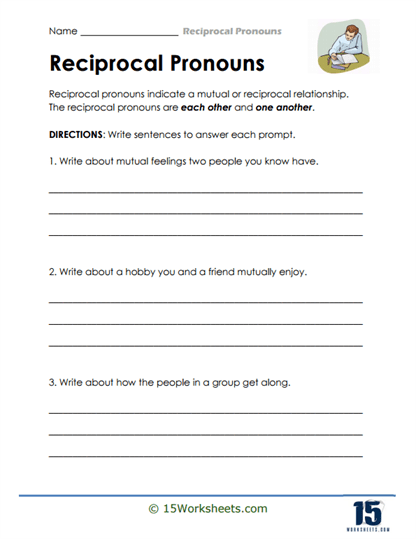
Mutual Moments
Students write short stories or sentences about “mutual moments” between characters. They’ll practice applying reciprocal pronouns in creative contexts. The activity builds both grammar and storytelling skills. It connects grammar rules with real-life communication.
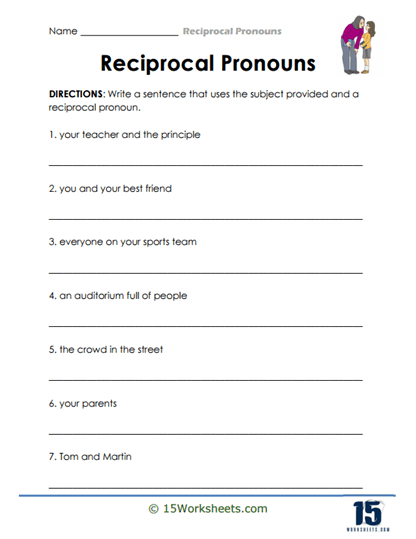
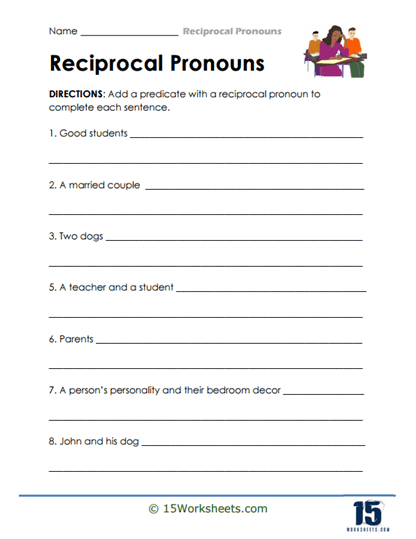
Reciprocal Relations
This worksheet focuses on how reciprocal pronouns express relationships. Students rewrite or complete sentences to show shared experiences. The activity highlights how grammar can reflect cooperation and connection. It helps students see pronouns as tools for meaningful writing.
Match Mates
Learners pair sentences or subjects with the right reciprocal pronoun in this matching exercise. The activity makes grammar practice interactive and puzzle-like. It reinforces how reciprocal pronouns always involve two or more. It’s simple but effective reinforcement.
Pair Practice
This worksheet provides sentences where students practice using reciprocal pronouns in pairs. It reinforces the idea of two-way action. Learners get repetition that builds fluency and confidence. The task feels straightforward and accessible.
Both Actions
Students focus on verbs that naturally take reciprocal pronouns, like help, love, or talk. They’ll practice combining them into sentences that show shared actions. The activity links verbs and pronouns in meaningful ways. It’s practical grammar in action.
Shared Thoughts
Here, students practice writing about people who share ideas or feelings. They’ll use reciprocal pronouns to complete sentences or short passages. It emphasizes pronouns as tools for expressing mutual understanding. The activity blends grammar with emotional context.
Mutual Understanding
This worksheet encourages learners to write about scenarios where people understand, respect, or care for one another. The focus is on using reciprocal pronouns to describe positive relationships. Students practice both grammar and empathy in writing. It’s a thoughtful approach to pronoun practice.
Shared Actions
Students complete sentences that describe cooperative or joint actions. The worksheet emphasizes when reciprocal pronouns fit naturally. It helps kids recognize situations where mutual action is implied. By practicing, they make smoother grammar choices.
Mutual Actions
This final worksheet reviews reciprocal pronouns by asking students to apply them in various contexts. It ties together earlier lessons with mixed exercises. Learners show they can recognize, choose, and use reciprocal pronouns correctly. It’s a strong capstone activity for the topic.
What Are Reciprocal Pronouns?
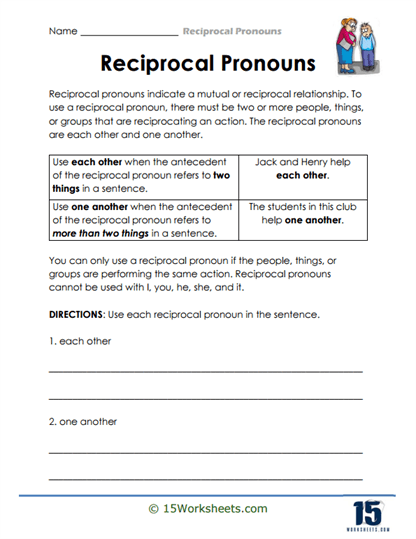
Reciprocal pronouns play a crucial role in English grammar, serving as a tool to express mutual actions or relationships between two or more subjects within a sentence. These pronouns are unique in that they specifically indicate that the action of the verb is being performed back and forth among the subjects. The two primary reciprocal pronouns in English are “each other” and “one another.” They help avoid redundancy in language by allowing speakers and writers to convey mutual interactions without needing to repeat the subjects or actions.
To understand the function of reciprocal pronouns, consider how they simplify sentence construction. Imagine trying to describe a situation where two people are interacting with each other without using a reciprocal pronoun. For example, instead of saying “Sarah respects John, and John respects Sarah,” you can simply say “Sarah and John respect each other.” The use of “each other” makes the sentence more concise and easier to understand, while still conveying the same meaning. This is especially useful in writing and speech, where clarity and brevity are often essential.
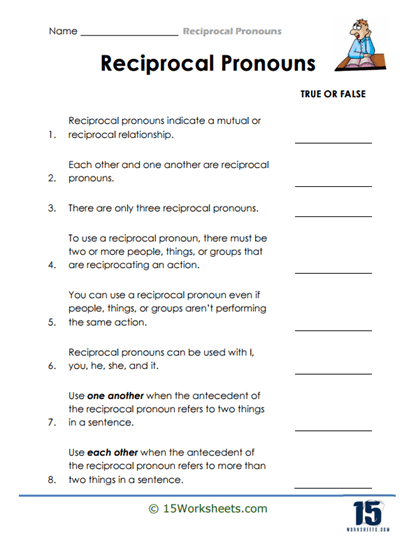
The distinction between “each other” and “one another” traditionally lies in the number of subjects involved. “Each other” is generally used when referring to a reciprocal relationship between two subjects. For instance, “The two friends always help each other with homework” clearly indicates that there are only two people involved in this mutual action. On the other hand, “one another” is used when the reciprocal relationship involves three or more subjects. An example would be, “The members of the team encourage one another during the game,” which suggests that the encouragement is shared among all members of the team, not just between two individuals.
However, it’s important to note that in contemporary English usage, the distinction between “each other” and “one another” is often blurred. Many speakers and writers use the two interchangeably, even though traditional grammar guidelines suggest maintaining the distinction. For example, someone might say, “The three siblings support each other” instead of “support one another,” and this would be widely accepted in modern communication. This flexibility reflects the natural evolution of language, where rules sometimes adapt to common usage patterns.
Reciprocal pronouns are essential for maintaining the efficiency and fluidity of language. By using these pronouns, speakers and writers can convey complex interactions and relationships succinctly, without sacrificing clarity. They allow for a smoother flow of information, especially in contexts where multiple subjects are interacting in similar ways. Understanding and correctly using reciprocal pronouns can significantly enhance both written and spoken communication, making expressions of mutual actions clear and effective.