
They're, There, and Their Worksheets

All About These 15 Worksheets
Homophones are tricky little word twins (or in this case, triplets) that can stump even seasoned writers. “They’re,” “there,” and “their” all sound exactly the same, but their meanings couldn’t be more different. This collection of worksheets takes those confusing words and turns them into clear, fun practice. With a mix of fill-in-the-blank, picture clues, editing challenges, and writing prompts, kids get to experience every angle of these words until the lightbulb moment clicks.
These worksheets are designed to build confidence step by step. At first, students get to choose from ready-made options, circle answers, or check boxes-safe ways to dip into the practice. Then they move into rewriting, correcting mistakes, and finally writing their own sentences. By the time they finish, they’re not just guessing anymore-they’re choosing the right homophone because they understand why it fits.
And let’s be honest: real-world writing is full of these three words. Whether kids are working on essays, stories, or even text messages, knowing the difference between “they’re,” “there,” and “their” makes a huge difference in clarity. Practicing with these worksheets gives them the skills to communicate clearly and avoid those classic mix-ups that make teachers (and spell check) cringe.
Have a Look Inside Each Worksheet
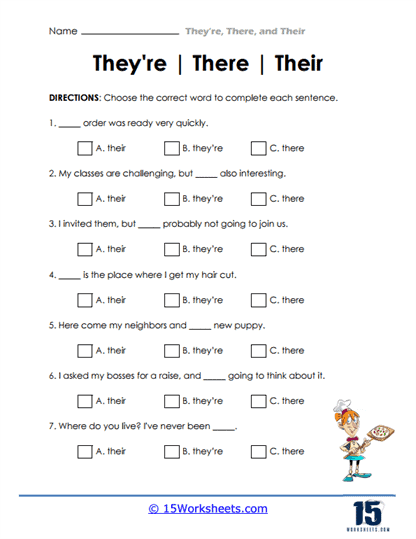
Mark The Box
Students read each sentence and tick the box for their, they’re, or there. It’s rapid-fire practice that builds quick recognition of possession, contraction, and location clues. The multiple-choice checkboxes keep it light and game-like. Great for sharpening accuracy with these three look-alike words.
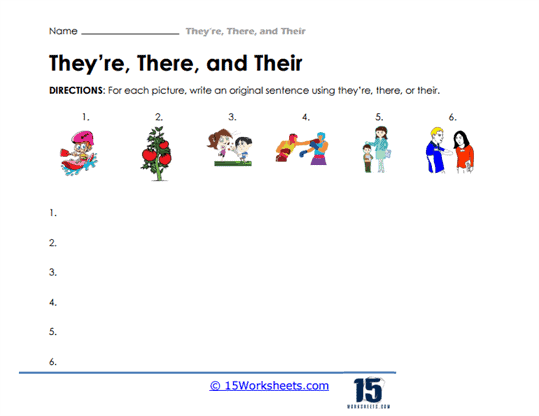
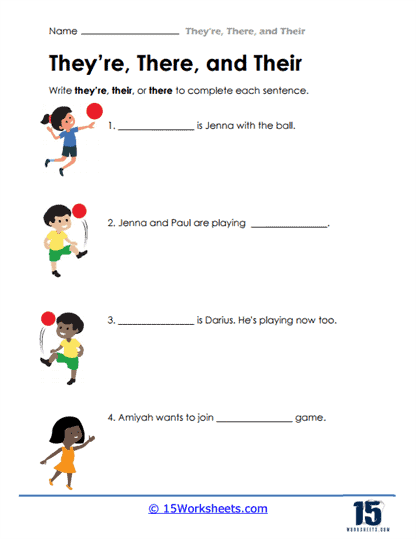
Picture In Context
Each sentence comes with a picture so kids can use visual context to choose the right word. Learners fill in the blank with they’re, there, or their as the image nudges them toward the meaning. It’s perfect for younger readers who benefit from seeing the situation. The visuals make the differences feel obvious and memorable.
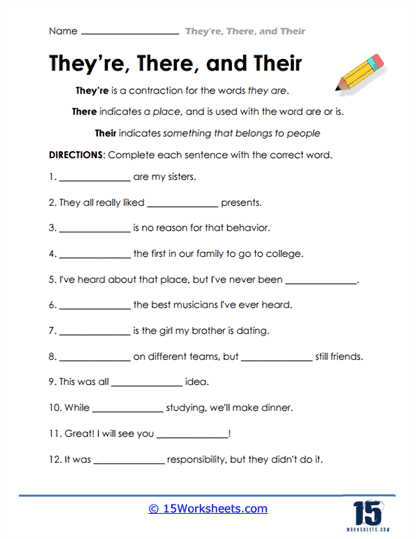
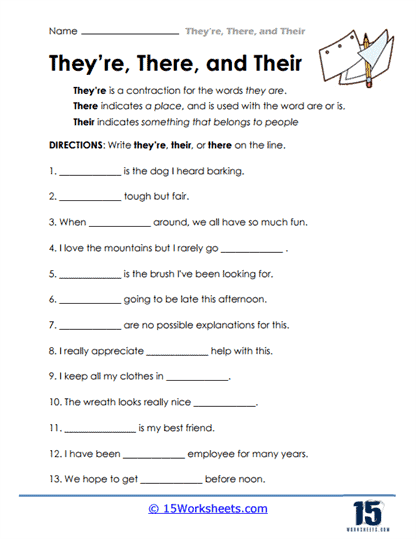
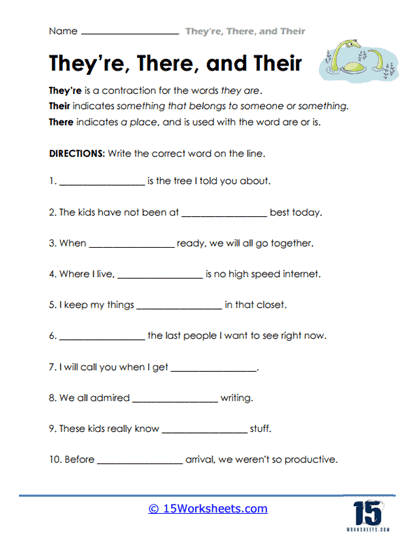
Filling In The Blanks
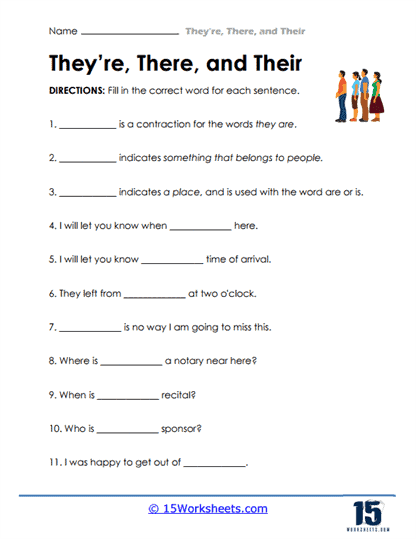
Students write they’re, there, or their on the line to complete each sentence. Short, focused prompts make it easy to practice many examples in one sitting. A quick tip box at the top reminds learners what each word means. Repetition here cements the habit of choosing the right homophone.
Freely Describe
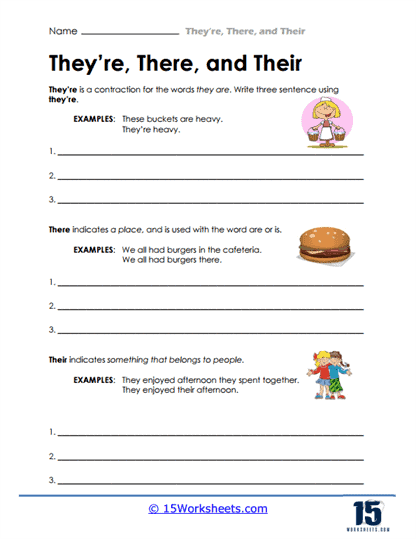
Kids study six small pictures and write an original sentence for each using the correct word. This turns practice into creative writing while still targeting the three homophones. Students have to think about meaning before choosing, which deepens understanding. It’s a fun way to prove they can use the words in their own voice.
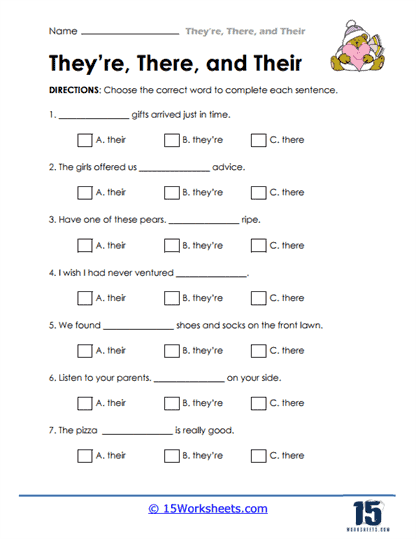
Pick From The Trio
Every sentence offers three check-box choices-one for each homophone-and learners select the best fit. The format is fast, consistent, and confidence-building. It encourages close reading for clues like possession, place words, and contractions. Ideal for warm-ups or quick checks for understanding.
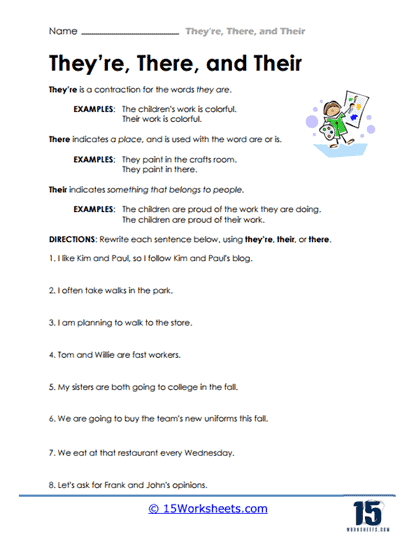
Rewrite For Clarity
Sentences with the wrong word are waiting to be fixed, so students rewrite them correctly. This activity shifts kids from “spotter” to “editor,” which is super useful for real writing. It strengthens the habit of double-checking homophones while revising. Expect cleaner, clearer sentences after a few rounds of this.
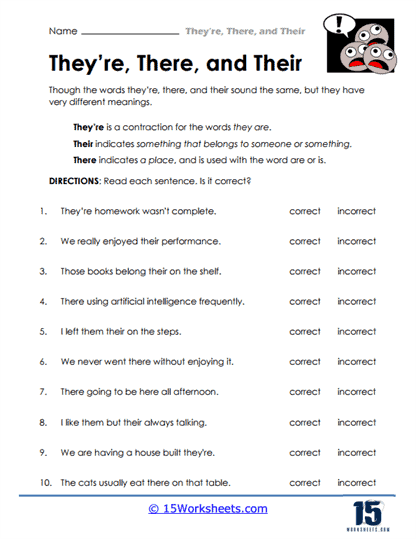
Grammar Evaluator
Learners judge each sentence as correct or incorrect based on homophone use. It’s a yes/no style task that trains an editor’s eye. Students learn to justify their choices using meaning clues. That evaluative mindset transfers nicely to proofreading their own work.
Picking the Perfect Homophone
This one blends recall and application-read the sentence and pick the exact word that fits. The challenge is to notice subtle context hints before deciding. It nudges kids to think “possession vs. place vs. they are” every single time. Consistent practice builds speed and accuracy with the trio.
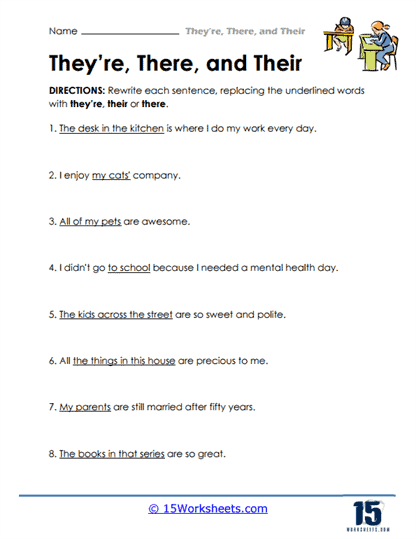
The Great Sentence Shift
Here, kids transform flawed sentences into polished ones by swapping in the correct homophone. It feels like a sentence-repair puzzle. Learners get hands-on experience with how tiny word changes affect meaning. That precision pays off in everyday writing.
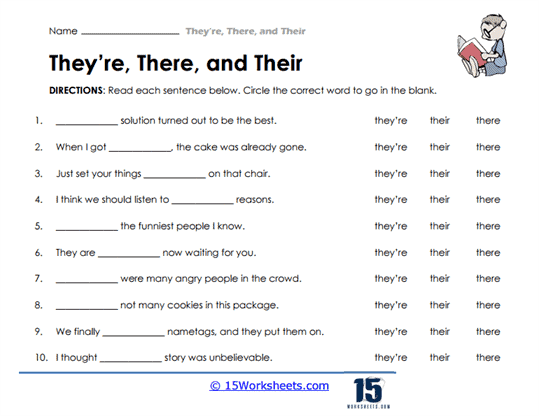
Circle Your Choice
Students circle the correct word that completes each sentence-simple, quick, effective. The low-friction format keeps attention on meaning, not mechanics. Great as a bell-ringer or exit ticket. Frequent, short reps help the right choice become automatic.
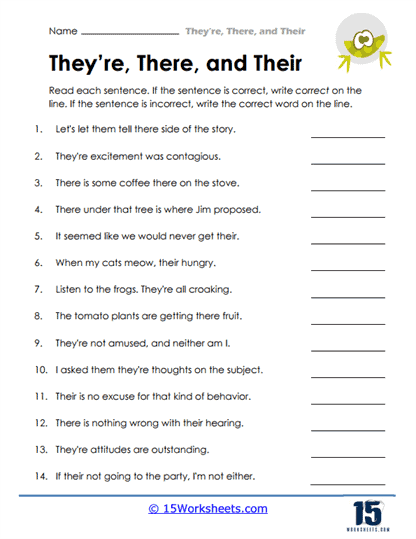
Leave It Or Fix It?
Each sentence might be right… or not. Learners decide whether to leave it as is or fix the homophone and then make the change if needed. This builds judgment and editing fluency at the same time. It’s a satisfying mix of error-spotting and mini-revision.
Completing The Sentence
Students fill in straightforward sentences by writing they’re, there, or their on the lines. The clean layout helps kids focus purely on meaning and structure. It’s excellent for mastery checks after earlier practice. A steady set of prompts reinforces the differences in practical contexts.
Visualizing The Meaning
Pictures and short prompts guide learners to connect the right word with what they see. Students must interpret the scene before choosing, which strengthens comprehension. It’s ideal for visual thinkers and multilingual learners. The images make those tiny differences feel big and obvious.
Trifecta Mastery
This worksheet mixes tasks-some blank-fills, some corrections, some choose-the-right-word-to test full understanding. The variety keeps engagement high while covering all angles of use. Students practice recognition, application, and editing in one place. It’s a great capstone for the homophone unit.
Writing With Precision
Kids craft original sentences or a short passage that uses all three words correctly. The emphasis is on clarity and careful word choice. It pushes learners beyond picking answers into communicating with real purpose. This is where homophone knowledge shows up in polished writing.
When To Use They’re, There, or Their
They’re”, “there”, and “their” are three commonly confused words in English. Here are their definitions and examples of their usage:
They’re – a contraction of “they are”. This word is used to describe a group of people or things. Example: They’re going to the store later.
There – refers to a place or location. This word can be used to indicate where something or someone is or where an action is taking place. Example: The cat is sleeping over there.
Their – indicates possession or ownership by a group of people. Example: They forgot their keys at home.
It’s important to note that “they’re” is a contraction of “they are”, while “their” and “there” are not. It is also important to use these words correctly to avoid confusion and unclear communication.
Examples of using them correctly:
They’re going to the party tonight.
There is a book on the table.
Their dog is very friendly.
Overall, understanding the proper usage of “they’re”, “there”, and “their” can help learners to communicate more accurately and effectively in English.
Common Errors When Using They’re, There, and Their
To help students in spotting errors in sentences, teachers can share these common errors in using They’re, There, and Their:
Using “there” instead of “they’re” to indicate a group of people. “There” indicates a place or location, while “they’re” is a contraction of “they are” and is used to describe a group of people or things.
Using “their” instead of “there” to indicate a place or location. “Their” indicates possession or ownership by a group of people, while “there” indicates a place or location.
Confusing the three words and using them interchangeably, which can lead to confusion and unclear communication.
Examples of common errors:
Their going to the party tonight. (Incorrect – “their” should be “they’re”)
There dog is very friendly. (Incorrect – “there” should be “their”)
They’re are so many people at the store. (Incorrect – “they’re” and “are” are redundant)
By avoiding these common errors, students can improve their grammar and communicate more accurately in English.