
Collective Nouns Worksheets

All About These 15 Worksheets
Collective nouns may sound fancy, but really, they’re just words we use to describe groups – like a flock of birds or a team of players. These worksheets take what could be a dry grammar lesson and turn it into something fun, quirky, and totally memorable. From underlining in sentences to hands-on cut-and-paste activities, there’s something here for every kind of learner. Even the trickiest differences, like collective nouns versus plurals or abstract nouns, are broken down into clear, kid-friendly tasks.
This collection is designed to give students repeated, playful practice with collective nouns, so spotting them becomes second nature. Whether they’re sorting, swapping words, or hunting through passages, the activities mix fun with focus. The variety ensures kids don’t get bored, while also covering all the angles: recognition, usage, and distinction from other noun types. It’s like a grammar gym where kids exercise their language muscles without even realizing how much they’re learning.
On top of the language practice, these worksheets sneak in a bit of culture and trivia. Think of matching animal group names – a “parliament of owls” isn’t just good grammar, it’s a peek into the creativity of the English language. By exploring these group terms, learners gain not just stronger grammar skills but also a deeper appreciation for how words shape our view of the world. These worksheets help students see grammar as something alive, playful, and useful in everyday life.
Have a Look Inside Each Worksheet
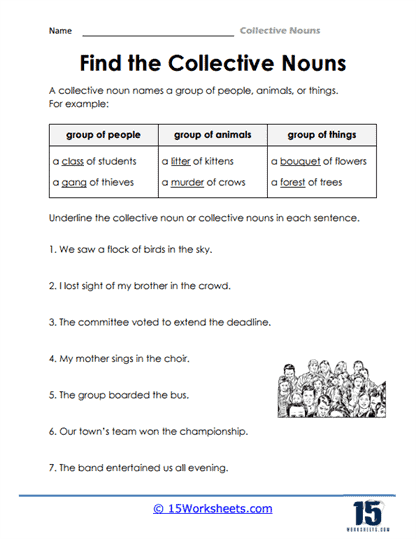
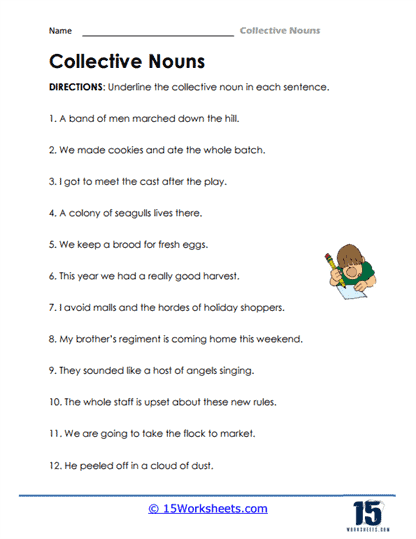
Underline and Learn
This worksheet has students underline collective nouns hidden in fun sentences. Kids sharpen their grammar skills by picking out words like “team” or “flock” in context. The activity makes collective nouns easy to spot and remember. It’s a simple but effective way to boost confidence in recognizing group words.
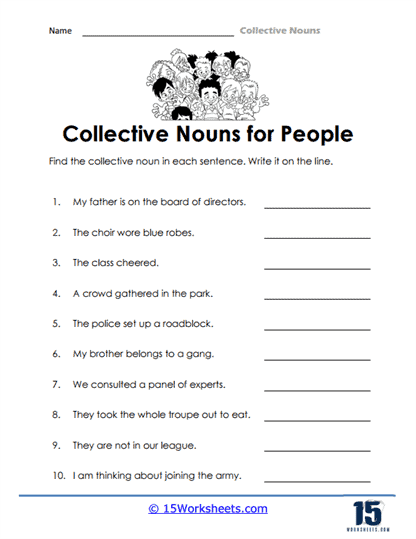
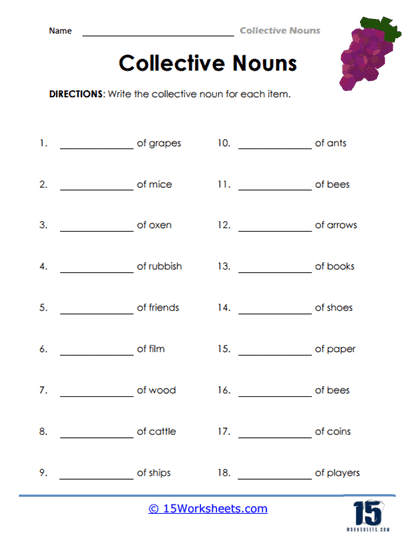
Identify and Write
Learners will read short prompts and then write the correct collective noun to finish the idea. It’s a mix of reading comprehension and vocabulary recall. The challenge helps students practice spelling and sentence-building too. This worksheet turns abstract word groups into something concrete and memorable.
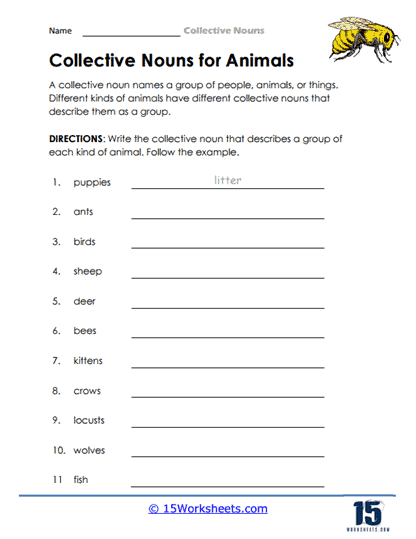
Animal Groups
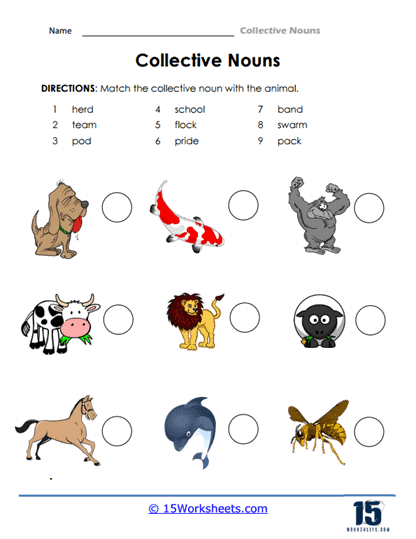
Here, students discover the quirky names we give to animal groups, like a “murder” of crows or a “pod” of dolphins. The activity blends science with language arts. Kids will enjoy seeing how creative English can be with these collective terms. It’s a playful way to link nature study with grammar practice.
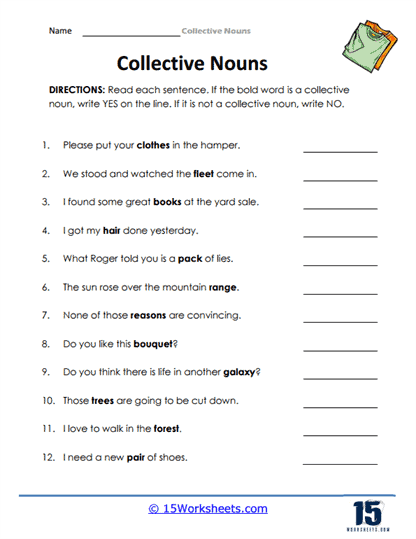
Yes or No?
Students decide if a highlighted word is truly a collective noun or not. It feels like a game of quick judgment, keeping learners engaged. This task strengthens critical thinking and vocabulary accuracy. By the end, kids sharpen their skills at telling real collective nouns from impostors.
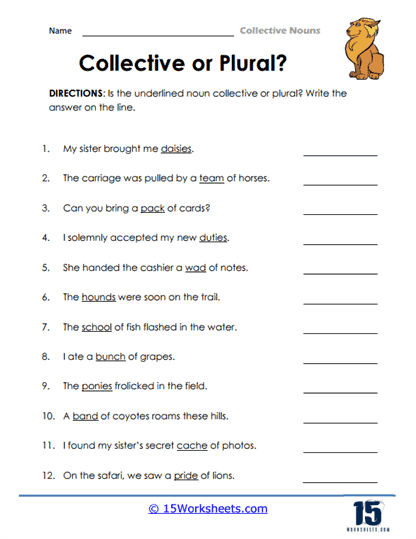
Collective Noun or Plural?
This worksheet tackles the tricky difference between collective nouns and simple plurals. Students get to sort words into the correct category. The activity clears up confusion between words like “flocks” and “flock.” It’s a handy exercise for building precision in grammar.
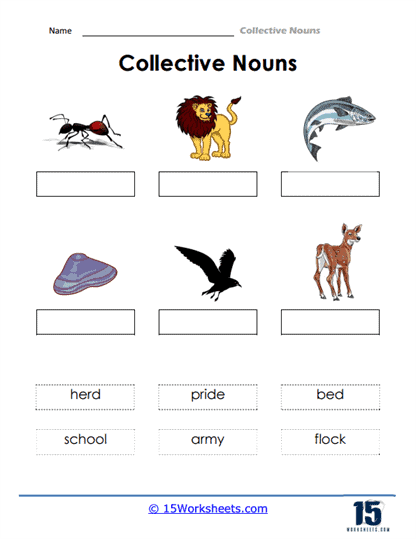
Cut and Paste to Match
Learners cut out collective nouns and paste them next to matching pictures or words. The hands-on approach makes grammar interactive and fun. This worksheet supports fine motor skills while teaching language. It’s perfect for tactile learners who like to move and create.
Learning More
This worksheet gives extra practice with collective nouns through fill-in-the-blank style exercises. Students must recall the right word to complete each sentence. The activity reinforces earlier lessons while adding variety. It’s a gentle way to deepen their knowledge without feeling repetitive.
The Missing Piece
Students complete sentences by inserting the correct collective noun from a word list. It’s like solving a little puzzle with words. The challenge keeps learners focused and thoughtful. This sheet helps kids see how collective nouns fit naturally into sentences.
Word Bank Challenge
Here, a bank of collective nouns is provided, and students must use them to fill in blanks correctly. It’s a great vocabulary-building task. Learners get the satisfaction of using new words in the right spots. This worksheet pushes kids to think carefully about word choice.
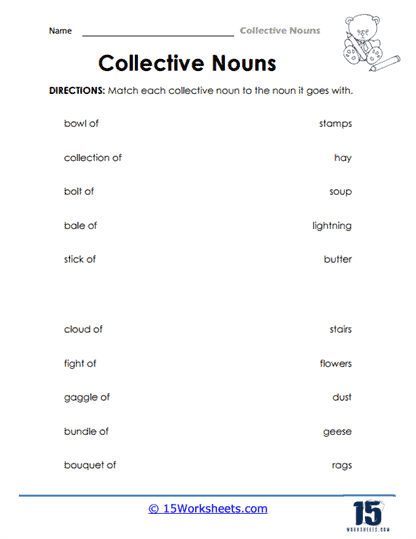
Pairing Perfection
Students draw lines to pair collective nouns with the right group they describe. It’s a matching game with a grammar twist. The activity makes abstract words more visual and memorable. It’s quick, fun, and reinforces learning in a lighthearted way.
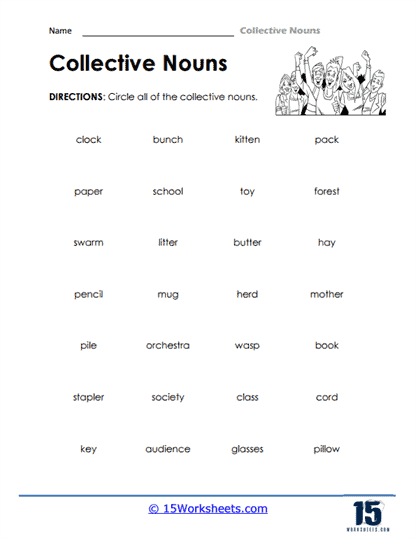
Spot the Collectives
This worksheet challenges kids to find collective nouns hidden inside sentences or short passages. It’s a grammar scavenger hunt in reading form. The exercise strengthens both comprehension and vocabulary. Students walk away more confident in spotting collective nouns in everyday text.
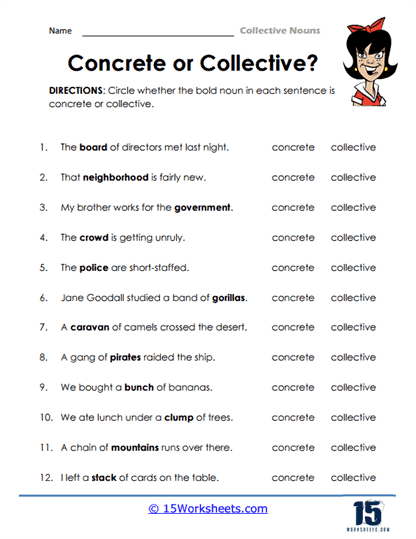
Classification Challenge
In this task, learners classify nouns into groups, sorting out collective nouns from other types. It’s a sorting game that doubles as a critical-thinking exercise. Students practice making distinctions and organizing information clearly. This worksheet builds a deeper grasp of grammar categories.
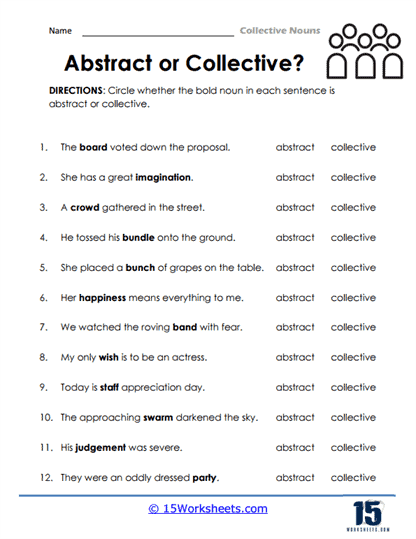
Abstract Vs. Collective
This worksheet compares abstract nouns with collective ones. Students get to contrast words like “happiness” and “team,” learning how they function differently. The activity develops awareness of subtle grammar differences. It’s perfect for learners ready to go beyond the basics.
Matching Animal Group Terms
Kids match animal names with their special group terms, like “a gaggle of geese” or “a pride of lions.” The activity feels almost like a trivia game. It builds vocabulary while sparking curiosity about animals. This one makes grammar knowledge both fun and memorable.
Word Swap
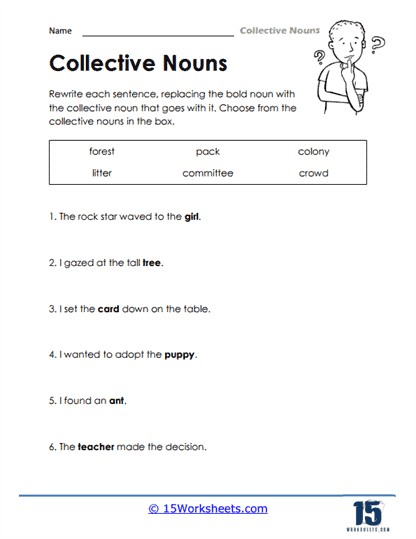
Here, students swap out plain words for collective nouns to make sentences richer. It’s a creative twist that encourages kids to experiment with vocabulary. The worksheet pushes them to improve word choice in writing. By the end, learners gain confidence using collective nouns naturally.
What are Collective Nouns?
A collective noun is a special type of noun that refers to a group of people, animals, or things considered as one whole. Even though the group is made up of multiple individuals, the noun itself is treated as a single unit.
Think of it this way: instead of naming each individual person or object, a collective noun gives us a convenient way to talk about the group as a whole. For example:
– “Team” refers to a group of players.
– “Herd” refers to a group of animals like cows or deer.
– “Family” refers to a group of related people.
– “Audience” refers to people watching a performance.
– “Committee” refers to a group formed for decision-making.
These nouns help us simplify language by grouping individuals under one term. So instead of saying “the players on the basketball court,” we can simply say “the team.”
Singular in Form, Plural in Meaning
Even though collective nouns refer to multiple people or items, they are usually treated as singular in grammar. This means they are often followed by a singular verb:
– “The committee decides on the new policy.”
– “The audience was impressed by the performance.”
In these examples, we’re focusing on the group as one single entity acting together. That’s why we use a singular verb like “was” or “decides.”
However, there are cases-especially in British English-where collective nouns can take plural verbs, particularly when the focus is on the individuals within the group rather than the group as a unit:
🇬🇧 “The team are wearing their new uniforms.”
🇺🇸 “The team is wearing its new uniform.”
Plural Forms of Collective Nouns
Some collective nouns can also be made plural when referring to more than one group:
– One team, two teams
– One family, several families
– A committee, many committees
Even in their plural forms, these words still refer to groups. For example, “families” doesn’t describe individual people-it describes several groups of related individuals.