
Reducing Fractions Worksheets

About These 15 Worksheets
Fractions can feel messy, especially when they’re not in simplest form-but simplifying them is like cleaning off a window so everything becomes clearer. These worksheets guide students in “reducing” a fraction by dividing the numerator and denominator by their greatest common factor (GCF) until they can’t go smaller. Learners move from basic drills to mixed numbers, then to puzzles and visual challenges, building both confidence and flexibility.
What stands out is how these worksheets mix the ordinary and the playful. Some are no-nonsense exercises to practice division, while others wrap that work into scenes-like secret codes or shading shapes. That variety keeps students engaged and helps them see fraction reduction as more than mechanics-it’s a tool for decoding, representing, and thinking in new ways.
Even beyond math class, fraction reduction shows up in life-like adjusting a recipe, cutting materials evenly, or understanding measurements. These worksheets help students make the leap from “just a math rule” to “useful everyday method.” By the end, simplifying fractions stops feeling like a chore and becomes something students can do with ease-and even a bit of pride.
Have a Look Inside Each Worksheet
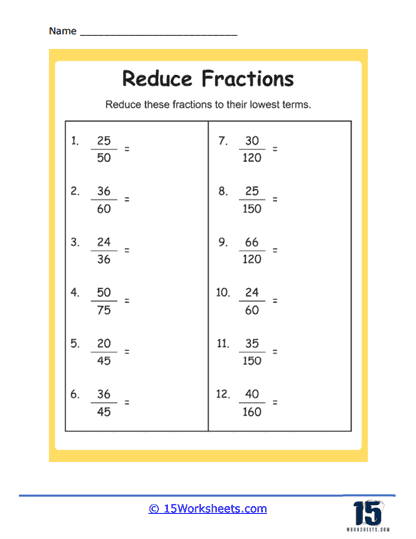
Reduce the Fractions
Students practice rewriting a set of proper fractions in lowest terms. Problems are clean and direct, so kids can focus on spotting common factors and dividing. It’s great fluency work with immediate wins on every line. Perfect for building automaticity with simplification.
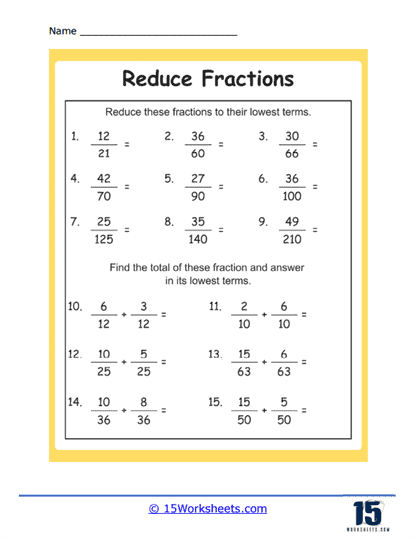
Lowest Terms
Learners reduce a fresh batch of fractions, then apply the idea in a quick “compute-then-simplify” section. That double pass helps them see simplification as a finishing step, not a separate chore. It builds confidence using factors after basic operations. A tidy tune‑up for fraction sense.
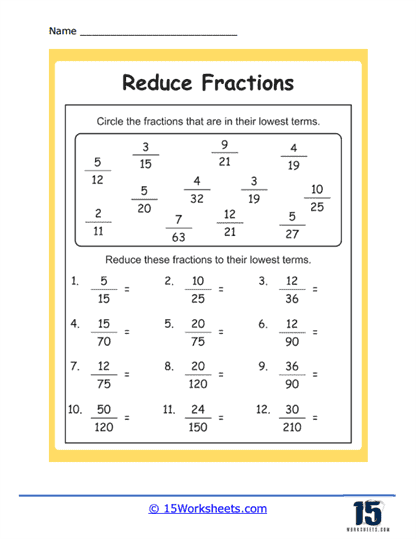
Circle the Lowest
This one starts by asking students to identify which fractions are already in simplest form. Then they reduce a second set to prove they can get any fraction there themselves. The two‑part format reinforces recognition and execution in one page. It’s a gentle checkup plus targeted practice.
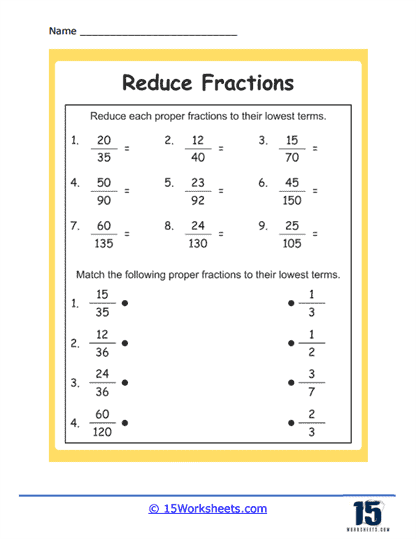
Simplifying Fractions
Kids reduce proper fractions and then match each to its simplest equivalent. The matching adds a visual, puzzle‑like feel that keeps attention high. Students must reason about equivalence, not just compute. It’s a nice bridge from mechanical steps to conceptual understanding.
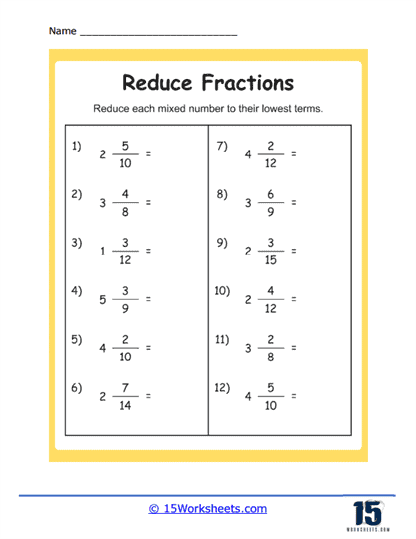
Reduce Mixed Numbers
Students simplify the fractional parts of mixed numbers to lowest terms. They practice keeping the whole number steady while reducing the numerator and denominator. That reinforces structure and place of each piece in a mixed number. It’s focused work that pays off in later operations.
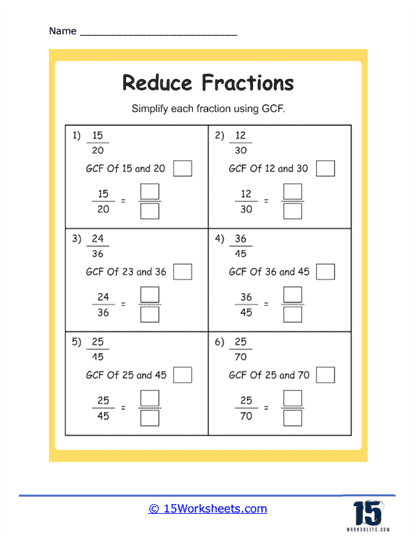
Using GCF
Each problem prompts learners to find the GCF first and then reduce the fraction. The layout nudges them to think before dividing, strengthening factor skills. Writing the GCF makes the reasoning visible. Great for students who benefit from structured, step‑by‑step scaffolds.
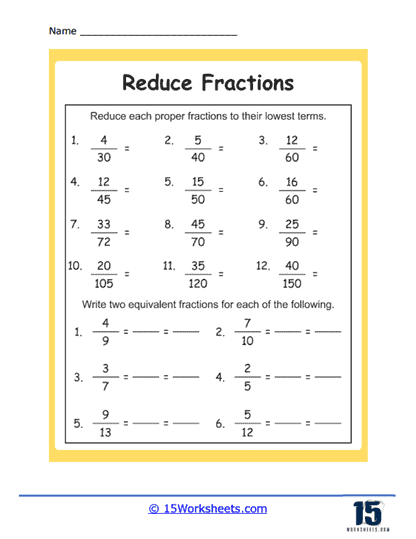
2 Equivalent Fractions
After reducing a set of fractions, students generate two different equivalents for each target. That “scale up/down” thinking deepens their feel for proportional relationships. It’s creative, yet disciplined, number play. By the end, equivalent fractions feel natural, not mysterious.
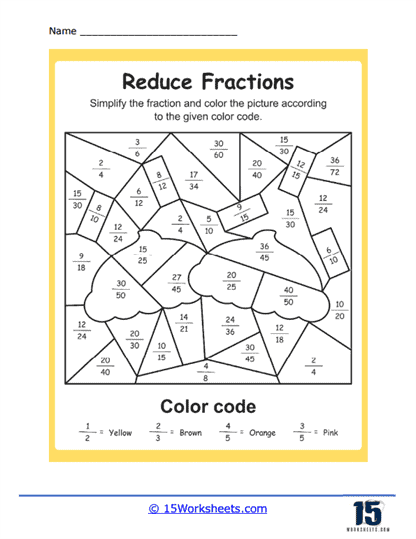
Color Code Puzzle
Learners simplify each fraction and then color regions using a key tied to the simplified value. It’s part math, part mystery picture. Immediate feedback pops as the image appears correctly only with correct reductions. A high‑engagement way to make practice stick.
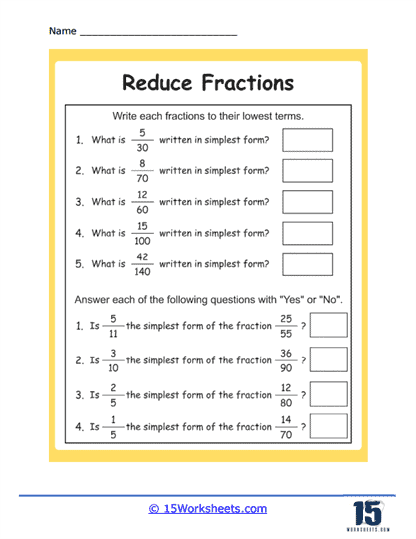
Simplest Form
Students write given fractions in simplest form, then answer yes/no questions about whether certain forms are already reduced. That second section tests discernment, not just computation. It strengthens fraction vocabulary like “simplest,” “lowest,” and “equivalent.” Quick, varied reps keep momentum up.
Reducing Dot Fractions
Kids count familiar icons (dots, hearts, stars, birds, and more) to form a fraction, then reduce it. The concrete visuals connect “parts of a set” to numeric form. It’s perfect for learners who need to see the quantity before they simplify. Concept and procedure meet in one activity.
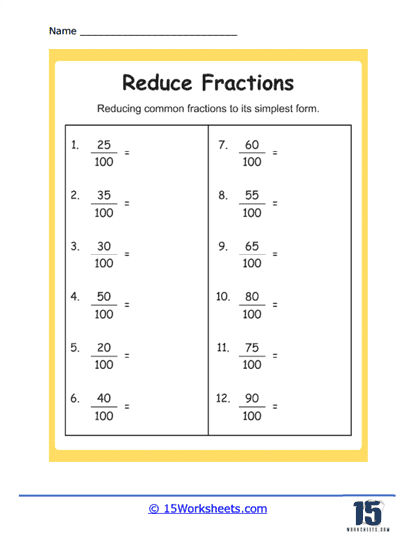
Reducing Common Fractions
All denominators are the same (like 100), so students can focus on numerator‑denominator relationships and common factors. The uniform base makes patterns pop. It’s a friendly way to see why multiples of 10 and 25 reduce so cleanly. Excellent for confidence building.
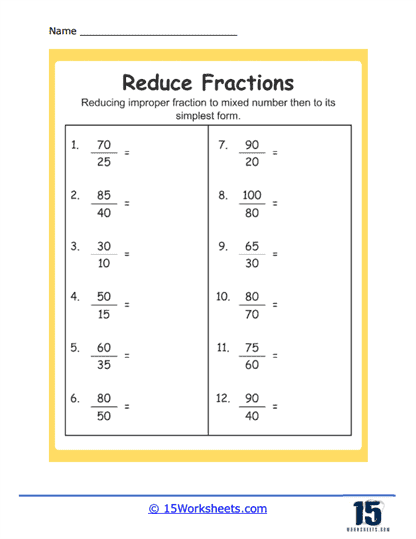
Reducing Improper Fractions
Learners convert improper fractions to mixed numbers and reduce to simplest form. That two‑step routine clarifies when to convert and when to simplify. It’s practical prep for every fraction unit that follows. Repetition here builds smooth, automatic transitions.
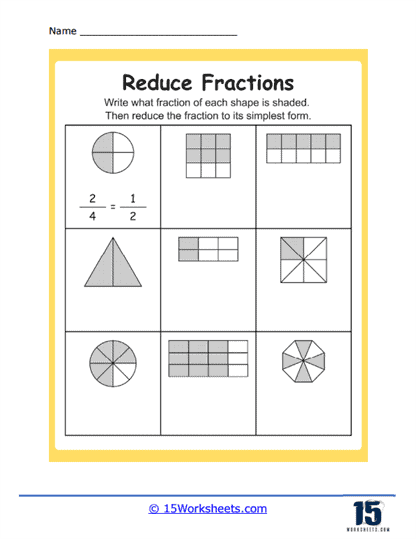
Simplifying Fractional Images
Students identify the fraction represented by shaded models, then reduce it. Visual models make equivalence and “same amount, different names” crystal clear. It’s an ideal checkpoint for conceptual understanding. Kids literally see why simplifying works.
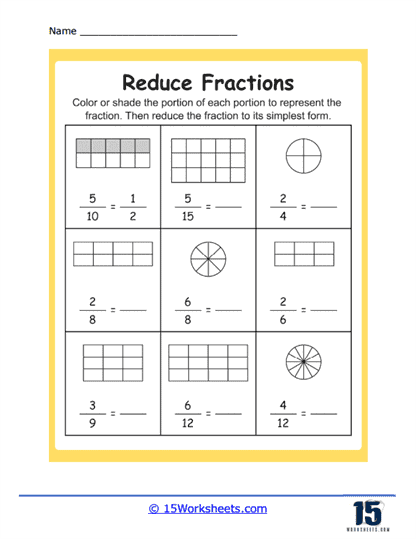
Reduce and Shade
First, learners shade or color to represent a given fraction; then they reduce it to simplest form. Producing the picture forces careful counting and fraction formation. Finishing with simplification ties representation to procedure. It’s hands‑on, calm, and surprisingly satisfying.
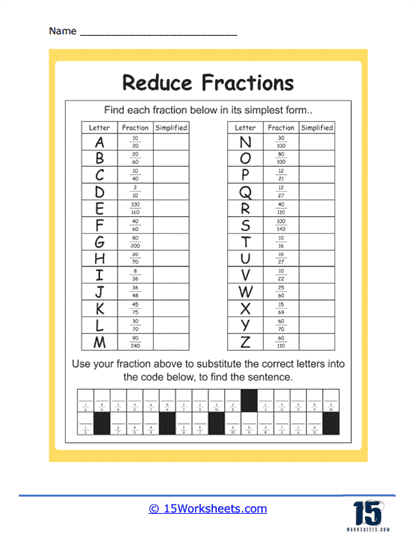
Simplifying Fractions Cryptogram
Each correct simplification reveals a letter, and the letters decode a hidden message. The built‑in self‑check keeps students motivated to get every reduction right. It turns routine practice into a mini‑mission. A fun closer that still delivers serious skill building.
How Do You Reduce a Fraction?
Reducing a fraction means reducing it to its simplest form, where the numerator (the number on top) and the denominator (the number at the bottom) have no common factors except 1.
To simplify a fraction, follow these steps:
Step #1- Find the Greatest Common Divisor (GCD), also known as the Greatest Common Factor (GCF), of the numerator and the denominator. This is the largest number that can evenly divide both the numerator and the denominator.
Step #2 – Divide both the numerator and the denominator by their GCD. The fraction you get as a result is the simplified form.
Here are three examples to help you understand this better:
Example 1 – Reduce 8/12
Step #1 – First, find the GCD of 8 and 12. The factors of 8 are 1, 2, 4, and 8, and the factors of 12 are 1, 2, 3, 4, 6, and 12. The greatest number that appears in both lists is 4, so the GCD is 4.
Step #2 – Divide both the numerator and the denominator by 4. Doing this gives you 8 ÷ 4 / 12 ÷ 4 = 2/3.
So, the simplified form of 8/12 is 2/3.
Example 2 – Reduce 15/25
Step #1 – The GCD of 15 and 25 is 5 (since both 15 and 25 can be divided evenly by 5).
Step #2 – Divide both the numerator and the denominator by 5 – 15 ÷ 5 / 25 ÷ 5 = 3/5.
So, the simplified form of 15/25 is 3/5.
Example 3 – Simplify 18/27
Step #1 – The GCD of 18 and 27 is 9 (since both 18 and 27 can be divided evenly by 9).
Step #2 – Divide both the numerator and the denominator by 9 – 18 ÷ 9 / 27 ÷ 9 = 2/3.
So, the simplified form of 18/27 is 2/3.
When Do You Reduce Fractions in Real Life?
Reducing fractions is something you might do without even thinking about it, especially when you’re trying to make everyday tasks quicker and easier.
For example, you’re cooking and the recipe asks for 4/6 of a cup of milk, but your measuring cup only shows 1/3, 1/2, and 1 cup. If you simplify 4/6 to 2/3, it suddenly fits what you have-and you save time and avoid a math headache.
Another time it comes up is when you’re helping kids with homework. If a worksheet asks them to color 8/12 of a shape, and you help them see that it’s the same as 2/3, you’re using the skill in a helpful and practical way.
Maybe you’re doing a little home improvement-measuring wood or fabric. If your board is 9/12 feet long, and you simplify that to 3/4, it’s easier to compare sizes or cut things evenly.
Even something as simple as splitting snacks can use this skill. Say you have 10 cookies and want to give 5/10 to one person and the rest to another. 5/10 simplifies to 1/2, so you know right away that you’re giving an equal share.
Simplifying fractions isn’t just a math trick-it’s a way to make everyday life just a little bit smoother.