
Multiplying Fractions Worksheets
All About These 15 Worksheets
Multiplying fractions can feel intimidating at first, but these worksheets turn the process into something approachable, engaging, and even fun. Instead of staring at dry numbers, kids get to solve puzzles, reveal hidden messages, and explore colorful models. Each worksheet is carefully designed to build confidence step by step, from multiplying simple unit fractions to applying those skills in real-world word problems. The variety makes practice feel fresh while ensuring repetition where it matters most.
This collection helps students understand not just how to multiply fractions but also why the rules work. Visuals like area models and fraction bars help learners see multiplication as combining parts of wholes, while word problems show how fractions matter in daily life-like doubling recipes or splitting supplies. Secret codes, puzzles, and themed activities add just enough playfulness to keep kids engaged. It’s math practice that feels more like an adventure than a chore.
What makes these worksheets especially useful is their balance of rigor and creativity. Straightforward drills provide essential practice with accuracy, while games and puzzles keep the energy positive. Together, they prepare learners for higher-level math by ensuring fraction multiplication feels natural and familiar. With this set, students not only gain fluency but also build the confidence to say, “I can do fractions!”
Have a Look Inside Each Worksheet
Secret Multiplying Fractions
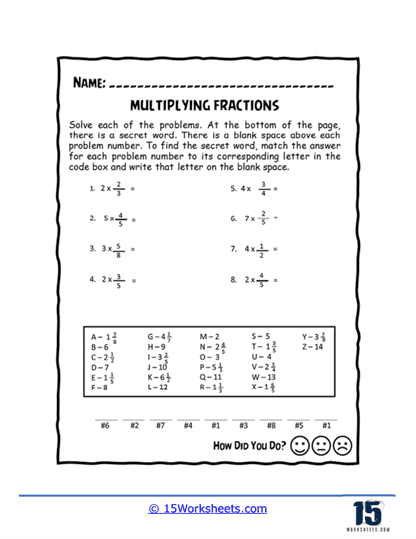
Students solve fraction multiplication problems to decode a hidden word from a letter-and-answer key. It’s like turning math into a spy mission with answers as secret codes. This keeps learners curious and motivated while they practice computation. It blends accuracy with a playful reveal-perfect for engagement and fluency.
What’s the Message
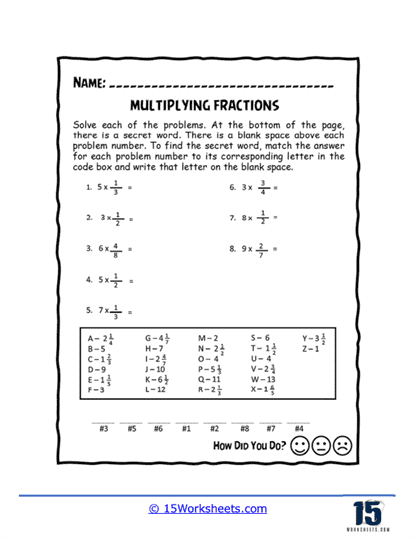
Learners multiply fractions and then match their answers to letters that spell out a secret message. It’s like math meets mystery storytelling. This reinforces both computation and decoding skills. It’s a delightful way to practice fractions that turns problem-solving into a reward.
Heart Puzzle
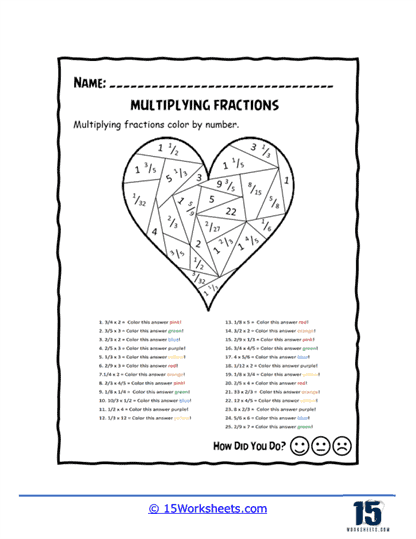
Students multiply fractions and use their answers to complete a heart-shaped puzzle. It’s math with a creative twist that turns calculations into art. They sharpen their skills while putting pieces together visually. This helps link fraction work with spatial logic and fun.
Arrow Multiplication
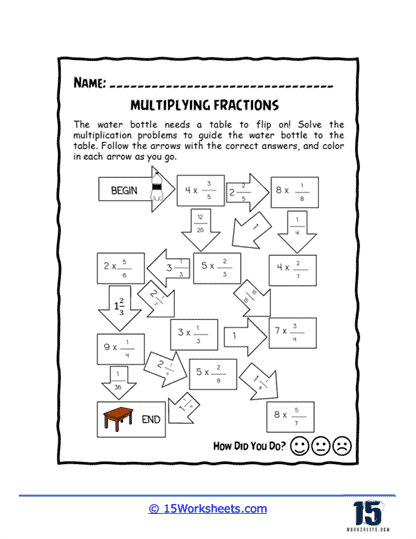
Kids follow a trail of fraction multiplication problems, using arrows to chart their route. It’s a journey-like format that adds adventure to practice. They solve problems step-by-step while navigating the path. It makes mastering fraction multiplication feel like exploring a map.
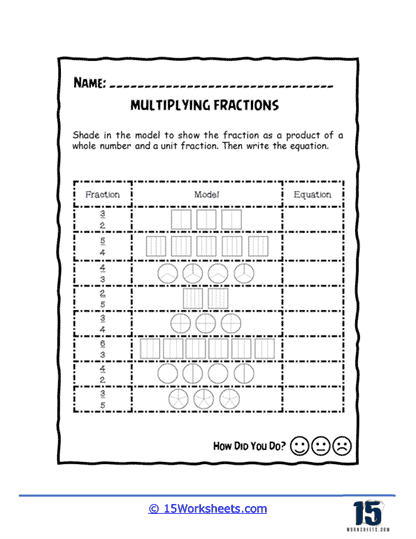
Models to Equations
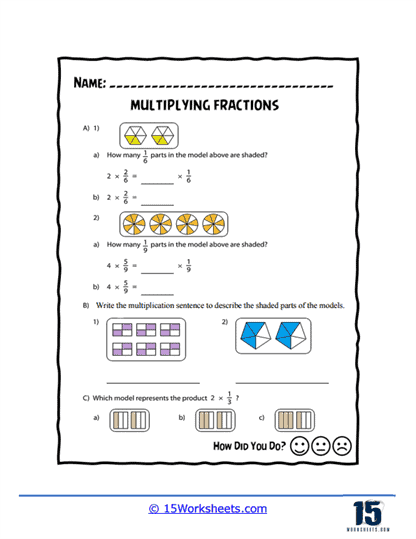
This worksheet shows visual fraction models (like bars or shapes) and asks students to write the corresponding multiplication equation. It connects visual understanding to symbolic math. Students bridge concrete reasoning with abstract representation. It solidifies their grasp of fraction concepts in two complementary ways.
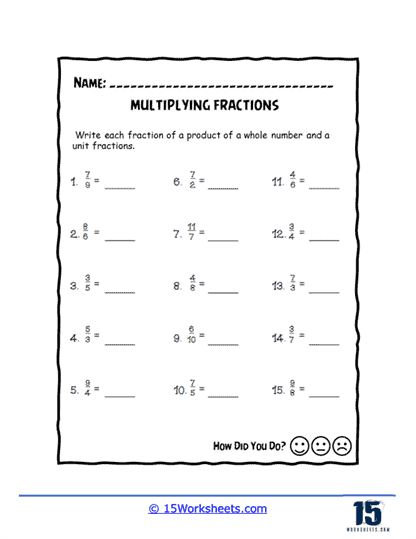
Unit Fractions
Learners multiply unit fractions (fractions with numerator 1) by other fractions. It highlights patterns that help simplify bigger problems. They develop fluency with a foundational building block of fractions. This focused practice builds intuitive number sense.
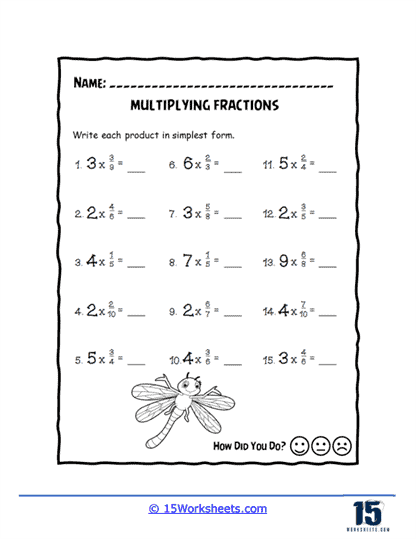
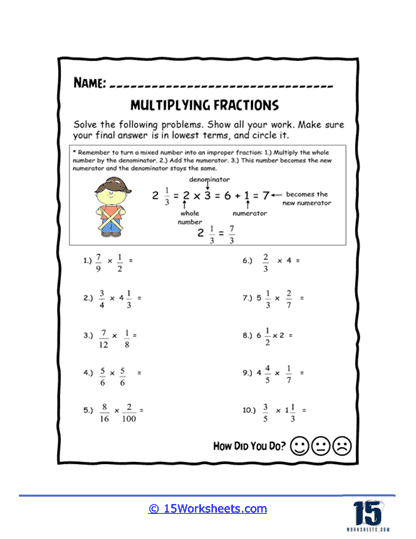
Whole Numbers and Fractions
Students multiply whole numbers by fractions, such as computing 3 × 2/5. It ties math to real-world contexts like doubling recipes. They practice adjusting parts of wholes in meaningful ways. Multiplying across types of numbers makes fraction use feel applicable and clear.
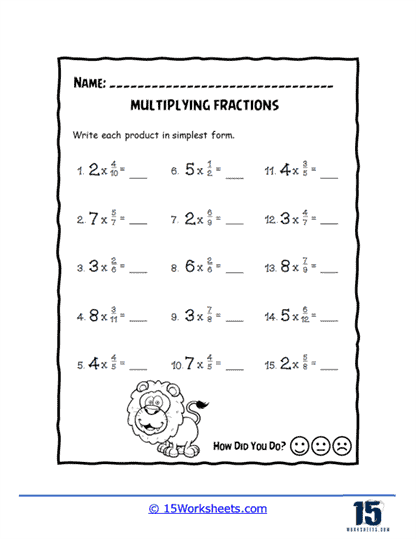
Whole Numbers Part 2
This continues practice multiplying fractions by whole numbers, possibly with more complex examples or mixed forms. It adds depth and repetition in an approachable format. Learners consolidate their understanding through variation. Consistency strengthens confidence and skill.
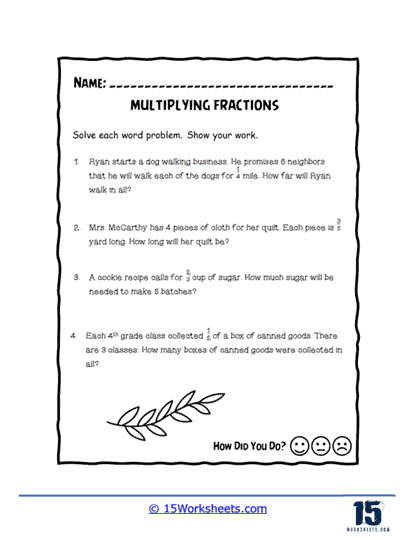
Multiplying Fractions Word Problems
Students apply fraction multiplication in story-based scenarios, like splitting ingredients or sharing. The context helps them interpret problems before calculating. It reinforces translation of real-life situations into math operations. Applying skills in context boosts comprehension and retention.
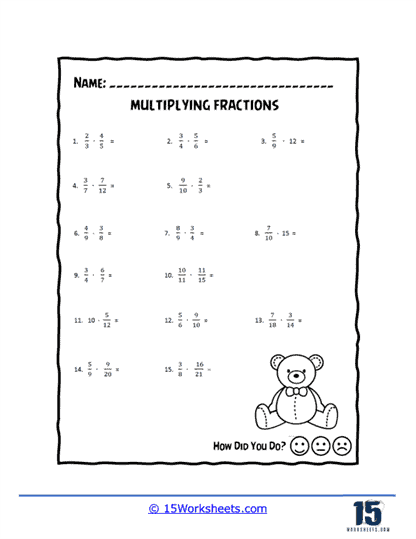
Multiply Fractions
A straightforward page of fraction multiplication problems, these worksheets offer targeted repetition. They’re the core workout: practice multiplying numerators and denominators. The structured tasks build speed and accuracy. Foundational drills support deeper understanding.
Different Denominators
Here, students multiply fractions that don’t share common denominators, sometimes requiring simplification at the end. It introduces extra thinking beyond basic multiplication. They learn to simplify while still applying multiplication rules. This strengthens both procedural sense and fluency with simplifying.
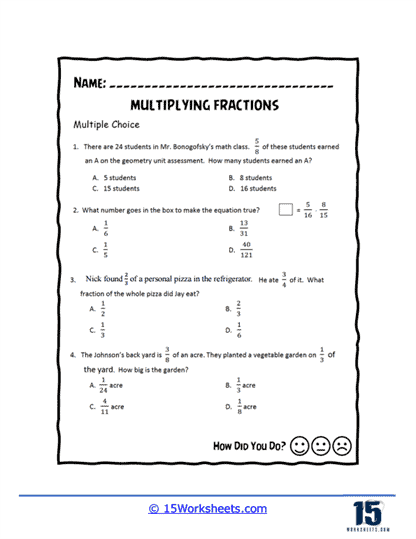
Multiple Choice Questions
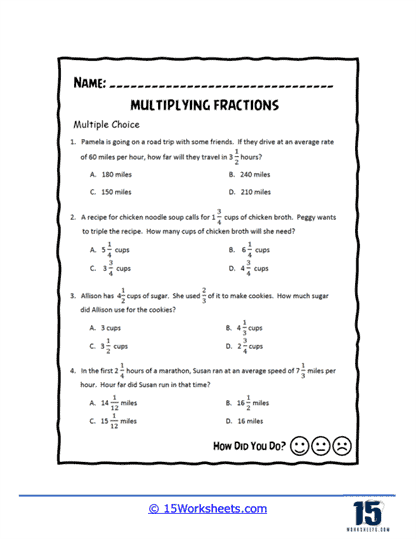
This sheet presents multiplication problems followed by several answer choices. It encourages quick decision making and error-checking through options. It’s a low-pressure way to test calculation and elimination skills. Choosing from answers builds both speed and confidence.
Mixed Multiple Choice
Learners solve multiplication problems that include whole numbers, mixed numbers, or mixed denominators and select answers from choices. It raises the bar with variety and challenges. They apply a range of fraction rules in one go. This holistic approach builds flexible problem-solving.
Fill In the Blanks
Students complete equations by writing in the missing fraction or product. It’s a recall-based activity more active than multiple choice. They reinforce computation skills by reconstructing answers. It boosts understanding of fraction equivalence and placement.
Area Model Multiplication
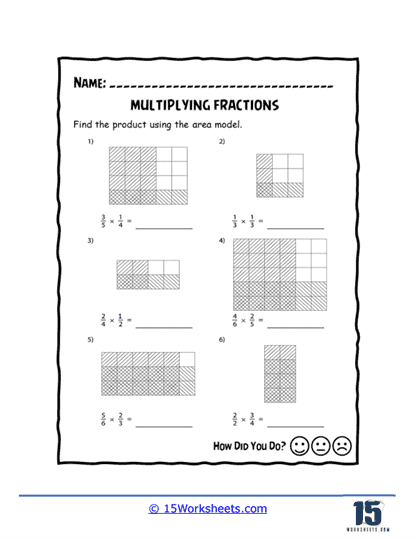
This worksheet shows area models (like grids) where students find the product by shading or measuring regions. It visualizes multiplication as combining parts of a rectangle. Learners see the math come alive in shape form. It links abstract numbers to clear geometric concept, reinforcing fraction understanding visually.
How to Multiply Fractions
Multiplying fractions may seem intimidating at first, but with the right approach, it can be a straightforward process. Here’s a step-by-step process on how to multiply fractions that teachers can guide their students through:
Step 1: Simplify the fractions.
If either of the fractions can be simplified, do so before multiplying. To simplify a fraction, divide both the numerator and the denominator by their greatest common factor. For example, 6/8 can be simplified to 3/4 by dividing both the numerator and the denominator by 2.
Step 2: Multiply the numerators.
Next, multiply the numerators of the two fractions together. This gives you the numerator of the result fraction. For example, to multiply 2/3 and 3/5, you would multiply the numerators 2 and 3 to get 6.
Step 3: Multiply the denominators.
Then, multiply the denominators of the two fractions together. This gives you the denominator of the result fraction. For example, to multiply 2/3 and 3/5, you would multiply the denominators 3 and 5 to get 15.
Step 4: Simplify the answer.
Finally, simplify the resulting fraction, if possible, by dividing both the numerator and denominator by their greatest common factor. For example, the product of 2/3 and 3/5 is 6/15, which can be simplified to 2/5 by dividing both the numerator and denominator by 3.
Remember that if you’re multiplying mixed numbers, you’ll need to convert them to improper fractions first before following the above steps. With practice, you’ll be able to multiply fractions quickly and accurately.