
Synthesis Worksheets
All About These 15 Worksheets
Synthesis writing sounds fancy, but really, it’s just the skill of taking information from different places and blending it into something meaningful. These worksheets guide students step by step so the task doesn’t feel overwhelming-starting from jotting down thoughts before reading, to comparing what authors say, and finally to pulling everything together in a structured essay. They’re designed to keep the process manageable and approachable, so even hesitant writers can see their progress.
By working through the collection, students learn not only how to organize ideas but also how to think critically about what they read. They get practice noticing how sources agree, disagree, or expand on each other, and they learn how to express that clearly in writing. It’s like having a coach whispering, “Okay, now connect that idea to this one,” at each step of the way. The end result? Essays that are stronger, clearer, and way more convincing.
Another perk of this collection is that it makes synthesis feel real and relevant. Whether students are reading nonfiction, analyzing literature, or diving into social topics like social media, the worksheets show them that connecting ideas is something people do every day. They’ll begin to see synthesis not as a dry school assignment, but as a life skill-whether they’re comparing reviews before buying a phone, weighing arguments in the news, or pulling evidence for a class debate.
Have a Look Inside Each Worksheet
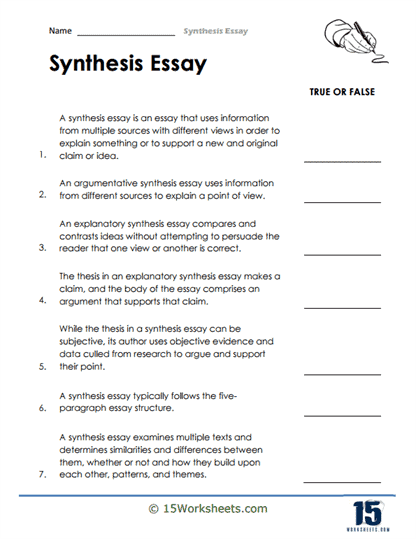
True Or False
Students read seven statements about synthesis essays and mark each one as true or false. Then they correct any misconceptions, which sharpens their grasp of core concepts. It’s a quick confidence builder and a great pre-assessment. Getting the basics straight helps them write stronger synthesis essays later.
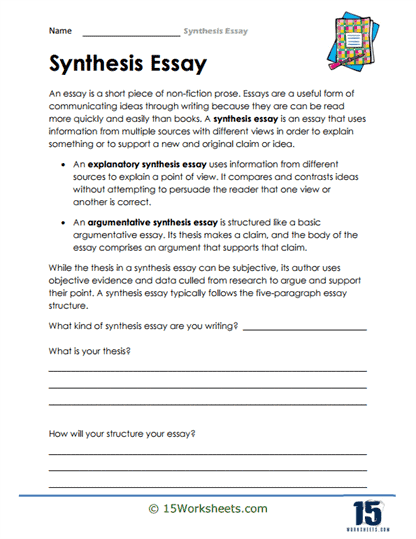
Explanatory And Argumentative
This worksheet introduces the two major types of synthesis essays and asks students to decide which one fits their purpose. They identify their thesis and sketch how they’ll structure support. The prompts keep the focus on audience, purpose, and tone. That choice-making muscle is essential for planning a clear, effective synthesis.
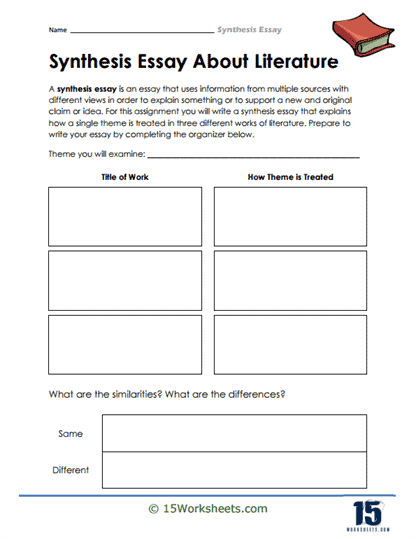
Same And Different
Learners compare how a single theme is treated across three literary works. They record titles, notes on treatment, and then list what’s the same and what’s different. The layout walks them straight into compare/contrast thinking. That side-by-side analysis fuels nuanced synthesis in literature-based essays.
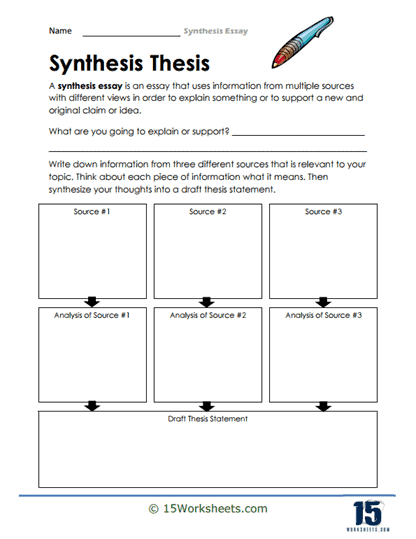
Multiple Sources
Students gather ideas from three sources, analyze each one, and draft a thesis statement at the bottom. The organizer separates evidence from interpretation so they don’t mix summary with analysis. It’s perfect for practicing how to “weave” sources, not stack them. By the end, they’ve built a thesis that emerges from the sources-not in spite of them.
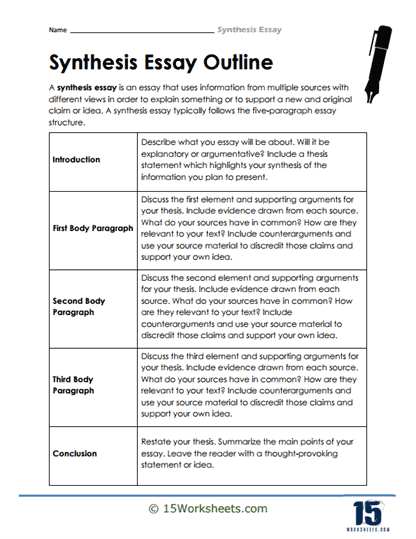
Five-Paragraph Structure
This outline spells out what belongs in each paragraph of a classic synthesis essay-intro, three body paragraphs, and conclusion. Prompts remind students to include counterclaims and to connect evidence back to their thesis. It’s a clear roadmap that reduces decision overload. When learners can see the structure, they can focus on substance.
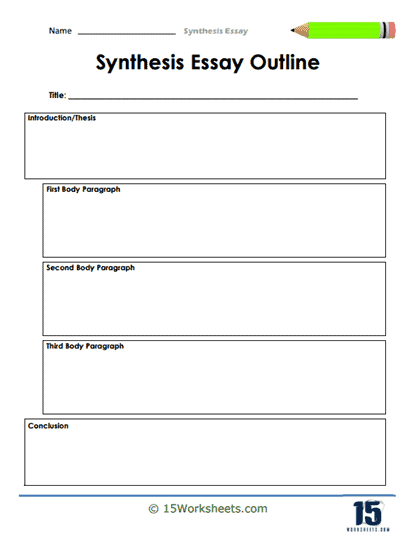
A Visual Framework
Here’s a clean, box-style organizer with big spaces for each section of the essay. Visual thinkers will love how easy it is to park ideas where they belong. It keeps evidence and reasoning tidy as drafts take shape. A neat plan translates into a smoother, more coherent synthesis essay.
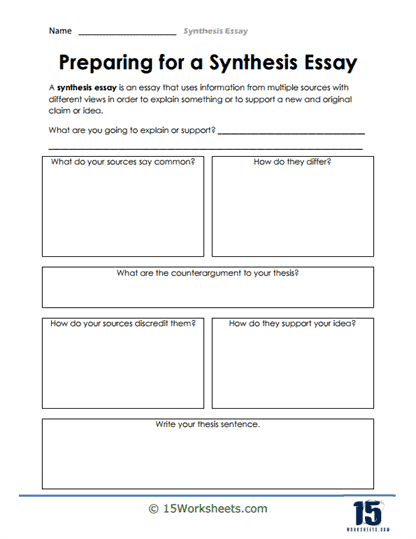
Preliminary Steps
Before drafting, students note what sources have in common, where they differ, and what counterarguments to expect. They also plan how to rebut those counterarguments and craft a working thesis. It’s a gentle push to think strategically, not just descriptively. These habits make later revisions faster and more focused.
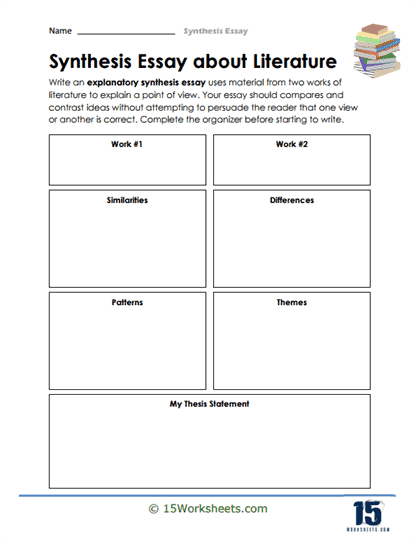
Explaining POVs
This organizer focuses on reading multiple texts to explain how different authors treat a topic. Students chart similarities, differences, patterns, and themes between works. The emphasis is on fair, balanced presentation of viewpoints. That practice strengthens explanatory synthesis and sets up respectful argument later.
Persuasive Arguments
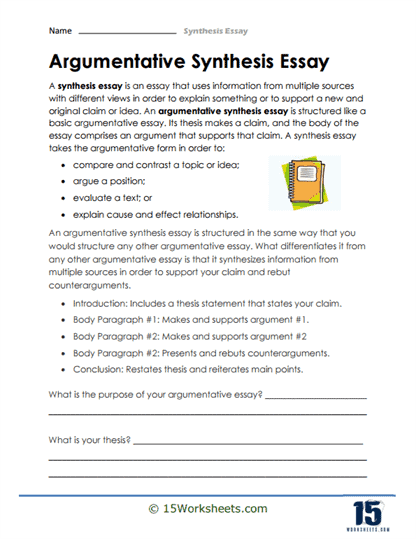
Students plan an argumentative synthesis essay by articulating a claim, mapping support, and anticipating rebuttals. The page reviews why a synthesis can take a persuasive form and how to structure it. Clear prompts keep the reasoning tight and evidence-driven. It’s great rehearsal for high-stakes writing tasks.
Explaining A Topic
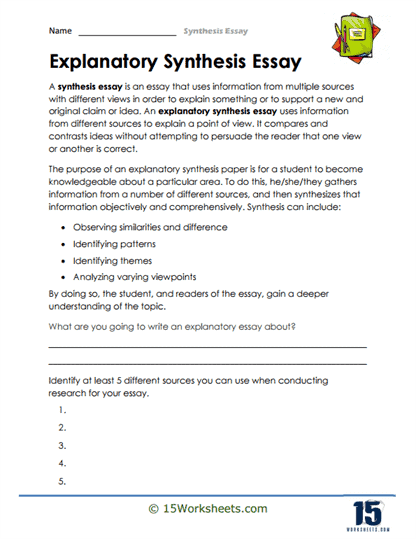
This sheet frames the explanatory synthesis: gather varied sources, look for patterns, and explain a point of view without “picking a side.” Students list at least five sources to consult. The focus is depth, clarity, and completeness. It’s ideal when the goal is understanding, not debating.
An Array Of Topics
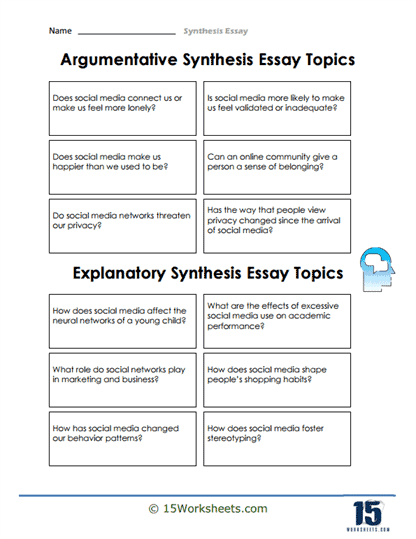
Need a topic? This page serves up argument and explanation prompts (many centered on social media) to spark ideas. Students pick one that intrigues them and consider what sources they’d need. Built-in variety makes it easy to differentiate and engage a whole class.
Literature Review
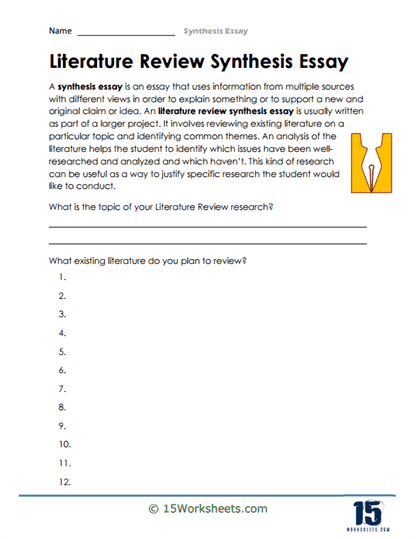
Learners plan a literature review-style synthesis by listing existing works to read and the big question they’ll investigate. The setup nudges them to find themes across the research. It’s a realistic taste of academic writing and scholarly voice. Students see how synthesis underpins serious inquiry.
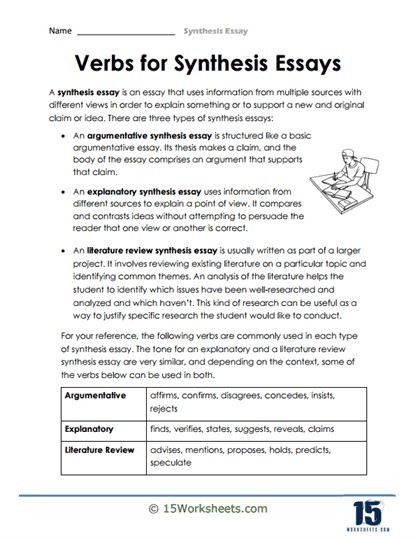
Commonly Used Verbs
This printable spotlights precise reporting verbs students can use when discussing sources (think: argues, illustrates, contends, refutes). Strong verbs keep summaries accurate and analysis sharp. It helps writers avoid vague phrasing like “talks about.” Better verbs = clearer synthesis and more credible tone.
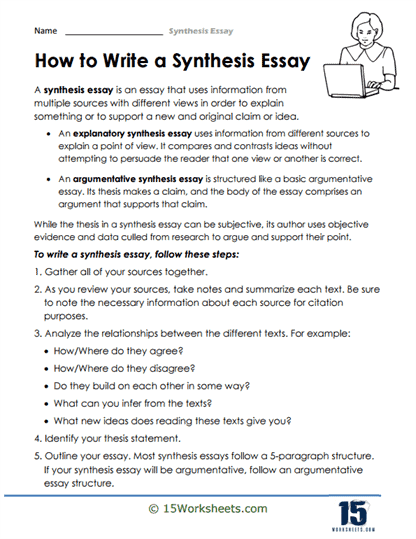
Step-by-Step Instructions
A friendly checklist walks writers from gathering sources to outlining, with reminders to analyze relationships among texts. The steps model how to move from notes to a defensible thesis. It’s the “do this next” guide nervous writers crave. Follow it once and the process sticks.
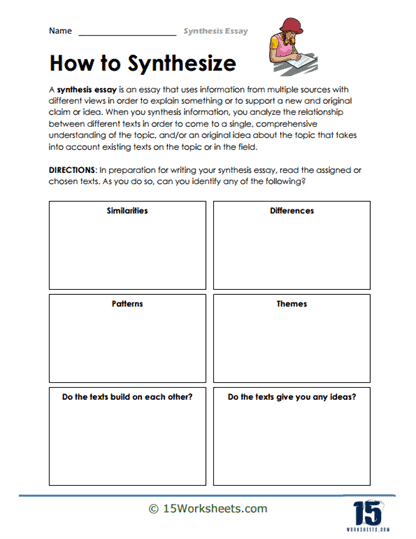
How To Synthesize
Students explicitly practice identifying similarities, differences, patterns, and themes across texts. Extra prompts ask whether texts build on each other or spur new ideas. It’s synthesis demystified: compare, connect, conclude. Those moves become the backbone of their essays.
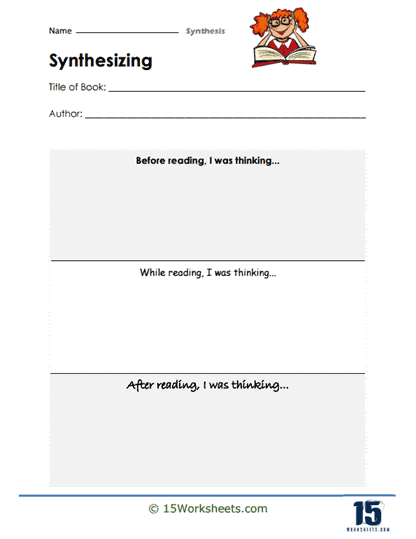
Before, While, After
Readers jot what they think before reading, capture thoughts during, and reflect after they finish. The simple sequence makes metacognition visible. It’s fantastic for showing how understanding evolves with evidence. That “thought growth” is exactly what synthesis writing asks for.
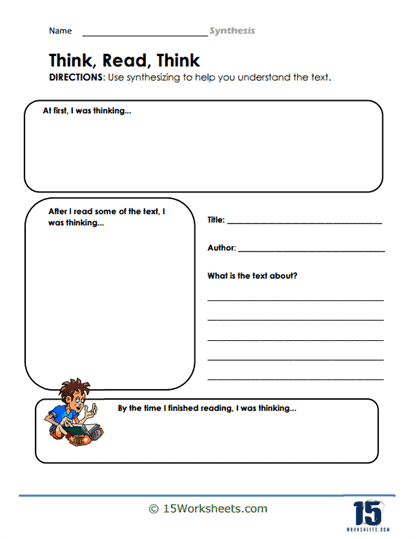
Think, Read, Think
This organizer captures initial ideas, mid-read adjustments, and end-of-read conclusions. A sidebar collects title, author, and gist to anchor the notes. Students see how new information reshapes prior beliefs. It’s a quick path from “first take” to text-informed stance.
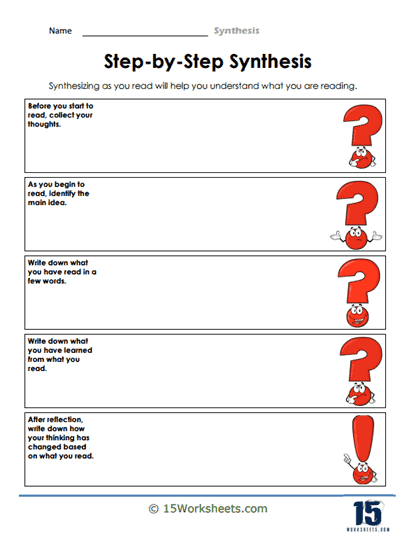
As You Read
Five friendly panels coach readers to gather main ideas, restate in a few words, note learning, and reflect on changed thinking. It’s guided practice in summarizing and sense-making. Kids are nudged to move beyond “what happened” into “what it means.” Those analytical nudges carry straight into synthesis paragraphs.
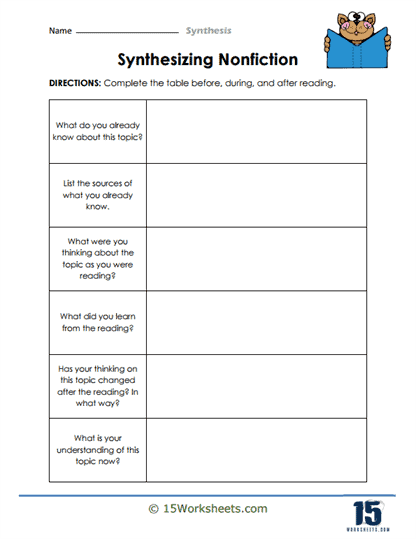
Nonfiction Texts
Students chart what they knew going in, track thinking during reading, and log what changed after. There’s a space to list where their prior knowledge came from, too. That transparency about sources boosts information literacy. It’s perfect for content-area texts and informational articles.
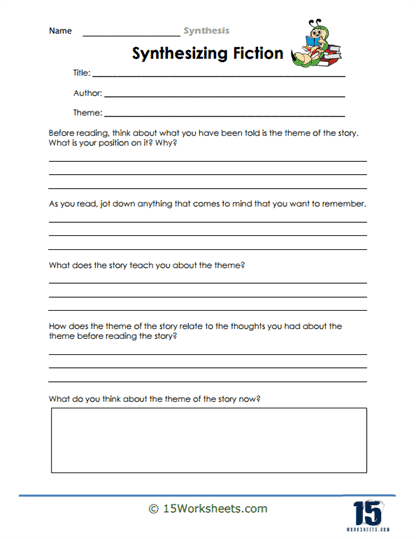
Studying Fiction
With title/author/theme up top, readers reflect before, during, and after to reconsider the theme. Prompts ask what the story taught them and how new insights connect to initial ideas. It builds stamina for theme analysis with evidence. Those reflections translate directly into literary synthesis paragraphs.
Beginning To Now
Students narrate how their thinking shifts from the start of a text to the end. Panels invite “First I thought… Now I’m starting to think… Here’s what I think now.” The structure encourages honest revision of ideas as evidence accumulates. That flexibility is a hallmark of good synthesis.
Making Notes
Lines and prompts (“I think this story is about… Now I wonder…”) guide purposeful, text-tied note-taking. Curiosity is built in, encouraging students to ask better questions as they read. It’s low-friction and reusable across genres. The habit of wonder leads to richer connections among texts.
Processing New Info
This page frames note-taking into three big moments: before reading (background knowledge), during reading (active thinking), and after reading (updated understanding). Students literally see learning happen. It’s great evidence for conferences and reflections. And it gives writers raw material for explanation and argument.
Summarize And Analyze
Students condense key points and then push past summary into analysis of what those points mean. The layout encourages the “so what?” after each chunk of information. It’s a bridge from comprehension to interpretation. That shift is exactly what elevates a synthesis from report to essay.
Thought Bubbles
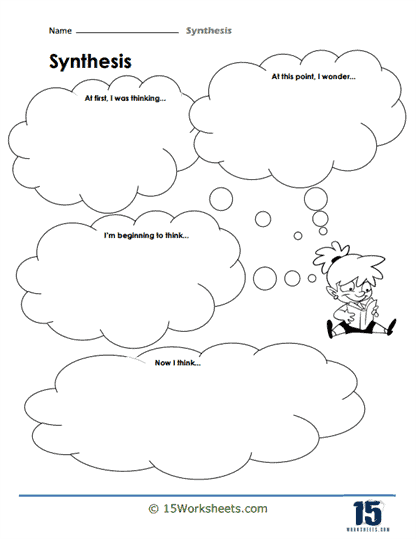
Giant thought clouds prompt students to record first thoughts, questions, evolving ideas, and final takeaways. The playful design keeps cognitive work light and visible. Teachers get a quick read on where thinking is headed. It’s a fun way to rehearse the inner monologue writers should show in synthesis.
Knowing And Thinking
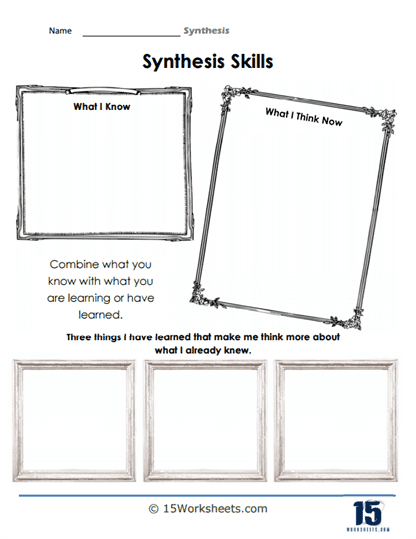
Two picture frames-“What I Know” and “What I Think Now”-anchor a short reflection on how learning changed prior knowledge. A trio of boxes asks for three new insights that challenged or deepened understanding. It normalizes growth and revision. Those metacognitive moves pay off when students integrate sources.
Articulate Your Thoughts
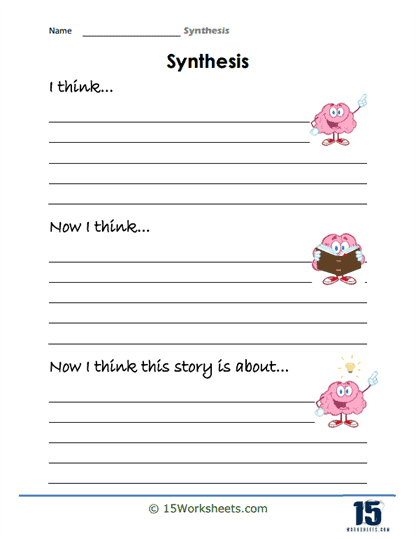
Sentence starters (“I think… Now I think… Now I think this story is about…”) help hesitant writers put change in thinking into words. The progression spotlights evidence-driven shifts. It’s simple, reflective, and highly reusable. The result is clearer, more defensible claims in synthesis writing.
First, Then, Now
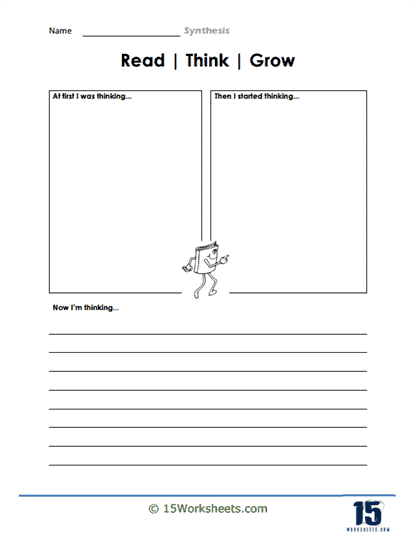
Panels labeled for the beginning, middle, and end of reading show how conclusions evolve. Students move from initial hunch to evidence-based stance. The long response line at the bottom supports fuller reflection. It’s perfect for exit tickets that feed tomorrow’s drafting.
What It Means To You
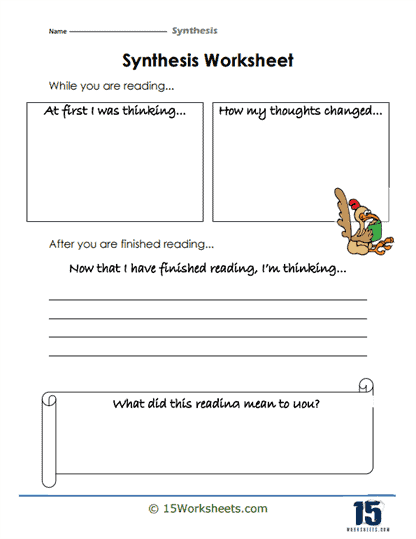
While reading, students note first thoughts and how those thoughts changed; after reading, they write what the text means to them. This personal lens helps connect evidence to interpretation. It’s a gentle path to voice in analytical writing. Meaning-making is the engine of good synthesis.
Compare And Combine
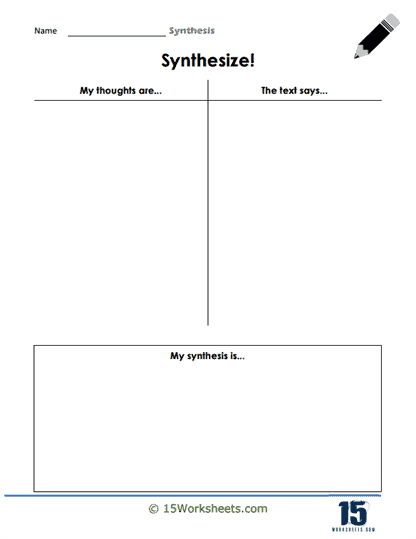
Two columns-“My thoughts are…” and “The text says…”-lead to a final box, “My synthesis is…”. Students practice reconciling prior ideas with textual evidence. It’s the literal act of synthesis in one page. Use it as a capstone organizer before drafting.
What Is Synthesis In Writing?
Synthesis is commonly used in formal English academic writing. It is a written argument that utilizes different sources to support a thesis (theory or statement put forward in academic circles to be proved through scientific evidence and analysis of published works). Within the educational domain, a synthesis usually takes the form of an essay, and is known as a “synthesis essay.”
Usage of a Synthesis
While a synthesis is primarily used in academic writing, it has other applications too. Following are some common examples of using a synthesis.
Analysis Papers
Such documents are used to examine different theories that might be related to one another. For instance, an analysis paper might compare different theories of evolution. To do that, the author can make use of a synthesis essay to build their argument.
Argument Papers
Argument papers are used to make a comparison of divergent views, support a coherent claim, etc. For example, an author may write an argument paper on the topic “Is Turnitin an Abuse of Students’ Rights?”
One argument could be that the online plagiarism detection service steals students’ work. On the other side, there’s the claim that students willfully give the permission to have their work archived before using the tool. Here again, a synthesis essay can help build the argument by analyzing both claims from a neutral standpoint.
Research Papers
To create a research paper of high value, you need to incorporate many reliable and accurate sources. For instance, if you’re writing on the social and economic effects of some proposed legislation, you can use a synthesis essay to evaluate multiple sources of published works and build your argument for or against the potential regulation.
Business Reports
Business reports are used to assess contrasting ideas. Authors of such documents try to find ways of blending different concepts together through their analysis.
Tips for Writing a High-Quality Synthesis Essay
A synthesis essay challenges students to engage critically with multiple sources, weaving them into a coherent, persuasive argument. To excel, students need more than summaries-they must demonstrate analysis, evaluation, and purposeful connection. Here are some key strategies teachers can share with their students:
1. Clarify Your Purpose and Central Idea
Every strong synthesis essay begins with a clear purpose. Ask yourself: What do I want my reader to understand or believe after reading my essay? The answer becomes your thesis-the guiding thread that ties everything together. Without this central focus, the essay risks becoming a collection of disconnected points rather than a unified argument.
2. Choose Sources with Care and Intention
Not all sources carry equal weight. Select those that are both credible and relevant to your thesis. Go beyond surface-level familiarity-immerse yourself in the arguments, assumptions, and implications of each source. Avoid the temptation to drop in citations without genuine engagement; instead, show your reader that you understand the nuances and can thoughtfully position the sources in relation to your claim.
3. Build a Deliberate Organizational Plan
Strong synthesis essays do not happen by accident. Create a structure that highlights relationships between sources rather than treating each one in isolation. Whenever possible, support each point with more than one source-this demonstrates depth of research and adds authority to your argument. Pay attention to moments of agreement and disagreement among the sources. Tension between perspectives often provides the richest ground for analysis and allows you to demonstrate discernment in evaluating which voices deserve more weight.
4. Document with Precision and Integrity
Credibility rests not only on analysis but also on academic honesty. Record full details of every source-author, title, publication, and page numbers-so that you can cite accurately. Proper attribution is more than a technical requirement; it signals respect for intellectual work and strengthens your own credibility as a writer. Whether quoting directly, paraphrasing, or summarizing, always acknowledge the original source. Doing so protects you from plagiarism and shows that your essay is built on a foundation of research, not assumption.