
Choosing Facts Worksheets
All About These 15 Worksheets
Choosing facts might sound easy, but when you’re reading, researching, or explaining something, it can be surprisingly tricky to know which details are worth keeping. These worksheets are designed to help students separate the “must-know” facts from the “fun but not necessary” details. Whether they’re highlighting, ranking, or categorizing, kids get to practice filtering information with a purpose. It turns the sometimes overwhelming flood of information into a manageable trickle of meaningful points.
This collection gives students plenty of practice in different ways. Some worksheets feel like detective work-asking how you know a fact is true-while others are more about sorting and organizing, like putting facts into categories or deciding which ones support the main message. Students also get to reflect on their own notes, making choices about what stays and what goes. These varied activities keep the skill fresh and engaging.
The payoff is huge: kids build confidence in tackling nonfiction texts, research projects, and even everyday conversations. They learn to avoid drowning in details and instead pull out the facts that actually matter. These worksheets prepare them not just for schoolwork, but for life skills like summarizing, explaining, and critical thinking. In short, it’s about learning to spot the gems in a sea of pebbles.
Have a Look Inside Each Worksheet
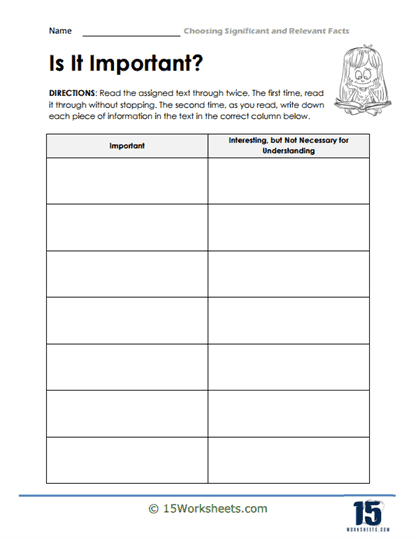
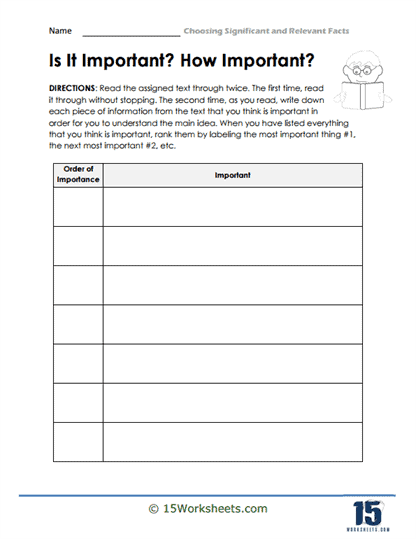
Is It Important?
Students decide whether a fact is truly important or just a fun detail-like packing for a trip: do you need that extra pair of socks or are they just cute? They build skills in distinguishing crucial information from fluff. It sharpens judgment and relevance awareness. It supports the habit of focusing on what matters most when presenting information.
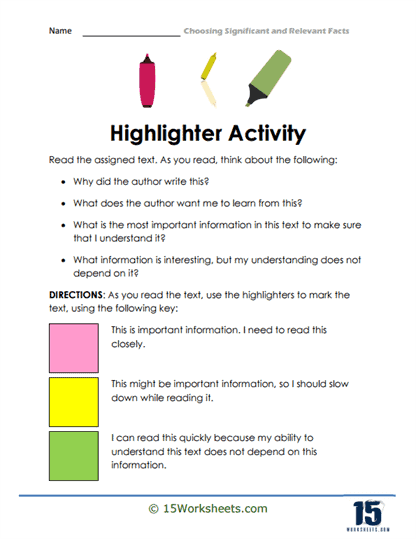
Highlighter Activity
Learners sift through short passages, using a virtual “highlighter” to pick out key facts. It turns research into a visual hunt-like spotting treasure in a text. This boosts scanning and selective reading skills. It reinforces the practice of identifying essential facts quickly and accurately.
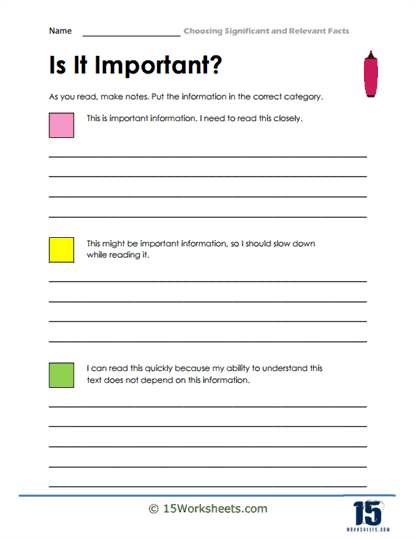
Taking Down Notes
This worksheet guides students in pulling out and writing down essential facts from short readings. It’s like becoming a mini note-taking ninja-snipping only what’s relevant. It enhances summarizing and organizational skills. It supports clear record-keeping and efficient information tracking.
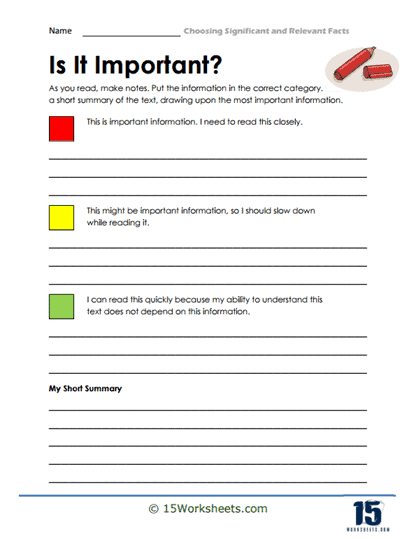
Categorize and Summarize
Students group facts into categories (e.g., dates, names, places), then write a summary. It’s like organizing your closet and then telling someone what you found. This activity supports both classification and synthesis skills. It reinforces how organizing facts helps when explaining ideas.
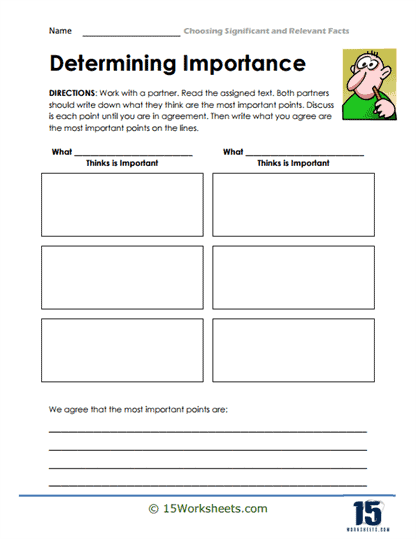
Determining Importance
Here, students rank facts by how much they contribute to understanding a topic. It’s like deciding which ingredients are essential to bake a cake. It builds evaluative thinking. It supports informed judgment about which facts carry weight.
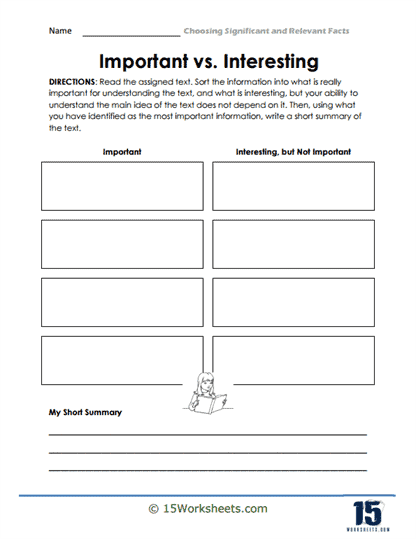
Important vs. Interesting
Students compare facts that are important versus those that are merely interesting. It’s a playful debate: “Is knowing the inventor’s birthday more useful than how their invention works?” They learn to prioritize substance over trivia. It helps them focus on facts that strengthen arguments or explanations.
Ranking the Order
This activity asks students to arrange facts in logical order to make sense-like lining up dominoes so each one leads to the next. It encourages sequence thinking and clarity. It supports building coherent narratives or explanations step by step.
How Do You Know?
Students reflect on how they know a fact is true-what source or evidence backs it up? It’s like citing your detective work after solving a case. It builds critical thinking and source awareness. It reinforces fact-checking as a habit.
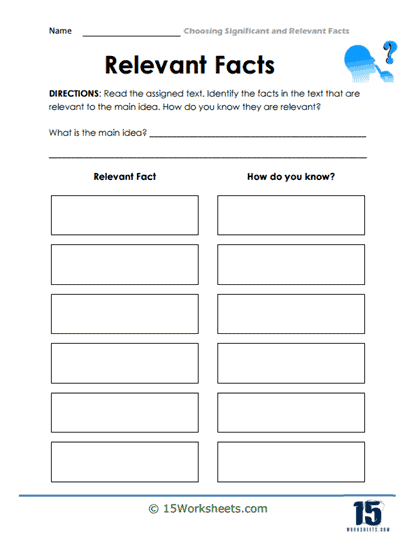
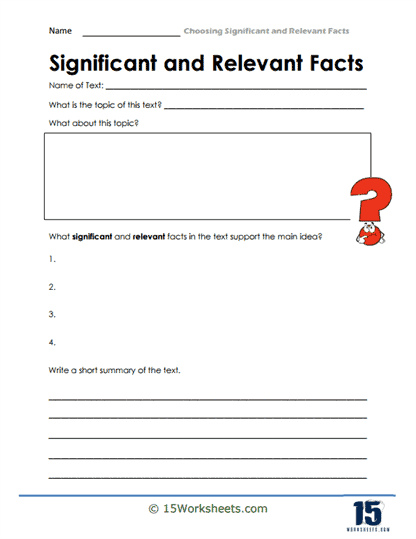
Significant and Relevant Facts
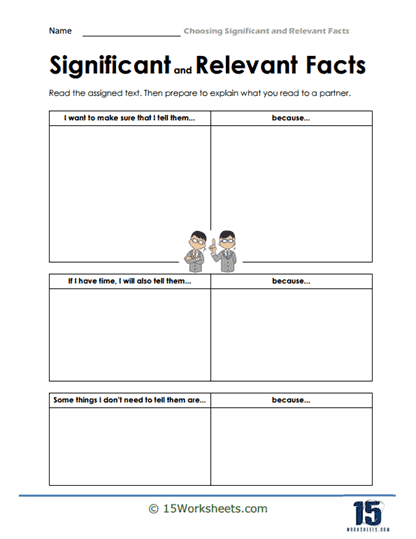
Learners identify which facts are significant or directly tied to the topic versus those that are minor details. It’s like picking the career-saving tools out of a toolbox. It encourages discernment between supporting evidence and extra tidbits. It supports focused and purposeful fact selection.
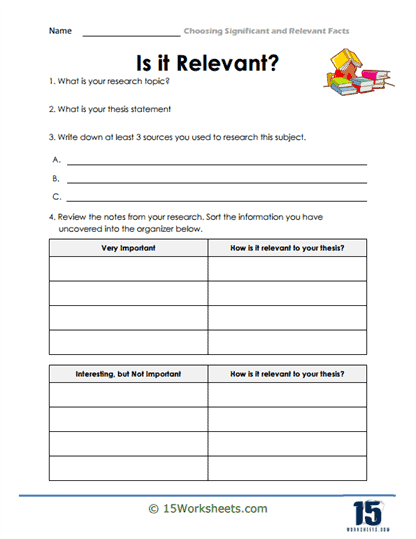
Reviewing Research Notes
Students go over their own fact notes-maybe cleaning out irrelevant info or reorganizing for clarity. It’s a self-editing moment for their fact stacks. It strengthens revision and curation skills. It supports reflection on the usefulness of the facts collected.
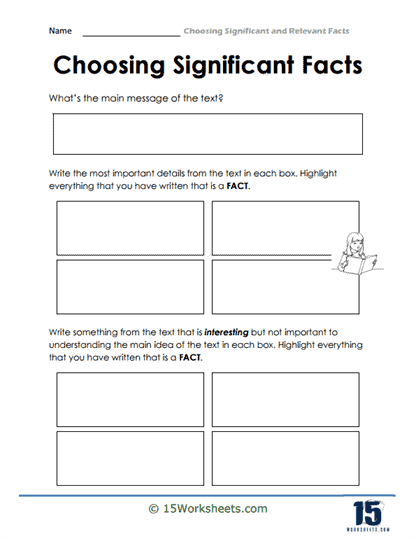
The Main Message
Here, students choose the facts that best convey the main point of a passage. It’s about spotlighting what truly tells the story. It teaches them to align facts with central ideas. It supports precise communication and summarization.
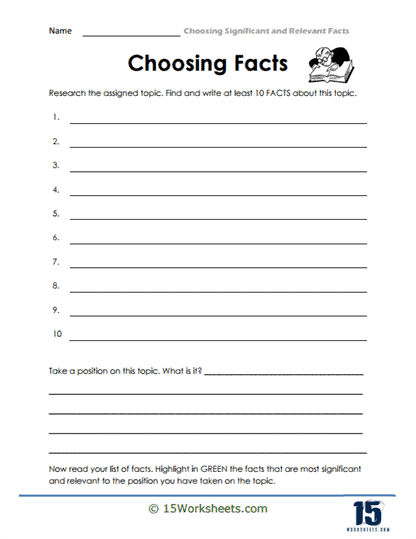
Listing Ten Facts
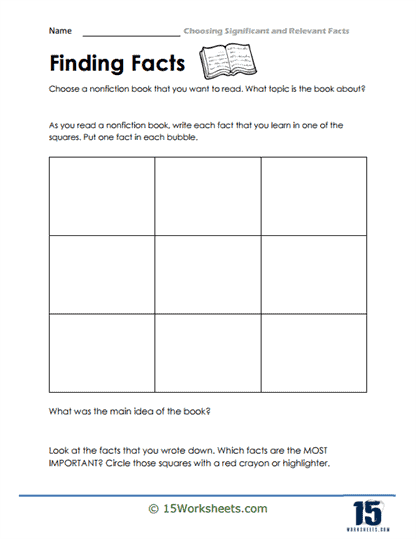
A timed or focused challenge: students list ten facts about a topic, building speed and depth. It’s like video game mode for fact-finding. It boosts information recall and breadth of coverage. It supports quick-thinking and factual exploration.
Reading Nonfiction
Students read a nonfiction paragraph and extract relevant facts-like detecting the bones beneath the text. It trains them to fish facts out of real-world passages. It enhances comprehension and extraction skills. It supports engaging with informative texts critically.
Explain What You Read
After reading, students pick out facts to explain the reading’s meaning. It’s like being a mini-expert summarizing a documentary clip. It builds comprehension and communication skills. It supports using facts to explain ideas clearly.
What and Why?
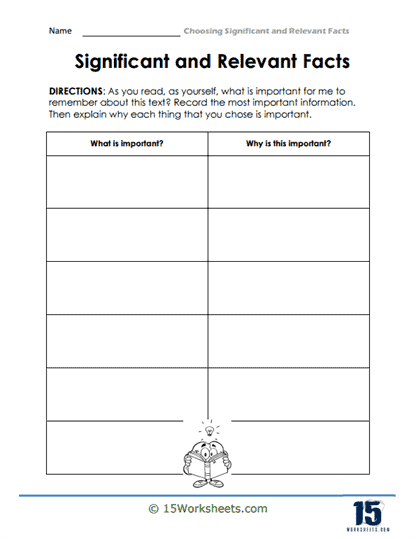
Learners extract a fact (the “what”) and explain its importance (the “why”). It’s like naming a landmark and then saying why it’s famous. It encourages deeper understanding and purposeful detail. It supports connecting facts with their significance.
How to Choose the Best Facts to Support Your Argument
Choosing the best facts to support your argument is crucial to making a convincing case. Here are some steps you can take to help you choose the best facts:
Define your argument
Start by clearly defining your argument. What point are you trying to make? What are you trying to convince your audience of?
Identify your Audience
Consider who your audience is and what they might find persuasive. What kinds of evidence or facts would be most convincing to them?
Conduct Research
Gather information from reputable sources to support your argument. Look for evidence that directly relates to your argument.
Evaluate the reliability of the sources you are using. Are they reputable? Are they biased in any way? Are they up-to-date?
Choose the facts that are most relevant to your argument. Avoid using irrelevant or tangential facts that don’t directly support your argument.
Use statistics and data to help support your argument. This can help make your argument more concrete and persuasive.
Use real-life examples to help illustrate your point. This can help make your argument more relatable and understandable.
Consider the counterarguments to your argument and choose facts that can help refute them.
Overall, the best facts to support your argument are those that are relevant, reliable, and persuasive to your specific audience. By taking the time to carefully select and present your evidence, you can make a compelling case for your argument.