
Run-on Sentences Worksheets

About Our Run-on Sentences Worksheets
Run-on sentences can make even the best ideas difficult to understand. When two or more complete thoughts are joined incorrectly, readers may struggle to follow the writer’s meaning. Our Run-on Sentences Worksheets help students recognize these common writing mistakes and learn several effective ways to fix them. Through identification activities, editing practice, and sentence revision exercises, students build the skills needed to create clearer, more polished writing.
This collection approaches run-on sentences from multiple angles to help students develop a strong understanding of sentence structure. Some worksheets focus on identifying run-ons, while others teach students how to correct them using periods, commas with conjunctions, or semicolons. Students also practice evaluating sentences, revising poorly constructed examples, and comparing different correction methods. The variety of activities keeps practice engaging while reinforcing the same essential grammar concepts.
Learning to fix run-on sentences does more than improve grammar-it strengthens overall communication. When students understand how to separate and connect ideas properly, their writing becomes easier to read and more effective. These worksheets encourage careful editing, attention to detail, and a deeper understanding of how sentences work. By mastering this skill, students become more confident writers who can express complex ideas with greater clarity and precision.
About Each Worksheet
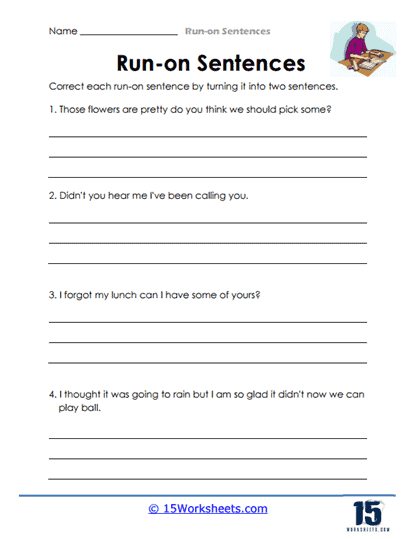
Turn It In Two
Sometimes the simplest solution is the best one, and this worksheet shows students how to break a run-on into two complete sentences. It helps learners recognize where one idea ends and another begins while strengthening sentence boundary awareness.
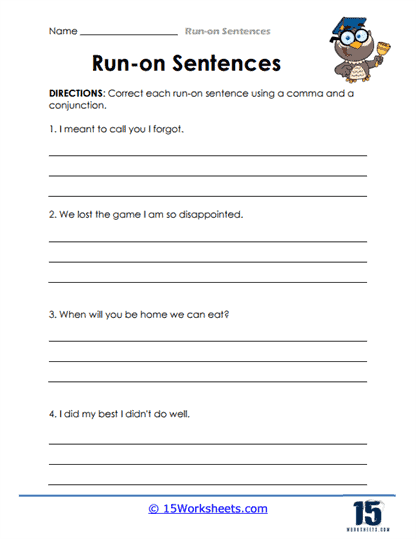
Comma And Conjunction
Students discover how a well-placed comma and conjunction can transform a run-on into a smooth, readable sentence. The activity provides valuable practice choosing the right connecting word for each situation.
Using Semicolons
This worksheet introduces students to one of the most useful punctuation marks for joining related ideas. By correcting run-ons with semicolons, learners gain confidence using more sophisticated sentence structures.
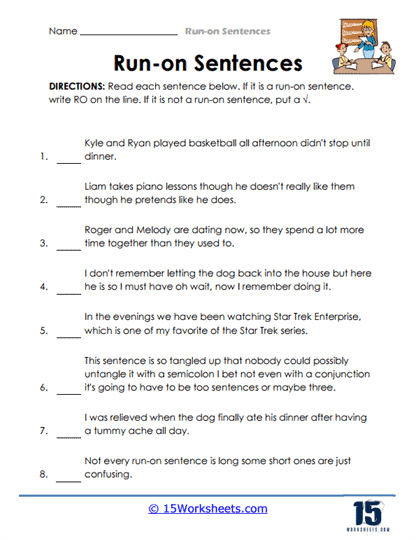
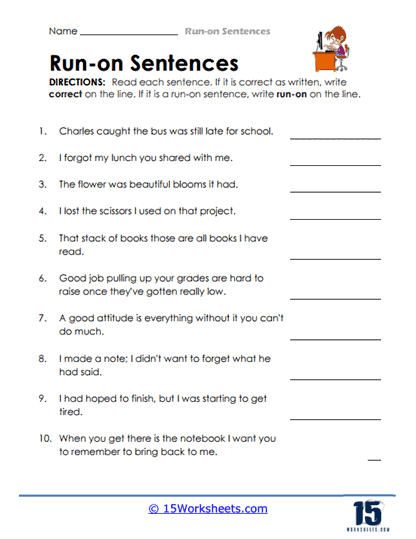
Identifying Run-ons
Before students can fix run-on sentences, they need to be able to spot them. This activity challenges learners to examine each sentence carefully and decide whether it contains a structural problem.
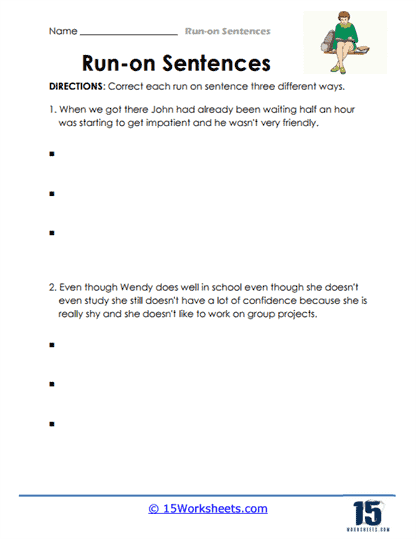
In Three Ways
Why settle for one solution when there are several? This worksheet encourages students to explore multiple correction strategies and see how different approaches can produce equally effective results.
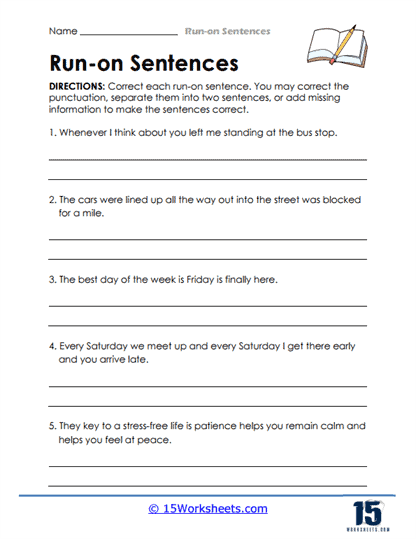
Making Corrections
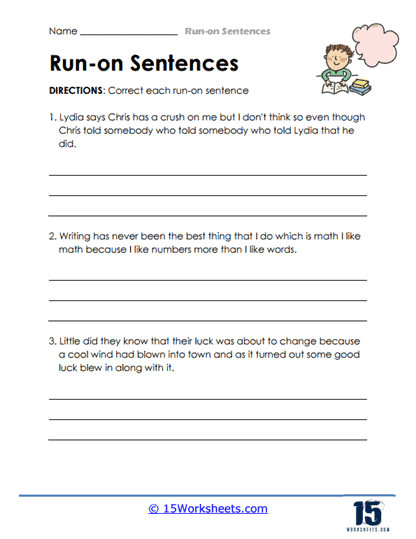
Students roll up their sleeves and put their editing skills to work in this hands-on activity. The focus is on transforming confusing run-ons into clear, properly structured sentences.
Revise Them
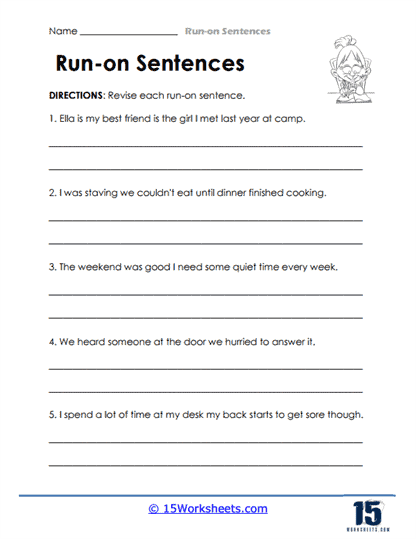
This worksheet feels like a real-world editing challenge as students revise sentences that need improvement. It reinforces the idea that strong writing often comes from thoughtful revision.
Find And Circle
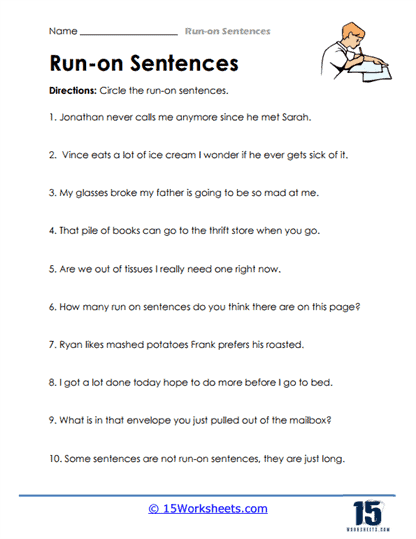
Part grammar lesson and part detective game, this activity asks students to hunt down run-on sentences hidden among correctly written examples. The search-and-identify format keeps learners actively engaged.
Correcting Sentences
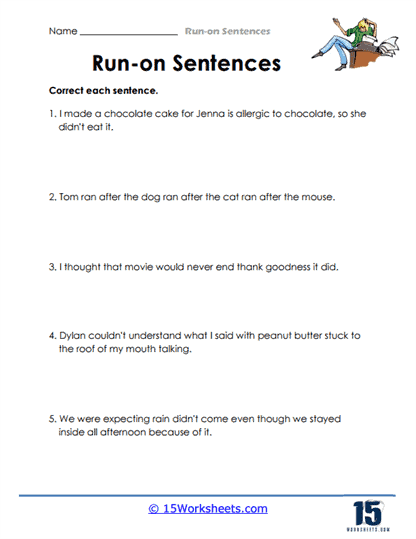
Students practice repairing run-ons by applying punctuation, conjunctions, and sentence separation techniques. The repeated revision work helps strengthen both grammar knowledge and editing confidence.
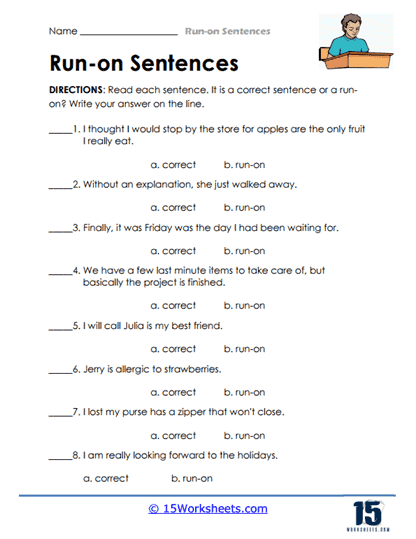
Correct Or Run-On?
This worksheet challenges students to make quick but thoughtful decisions about sentence structure. By evaluating each example, learners sharpen their ability to recognize grammatical errors.
Read A Or B
The multiple-choice format adds a fun twist to run-on sentence practice. Students must decide whether each sentence is correct or contains a run-on, encouraging careful reading and analysis.
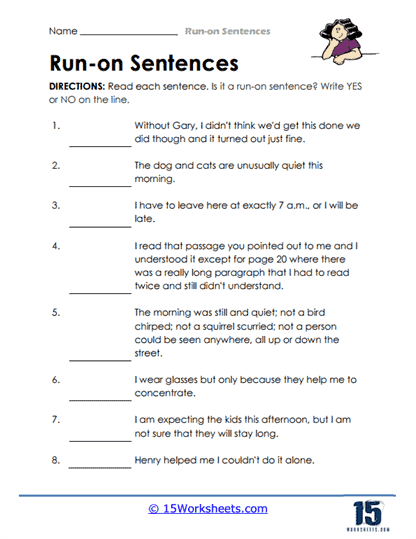
Yes Or No
Simple directions make this worksheet easy to jump into while still providing meaningful grammar practice. Students focus on identifying run-ons and building confidence in their editing abilities.
Add, Break, Or Include
Not all run-ons need the same fix, and this worksheet highlights that important lesson. Students decide whether to add punctuation, break sentences apart, or insert conjunctions to improve clarity.
What Are Run-on Sentences?
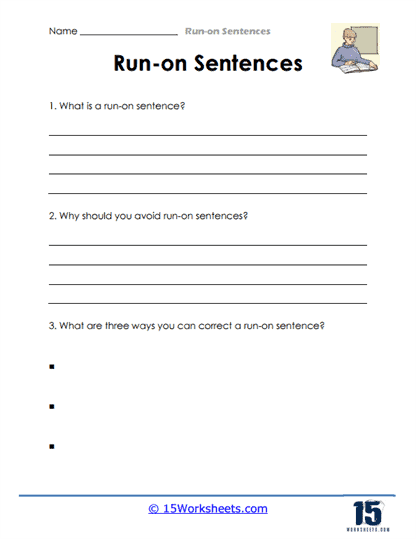
This worksheet shifts from practice to understanding by asking students to explain run-ons in their own words. It helps reinforce the concepts behind the corrections they have been making.
True Or False
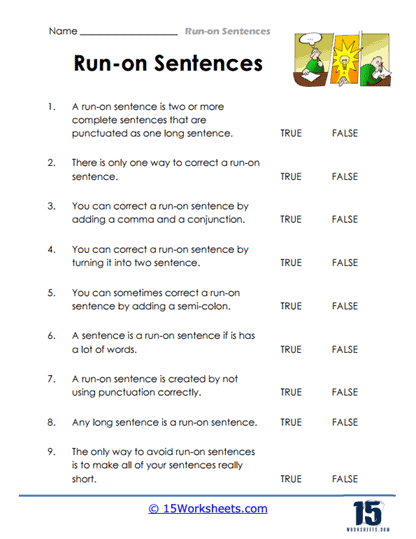
Students test their knowledge by sorting facts from misconceptions about run-on sentences. The quiz-style format makes grammar review feel a little more interactive and engaging.
What are Run-on Sentences?
A run-on sentence is like a really long sentence that has too many ideas or parts mixed together without a proper break. It’s like trying to say too much all at once without taking a pause or using the right punctuation.
Let’s say we have this sentence –
“I went to the park I played on the swings with my friends we had a picnic too.”
That’s a run-on sentence because it has too many parts combined without any stops or punctuation.
To fix a run-on sentence, we need to separate the different ideas or parts into separate sentences or use the right punctuation. For example, we can make it into two sentences like this:
“I went to the park. I played on the swings with my friends. We had a picnic too.”
Or we can use a special punctuation called a comma and a word like “and” or “but” to connect the ideas:
“I went to the park, and I played on the swings with my friends. We had a picnic too.”
See, by making separate sentences or using commas and words like “and” or “but,” we can make the ideas clearer and easier to understand.
So, a run-on sentence happens when we try to put too many ideas together without the right pauses or punctuation. We need to separate them properly to make our writing easier to read and understand.