
Problem and Solution Worksheets
All About These 15 Worksheets
Every good story (and most real-life situations) has a problem and a solution, and these worksheets help students practice spotting both. The collection includes simple match-up activities, creative drawing tasks, and deeper narrative analysis. Kids learn to see how problems unfold, how characters respond, and why certain solutions make sense. With fun, varied formats, these worksheets keep the process of learning problem-and-solution structure fresh and engaging.
As students work through these pages, they sharpen both reading comprehension and critical thinking. Some worksheets ask them to identify the main character’s challenge, while others guide them to brainstorm constructive solutions of their own. Advanced activities even include weighing multiple solutions or analyzing root causes. By seeing problems from many angles, kids start to understand that problem-solving is both a skill for reading stories and a tool for everyday life.
What makes this collection especially powerful is its connection to real-world thinking. Whether kids are working through a fictional character’s dilemma or an everyday scenario like a lost toy, they learn that every problem has more than one possible solution. These worksheets encourage creativity, empathy, and decision-making-all skills that extend far beyond the classroom.
Have a Look Inside Each Worksheet
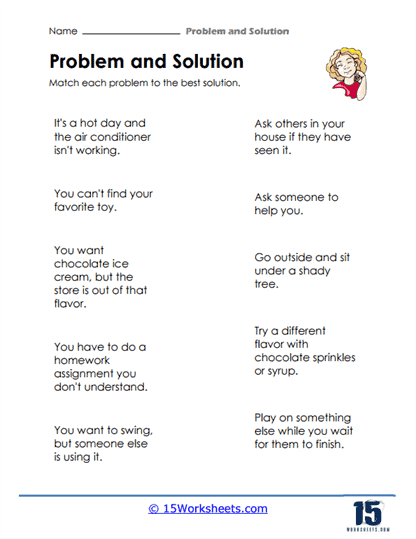
Match Them
Students read short scenarios and match each with the correct solution. It’s a simple introduction to problem-and-solution thinking. Kids practice recognizing logical connections between issues and fixes. This builds both reading comprehension and critical reasoning.
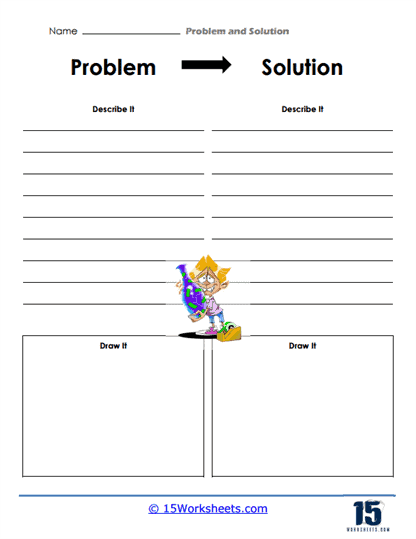
Describe and Draw
Learners describe a problem in words and then draw the solution. It blends literacy with creativity. The activity makes abstract problem-solving more concrete. Kids love turning ideas into pictures.
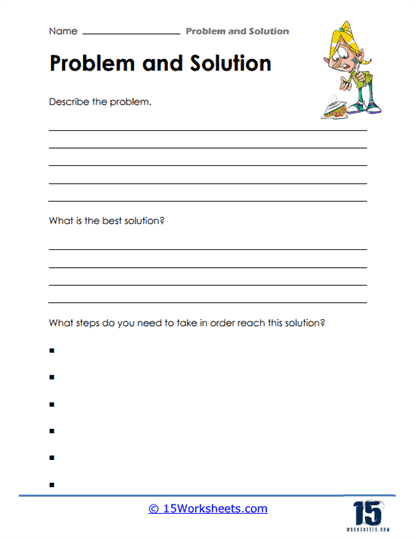
Necessary Steps
This worksheet breaks down how to solve a problem into step-by-step actions. Students learn to think in sequences. It builds organization and planning skills. The structure helps them see that solutions are often a process, not just a quick answer.
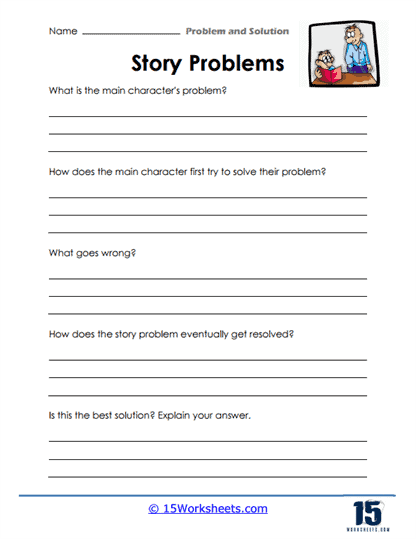
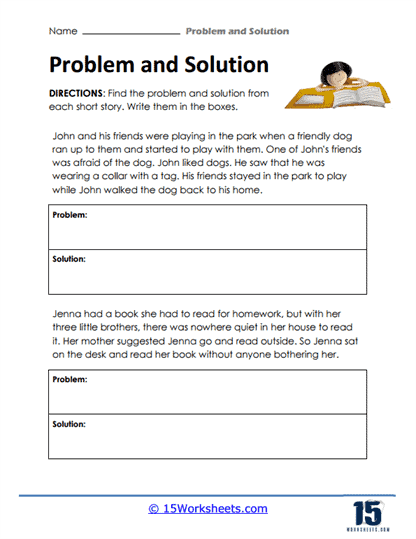
Story Problems
Children read short stories and identify the problem and its resolution. This strengthens narrative comprehension. They practice focusing on key details in a text. It’s a fun way to tie literature and problem-solving together.
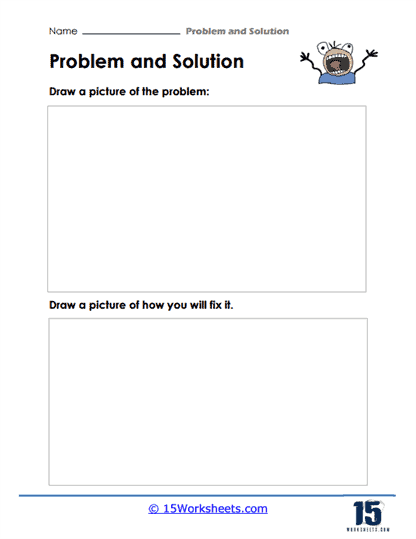
Visualize It
Students picture a problem and imagine possible solutions. They use diagrams or drawings to show their ideas. This worksheet encourages creative brainstorming. It helps visual learners shine in problem-solving tasks.
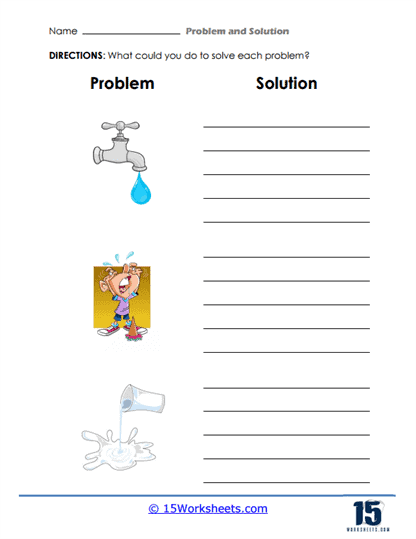
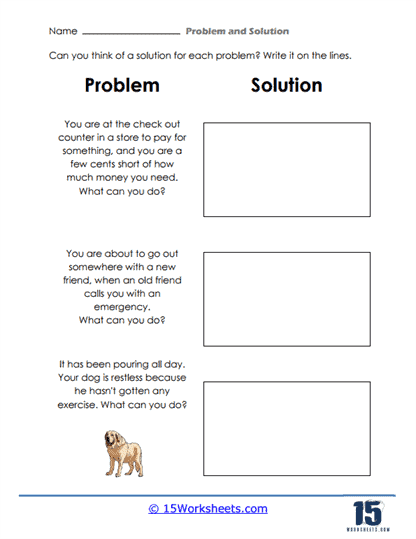
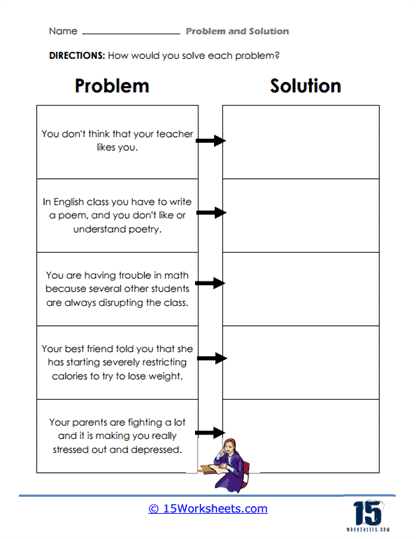
What Can You Do?
Kids read about everyday situations and suggest what they could do to solve them. It invites personal reflection and practical thinking. The worksheet builds empathy and real-world problem-solving. It makes the skill feel useful and relatable.
Solving Problems
Learners practice identifying problems in different scenarios and offering solutions. The activity reinforces cause-and-effect thinking. It encourages kids to analyze situations carefully. It’s an all-purpose worksheet for practicing the skill.
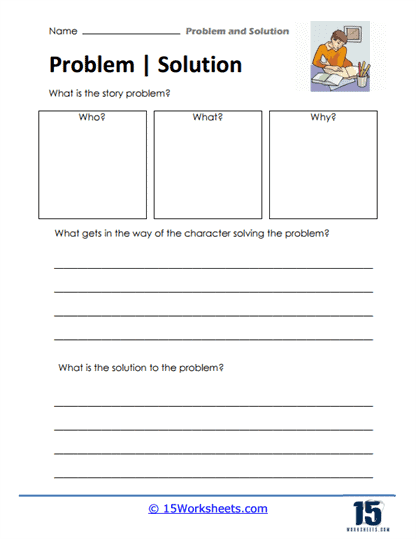
Who, What, Why?
Students answer key questions to uncover the main problem in a story. They then brainstorm possible fixes. The worksheet teaches how to ask guiding questions. It makes identifying problems systematic and clear.
Narrative Analysis
Kids analyze longer reading passages to find the central problem and solution. It deepens their comprehension skills. The activity works well for older students or advanced readers. It connects text analysis with logical reasoning.
A Quick Recall
This worksheet asks students to recall and write down problems and solutions from stories they’ve read. It checks memory and comprehension. The quick format makes it low-stress. It’s perfect for short review sessions.
The Main Character
Learners focus on the main character’s problem and how they solved it. It highlights character motivation and development. The activity builds both comprehension and empathy. It’s a strong bridge between reading and critical thinking.
Choose the Best
Students evaluate multiple solutions and choose the most effective one. This teaches decision-making and weighing options. It encourages kids to think critically, not just give the first answer. It’s an introduction to higher-level problem-solving skills.
Think Constructively
Learners are asked to suggest constructive, positive solutions to problems. It promotes resilience and positive thinking. The activity moves beyond just “fixing” to thinking about better outcomes. It’s useful for building social-emotional skills.
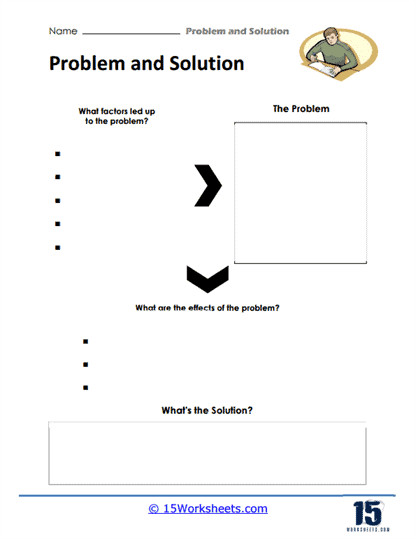
Get to the Root
This worksheet helps students dig deeper into why a problem exists. They identify causes as well as solutions. It strengthens analytical thinking. It shows that good problem-solving starts with understanding the root issue.
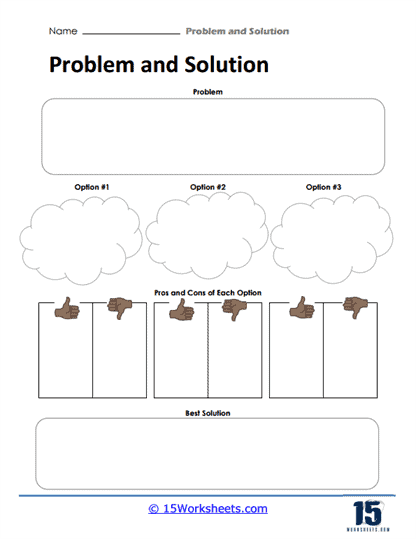
Weighing Options
Students consider different solutions and the pros and cons of each. They practice evaluation and reasoning. The activity develops decision-making skills. It shows that sometimes the best solution requires careful thought.
What Is the Problem and Solution Approach?
In writing, a “problem and solution” approach refers to a method where a particular issue or problem is identified, and then one or more solutions are proposed to address that problem. This structure can be useful in various forms of writing, such as essays, reports, proposals, and opinion pieces. It can be used in academic, professional, and journalistic contexts.
The basic premise may follow this pattern:
Problem – Littering on the school playground.
Solution – Implement a campaign about the importance of a clean environment, install more trash cans around the playground, and set up a weekly cleanup program where students take turns picking up litter.
Problem – Students are not getting enough physical activity during the day.
Solution – Incorporate short physical activity breaks throughout the day, add more physical education classes to the schedule, or start a school sports club.
Problem – Students are not eating a healthy lunch.
Solution – Provide education about the importance of healthy eating, add more healthy options to the school menu, or have a “healthy lunch” contest to motivate students.
An essay might identify a problem such as climate change, and propose solutions like reducing greenhouse gas emissions, promoting renewable energy, and implementing international cooperation on environmental regulations.
Problem – The escalating problem of climate change.
Solution – Implementing stricter international regulations on greenhouse gas emissions, promoting the use of renewable energy sources, and educating the public about sustainable practices.
An opinion piece in a newspaper might identify a problem such as deteriorating public education quality and propose solutions such as increased funding, lower teacher-student ratios, and updated educational materials.
Problem – The deteriorating quality of public education.
Solution – Increase educational funding, decrease student-teacher ratios, and provide up-to-date and relevant educational materials.