
Organizing Complex Ideas Worksheets
About Our Organizing Complex Ideas Worksheets
Some topics are easy to explain in a few sentences, while others require careful planning and organization to make sense. Our Organizing Complex Ideas Worksheets help students break large, complicated concepts into smaller, more manageable pieces. Through diagrams, graphic organizers, timelines, charts, and planning tools, students learn how to sort information, identify relationships, and present ideas clearly. These activities make challenging topics feel much less overwhelming and much more approachable.
This collection introduces students to a variety of organizational strategies that can be applied across subjects. Some worksheets focus on cause-and-effect relationships, while others explore timelines, cycles, webs of ideas, tree diagrams, analogies, and visual mapping techniques. Students learn that different types of information often require different organizational structures. By experimenting with multiple approaches, they become more confident in selecting the best method for communicating their ideas effectively.
Strong organization is one of the most important skills in writing, research, problem-solving, and critical thinking. When students can arrange information logically, they are better able to understand complex topics and explain them to others. These worksheets encourage learners to think carefully about how ideas connect, how information should be presented, and how visuals can improve understanding. The result is a collection that helps students become more thoughtful communicators and more effective learners.
About Each Worksheet
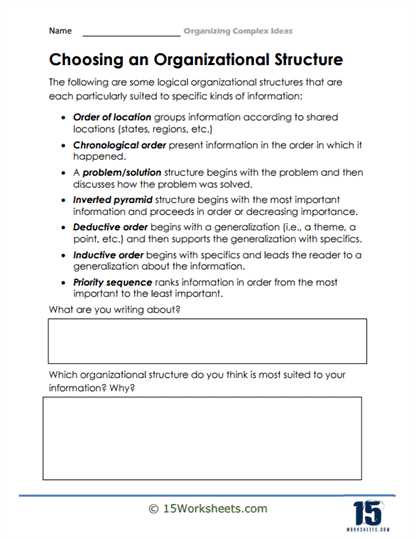
Choose A Structure
Not every topic should be organized the same way, and this worksheet helps students figure out why. By exploring different organizational formats, learners discover how structure can make information easier to understand and follow.
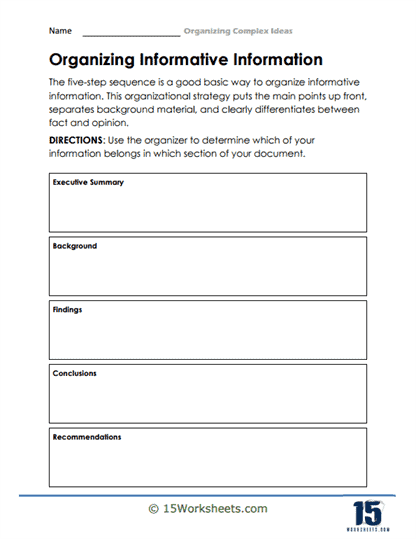
Five-Step Sequence
This worksheet introduces a practical framework for presenting information in a logical order. Students learn how to move from summary to recommendation while keeping their ideas organized and purposeful.
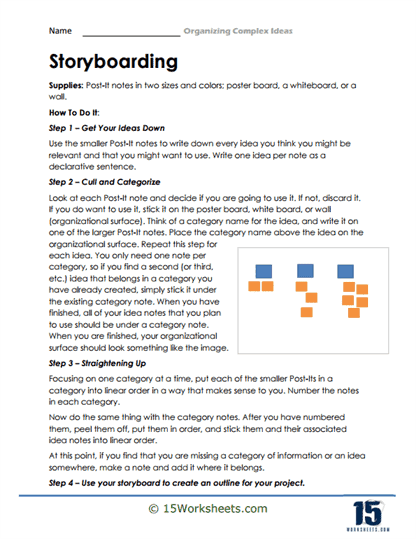
Storyboarding
Sometimes the best way to organize ideas is to physically move them around until everything clicks into place. This activity encourages students to sort, rearrange, and refine their thinking before they begin writing or presenting.
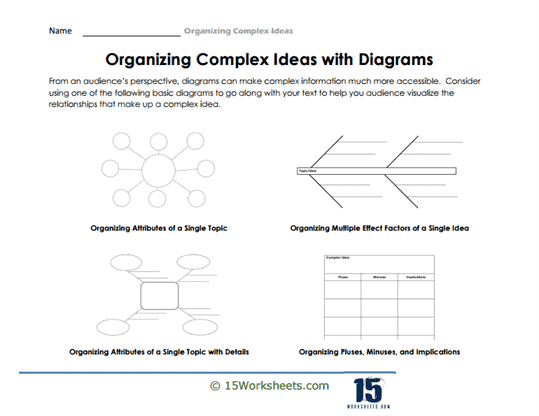
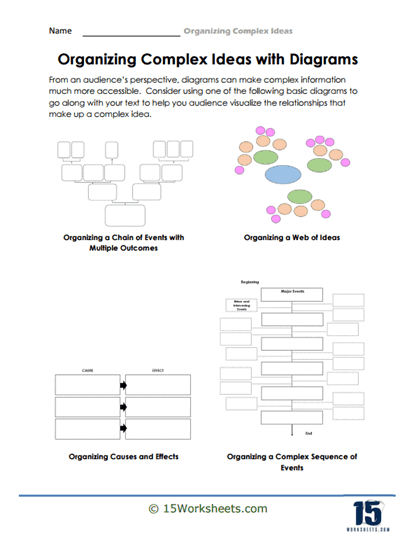
Using Diagrams
Complex ideas often become much clearer when students can see them visually. This worksheet explores several diagram styles and helps learners decide which one best fits their topic.
A Single Topic
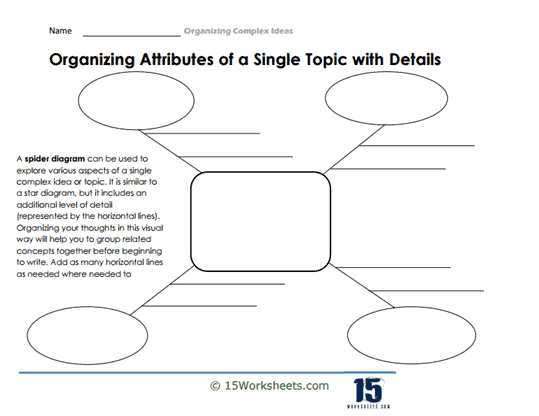
This spider diagram helps students take one big idea and break it into smaller, connected pieces. It’s a useful tool for brainstorming and exploring a subject from multiple angles.
Multiple Effect Factors
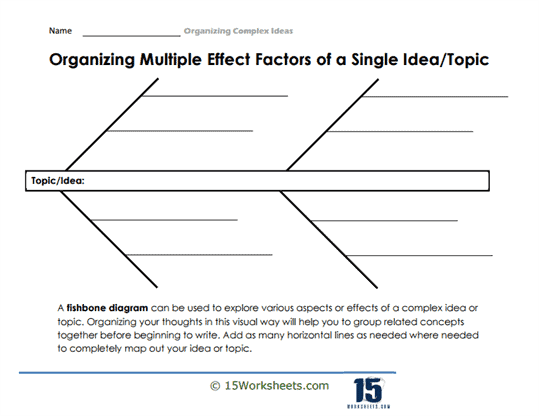
Students use a fishbone diagram to investigate the many causes or influences connected to a single idea. The visual format makes it easier to spot patterns and relationships that might otherwise be overlooked.
A Web Of Ideas
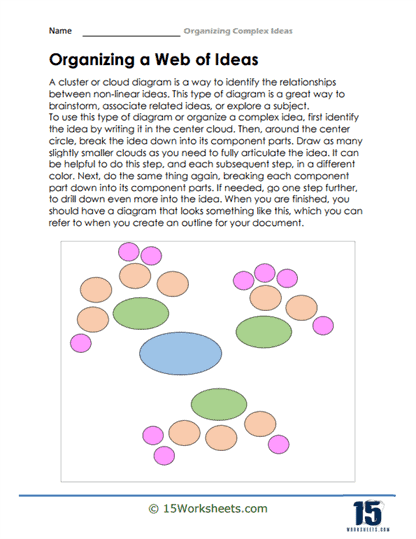
This worksheet encourages free-flowing thinking while still providing structure. Starting with one central idea, students branch outward to create a visual network of related concepts and details.
Several Outcomes
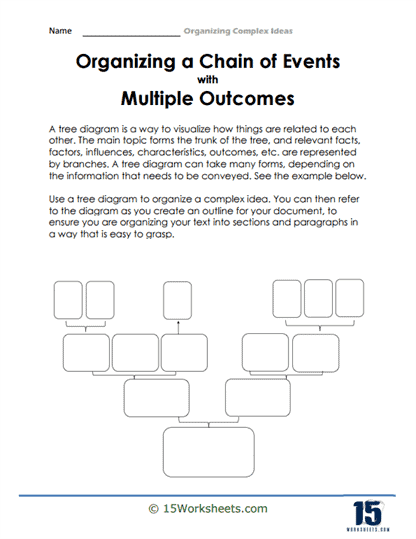
One event can often lead to many different results, and this tree diagram helps students map those possibilities. It’s a great exercise for exploring cause-and-effect relationships in a clear, organized way.
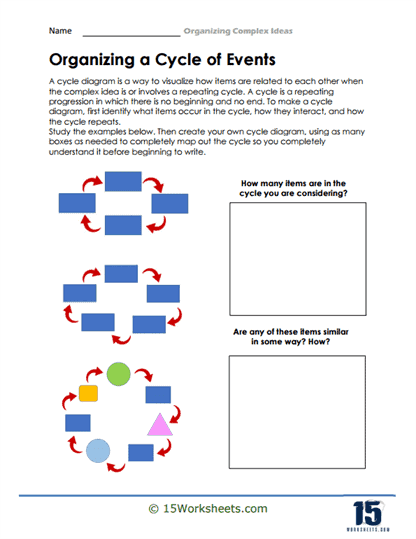
A Cycle Of Events
Some processes don’t have a clear beginning or ending, and this worksheet is designed for exactly those situations. Students create a cycle diagram that highlights how different stages connect and repeat over time.
Choose A Diagram
With so many visual organizers available, choosing the right one can be a challenge. This worksheet helps students compare several diagram types and select the best fit for their information.
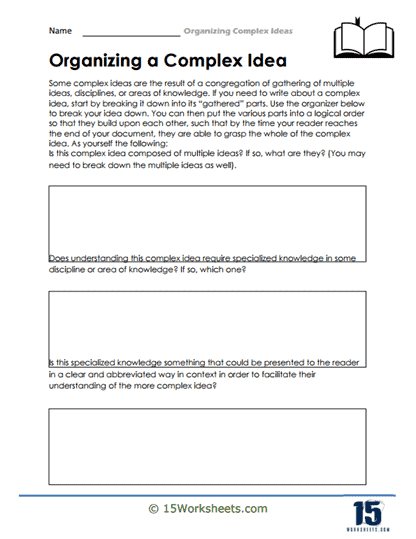
What You Need To Know
Complex topics often require background knowledge before they can be fully understood. This activity encourages students to identify essential concepts and think about how to explain them clearly to others.
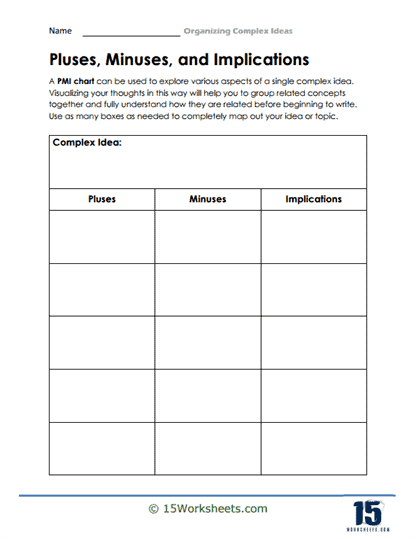
Pluses, Minuses, Implications
Every idea has strengths, weaknesses, and possible consequences, and this worksheet helps students examine all three. The PMI format encourages balanced thinking and deeper analysis.
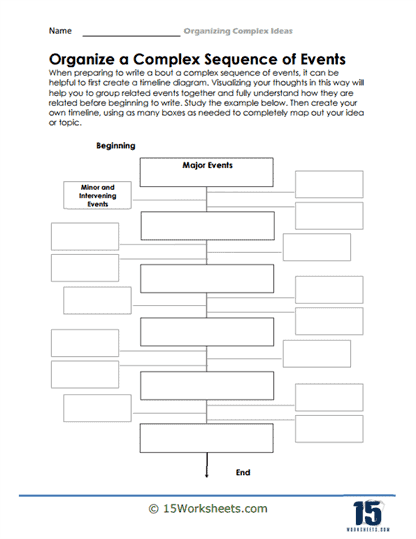
A Complex Sequence
When events unfold over time, keeping them organized can make all the difference. This timeline activity helps students map major and minor events in a way that reveals important connections.
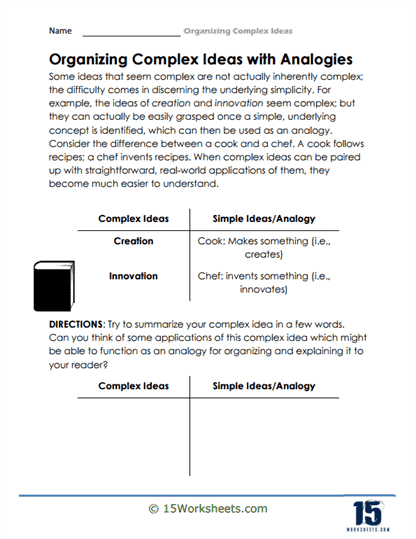
Using Analogies
Comparing a difficult idea to something familiar can make it much easier to understand. This worksheet encourages creative thinking as students develop analogies that simplify complex concepts.
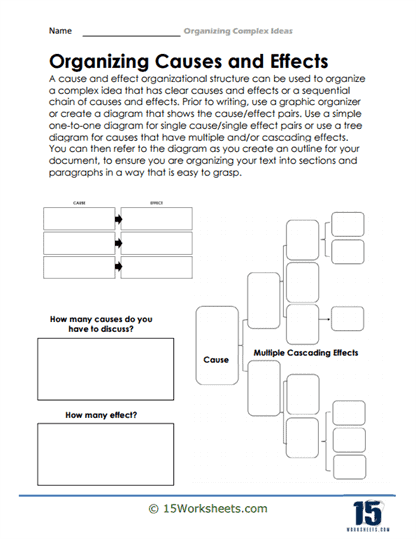
Causes And Effects
This organizer helps students trace how actions, decisions, or events lead to specific outcomes. By visually mapping connections, learners gain a stronger understanding of causality and logical relationships.
How to Organize Complex Ideas
If you have ever had a million thoughts zooming in and out of your head, you know how frustrating and overwhelming it feels. Maybe you are trying to fix a problem at your workplace, but with so many complex ideas, you keep getting lost in your thoughts, or maybe someone is talking to you, but with so many ideas racing through your head, you are having a difficult time paying attention.
The good news is that there are ways to organize complex ideas that may not entirely make sense to you at the moment. These ways will give you a kick start so that you can think properly and plan your next big idea.
1. Visual Thinking
When you find that you have too many thoughts in your head, instead of stressing out, sit down, close your eyes, and think about what you need to accomplish. Go through ideas step-by-step in your head without overwhelming yourself. If you can’t picture yourself accomplishing a part of the project, ask yourself why.
Take time to think about your project and go through each of your ideas. When you think about the process, you will have saved yourself from physically starting something and halfway through realizing that there is something you don’t understand.
2. Mind Maps
If you feel like your brain will explode because of all the complex ideas in your head, you can benefit from mind maps. A mind map can help you put ideas down on paper so you can work through them methodically instead of tying yourself up inside your head.
The biggest trick when using a mind map is understanding and accepting that there is no concept of bad ideas. Put down everything you want on a piece of paper. You’d be surprised at the number of ideas you can write down. Once you have everything down on paper, it will become easier to sort through the ideas in your head.
3. Time Frame
We believe that the most essential and stressful part of a big project is meeting the deadline. Even though a calendar can be used to keep track of all the things that need to be accomplished within a tight time frame, a timeline can help you visualize some of the more complex ideas.
A time frame can help you build a straight line of things that need to be completed, along with an estimated time period needed for every step. If you find yourself falling behind, you can adjust the remaining part of your project without compromising on the final deadline.
4. Checklist
If you want to organize complex ideas, creating a checklist is one of the most important things you must do. When you make a checklist, you will be forced to write down the things that you need to accomplish. Checklists can also be used to organize your day-to-day thoughts so that you can complete a large project using smaller steps.
With a busy schedule, a checklist will ensure you do not forget or let anything slide. Moreover, you will feel super motivated and accomplished each time you can physically tick off the boxes of each task you complete. You can also use your phone if you do not want to use physical paper. Some programs will help you organize complex ideas inside your head that you can simply download on your phone, laptop, tablet, or computer.