
Decomposing Fractions Worksheets
All About These 15 Worksheets
Fractions can sometimes feel like little puzzles, and decomposing them is basically the art of breaking those puzzles into smaller, friendlier pieces. These worksheets guide students through that process using number bonds, fraction bars, models, and even fun shapes like hearts. Each sheet gives learners a different way to see how fractions can be expressed as the sum of other fractions. The more ways they practice, the more flexible and confident they become in working with fractions.
This collection makes fraction work less intimidating and more hands-on. By “picking apart” fractions, kids learn that there’s more than one way to represent the same value. They’ll start to see patterns, discover shortcuts, and realize that breaking down fractions isn’t just math busywork – it’s actually a tool for understanding. With visuals, games, and structured practice, the worksheets keep the learning fresh and accessible.
Even better, decomposing fractions connects to real-world math thinking. Whether kids are splitting a pizza, measuring ingredients in cooking, or solving problems in science, understanding how to break numbers into parts is an everyday skill. These worksheets help kids see fractions not as scary numbers with slashes, but as flexible building blocks they can rearrange and work with.
Have a Look Inside Each Worksheet
Fraction Bars
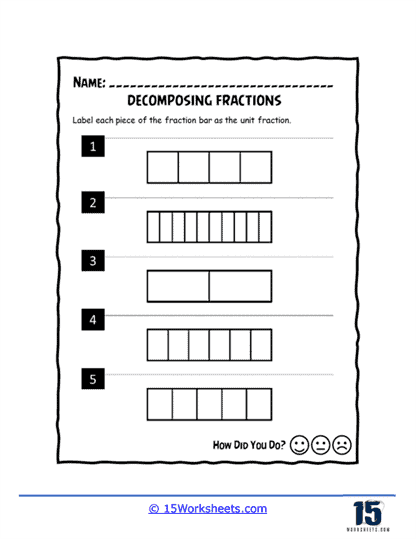
Students use visual fraction bars to break a fraction into smaller fraction pieces. They see how a whole bar can be divided into parts to make up a given fraction. This supports strong visual understanding of how fractions relate to each other.
Decomposing Box Fractions
This worksheet uses box models (i.e. squares/rectangles divided into parts) to decompose fractions. Students break down a given fraction into sums of smaller fractions using these box visuals. It helps with spatial reasoning and understanding fraction equivalence.
Broken Part Fractions
Here, fractions are shown as “broken parts,” perhaps with pieces missing or separated, and students decompose the given fraction. They figure out how to build up to the full fraction using smaller ones. It reinforces that fractions can be made of multiple “smaller” bits.
Pick Apart Fractions
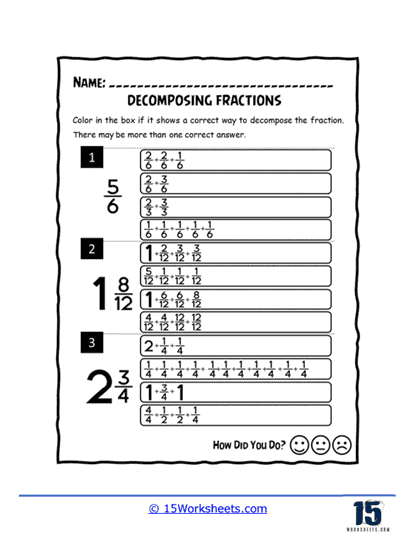
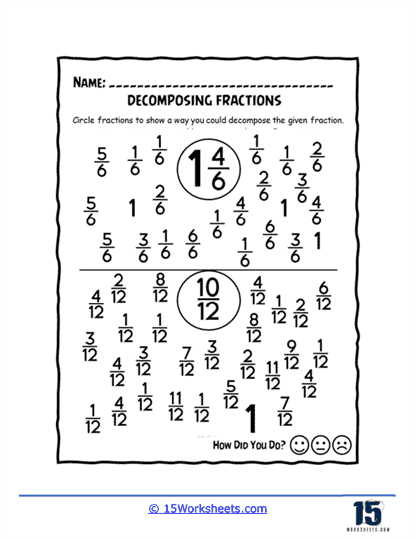
Learners are prompted to “pick apart” a fraction into component smaller fractions (with same denominator) or by various ways. It encourages exploring different ways one fraction can be expressed. This builds flexibility and deeper insight into fraction composition.
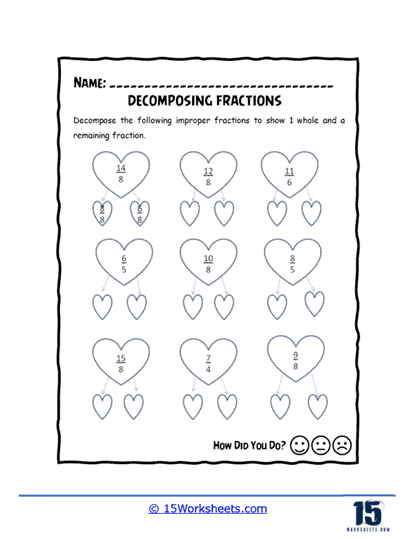
Decomposing Heart Fractions
Using heart-shaped models or visual heart pieces, students split fractions into smaller parts. This adds a fun shape to help visualize parts of a whole. It combines visual interest with fraction decomposition to engage learners.
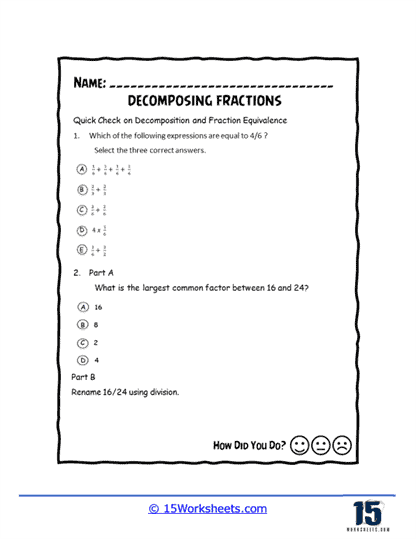
Fraction Expressions
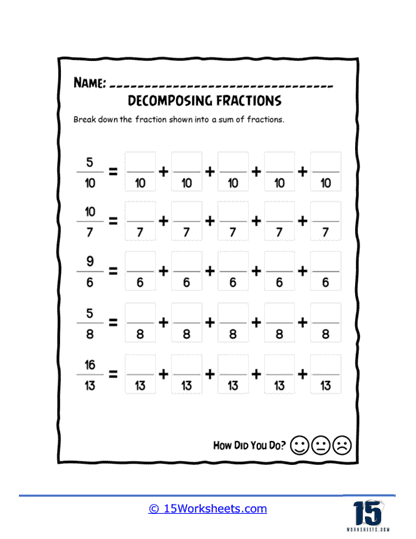
Students express a fraction as an addition of smaller fractions (writing expressions). They may also see multiple equivalent ways or write out expressions that show decomposition. This builds algebraic thinking and notation skills.
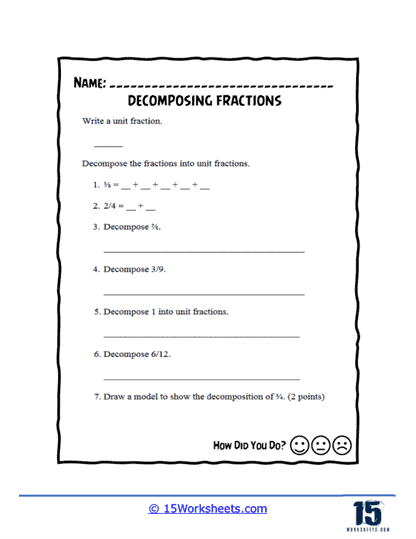
Decomposing Unit Fractions
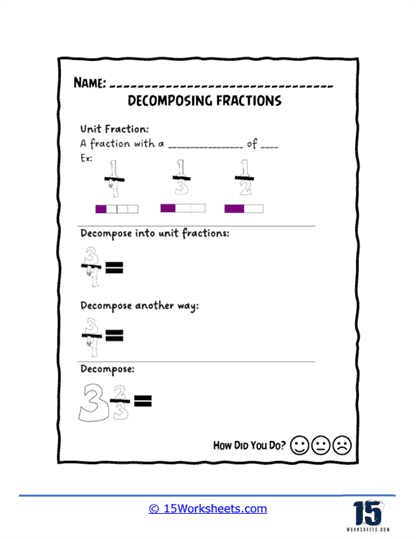
Focus here is on unit fractions (fractions with numerator 1) and how a larger fraction can be made of unit fractions. Students break given fractions into sums of unit fractions. It builds foundational understanding of what unit fractions are and how they combine.
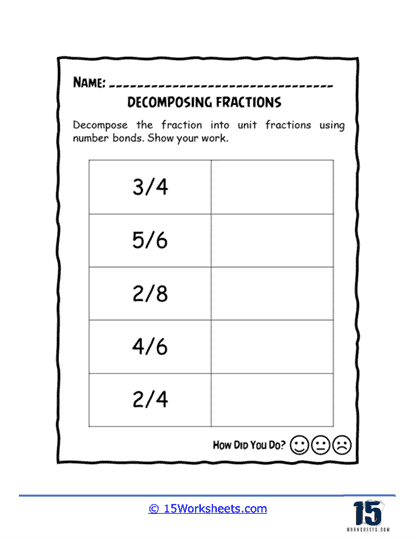
Using Number Bonds
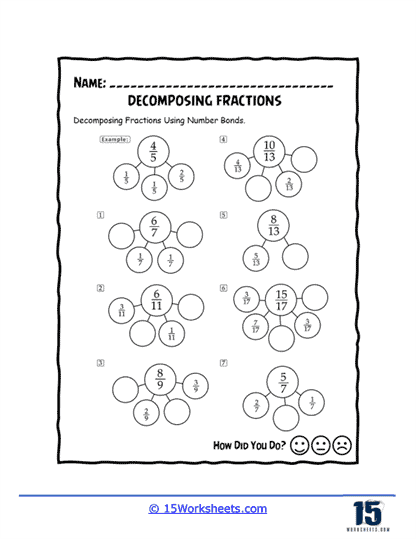
This worksheet uses number bonds (a visual tool for showing how one number splits into two or more parts) applied to fractions. Students decompose fractions using bonds (e.g. splitting 3/4 into 1/4 + 2/4). It helps with part-whole thinking in a structured way.
Decompose Fractions Many Ways
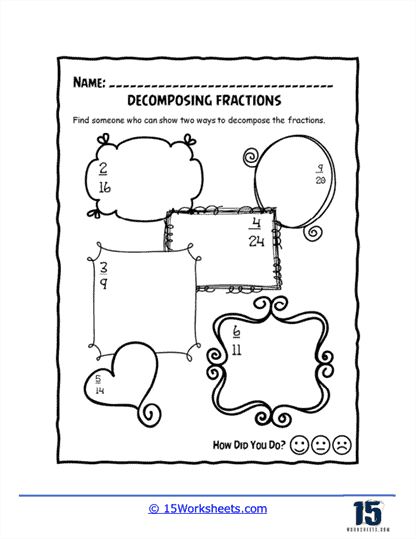
Students are asked to decompose the same fraction in multiple different ways. Rather than just one correct decomposition, they explore several possibilities. This strengthens understanding that decomposition isn’t unique and builds creative problem solving.
Crumble the Fraction
Possibly uses metaphor or visual of “crumbling” a fraction into smaller pieces. Students break down fractions in different ways (with emphasis on smaller parts). This is likely playful, helping reduce anxiety about “messy” fractions.
Fraction Number Bonds
Very similar to using number bonds, this emphasizes decomposing fractions by thinking of how to bond parts together. Students see fractions in relationships (how pieces join to make whole). Good for reinforcing part-whole concept and addition with fractions.
Fraction Models
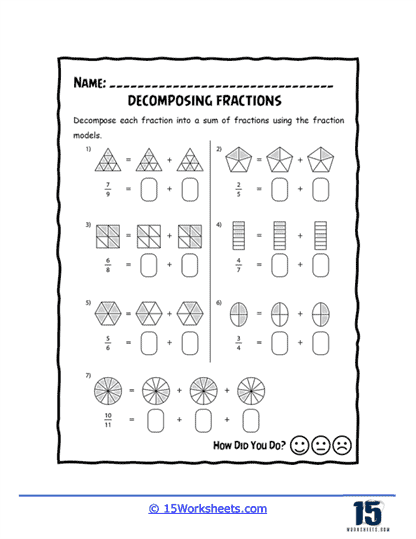
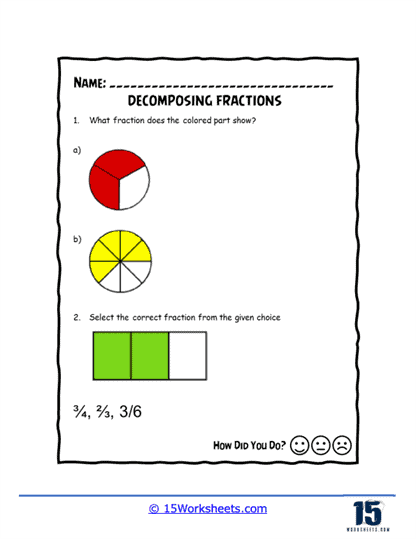
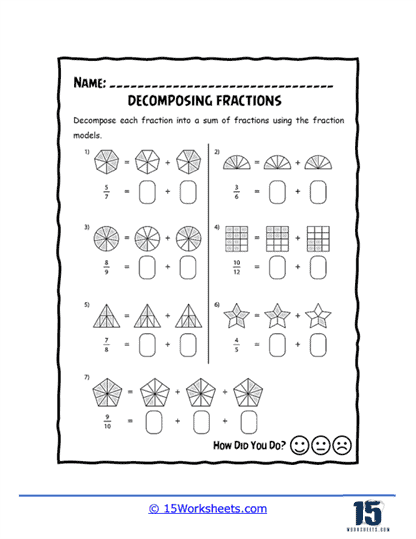
Visual models (often shapes or divided areas) are used for decomposing fractions. Students see model diagrams showing how a fraction splits. These help students translate between pictorial and numeric representation.
Decomposing Fraction Models
Combines models with more challenging decomposition tasks. E.g. seeing a model and writing the decomposition, maybe into non-unit parts. Helps with mapping visuals to numeric parts and increasing complexity.
Breaking Down Fractions
Likely more general tasks of decomposing fractions into smaller fractions, possibly with mixed denominators or larger denominators. Helps students practice standard decomposition methods. Reinforces fluency & understanding.
Decomposing Mixed Numbers
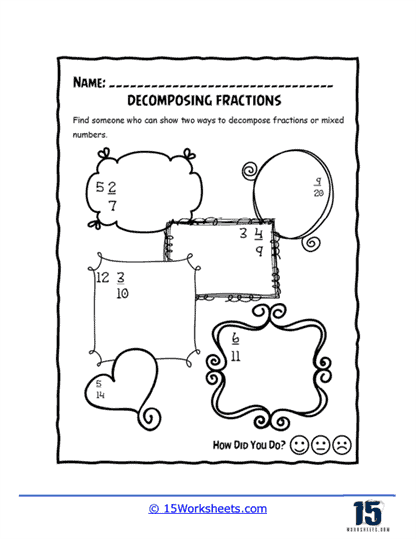
Works on mixed numbers (whole + fraction) and how to decompose the fractional part (or perhaps decompose the mixed number into sum of fractions and whole plus fraction). This is a step up in difficulty and helps students working with more complex fraction forms.
How Do You Decompose Fractions?
Decomposing fractions means breaking a fraction into the sum of smaller fractions with the same denominator. It can be a useful way to simplify problems, make sense of fractions, or teach fraction concepts. Here’s a step-by-step guide that teachers can share with their students to help them in decomposing fractions:
Choose Smaller Fractions with the Same Denominator – Identify fractions with the same denominator that, when added together, will equal the original fraction. There can be more than one correct answer when decomposing a fraction, as it can be broken down into different combinations of smaller fractions.
For example, let’s say you want to decompose the fraction 5/6. Here are two possible ways to decompose it:
Option 1:
- 1/6 + 1/6 + 1/6 + 1/6 + 1/6
- 5/6 = 1/6 + 1/6 + 1/6 + 1/6 + 1/6
Option 2:
- 1/6 + 4/6
- 5/6 = 1/6 + 4/6 (Note that 4/6 can be further simplified to 2/3)
Write the Decomposition – Write the original fraction as the sum of the smaller fractions you have chosen. You can write it in equation form, as shown in the examples above.
Simplify if Necessary – If any of the smaller fractions in your decomposition can be simplified further, do so. For example, in Option 2 above, we can simplify the decomposition as follows:
5/6 = 1/6 + 2/3
Decomposing fractions can also be done using mixed numbers or improper fractions. The key is to break down the original fraction into a sum of smaller fractions with the same denominator, which can help you better understand or manipulate the fractions in various mathematical or real-world situations.
Real World Applications
Decomposing fractions plays a valuable role in making everyday tasks more approachable and efficient. By breaking down fractions into smaller, more manageable parts, we can gain clearer insights into the quantities involved in our daily decisions. This practice isn’t just a mathematical exercise-it’s a powerful tool that supports clarity, precision, and problem-solving across diverse real-world scenarios.
Consider common activities such as cooking, budgeting, and time management. When preparing a meal and adjusting a recipe to serve fewer people, decomposing fractions allows for accurate measurement of ingredients, ensuring consistent results. Similarly, when planning a budget or distributing shared expenses, breaking fractions down helps clarify how resources are being allocated, making financial decisions more transparent and less overwhelming. Even in organizing a busy schedule, fractional thinking can help divide time effectively, helping you balance responsibilities while identifying where time can be gained or lost.
Beyond practical life management, decomposing fractions is also critical in fields that depend on precision and understanding of proportions-like education, construction, or even the arts. Teachers often use decomposition to help students grasp how fractions work and relate to each other. Designers and builders rely on it for accurate scaling and material division. In artistic endeavors such as sewing or woodworking, decomposing fractional measurements ensures symmetry and detail in the final product. Whether you’re analyzing a basketball player’s shooting percentage or preparing canvas sizes for a painting, the ability to see and work with parts of a whole can make all the difference.