
Complex Sentences Worksheets
All About These 15 Worksheets
Complex sentences add flavor to writing, and this collection of worksheets helps students master them step by step. From identifying dependent clauses to practicing subordinating conjunctions, the activities guide learners through the building blocks of sentence variety. Some worksheets ask kids to underline, match, or rearrange clauses, while others challenge them to write their own. The mix of guided practice and creative tasks keeps grammar from feeling dry.
What makes these worksheets especially effective is their focus on both recognition and application. Learners don’t just label parts of a sentence-they actively transform simple ideas into richer, more detailed statements. With exercises like “Make It Complex” and “Sentence Expansion,” students see how small grammar tweaks can completely change tone and clarity. Over time, they build the confidence to use complex sentences naturally in essays, stories, and conversations.
Beyond grammar class, these worksheets prepare students for real-world writing. Complex sentences are everywhere-from books and articles to everyday communication. Practicing them strengthens critical thinking, improves punctuation skills, and helps kids express relationships between ideas more clearly. With these worksheets, students don’t just learn about complex sentences-they learn how to wield them effectively.
Have a Look Inside Each Worksheet
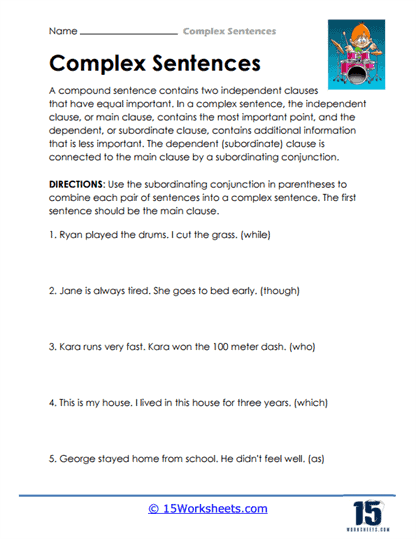
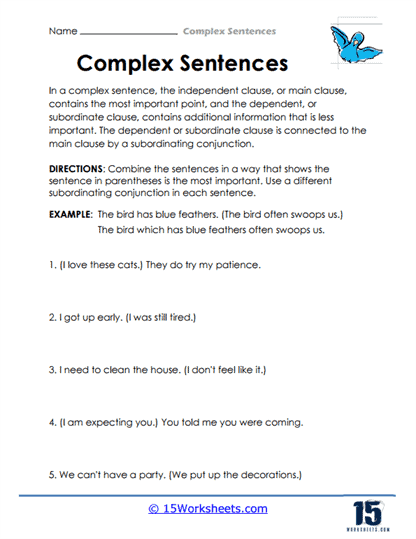
Combining Pairs
Students join independent and dependent clauses to form complex sentences. It’s like playing matchmaker for grammar pieces. The activity shows how ideas connect in meaningful ways. Kids learn the basics of sentence variety and flow.
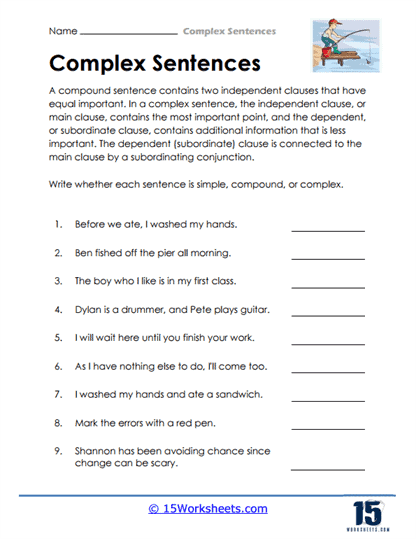
Identifying Sentence Types
This worksheet asks learners to spot whether a sentence is simple, compound, or complex. It’s a grammar “Guess Who?” game where every sentence has a secret identity. The exercise sharpens classification skills. Students gain confidence in spotting sentence structures.
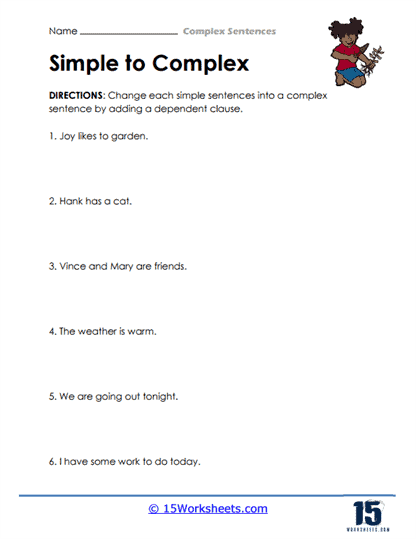
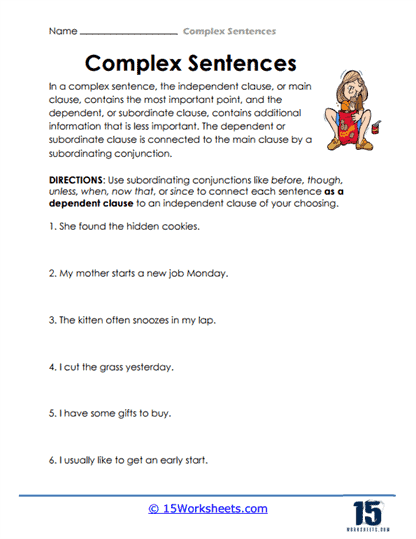
Add A Dependent Clause
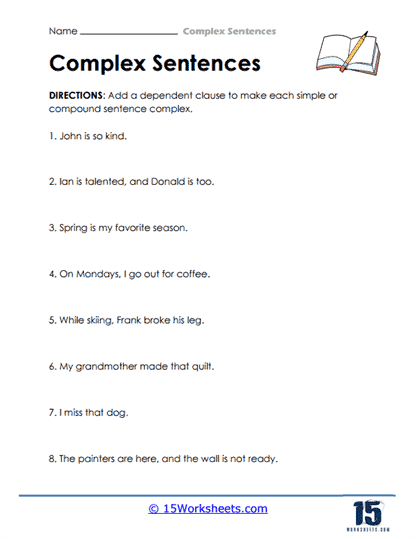
Here students extend plain sentences by adding dependent clauses. It’s like giving a bare sentence a stylish upgrade. The task builds creativity and structure awareness. Learners see how clauses enrich writing.
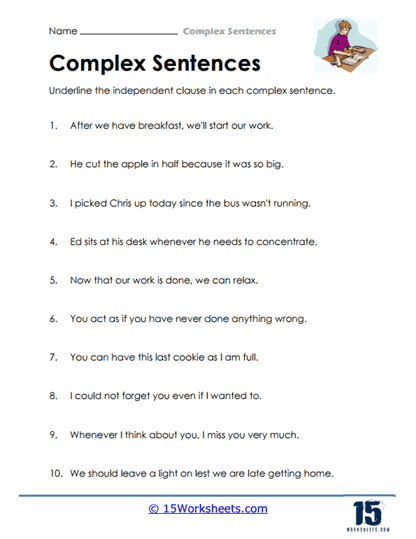
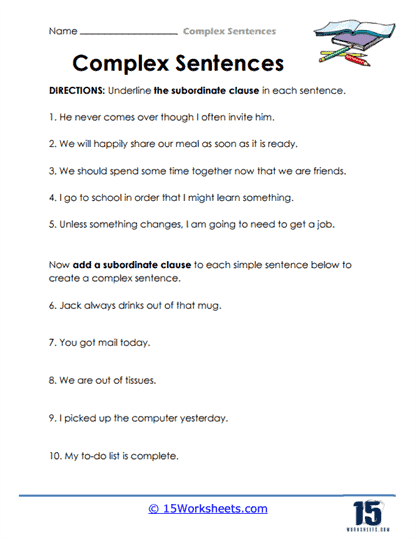
Find And Underline
Students act as grammar detectives, underlining dependent clauses in given sentences. The activity focuses on attention to detail. It makes hidden parts of complex sentences stand out. Kids practice recognizing key building blocks of writing.
The Most Important
This worksheet has students rank clauses by importance, deciding which is main and which is dependent. It encourages deeper thinking about sentence meaning. The task blends grammar with comprehension. Learners better understand how emphasis shapes writing.
Subordinating Conjunctions
Here students practice with words like “because,” “although,” and “since.” The worksheet shows how conjunctions glue ideas together. It highlights their role in making sentences complex. Learners expand their toolkit for clear expression.
Subordinate Clauses
Students dive deeper into the world of clauses that can’t stand alone. The activity teaches how these depend on main ideas. It’s an exploration of grammar teamwork. Kids learn why dependent clauses matter in writing.
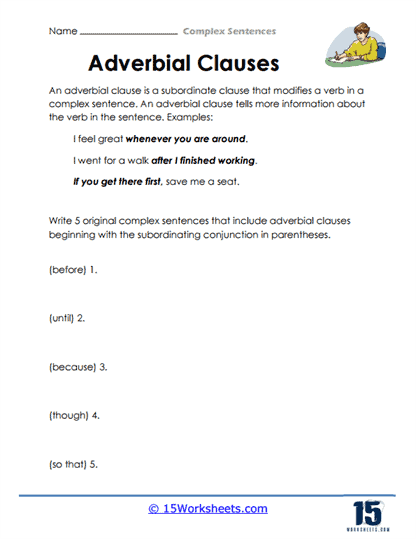
Five Original
This worksheet challenges learners to write five of their own complex sentences. It’s creativity meets structure. The repetition builds confidence through practice. Students strengthen both grammar and imagination.
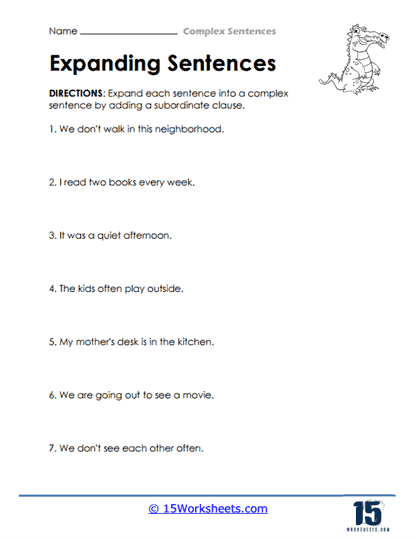
Sentence Expansion
Kids take simple sentences and expand them with details and clauses. The exercise feels like stretching sentences to full strength. It encourages variety and richness in writing. Students see how little changes add big impact.
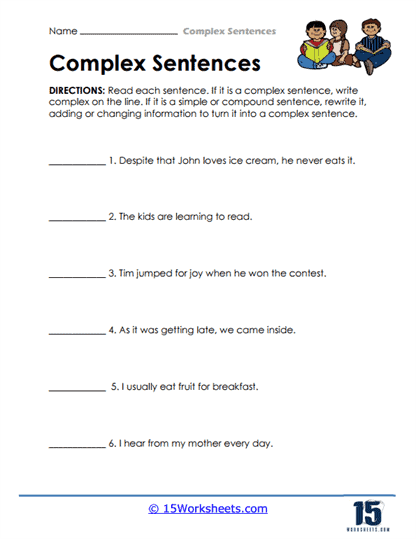
Identify And Rewrite
Students identify weak or plain sentences and rewrite them as complex ones. It’s a grammar makeover activity. The transformation helps learners see writing possibilities. Confidence grows as they polish their work.
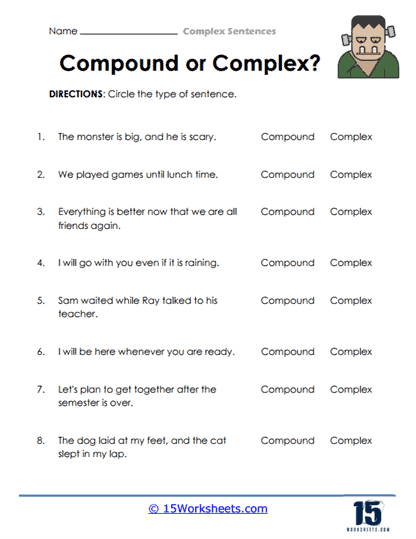
Compound Or Complex?
This worksheet helps learners distinguish between compound and complex sentences. It’s a comparison challenge that clears up confusion. The task builds critical thinking about structure. Students learn to see the difference clearly.
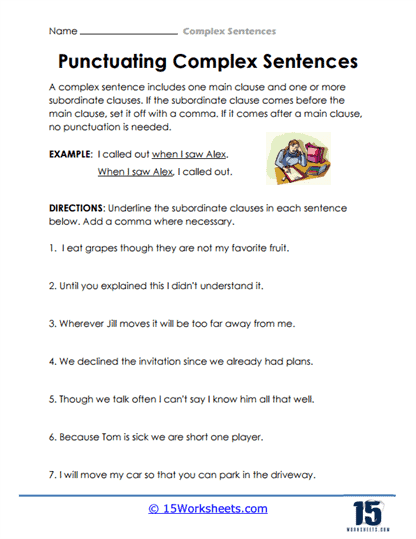
Adding A Comma
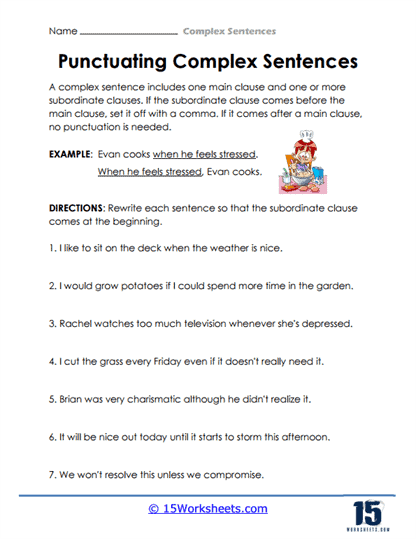
Here kids learn correct comma placement in complex sentences. The activity shows how punctuation shapes meaning. It’s practical and precise practice. Students avoid common mistakes while improving clarity.
Rearranging And Rewriting
Learners shuffle sentence parts to create new structures. It’s like playing cards with clauses. The exercise encourages flexibility and experimentation. Students see how word order changes emphasis.
Make It Complex
This worksheet pushes students to rewrite plain sentences into more complex forms. It’s hands-on grammar crafting. Learners gain practice in adding depth. Writing feels more polished and engaging.
About The Pictures
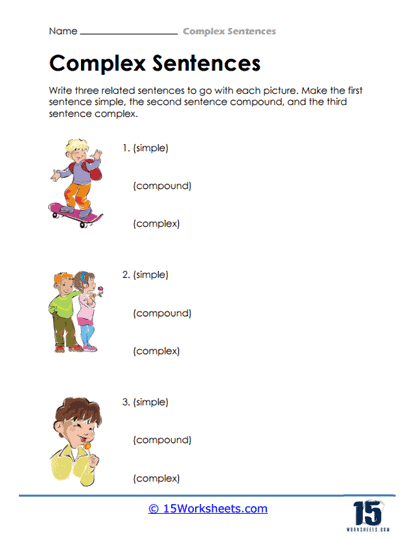
Students look at pictures and write complex sentences to describe them. The visuals inspire creativity and grammar application. It’s fun and interactive practice. Kids connect grammar skills to real communication.
What are Complex Sentences?
Complex sentences are sentences that contain an independent clause (a complete sentence) and at least one dependent clause (an incomplete sentence). The dependent clause relies on the independent clause for meaning and cannot stand alone as a complete sentence. Complex sentences are used to express relationships between ideas, such as cause and effect, condition, contrast, concession, and time.
Here are five examples of complex sentences:
“Although it was raining, she went for a walk.”
Independent clause: “She went for a walk.”
Dependent clause: “Although it was raining.”
This sentence shows a contrast between the action of going for a walk and the condition of rain.
“Because I studied hard, I passed the exam.”
Independent clause: “I passed the exam.”
Dependent clause: “Because I studied hard.”
This sentence shows a cause and effect relationship between studying hard and passing the exam.
“I will go to the party if I finish my work.”
Independent clause: “I will go to the party.”
Dependent clause: “if I finish my work.”
This sentence expresses a condition. The speaker will go to the party if they finish their work.
“She couldn’t watch the movie since she didn’t have a ticket.”
Independent clause: “She couldn’t watch the movie.”
Dependent clause: “since she didn’t have a ticket.”
This sentence indicates a cause and effect relationship. The reason for not being able to watch the movie is the lack of a ticket.
“After I eat dinner, I will go for a run.”
Independent clause: “I will go for a run.”
Dependent clause: “After I eat dinner.”
This sentence expresses a time relationship. The speaker plans to go for a run after eating dinner.
How Do You Identify a Complex Sentence?
To identify a complex sentence, you need to look for certain structural elements within the sentence. A complex sentence consists of an independent clause and at least one dependent clause. Here’s how you can identify a complex sentence:
Look for an Independent Clause – An independent clause is a group of words that can stand alone as a complete sentence because it expresses a complete thought. It contains a subject and a predicate. Identify the main idea or complete thought in the sentence.
Example: “I went to the store.”
In this sentence, “I went to the store” is an independent clause.
Look for a Dependent Clause – A dependent clause, also known as a subordinate clause, cannot stand alone as a complete sentence because it does not express a complete thought. It depends on the independent clause for meaning and usually begins with a subordinating conjunction or a relative pronoun.
Example: “because I needed some groceries.”
In this sentence, “because I needed some groceries” is a dependent clause.
Identify the Relationship – Determine how the dependent clause is related to the independent clause. Dependent clauses can express various relationships such as cause and effect, condition, contrast, concession, and time.
Example: “I went to the store because I needed some groceries.”
In this sentence, the independent clause is “I went to the store,” and the dependent clause is “because I needed some groceries.” The dependent clause provides the reason or cause for the action expressed in the independent clause.