
Active and Passive Voice Worksheets
All About These 15 Worksheets
Active and passive voice might sound like something out of a grammar courtroom, but they’re really just two different ways of arranging who does what in a sentence. In active voice, the subject takes charge-“The cat chased the mouse.” In passive voice, the subject is more laid-back-“The mouse was chased by the cat.” Both are useful, but students often need practice figuring out when to use each. That’s exactly what this collection is here for.
These worksheets offer a balanced mix of identification, rewriting, and even a bit of creative play. Some sheets focus on quick “spot the difference” exercises, while others dive deeper into how changing the voice affects tone, clarity, and style. There are even worksheets that show how passive voice can be used on purpose to build suspense or mystery-perfect for budding storytellers. The variety keeps the practice fresh and helps learners build both accuracy and flexibility.
On top of improving grammar skills, these worksheets help students become sharper writers overall. They’ll learn how word choice and sentence structure affect meaning and impact, making their writing more effective in both academic and real-world contexts. Whether it’s editing essays, writing stories, or simply sounding more confident on paper, this collection gives students the tools to command their own sentences.
Have a Look Inside Each Worksheet
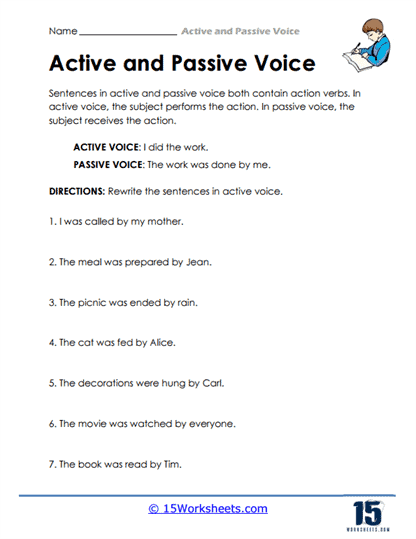
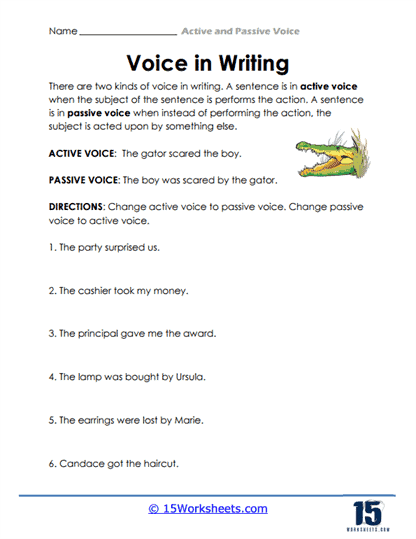
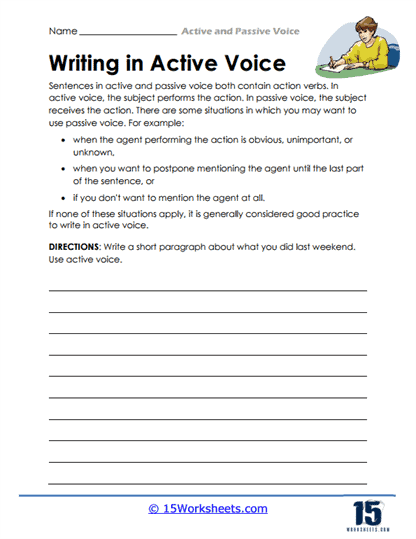
Writing in Active Voice
This worksheet focuses on sharpening students’ skills in writing strong, direct sentences. Learners practice turning weak or wordy structures into clear active-voice statements. The activities highlight why active voice is preferred for impact and clarity. It’s a great way to build confidence in everyday writing.
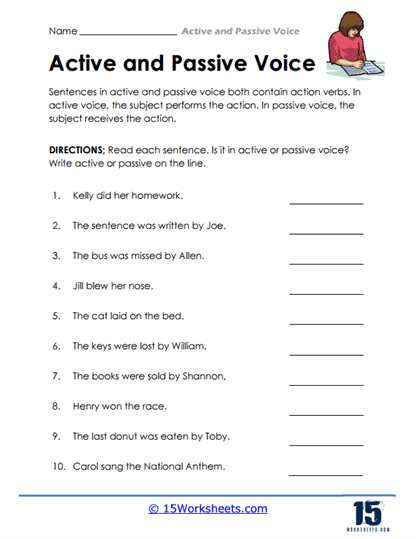
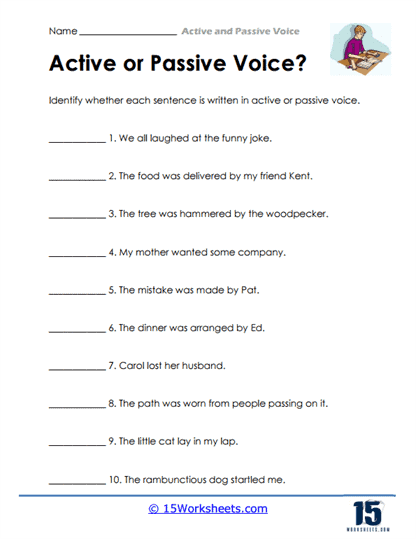
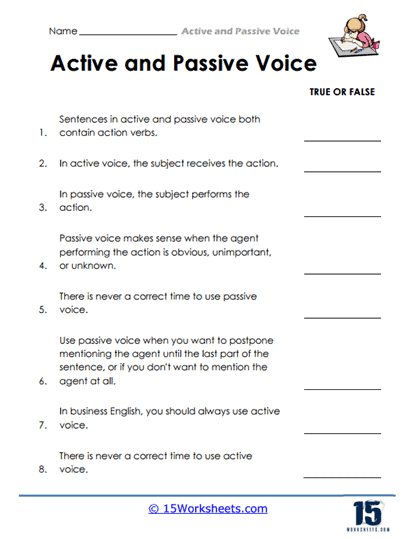
Active or Passive?
Students get to play “detective” by identifying whether sentences are in active or passive voice. The worksheet includes examples that test observation skills and understanding of sentence structure. Learners will also practice switching sentences between voices. It turns grammar practice into a fun, quick-spotting challenge.
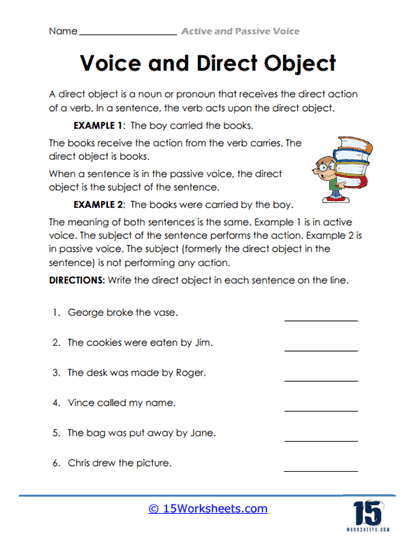
Voice and Direct Object
This worksheet helps students connect active and passive voice with direct objects in sentences. They’ll learn to trace who is doing the action and who receives it. By practicing identification and rewriting, they deepen their understanding of how sentences are built. It’s an excellent step toward mastering complex sentence structures.
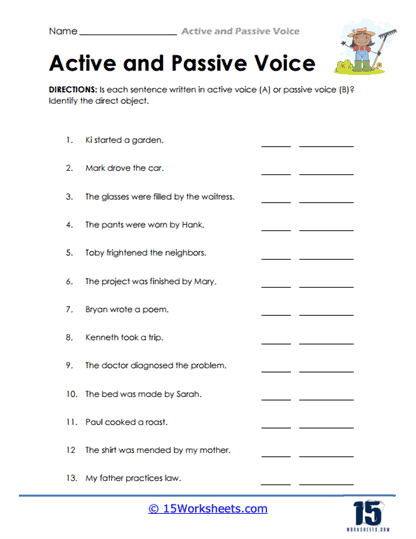
A or B
Here, students compare two versions of sentences-one in active voice and one in passive. They’ll decide which is clearer, stronger, or more effective in each case. The exercise encourages critical thinking about writing style and audience impact. It’s a simple but powerful way to highlight why voice matters.
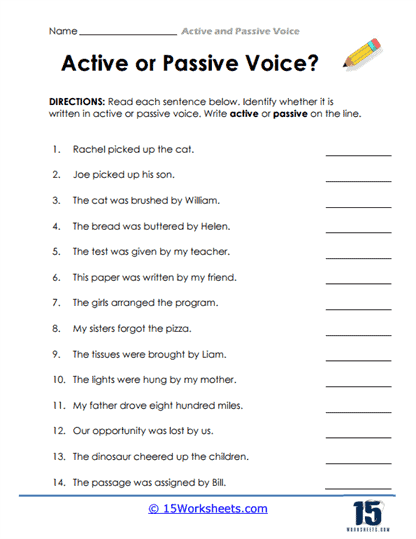
Classify It
This worksheet challenges students to sort sentences into active and passive categories. The activity trains them to recognize grammar patterns quickly and accurately. Once sorted, learners reflect on the different effects of each voice. It’s like a sorting game that builds both speed and skill.
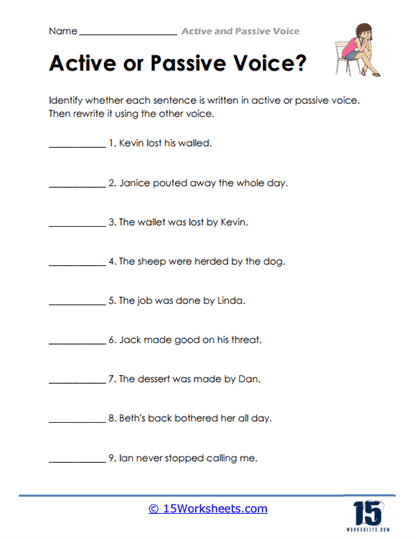
Switching Voice
Students dive into sentence transformation exercises, moving phrases from active to passive and vice versa. The worksheet encourages flexibility in thinking about sentence construction. It shows how meaning can stay the same while tone and focus shift. Learners will come away with stronger control over their writing style.
Simple Sentences
This worksheet starts at the foundation: using short, simple sentences to learn about active and passive voice. Students break down easy examples to see how voice works. They’ll practice rewriting and comparing outcomes in each style. It’s perfect for beginners who need a solid introduction.
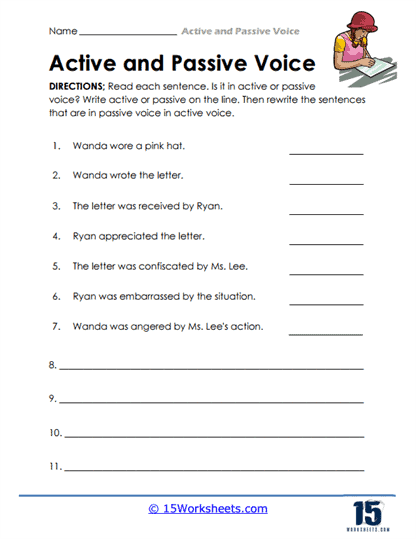
Passive to Active
The focus here is on rewriting sentences written in passive voice into more direct active-voice versions. Students learn why active often improves clarity and style. The exercise sharpens editing and proofreading skills. It’s like giving sentences a makeover for stronger impact.
Switch It Up
This worksheet gives students practice with a variety of sentence types that they’ll flip between voices. It builds fluency and flexibility in manipulating sentence structure. The playful approach keeps the activity from feeling repetitive. It’s grammar practice with a creative twist.
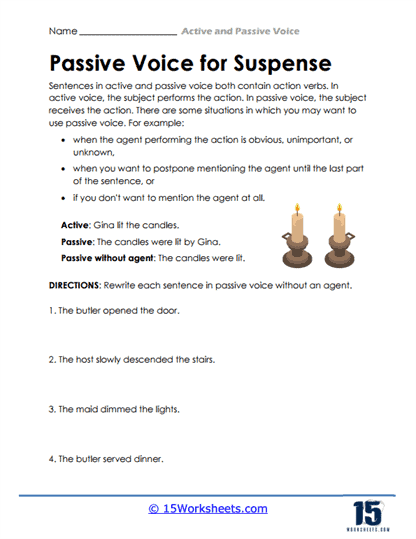
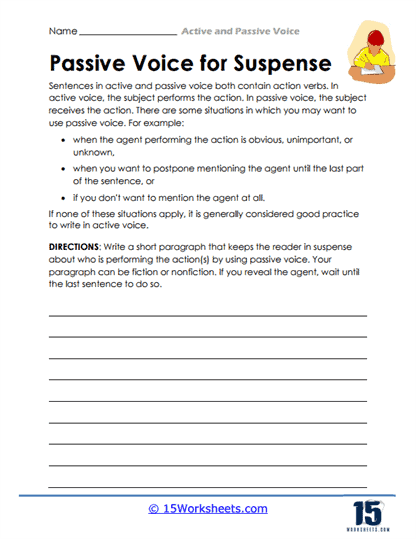
Passive Voice for Suspense
Students learn that passive voice isn’t “bad”-it has a special use for creating suspense and mystery. The worksheet highlights how shifting focus can build tension. Learners practice rewriting sentences to explore this stylistic effect. It’s a fun way to see how grammar can shape storytelling.
Understanding Active and Passive Voice
This worksheet takes a more in-depth look at what defines each voice. Students practice labeling, rewriting, and explaining sentence structures. It’s designed to deepen comprehension rather than just quick identification. Great for reinforcing the “why” behind the rules.
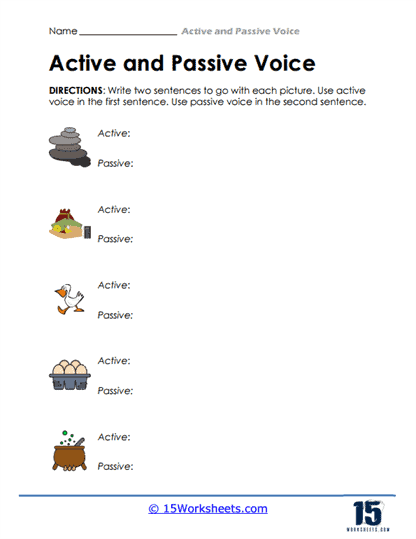
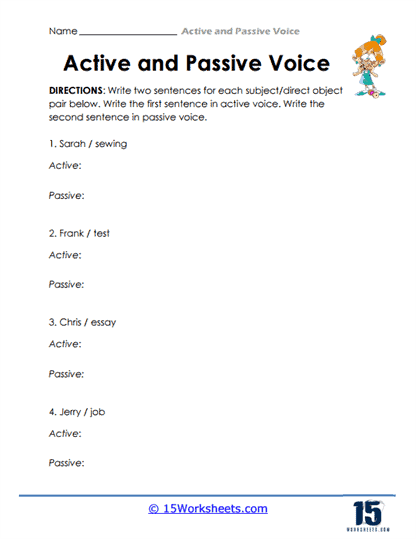
Write 2 Sentences
Students are prompted to write their own sentences in both active and passive voice. The worksheet pushes them to apply knowledge rather than just spot examples. It builds creativity and personal ownership of grammar. Learners will see how flexible language can be when they control it themselves.
More Suspense
A follow-up to the earlier suspense worksheet, this one dives deeper into how passive voice can change tone. Students practice rewriting and comparing the mood of active versus passive sentences. It encourages thoughtful stylistic choices in writing. Perfect for kids who enjoy creative twists in grammar.
Subject and Direct Objects
This worksheet reinforces understanding of sentence parts by focusing on subjects and direct objects. Students learn how these roles shift when switching from active to passive voice. The activities encourage careful analysis and rewriting. It’s a strong tool for connecting grammar rules with sentence meaning.
Writing in Active Voice (Advanced)
This version pushes students further into active voice mastery. They’ll work with more complex sentences and practice editing text for clarity. The focus is on polishing writing to make it bold and engaging. It’s a final challenge that builds toward fluency in voice choice.
What Is Active and Passive Voice Writing?
The difference between writing in active and passive voices lies in the way the action in a sentence is presented and how the subject and object are related. Both voices can be used in writing, but they have different effects on the clarity and style of the text.
Active Voice
In active voice, the subject of the sentence performs the action. The focus is on the doer of the action, making the sentence more direct and clear. Active voice is generally preferred in writing because it is more concise and easier to understand. It is also considered more engaging and dynamic.
Example: The dog (subject) chased (verb) the cat (object).
Passive Voice
In passive voice, the subject of the sentence is acted upon by the verb. The focus shifts from the doer of the action to the receiver of the action. Passive voice can sometimes result in sentences that are less clear or more wordy, but it can be useful in certain situations, such as when the doer of the action is unknown, unimportant, or deliberately being omitted.
Example: The cat (subject) was chased (verb) by the dog (agent).
In general, it is a good practice to use active voice whenever possible to make your writing more clear, concise, and engaging. However, there are situations where passive voice is appropriate or necessary, so it is essential to understand both and use them effectively.
Improving your ability to write in the active voice involves developing a better understanding of sentence structure and practicing the skill until it becomes second nature. Here are some tips to help you improve your ability to write in active voice:
Understand the difference between active and passive voices. Familiarize yourself with the distinctions between the two voices, as explained in the previous answer. Knowing the differences will help you recognize when you are using passive voice and make it easier to switch to active voice.
Identify the subject and verb. In each sentence, identify the subject (the doer of the action) and the verb (the action itself). Ensure the subject is performing the action, rather than having the action done to it.
Practice rewriting sentences. Take sentences written in passive voice and practice rewriting them in active voice. This exercise will help you become more comfortable with the process and better recognize passive constructions.
Use strong action verbs. Choose specific and vivid verbs that clearly convey the action taking place. Avoid weak or generic verbs, such as “is,” “are,” “was,” or “were,” which can often lead to passive constructions.
Minimize the use of “to be” verbs. The verbs “is,” “am,” “are,” “was,” “were,” “be,” “being,” and “been” often signal passive voice when combined with past participles. Try to minimize their use and opt for more active verbs instead.
Be mindful of your writing style. When writing, be conscious of your tendency to use passive voice. Make a deliberate effort to use active voice, and over time, this will become more natural.
Edit and revise. After writing, go through your work and identify any instances of passive voice. Rewrite those sentences in active voice to strengthen your writing.
Read and analyze other texts. Study examples of writing that effectively use active voice. Pay attention to how the authors construct their sentences and convey action. This will help you learn from their techniques and improve your own writing.
Seek feedback. Share your writing with others and ask them to specifically comment on your use of active voice. They may be able to point out instances of passive voice that you missed and offer suggestions for improvement.
Practice regularly. Like any skill, writing in active voice improves with practice. Write regularly and consistently work on incorporating active voice into your writing.
By following these tips and consistently practicing, you will improve your ability to write in active voice, making your writing clearer, more engaging, and more effective.
How to Write in Passive Voice
Although the active voice is generally preferred for clarity and conciseness, there are situations where the passive voice is appropriate or even necessary. To write in the passive voice, follow these steps:
Identify the subject and object – Determine the subject (the doer of the action) and the object (the receiver of the action) in the sentence. In passive voice, the focus is on the object or the action itself, rather than the subject.
Reverse the order of the subject and object – In passive voice, the object takes the place of the subject in the sentence. Rearrange the sentence so that the object comes before the verb, and the subject (if included) comes after the verb.
Use a form of “to be” verb – In passive constructions, a form of the verb “to be” (is, am, are, was, were, be, being, or been) is used in combination with the past participle of the main verb. Choose the appropriate form of “to be” according to the tense and subject of the sentence.
Add the past participle of the main verb – The main verb in passive voice sentences is in the past participle form (e.g., written, eaten, played). Combine the past participle with the appropriate form of “to be” to create the passive verb phrase.
Include the agent (optional) – If the doer of the action is relevant or necessary for context, include the agent by adding the preposition “by” followed by the subject. However, in some cases, the agent may be unknown, unimportant, or intentionally omitted, in which case you can leave it out.
Here’s an example to illustrate the process:
Active voice: The scientist (subject) conducted (verb) the experiment (object).
Passive voice: The experiment (subject) was conducted (verb) by the scientist (agent).
Remember that while it’s important to know how to write in passive voice, it’s generally best to use active voice in your writing for clarity and engagement, unless a specific situation calls for passive voice.
Situations where passive voice may be appropriate include:
When the doer of the action is unknown or unimportant: “The cave paintings were discovered in 1940.”
When the focus is on the action or the receiver of the action: “A new method has been developed to improve battery life.”
When the agent needs to be deliberately omitted or de-emphasized: “Mistakes were made during the project.”
In scientific or technical writing, where the focus is on the process or results, rather than the researchers: “The samples were analyzed using gas chromatography.” In such cases, using passive voice can be an effective choice to convey the intended meaning.