
Topic Sentences Worksheets
All About These 15 Worksheets
Topic sentences might look small on the page, but wow, do they carry a lot of weight. They’re like the GPS for your paragraph, pointing readers in the right direction so nobody gets lost halfway through. Without them, writing feels like wandering through a story with no guide – interesting, maybe, but a little confusing too.
This set of worksheets is all about helping students see just how powerful one good sentence can be. Some sheets are light and playful – like checking yes/no boxes or spotting clue words – while others are more hands-on, like crafting sentences from pictures or planning an argument. The variety means kids aren’t just memorizing rules; they’re actually trying out different ways to say, “Here’s the main idea!”
And honestly, these aren’t just writing drills. They build skills kids will use outside of school too – organizing thoughts, taking a stand, and making themselves clear when they talk or write. Think of it as training wheels for better communication, whether that’s in an essay, a class discussion, or even texting a friend.
Have a Look Inside Each Worksheet
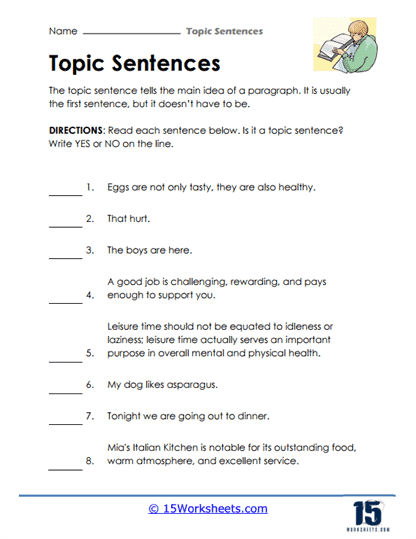
Yes Or No
In this worksheet, students decide whether given sentences or statements qualify as good topic sentences or not. It helps them learn to distinguish topic sentences from supporting details or irrelevant information. The yes/no format makes the activity quicker and builds confidence in recognition. This supports understanding how the main idea sets the tone for a paragraph.
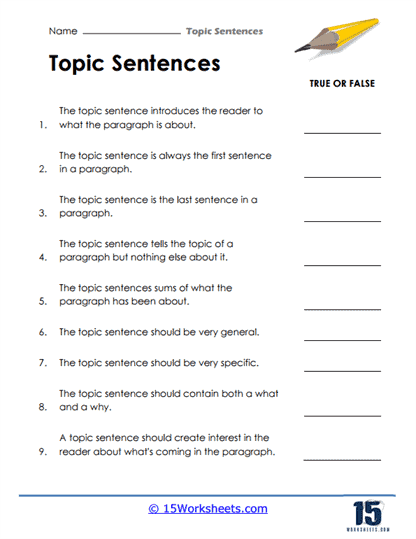
True Or False
Students read sentences and choose whether the sentence is a true topic sentence (one that captures the main idea) or false (it doesn’t). This reinforces what makes a topic sentence strong versus weak. It encourages critical thinking and reading carefully. Great for sharpening skills in spotting what truly defines the main idea.
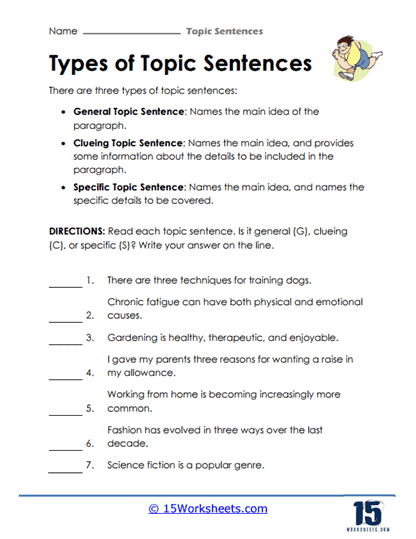
Learn The Types
This one likely introduces different kinds of topic sentences (maybe general vs specific; claim vs fact; maybe question vs statement). Students may categorize example sentences into the different types. They’ll develop awareness of variety in topic sentence structure. Helps them understand not just what topic sentences are, but how they can differ.
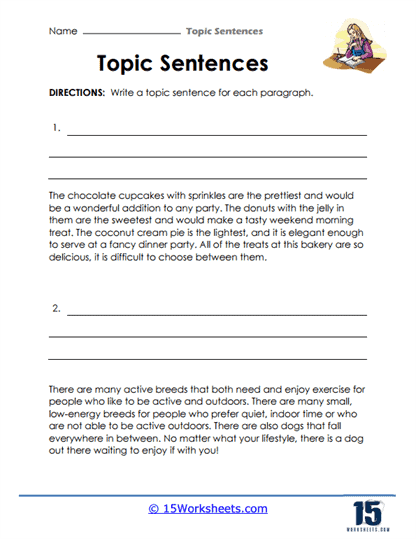
One For Each
Probably students are given a list of supporting details or mini-paragraphs and must write one topic sentence for each. Or possibly they match topic sentences to paragraphs. It gives practice in crafting topic sentences tailored to a set of supporting information. Builds skill in synthesis – pulling together details under a single coherent statement.
Clue Words
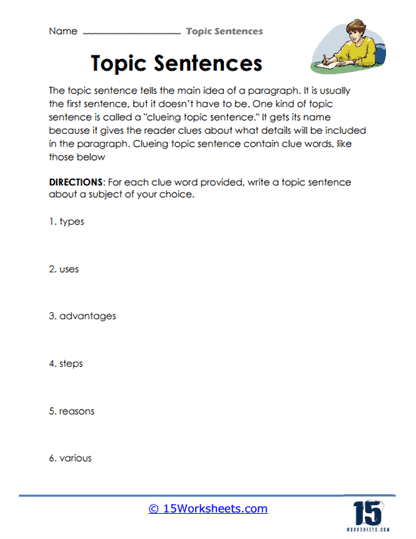
Students look for “clue words” or signal words that often appear in topic sentences – words like “mainly,” “primarily,” “overall,” “in conclusion,” etc. Or they may need to insert clue words in weak topic sentences. Helps with recognizing linguistic signals of main ideas. Supports vocabulary awareness and strengthens precision in writing topic sentences.
Follow The Prompts
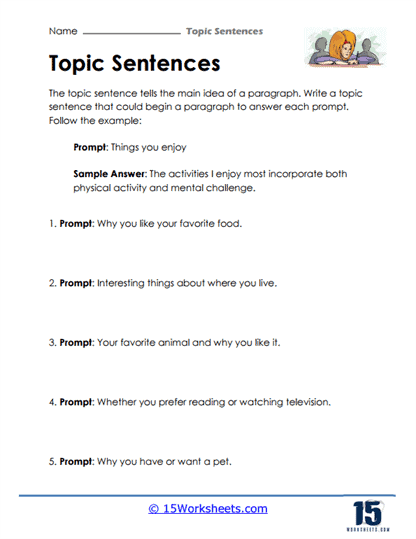
Here students are given prompts (topics or starts of idea) and must write topic sentences from them. Might also have them modify weak topic sentences based on prompts. Encourages creativity in starting a paragraph. Builds independence in writing topic sentences rather than just identifying them.
Compound And Complex
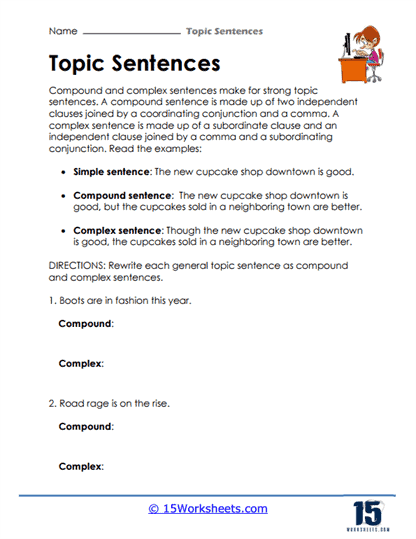
Focuses on students writing or identifying topic sentences that are compound or complex in structure (i.e. with multiple clauses). They practice more sophisticated sentence construction. Helps students vary their writing and avoid overly simple topic sentences. Builds understanding of how adding clauses can clarify or nuance the main idea.
Fill Out The Info
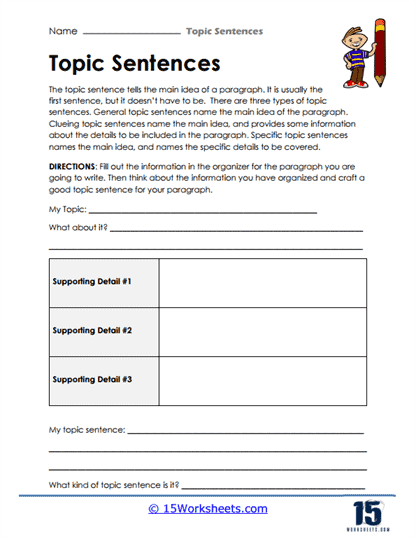
Probably students are given supporting details and asked to “fill out” missing pieces of a topic sentence (e.g. missing subject, main idea, or qualifier). Or they could be given a topic sentence scaffold to complete. Helps practice structure – what parts a topic sentence should include. Reinforces clarity and completeness.
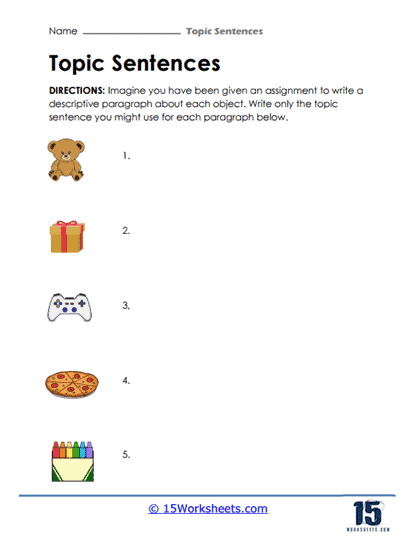
Describe What You See
Likely uses images or scenes, asks students to look and craft topic sentences that describe the main idea. Encourages use of observation and descriptive language. Connects visual stimuli to writing. Helps students see how a topic sentence captures the “big picture” idea rather than mere details.
Change The Type
Maybe students rewrite topic sentences changing their type: turning a simple one into a compound/complex one, or changing a question type into a statement, etc. Helps them see flexibility in how main ideas can be expressed. Encourages revision skills. Reinforces how structure affects meaning and tone.
Take A Position
Students likely choose a stance on a topic and write a topic sentence that reflects that position. Good practice for persuasive or argumentative writing. Helps students think critically and express point of view early. Builds ability to set up paragraphs that will argue or support a position.
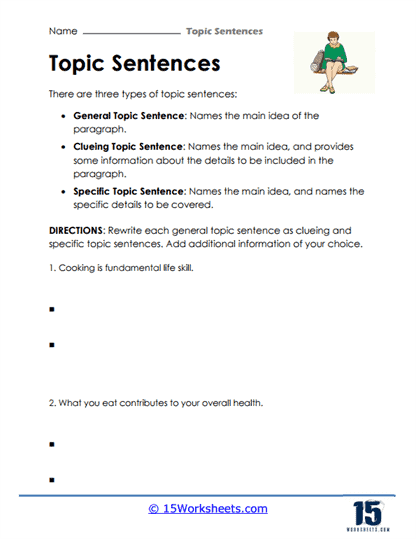
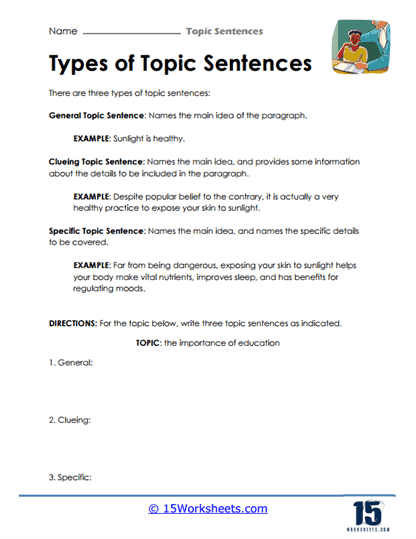
Three Kinds
Probably introduces three types of topic sentences (such as general, specific, question-based, etc.) and has students identify or write examples of each. Gives variety in thinking about what a topic sentence can look like. Helps with flexibility and understanding different styles. Strengthens awareness of tone and audience.
Clueing With A Clue
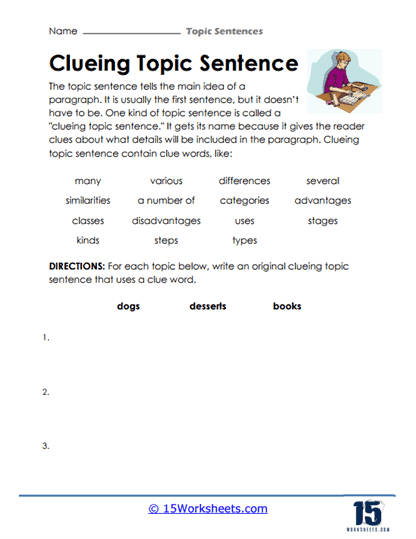
This seems similar to “Clue Words,” but perhaps stronger: students get clues or hints embedded in supporting details and use them to craft topic sentences. Encourages inference and integrating details. Develops skill in synthesizing info to locate the main idea. Makes students active in constructing topic sentences from clues.
Plan Then Compose
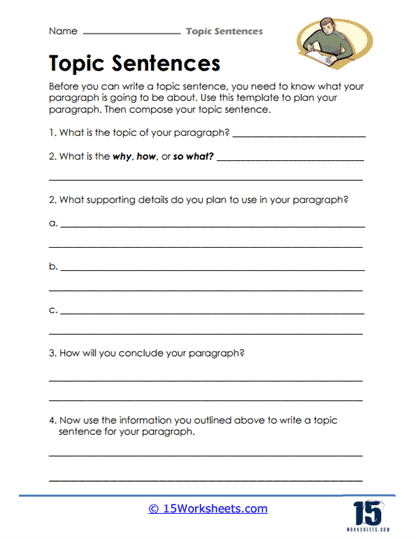
Students first plan: decide what their main idea is and what supporting details will be, then compose the topic sentence. A two-step process to build thoughtfulness in writing. Helps with organization and pre-writing planning. Encourages more effective, intentional topic sentence construction.
Read And Answer
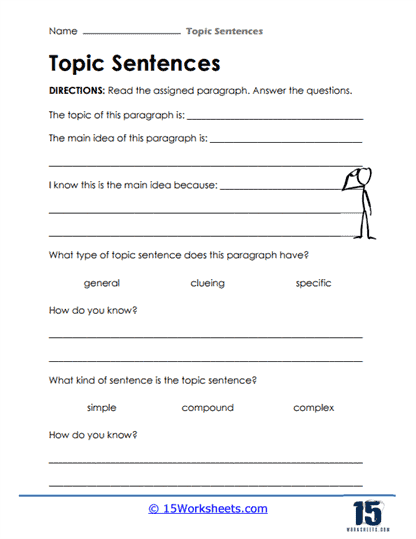
Probably students read a short paragraph or text, then answer questions about what the topic sentence is, or write their own based on reading. Reinforces both reading comprehension and writing. Helps students connect reading and writing skill sets. Builds ability to extract the main idea from texts and reflect it in a topic sentence.
What is a Topic Sentence?
A topic sentence is the main sentence in a paragraph that summarizes the central idea or point the paragraph will discuss. It acts as a guide for the reader, indicating what to expect in the sentences that follow. Typically, the topic sentence is the first sentence of a paragraph, though it can sometimes appear in the middle or even the end. It directly supports the thesis statement of an essay or a broader argument by introducing a specific point that contributes to the overall argument or idea. In doing so, it helps maintain a logical flow and coherence within the writing.
A good topic sentence is clear and concise, focusing on a single idea that can be elaborated upon in the rest of the paragraph. The supporting sentences that follow provide examples, evidence, or further explanations to back up the idea presented in the topic sentence. While the topic sentence often reveals the paragraph’s subject, it also may indicate the writer’s stance or attitude toward the topic. By crafting a strong topic sentence, writers ensure that their paragraphs are well-organized and effectively contribute to the essay’s overall purpose.
How to Write a Topic Sentence
The first step in writing a high-quality topic sentence is to have a clear understanding of the paragraph’s main idea or focus. Before writing, ask yourself: what is the key point I want to convey in this paragraph? The topic sentence should encapsulate this point in a concise manner. It’s important to ensure that the topic sentence relates directly to the thesis or main argument of the larger piece of writing. A well-crafted topic sentence does not merely state a fact but introduces an idea that the paragraph will explore in more depth, setting the stage for the supporting evidence that follows.
Be Clear and Specific
A high-quality topic sentence should be clear and specific, giving the reader a precise idea of what the paragraph will discuss. Vague or overly broad sentences can confuse the reader or make the paragraph feel unfocused. To avoid this, focus on a single point or idea rather than trying to introduce multiple concepts at once. For instance, instead of saying, “Many factors affect climate change,” a more focused topic sentence would be, “Human activities, such as burning fossil fuels and deforestation, are the primary contributors to climate change.” The latter is specific and sets a clear direction for the paragraph.
Connect to the Thesis
The topic sentence should not exist in isolation but should tie back to the essay’s overall thesis or argument. Every paragraph in a well-structured essay should support the central thesis, and the topic sentence helps achieve that by framing the paragraph in relation to the larger argument. For example, if your essay’s thesis is about the importance of renewable energy, a good topic sentence might be, “Solar power offers a viable alternative to fossil fuels because it is sustainable and increasingly affordable.” This sentence connects directly to the larger theme of renewable energy and primes the reader for evidence and discussion that will follow.
Make It Engaging
A great topic sentence not only informs but also engages the reader’s interest. This can be achieved by using strong and active language, asking a question, or presenting a surprising fact or statistic. For example, a topic sentence like, “Why do some societies thrive while others struggle?” immediately grabs attention and invites the reader to think more deeply. An engaging topic sentence encourages the reader to continue reading with interest and curiosity, ensuring they remain engaged with the content of the paragraph.