
R Controlled Vowels Worksheets
All About These 15 Worksheets
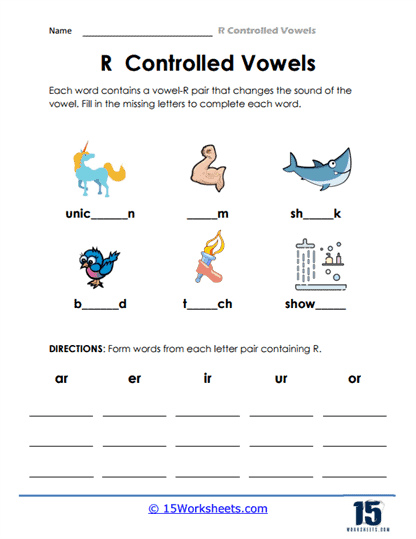
R controlled vowels, often called “bossy R,” are one of those phonics hurdles that can trip up early readers. When a vowel is followed by an R, it stops sounding like the vowel they expect, and instead takes on a whole new sound-like in car, bird, fur, or fork. These worksheets are built to tackle that confusion head-on with plenty of hands-on activities. Kids sort, circle, spell, match, and even draw R-controlled words, giving them lots of different ways to practice and really lock the concept in.
The collection covers all the major R-controlled vowel teams: ar, er, ir, or, ur. Some sheets zero in on one pattern, while others mix them together for comparison. That balance of focus and variety makes the worksheets useful for both introducing the patterns and reviewing them later. By repeatedly seeing how “bossy R” changes vowel sounds, kids start to read and spell these tricky words with confidence.
Beyond just decoding, these worksheets help kids understand that language doesn’t always play by simple rules. They encourage flexibility in thinking, attention to spelling patterns, and stronger listening skills. Since R-controlled vowels appear constantly in everyday reading, mastering them builds a foundation for smoother reading, clearer spelling, and greater confidence with more complex words.
Have a Look Inside Each Worksheet
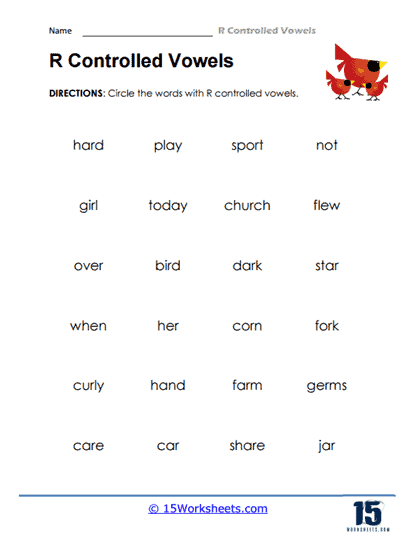
Word Hunt
Students scour a scene filled with words to pick out those containing bossy-R patterns like ar, er, ir, or, or ur. It’s like a phonics treasure hunt that keeps their eyes and ears sharp. The activity builds awareness of how “R” changes vowel sounds. It reinforces recognition through play and engagement.
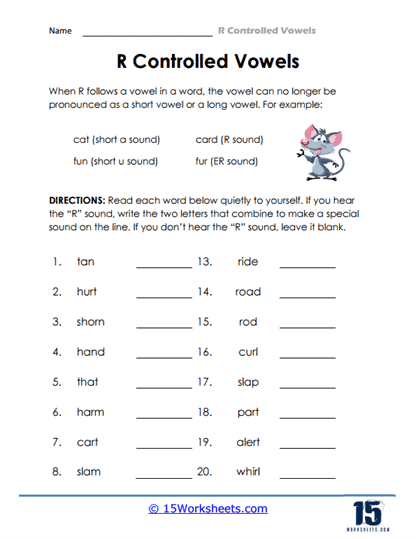
Reading Quietly
Learners read short passages or lists that feature R-controlled words in context-perfect for building fluency. It helps them hear how R affects vowel sounds within real reading situations. Quiet reading reinforces decoding skills calmly and confidently. It supports reading fluency and comprehension simultaneously.
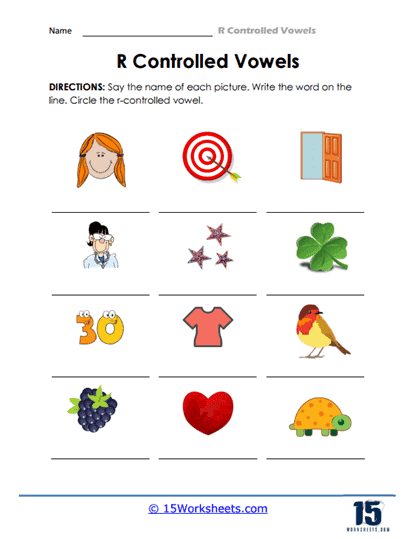
Naming Pictures
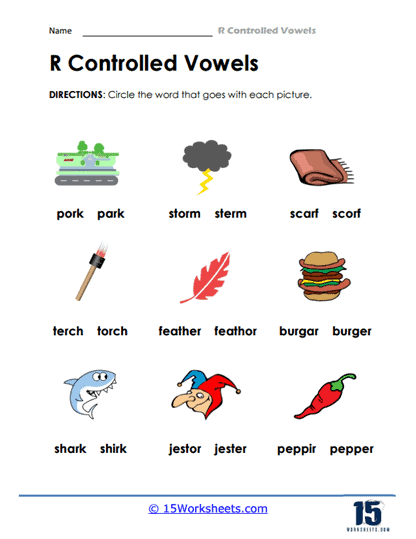
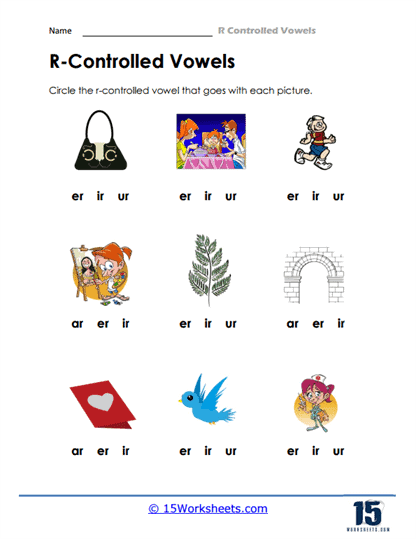
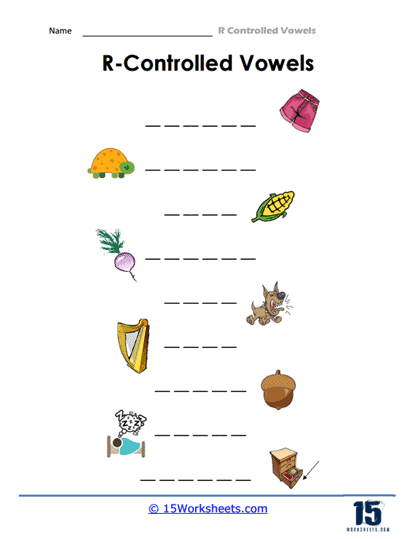
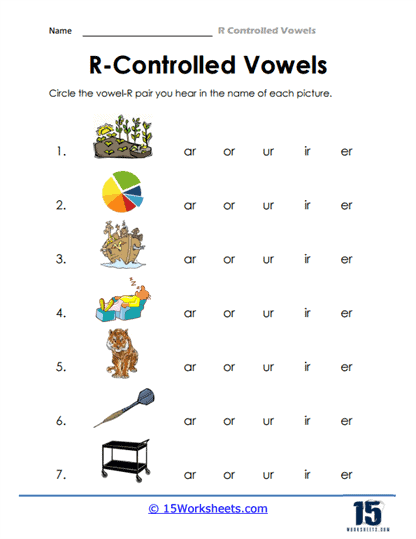
Kids look at images (like a bird or fork) and name them, focusing on identifying the R-controlled vowel in each word. The visual clue makes phonics feel instantly recognizable. It connects spoken sound, meaning, and spelling in one step. It strengthens vocabulary alongside phonemic awareness.
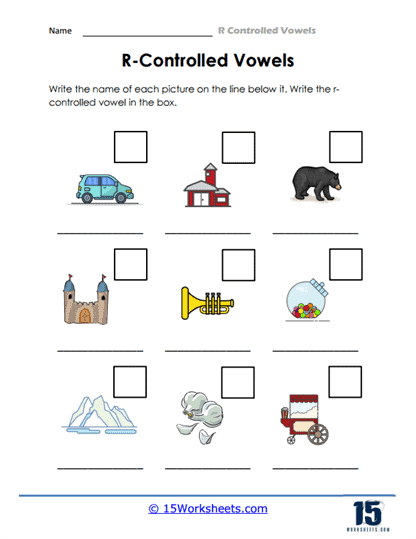
Vowel In a Box
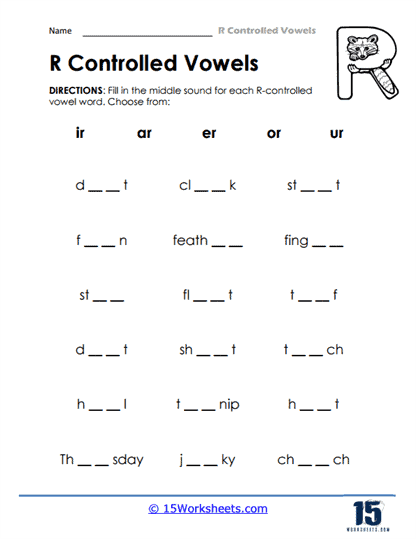
A fill-in-the-blank style sheet where students slot the correct vowel-R combination into a “box,” completing words like “b_rn” to make barn. It visually separates the key part of the word they’re focusing on. This supports spelling clarity by isolating the tricky bit. It reinforces the bossy-R pattern directly.
Missing Middle
Here, the vowel-R pair is removed from the middle of a word, and students must figure it out to complete the word correctly. It’s like solving a small phonics puzzle. This deepens awareness of vowel sounds in tricky spots. It’s both fun and instructive.
Circle The Match
Students match words with the same R-controlled vowel sound-circling the pairs to connect them visually and phonically. It reinforces pattern recognition through pairing. It strengthens blending of sound and meaning. It’s an accessible activity with a matching twist.
Choose From Three
Given three vowel-R options (e.g., ar, er, ur), learners select and insert the correct one to complete words like “f-k” to become fork. It encourages close listening and sound judgment. It’s essentially a phonics multiple-choice quiz. It teaches precision in pronunciation and spelling.
Influence Of R
A worksheet that explicitly highlights how the “r” changes the sound of each vowel, maybe through minimal pairs like “car” vs. “cat.” It pulls back the curtain on the “bossy R” concept in a clear way. Builds phonemic insight about how vowels shift under R’s influence. Strengthens conceptual understanding of phonics.
Letter By Letter
Students build R-controlled words step-by-step, maybe adding one letter at a time to turn “b-” into “bird.” It’s like watching words grow on paper. This pacing supports both spelling and comprehension. It reinforces structure through sequencing.
Spell And Draw
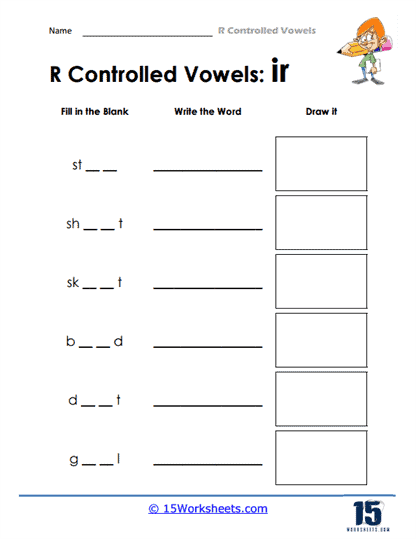
Students spell an R-controlled word and then draw a picture representing it (e.g., writing star and drawing one). It mixes phonics with creativity. Drawing helps cement meaning and memory. It makes the learning memorable and enriching.
Which Pair?
Learners compare and choose between two R combinations, for instance deciding whether the correct spelling is fur or fir. It’s a simple but effective comparison activity. Supports decision-making based on sound and context. Encourages careful listening and spelling.
Unlocking ‘Er’
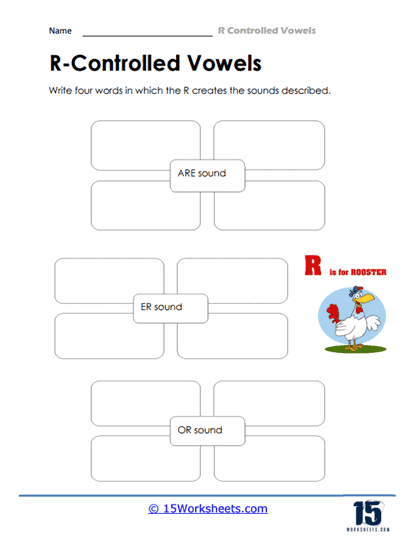
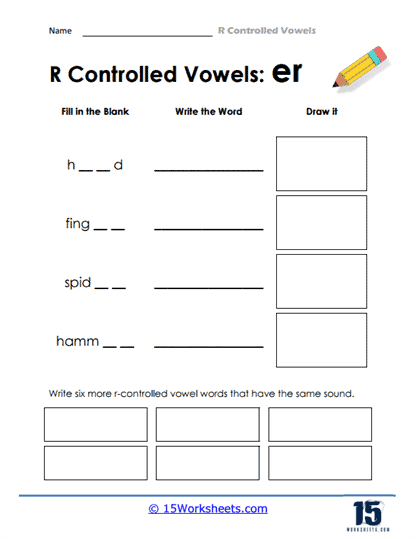
A focused sheet just for words with er, guiding students through examples like her, term, or bird to deepen familiarity. It helps them recognize that er is one specific type of bossy-R. This targeted practice builds confidence in that sound. It reinforces familiarity through repetition.
Completion And Formation
A deeper practice sheet that asks students to both fill in missing R combinations and maybe trace or write the whole words. Combines recognition with motor skills. Strengthens phonics knowledge and writing fluency. Provides well-rounded support in word formation.
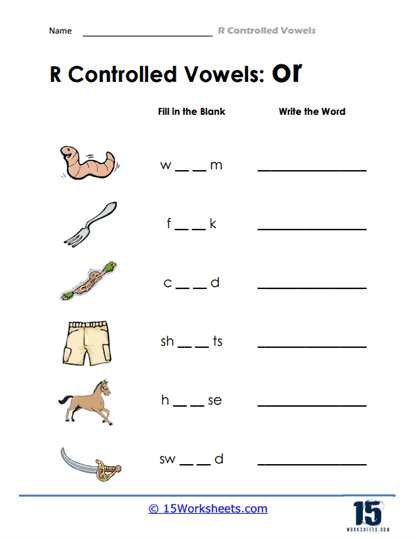
Conquering OR
Focuses solely on or-say, with words like fork, story, or corn-helping learners master this one pattern. It isolates or to highlight the sound it makes under R’s influence. Ideal for learners who need concentrated practice. It builds mastery through focus.
Crafting Words
Students may be encouraged to build their own R-controlled words using provided letter tiles or word parts. There’s a bit of construction play in phonics-like word building with Lego. It’s imaginative and reinforces understanding through creativity. It immerses learners in pattern-application.
Influence Of R (bonus repetition?)
Possibly a variation on earlier sheets that emphasizes R’s impact through another creative lens-sorting or comparing again. The repeat approach helps reinforce learning through variation. It builds retention through revisiting the same core concept. Keeps concepts fresh yet consistent.
What Is Meant by R-Controlled Vowels?
In the English language, vowels play a crucial role in the formation of words and their pronunciation. We often think of vowels as the letters A, E, I, O, and U, but when we dive deeper into the sounds they make, we realize that these five letters produce a wide variety of sounds, known as phonemes. The English language contains nearly 20 distinct vowel phonemes, making it a complex system for learners, especially when trying to master pronunciation and spelling. Among the various types of vowel sounds, one of the trickiest to grasp is the r-controlled vowel.
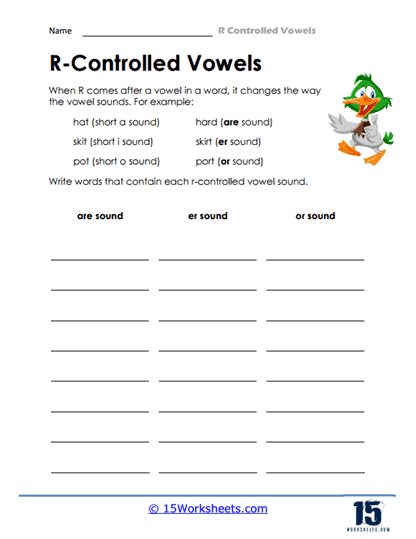
R-controlled vowels occur when a vowel is followed by the letter “r,” which drastically alters the sound of the vowel. Unlike short or long vowels, r-controlled vowels don’t conform to the typical sounds we associate with these letters. Instead, the “r” takes control of the vowel’s sound, bending it into something different, which is why these vowel combinations are sometimes referred to as “bossy r.” This phenomenon is common in words like “car,” “bird,” “star,” and “fork.” The letter “r” exerts such a strong influence over the preceding vowel that it essentially creates a new sound, making it neither long nor short.
Understanding and mastering r-controlled vowels is essential for developing strong reading and phonics skills. These vowel sounds appear frequently in English, and without proper recognition of how the “r” changes the sound, students can easily mispronounce words, leading to confusion in both speech and comprehension. That’s where r-controlled vowels worksheets come into play, providing structured, engaging exercises that help learners practice and internalize these unique vowel sounds. Through these worksheets, students can improve their ability to decode words correctly and enhance their overall reading fluency.
The Importance of R-Controlled Vowels
One of the primary reasons r-controlled vowels are important in reading is their role in developing decoding skills. Decoding is the process by which students break down and interpret the sounds in a word to read it correctly. Since r-controlled vowels don’t follow the usual vowel sound patterns, they can easily confuse readers if not understood properly. Words like “bird,” “car,” and “fur” can present challenges for students if they aren’t familiar with how the “r” changes the sound of the preceding vowel. By teaching students to recognize r-controlled vowels and understand their unique sound, educators help students become more confident in their ability to decode words, leading to smoother, more fluent reading.
For instance, a student who knows the sound of “a” in the word “cat” may initially mispronounce “car” by trying to apply the same vowel sound. When they learn that the “r” in “car” changes the way the vowel is pronounced, they can correctly decode the word. This knowledge allows readers to navigate texts more fluidly without getting stuck on unfamiliar words, which is essential for building reading confidence and speed. R-controlled vowels are an integral part of phonics, the system that teaches students how to decode written language by connecting letters and sounds, and without mastery of these vowel sounds, students may struggle with reading fluency.
Reading Comprehension
Beyond decoding, reading comprehension also relies heavily on students’ ability to recognize and correctly pronounce r-controlled vowels. When students mispronounce words due to an incorrect understanding of these vowels, it can disrupt their overall comprehension of a passage. For example, confusing the word “bird” with “bed” or “fur” with “far” can lead to misunderstanding the meaning of a sentence, which in turn affects a student’s ability to grasp the main ideas or themes in a text. Proper understanding of r-controlled vowels ensures that students can read and interpret texts accurately, which is critical for success in reading comprehension tasks.
The ability to read with understanding depends not only on recognizing individual words but also on understanding how those words fit into larger ideas. When a student can quickly and accurately decode words like “star,” “corn,” or “park” without pausing to figure out how the r-controlled vowels work, they can devote more cognitive energy to making sense of the story or information. This results in deeper comprehension, as students are able to focus on the content rather than getting bogged down by decoding difficulties. In this way, mastering r-controlled vowels is an essential building block for developing higher-level reading skills.
Spelling and Word Recognition
R-controlled vowels also play a significant role in spelling and word recognition. Because these vowels don’t follow the typical short or long vowel sounds, students often make spelling mistakes if they haven’t fully grasped how these vowels are influenced by the letter “r.” For example, a student might incorrectly spell “car” as “cer” or “star” as “stir” because they aren’t yet familiar with the phonics rules governing r-controlled vowels. By mastering these vowel patterns, students improve their spelling accuracy, especially when it comes to common r-controlled words.
Word recognition, or the ability to identify words at a glance without sounding them out, is also enhanced through a solid understanding of r-controlled vowels. When students can instantly recognize words like “turn,” “march,” or “horse,” they are more likely to read fluently and with confidence. This word recognition skill is crucial for becoming a proficient reader, as it reduces the mental effort required to decode every word, allowing students to focus on understanding and enjoying what they are reading.
Phonemic Awareness and Language Mastery
Phonemic awareness, the ability to hear, identify, and manipulate individual sounds in spoken words, is another key area where r-controlled vowels are important. Phonemic awareness is foundational to both reading and writing success because it enables students to break down words into their component sounds. R-controlled vowels, with their distinctive phonetic properties, challenge students to listen carefully to how sounds change when “r” follows a vowel. Understanding these sound changes helps students develop a deeper awareness of the nuances of language, making them more adept at both reading and spelling.
In addition, mastering r-controlled vowels contributes to overall language mastery. These vowels are present in a wide variety of common words used in everyday conversation, academic settings, and literature. Whether students are reading fiction, writing essays, or engaging in classroom discussions, having a firm grasp of r-controlled vowels allows them to communicate more effectively. For example, when students are able to read words like “corner,” “artist,” or “nurse” with ease, they can engage more deeply with the content of a story or conversation. This mastery also helps in writing, as students will be able to spell words correctly and use them confidently in their own work.
As their confidence grows, so does their independence. Students who have mastered r-controlled vowels are less reliant on teachers or parents to help them with difficult words. They can approach new texts with the assurance that they have the tools to decode complex words on their own. This independence is crucial as students progress to more challenging reading materials, including chapter books, textbooks, and beyond. It empowers them to take charge of their own learning and enjoy the process of reading and writing without unnecessary roadblocks.