
Soft G Worksheets
All About These 15 Worksheets
The soft G sound can be a little sneaky for learners-it’s the “j” sound hiding inside the letter G when it appears before E, I, or Y. Words like giant, giraffe, and gentle don’t always follow the “what you see is what you hear” rule, which can confuse kids. These worksheets are designed to make sense of that rule in a fun, approachable way. They turn what might feel like a tricky exception into a pattern that students can master with confidence.
This collection uses a wide variety of activities to keep practice fresh. Some worksheets lean on listening, others on sorting, and some on coloring or writing. Each one reinforces the same phonics rule from a different angle, so learners get multiple chances to recognize, apply, and remember it. That kind of repeated exposure helps cement the concept in long-term memory.
By practicing soft G in different formats, kids start to notice the sound in everyday reading and speaking. They’ll become more accurate spellers, sharper readers, and more confident communicators. Plus, understanding soft G helps them see how English spelling patterns actually do have rules-even if they look a little quirky at first!
Have a Look Inside Each Worksheet
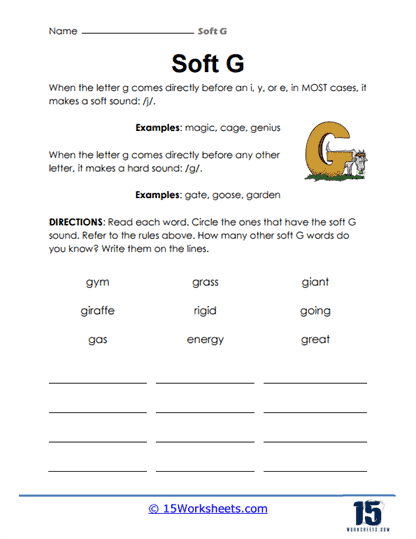
Learn The Rules
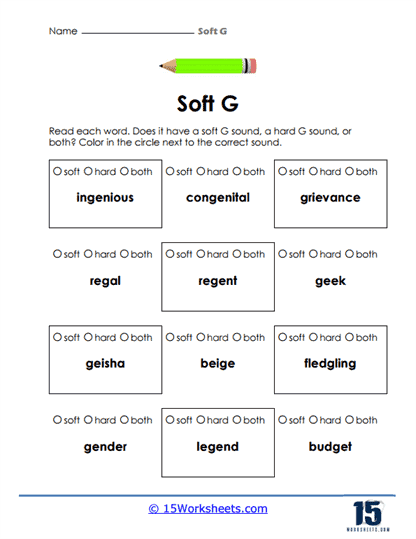
Students explore the “soft G” rule-when the letter G sounds like “j” before E, I, or Y. They review examples and non-examples to build phonics awareness. It sets the stage for smart word decoding.
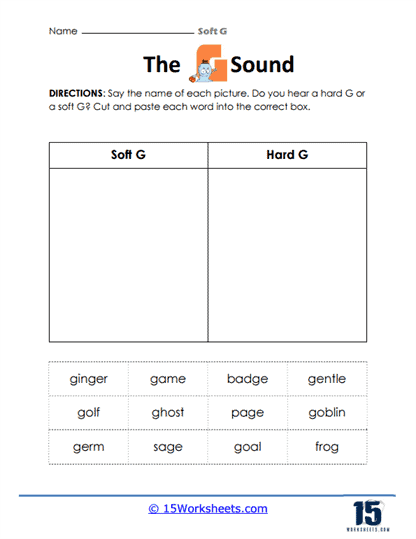
Sort Into Boxes
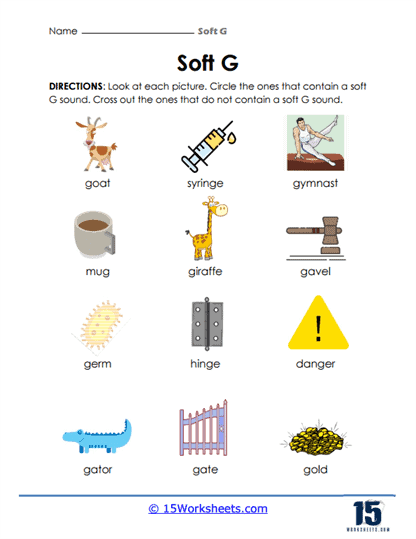
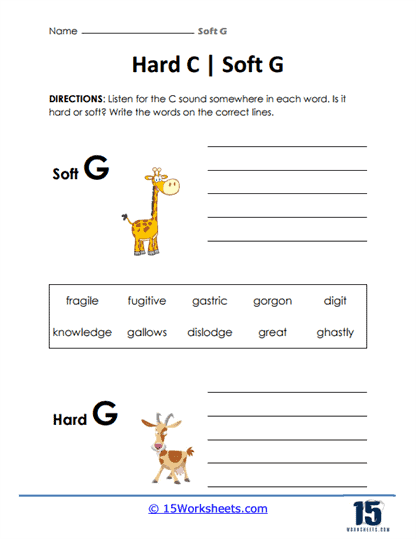
Learners sort words or images into boxes based on whether they use a soft G or not. The visual sorting task helps reinforce the rule in a hands-on way. It’s like organizing a sound-based treasure hunt.
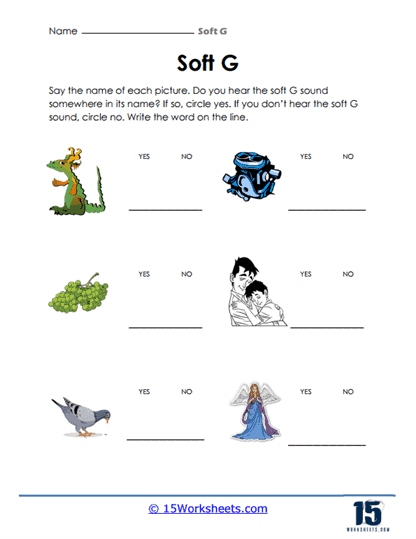
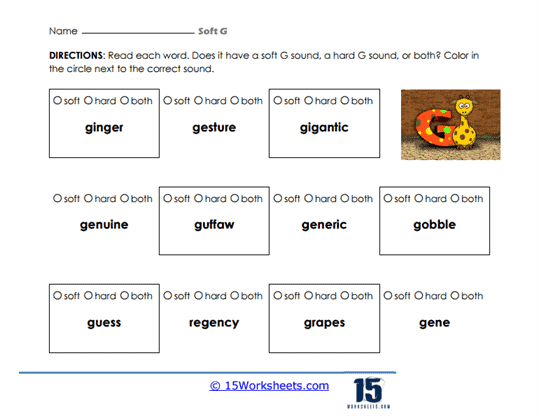
Which Do You Hear?
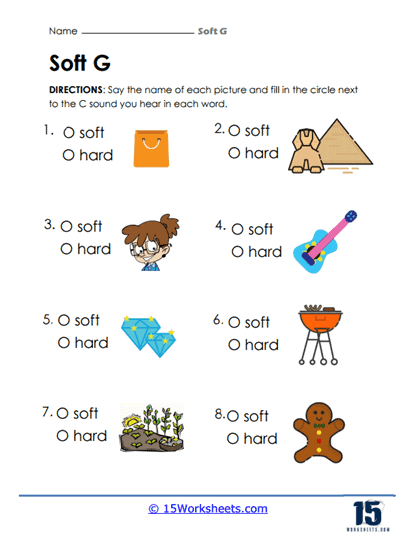
Kids listen to words and decide whether they hear the soft G sound. This sharpens their auditory discrimination and listening skills. It’s a mini sound detective adventure.
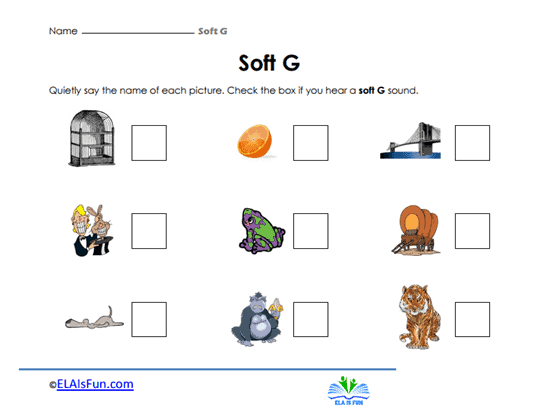
Listen And Check
Students listen to spoken words and then check off those that feature the soft G. It ties auditory input to visual recognition for stronger phonemic connections. This activity bridges listening and reading seamlessly.
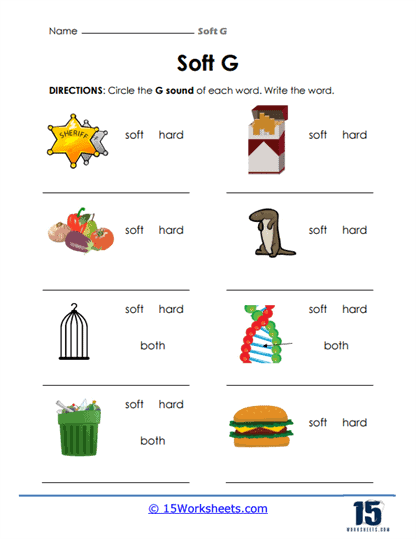
Circle Fill-In
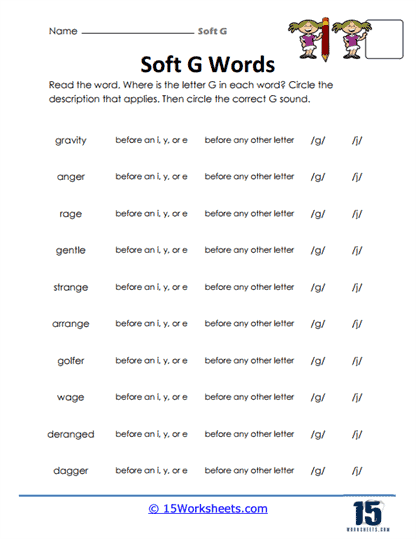
This worksheet invites learners to circle the correct soft G (e.g., “g” or “j”) to complete words. It’s a neat way to connect sound and spelling visually. The simple format makes practice feel crisp and clear.
Categorizing Pictures
Students sort pictures (e.g., “giraffe” vs. “goat”) based on whether the word starts with a soft or hard G. It pairs images with phonics for better recall. Visual and auditory learning work together here.
Word Box Challenge
Kids write or place soft G words into a box grid, organizing them by spelling or sound. It’s a fun flip on crossword-style thinking-but all about sounds. This adds writing practice to the mix.
Say It Aloud
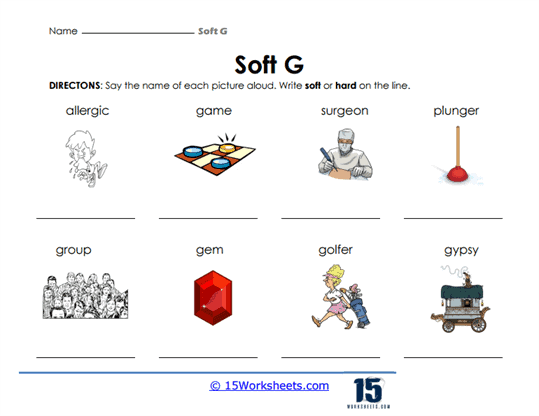
Learners read soft G words aloud to practice pronunciation. The focus is on hearing themselves say “j” for G before E, I, or Y. It helps build confident speaking and awareness.
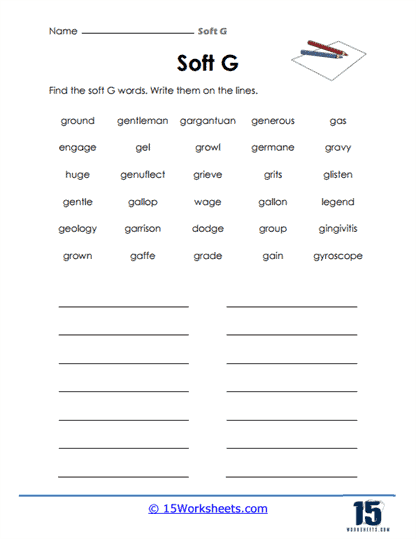
Search And Write
This activity challenges students to find soft G words in a passage or word list and write them out. It supports spelling skills and attention to detail. Plus, it feels like a literacy scavenger hunt.
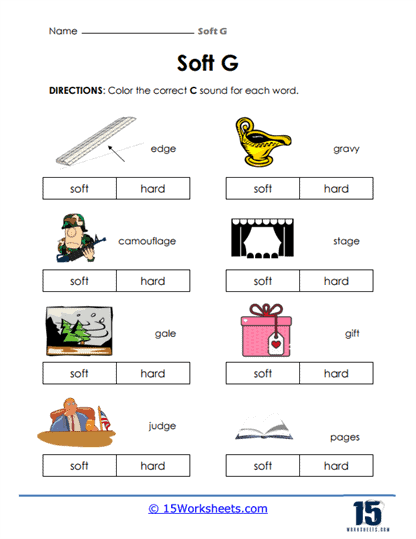
Colorful Circles
Children highlight or color soft G words within a grid or list. The colorful twist turns practice into a creative scanning game. It’s both visually stimulating and phonically focused.
Color Your Choice
Similar to “Colorful Circles,” but with choice-students pick their coloring medium or style to mark soft G words. That personal touch keeps them engaged. It’s learning with artistic flair.
Sound Identification
Students listen and identify if a word has a soft G sound or not. This builds listening discrimination in a focused, auditory way. It’s like training their ears for subtle sound cues.
Interesting Blends
Learners examine blends and decide if the letter combination produces a soft G sound. It deepens their understanding of letter patterns in context. A thoughtful way to connect sounds to spelling patterns.
Form Mastery
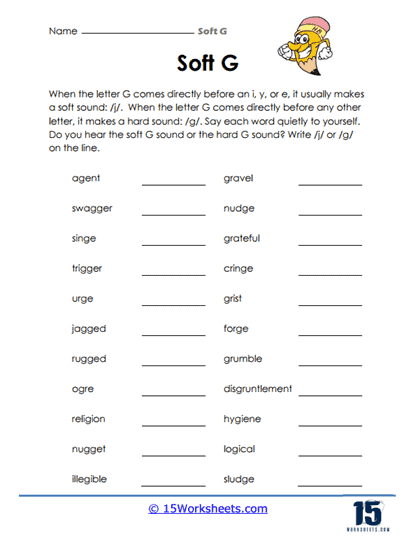
This worksheet helps students practice writing soft G words and mastering their correct forms. It combines handwriting practice with phonics. It reinforces both the look and the sound.
J Versus G
Students compare words starting with “J” (like “jump”) vs. soft G words (like “giraffe”). It helps clarify why G sometimes mimics J before E, I, Y. It’s like a mini phonics showdown with two nearly identical sounds.
What Are Soft G Words?
The term “soft G” refers to the pronunciation of the letter “G” as the /ʒ/ sound, similar to the sound of the letter “J”. The soft G sound occurs when the letter “G” appears before the vowels “E”, “I”, or “Y”.
Here are a few examples of words with the soft G: Gentle, Giraffe, Giant, Gel, Gym, Gypsy, Margin, Age, Cage, Gem
In contrast, when the letter “G” appears before the vowels “A”, “O”, or “U”, it is generally pronounced as a hard G, which sounds like the /g/ sound. For example, words like “go”, “gate”, and “gum” have a hard G sound.
Understanding the difference between soft G and hard G is essential for learners in reading, pronunciation, and spelling.
The Importance of Soft G
Understanding and mastering the soft ‘G’ sound is of great significance for several reasons:
- Reading Proficiency: Accurate recognition and pronunciation of the soft ‘G’ sound are fundamental for fluent reading. They enable students to decode words correctly and comprehend text effectively.
- Spelling Competence: Proficiency in spelling words with the soft ‘G’ sound enhances students’ overall spelling skills. When they can accurately identify and use this sound, they are better equipped to spell words correctly.
- Phonemic Awareness: Recognizing and manipulating the soft ‘G’ sound fosters phonemic awareness-the ability to identify and manipulate individual phonemes (sounds). This skill is crucial for literacy development and reading comprehension.
- Vocabulary Growth: Learning and using words with the soft ‘G’ sound exposes students to a wider range of vocabulary, enriching their comprehension and language skills.