
CVVC Words Worksheets
All About These 15 Worksheets
Learning CVVC words (that’s “consonant-vowel-vowel-consonant”) is like discovering the secret sauce of phonics. These worksheets give kids a front-row seat to how vowel teams work together to make sounds, whether it’s “ee” in feet or “oa” in boat. With picture clues, fill-in-the-blanks, and sorting challenges, the collection keeps practice lively instead of repetitive. Each activity is designed to give students the confidence to decode and spell these tricky words with ease.
The variety here is what makes the set so effective. Some worksheets lean on visuals to help younger learners, while others push kids to categorize or even create their own CVVC words. There’s a healthy mix of puzzle-style fun and structured phonics drills, so children get both accuracy and engagement. It’s a balanced approach that helps the rules stick without turning reading time into a chore.
Beyond phonics, these worksheets support wider literacy skills. Kids aren’t just memorizing patterns-they’re also learning to use these words in sentences, stories, and real communication. Mastering CVVC words gives students a stronger foundation for reading longer texts and writing with confidence. They’ll start spotting these word patterns everywhere, making reading smoother and way more fun.
Have a Look Inside Each Worksheet
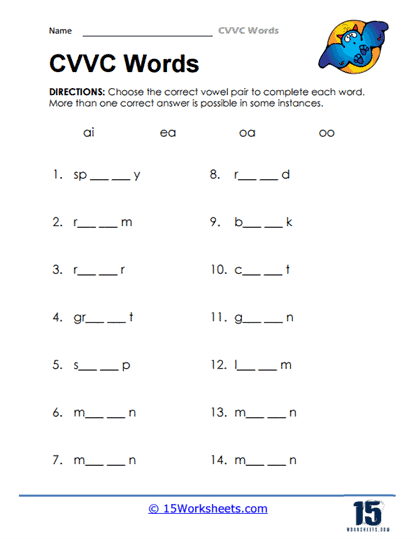
Pick The Perfect Pair
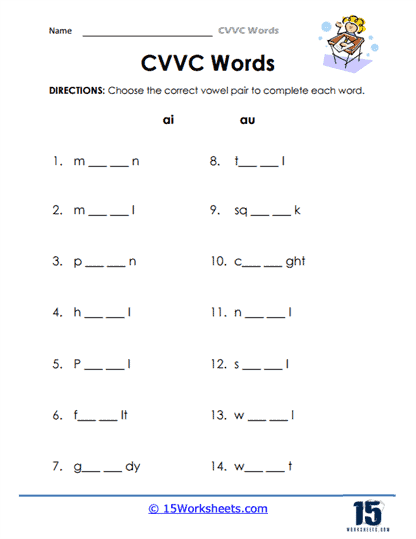
Students match words with the correct vowel pair to complete each CVVC word. This worksheet builds recognition of vowel team patterns in a fun way. The activity feels a bit like solving mini word puzzles, which keeps kids engaged. It’s great practice for strengthening reading fluency and spelling confidence.
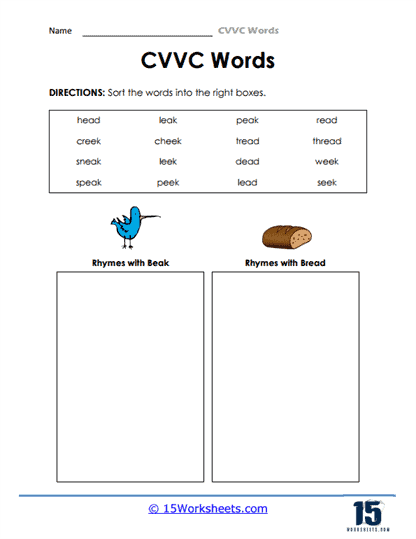
Beak Or Bread
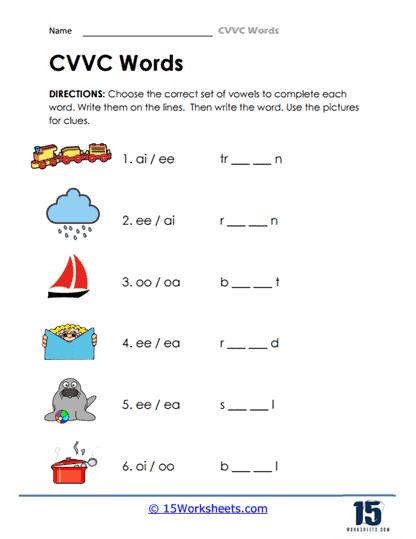
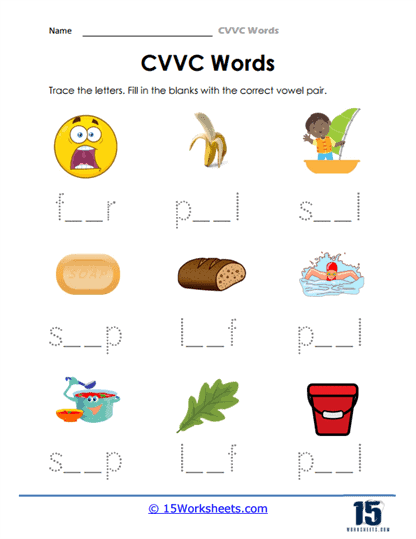
Here learners choose the correct CVVC word that matches a picture clue. The challenge helps students link sounds, spellings, and meanings together. It’s like a phonics guessing game where visuals lead the way. This worksheet supports both vocabulary growth and phonics mastery.
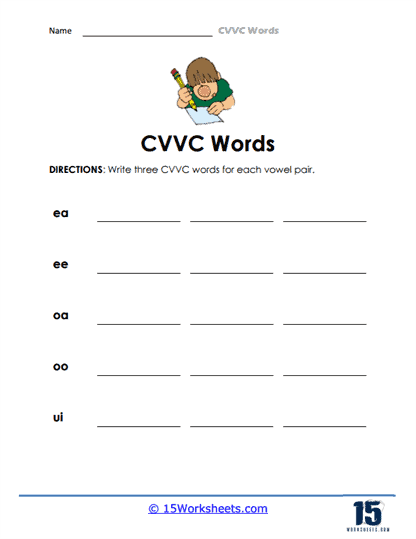
Word Generation
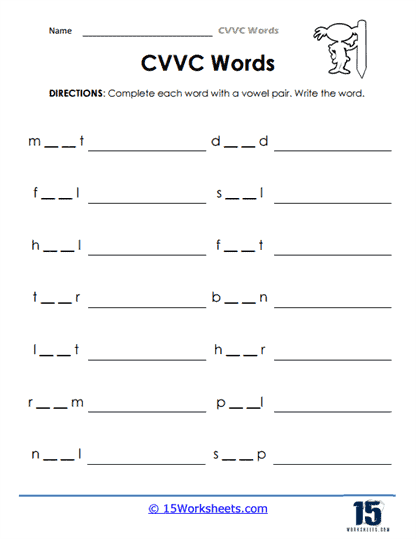
Students create new CVVC words by inserting the right vowel pair into given word frames. The task encourages creativity and a deeper understanding of vowel teams. Kids enjoy “building” words while learning spelling patterns. It’s perfect for reinforcing phonics rules in an active way.
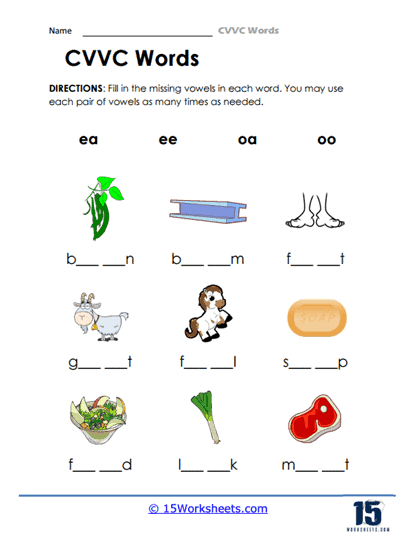
Vowel Fillers
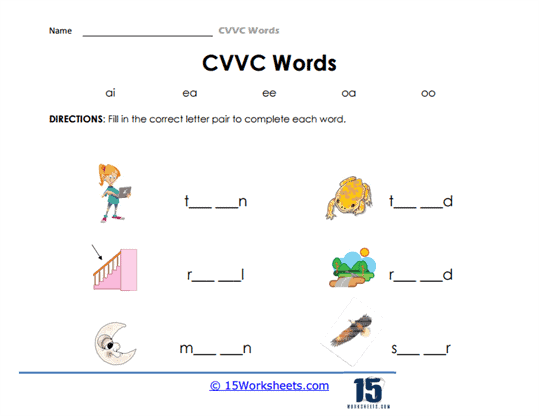
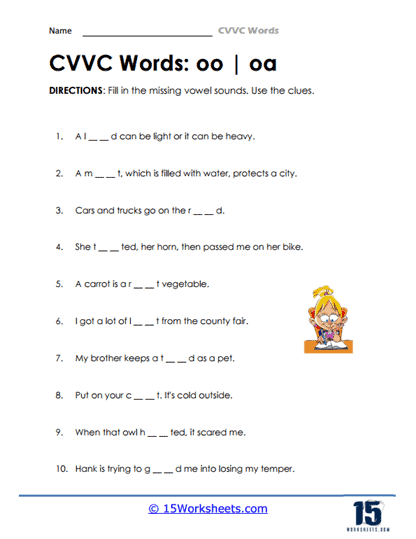
This worksheet asks kids to fill in the missing vowel pairs to complete CVVC words. It strengthens recognition of common vowel combinations like “ee,” “oa,” and “ai.” The fill-in-the-blank style makes it feel like a word puzzle. Learners gain both spelling accuracy and decoding practice.
Choose From The Two
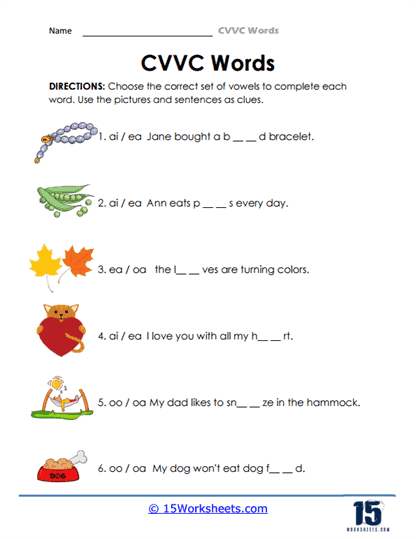
Students pick between two possible vowel teams to complete each CVVC word. The activity makes them think carefully about vowel sounds and spelling choices. It’s an engaging way to practice accuracy while making quick decisions. Kids become more confident in choosing the correct vowel combination.
Picture Clues
Here learners match CVVC words with images to demonstrate understanding. The visual support helps anchor tricky vowel patterns in memory. It feels like a phonics picture hunt. This worksheet blends reading, spelling, and comprehension skills together.
Fill In The Gaps
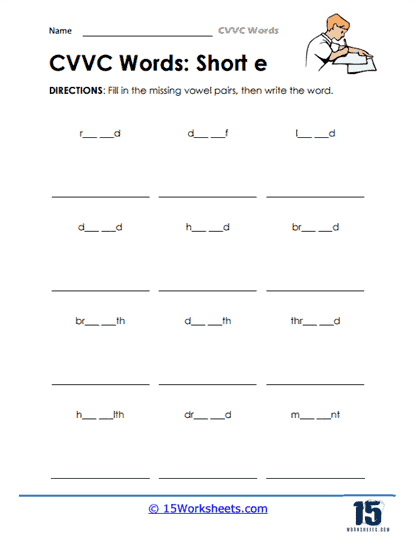
Kids complete CVVC words by writing in the missing letters. The straightforward design gives plenty of focused practice on common vowel teams. It’s simple but effective for mastering tricky phonics rules. By the end, learners recognize patterns more quickly in their reading.
Sentence Builder
Students place CVVC words into sentences to complete short stories. This task helps them see words in action, not just in isolation. It turns phonics practice into a mini storytelling challenge. The worksheet strengthens comprehension and fluency at the same time.
Read And Categorize
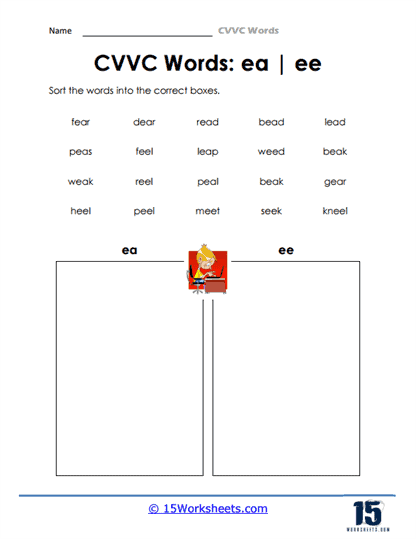
Here learners read a list of CVVC words and sort them into categories based on vowel patterns. It sharpens attention to detail while building vocabulary groups. The sorting adds an extra layer of critical thinking. This worksheet encourages kids to notice patterns across words.
Vowels In Action
This worksheet focuses on applying vowel team knowledge in context. Kids read, identify, and use CVVC words in short exercises. It helps cement vowel sounds through repetition and application. Learners get both practice and confidence in recognizing vowel teams.
CVVC Word Mystery
Students solve clues to discover mystery words that follow the CVVC pattern. The puzzle-like format makes learning playful and engaging. It feels like a treasure hunt with letters. This worksheet keeps kids curious while boosting phonics skills.
Consonant Combinations
This activity highlights how consonants and vowel teams work together in CVVC words. Students build and decode words with careful attention to sound placement. It’s a deeper dive into word structure. Learners come away with stronger decoding and spelling skills.
Trace And Create
Kids trace CVVC words for handwriting practice, then try writing them independently. It combines phonics with fine motor skills in one neat package. The tracing offers support while the creating builds independence. This worksheet is perfect for younger learners who need handwriting reinforcement.
Fill And Complete
Here students fill in missing letters to finish both CVVC words and short sentences. It’s a blend of spelling and comprehension practice. The activity keeps learners on their toes with context clues. Kids strengthen both reading and writing skills in one go.
Invent And Record
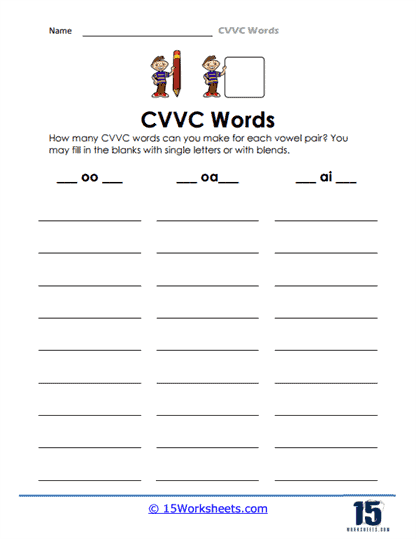
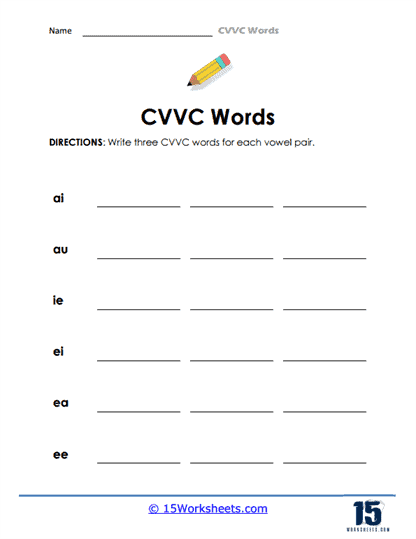
This worksheet encourages students to invent new CVVC words (real or silly) and write them down. The creative twist makes phonics fun and imaginative. Learners experiment with vowel combinations while reinforcing spelling patterns. It’s a playful way to deepen understanding of vowel teams.
What are CVVC Words?
CVVC words are four-letter words that follow the pattern of a consonant (C), a vowel (V), another vowel (V), and a consonant (C). In CVVC words, the two vowels typically create a single, long vowel sound or a diphthong. These words are useful for teaching children about vowel combinations, long vowel sounds, and diphthongs in English.
Some examples of CVVC words include:
“boat” (C: /b/, VV: /oʊ/, C: /t/)
“rain” (C: /r/, VV: /eɪ/, C: /n/)
“deer” (C: /d/, VV: /ɪər/, C: /r/)
“seed” (C: /s/, VV: /iː/, C: /d/)
“loud” (C: /l/, VV: /aʊ/, C: /d/)
Understanding CVVC words is important for children as it helps them recognize and decode common vowel combinations and long vowel sounds in the English language. Mastering CVVC words can improve their reading fluency, vocabulary, and overall language skills.
The Importance of CVVC Words
CVVC words are characterized by their two consecutive vowels, typically found in words like “boat,” “rain,” and “clean.” Understanding and recognizing CVVC words is important for several key reasons:
1. Word Decoding Mastery: CVVC words are prevalent in English texts. Proficiency in recognizing and pronouncing CVVC words is crucial for accurate word decoding, which significantly improves reading fluency.
2. Spelling Proficiency: Understanding CVVC words aids students in accurately representing these sounds with letters in their writing, contributing to improved spelling skills.
3. Vocabulary Enrichment: Proficiency in CVVC words enables students to learn and understand a diverse range of words, enhancing their vocabulary.
4. Reading Comprehension: Recognizing CVVC words enhances reading skills, allowing students to decode words quickly and accurately, which in turn leads to better comprehension of texts.
5. Phonemic Awareness: Engaging with CVVC words encourages phonemic awareness as students learn to distinguish and manipulate vowel sounds.
6. Early Literacy Support: Proficiency in CVVC words supports early literacy efforts, helping educators identify and address difficulties in reading readiness.
This collection of CVVC Words worksheets is an invaluable resource that equips educators to guide their students toward phonetic mastery. By engaging with these worksheets, students not only develop a strong foundation in CVVC words but also unlock the door to reading, spelling, and overall language proficiency.
This collection empowers educators to nurture young learners on their journey to becoming confident and proficient readers and communicators, capable of unraveling the beauty and complexity of the English language.