
Math Vocabulary Worksheets
About Our Math Vocabulary Worksheets
Math has its own language, and learning that language helps students become more confident problem-solvers. Our Math Vocabulary Worksheets introduce learners to the words, symbols, and terms they encounter as they explore arithmetic, fractions, geometry, measurement, graphing, probability, and more. Instead of simply memorizing definitions, students practice using math vocabulary in meaningful ways that connect directly to the concepts they are learning. These activities make mathematical language feel familiar, approachable, and useful.
This collection covers a wide range of essential math terms through matching exercises, word banks, puzzles, graphing activities, geometry practice, and hands-on problem solving. Students learn the names of symbols, operations, shapes, measurement concepts, graphing terms, fraction vocabulary, and multiplication language while applying those words in authentic mathematical situations. The variety of activities helps reinforce vocabulary from multiple angles, making it easier for learners to recognize and use important terms with confidence.
A strong math vocabulary helps students understand directions, explain their thinking, and solve problems more effectively. When learners know the difference between a numerator and a denominator or a factor and a product, they spend less time decoding instructions and more time focusing on mathematical reasoning. These worksheets strengthen communication, comprehension, and critical thinking while giving students the language they need to succeed in every area of mathematics.
About Each Worksheet
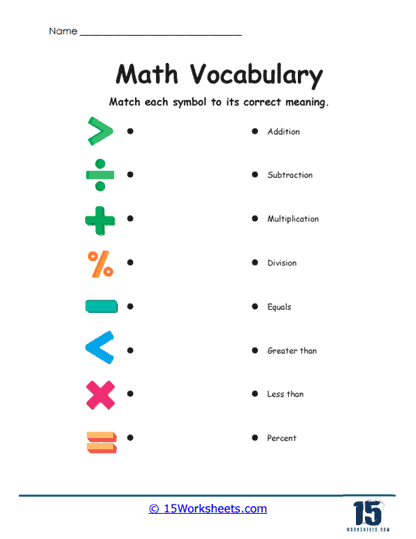
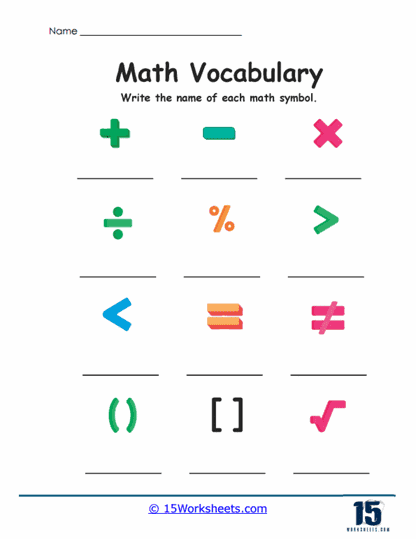
Symbol Match-Up
Students connect familiar math symbols with the words they represent, turning abstract symbols into meaningful vocabulary. It’s a simple activity that builds confidence every time learners read or write an equation.
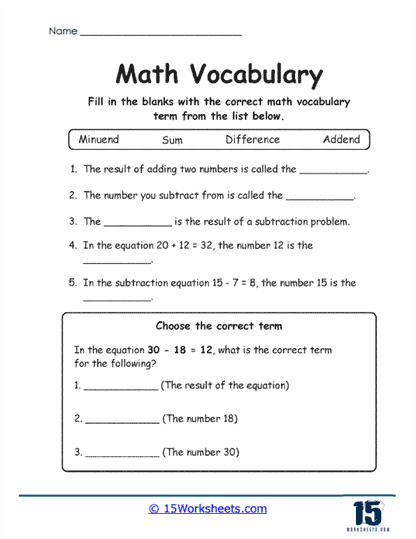
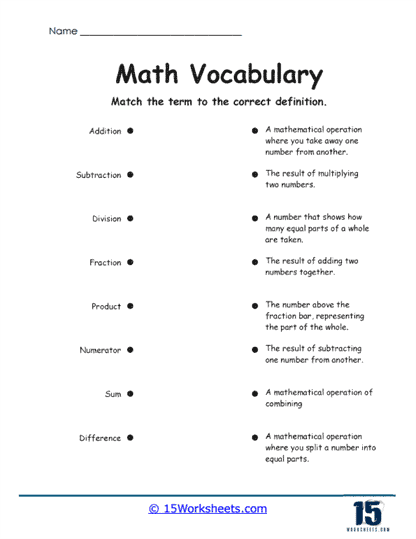
Operation Word Bank
This worksheet helps students put names to the numbers they work with every day. By matching terms like sum and difference to real examples, math vocabulary starts to feel much more natural.
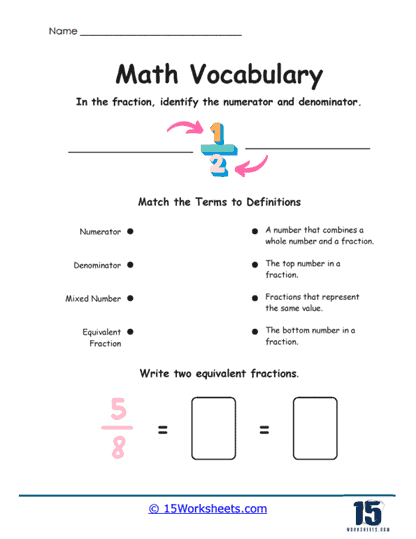
Fraction Language Builder
Fractions become less intimidating when students understand the language behind them. This activity introduces key terms while giving learners practice using them in meaningful ways.
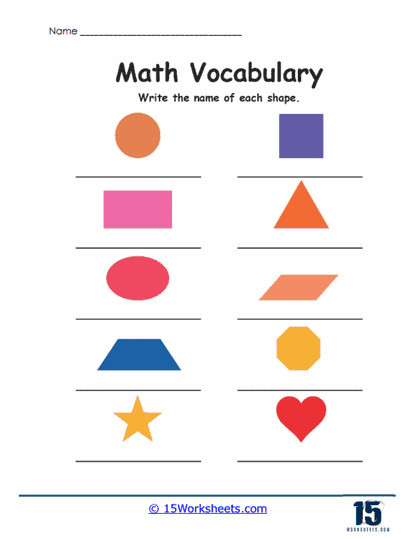
Shape Name Practice
Students look closely at a variety of geometric figures and give each one its proper name. It’s a great way to strengthen geometry vocabulary while sharpening observation skills.
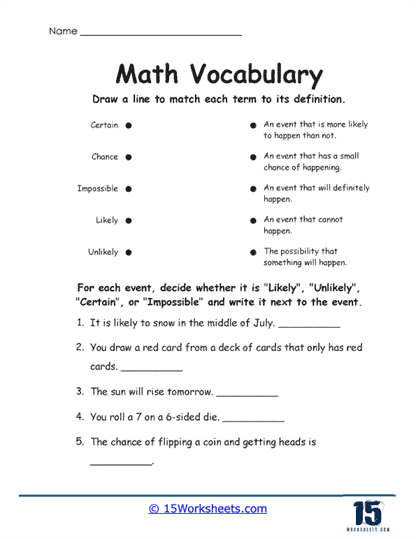
Probability Word Match
Chance is everywhere, and this worksheet helps students describe it using the correct mathematical language. Real-life examples make probability vocabulary feel both practical and easy to understand.
Operations Vocabulary Review
This review activity brings together many of the most important arithmetic terms in one place. Students strengthen their understanding of operations while reinforcing the language they use to explain their work.
Addition and Subtraction Terms
Students move beyond solving equations by identifying the special names for each number in an addition or subtraction problem. Creating their own examples helps turn vocabulary into lasting knowledge.
Math Symbols Identification
Math is filled with symbols, and this worksheet helps students recognize them quickly and accurately. Becoming fluent with these visual shortcuts makes reading equations much easier.
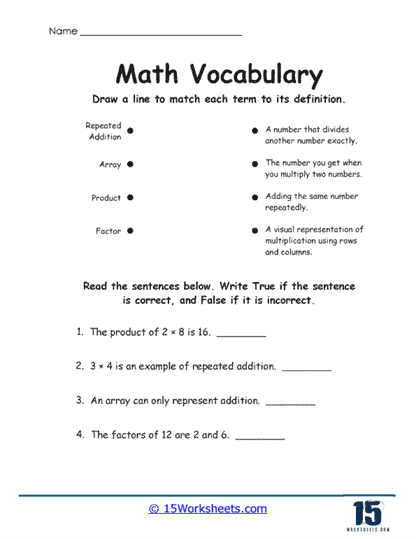
Multiplication Vocabulary
Students explore the language of multiplication through matching activities and quick concept checks. Understanding terms like factor and product helps make multiplication strategies much clearer.
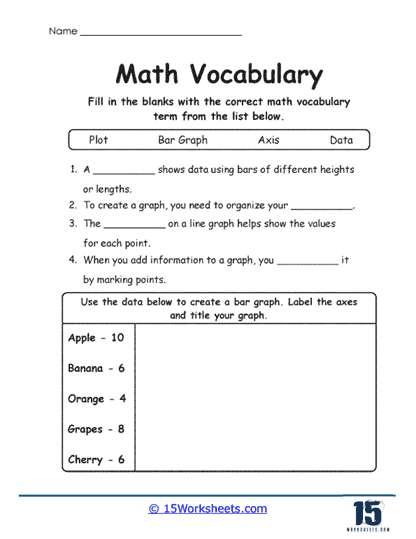
Graphing Vocabulary
This worksheet combines vocabulary practice with hands-on graphing so students can immediately apply what they learn. By the end, graph terms feel much more familiar and useful.
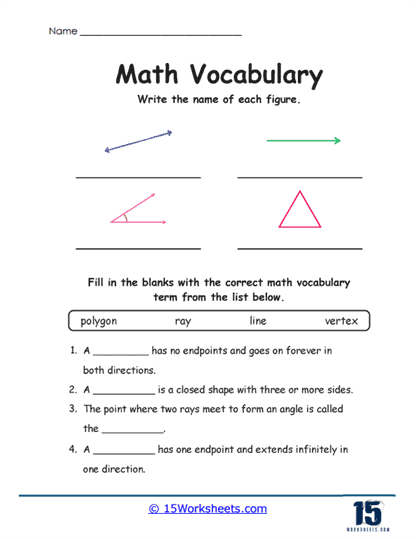
Geometry Word Practice
Lines, rays, angles, and polygons all have their own names, and this worksheet introduces them in a visual and engaging way. Students build geometry vocabulary while connecting words to the figures they describe.
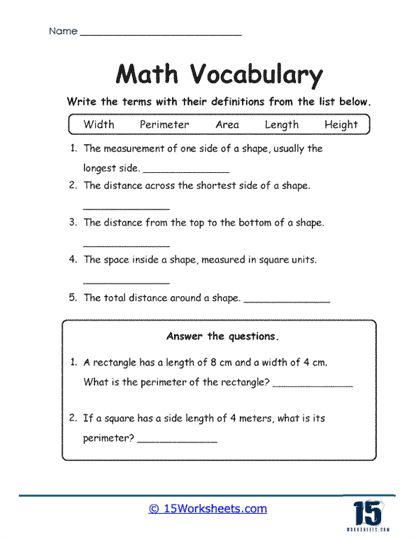
Measurement Vocabulary
Everyday measurement becomes a little easier when students know the right terminology. This activity combines definitions with practical problems to make math language feel relevant.
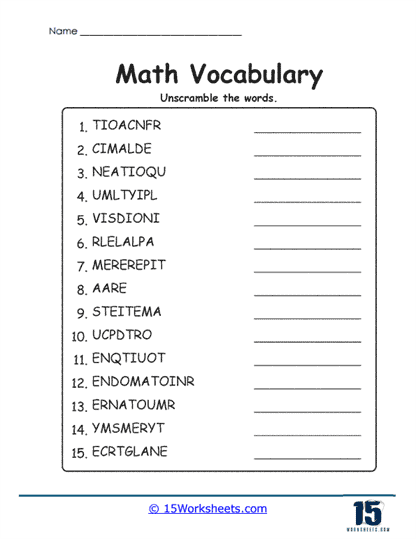
Unscramble the Math Terms
Vocabulary review turns into a puzzle as students unscramble important mathematical words. It’s an enjoyable way to strengthen spelling while reinforcing concepts from many areas of math.
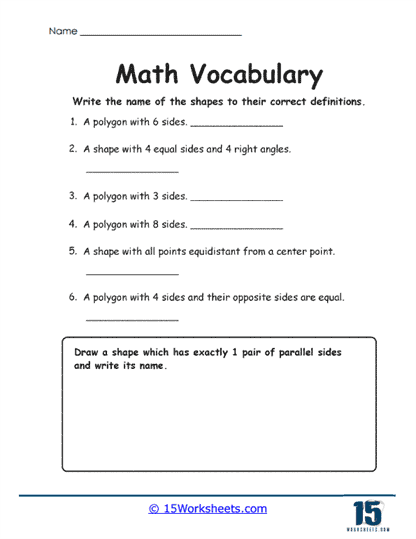
Shape Definitions
Students match geometry terms with their definitions before putting their knowledge to work by drawing shapes. The combination of reading and creating helps reinforce important concepts.
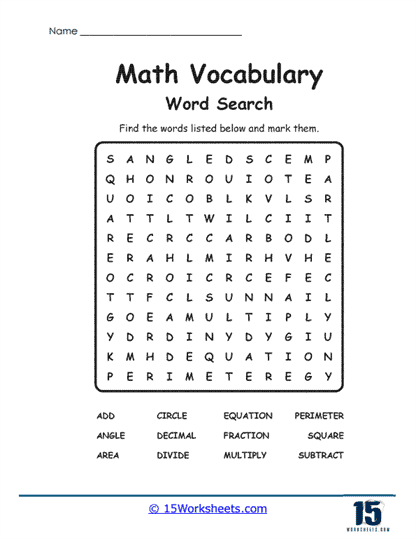
Math Word Search
This classic word search gives students a relaxing way to review essential math vocabulary. Finding familiar terms over and over helps improve recognition and recall without feeling like traditional study.
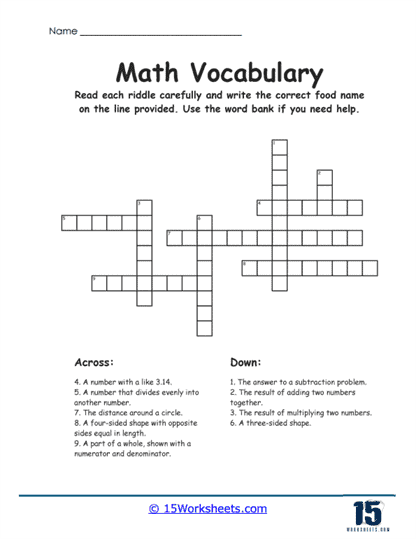
Math Crossword
Students solve definition clues to complete a crossword packed with important mathematical terms. The puzzle format makes vocabulary review feel more like a game while strengthening long-term retention.
What is Math Vocabulary?
Math vocabulary is the collection of words, symbols, and terms used to describe mathematical ideas, operations, relationships, and concepts. Words like sum, factor, numerator, perimeter, and axis all have specific meanings that help students understand and communicate mathematical thinking. Symbols such as +, −, ×, ÷, and = are also part of this language because they represent important mathematical actions and relationships. Learning this vocabulary allows students to read problems more accurately and follow mathematical instructions with greater confidence.
As students move through different areas of mathematics, they continue adding new vocabulary to their growing understanding. Geometry introduces words like polygon and angle, fractions include terms such as denominator and equivalent fraction, while graphing, probability, and measurement each have their own specialized language. Understanding these terms helps students recognize connections between ideas and explain how they solved a problem. A strong vocabulary also makes classroom discussions and written explanations much easier.
Developing math vocabulary supports success far beyond memorizing definitions. Students who understand mathematical language can follow directions more easily, communicate their reasoning clearly, and tackle unfamiliar problems with greater confidence. These skills strengthen both mathematical thinking and overall academic performance. As learners build their math vocabulary, they also build the foundation for success in more advanced mathematics for years to come.