
Ed Word Family Worksheets







About These 15 Worksheets
The -ed Word Family is one of those magical little endings that shows up everywhere, from simple rhyming words like bed and red to past-tense verbs like jumped and helped. Once kids spot that “-ed” chunk, it opens the door to both reading fluency and understanding grammar in action. These worksheets make learning the pattern a lot less intimidating and way more fun. Think of them as training wheels for spelling and reading success.
This collection takes students through a variety of playful activities-coloring, matching, cutting, tracing, writing, and even word searches. By approaching the “-ed” family in multiple ways, kids not only memorize the endings but also actually use them in meaningful contexts. They get plenty of repetition without the boredom, which is the secret recipe for building mastery. With every sheet, they’re strengthening both vocabulary and comprehension.
And let’s not forget the real-world connection: the “-ed” ending is everywhere! Whether it’s spotting bed in a storybook or recognizing called in a conversation, these worksheets give students the confidence to decode words on the fly. The activities also sneak in some handwriting and fine motor practice, so kids are learning more than one skill at a time. It’s reading, writing, spelling, and fun-all rolled into one package.
Have a Look Inside Each Worksheet
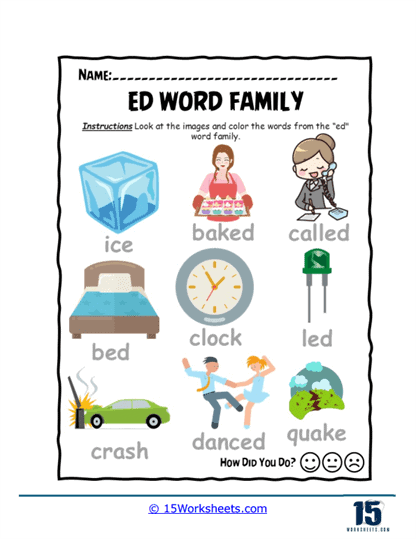
Color and Identify – Ed Match
Students look at pictures and color the words that belong to the “-ed” family, such as bed, baked, and called. This helps kids distinguish “-ed” words from unrelated ones using strong visual cues. The activity makes phonics fun while building vocabulary connections. It also trains students to recognize common spelling patterns quickly.
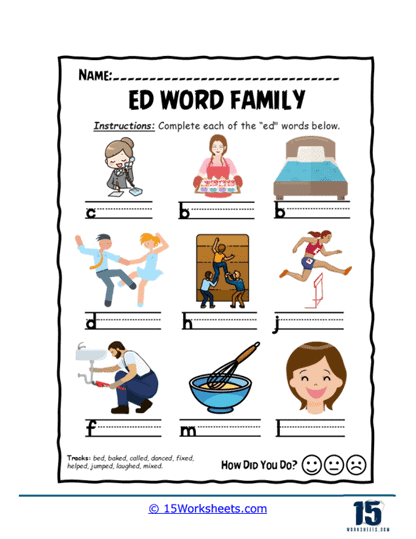
Fill in the Words – Word Builder
Kids complete partial “-ed” words by adding the missing first letter, guided by picture prompts like called, baked, and jumped. The exercise blends phonics with handwriting practice. It develops spelling accuracy and phonemic awareness. Students strengthen both recall and handwriting fluency.
Match with Pictures 1 – Dance Bake
Children match words like danced, baked, bed, and called with the correct images. This activity makes learning concrete by connecting visuals with text. Matching boosts comprehension and vocabulary retention. Students practice recognizing words in different contexts for better fluency.
Match with Pictures 2 – Jump Fix
Here, kids match another set of “-ed” words to pictures, including jumped, fixed, mixed, and helped. The focus is on verbs in the past tense. This reinforces the link between actions and their written form. Students gain confidence in recognizing common past-tense words.
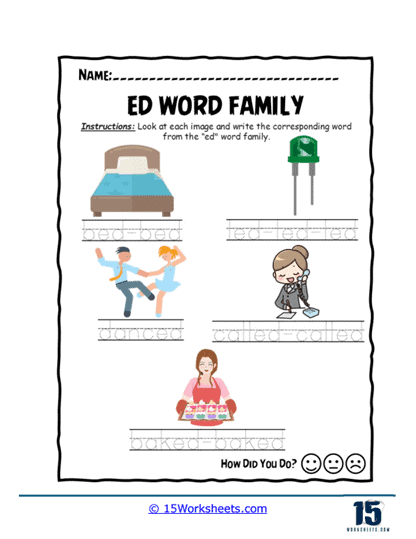
Write It Out 1 – Bed Led
Students look at pictures and write the matching “-ed” words, such as bed, danced, called, and baked. The task gives repeated spelling practice. It strengthens memory and fine motor skills. Over time, students develop fluency and confidence.
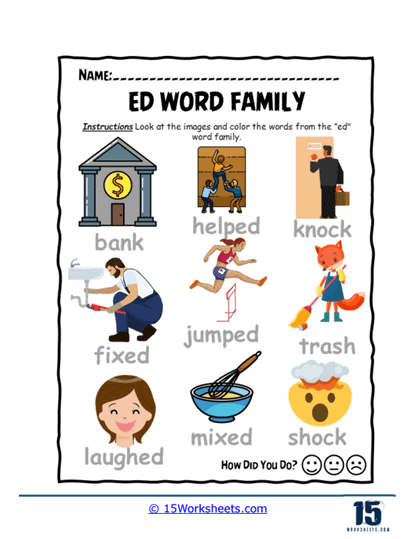
Color and Identify 2 – Laugh Mix
Learners color words like laughed, helped, and fixed from a group of mixed images. Distractor words are included to sharpen focus. This reinforces attention to endings when decoding words. It supports both reading and writing growth.
Write It Out 2 – Fix Mix
Students write out words such as helped, jumped, mixed, and laughed using picture prompts. The activity strengthens spelling and recall. Writing also builds long-term memory of word endings. This skill transfers directly into real reading and writing tasks.
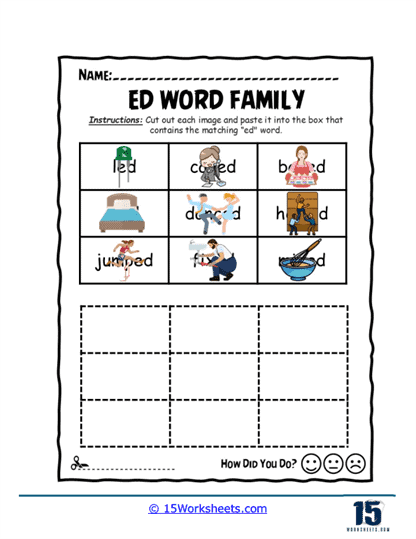
Cut and Paste – Ed Sort
Children cut out images and paste them under the correct “-ed” word labels. The hands-on format makes literacy interactive and fun. It develops sorting and categorization skills. Students also improve motor coordination while practicing phonics.
Write Practice 1 – Bake Help
Students repeatedly write words like baked, helped, and others alongside images. The repetition cements spelling patterns. Writing boosts speed and accuracy. Kids also gain confidence in spelling independently.
Write Practice 2 – Bed Dance
This worksheet has students repeatedly write words such as bed, danced, fixed, and called. The repetition makes endings automatic. Fine motor control improves with each attempt. Students become faster and more accurate with familiar word families.
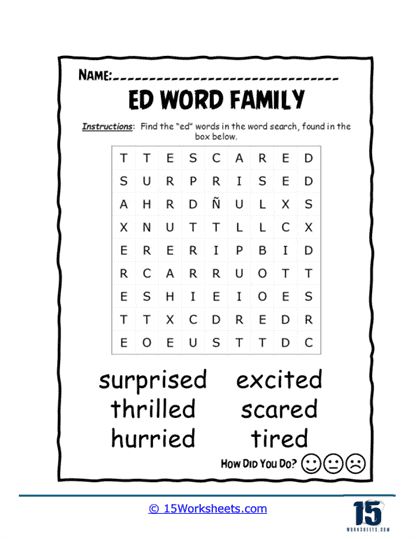
Word Hunt Puzzle 1 – Scared Grid
Students solve a word search with hidden “-ed” words like surprised, thrilled, hurried, and tired. It’s a mix of spelling, scanning, and persistence. The puzzle keeps learners engaged. It strengthens recall of common word endings.
Word Hunt Puzzle 2 – Bored Board
Another search puzzle challenges students to find washed, yelled, stopped, and walked. This reinforces verb endings in a playful way. Kids practice patience and problem-solving. It also sharpens focus on phonics.
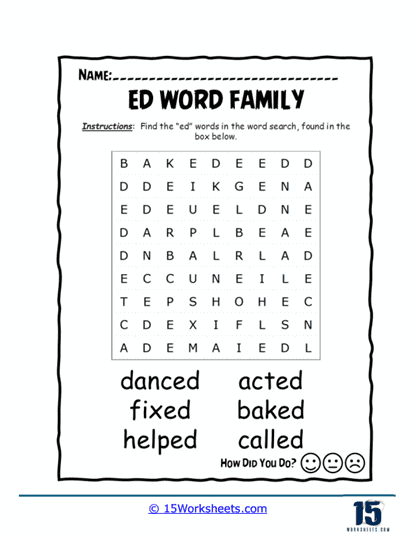
Word Hunt Puzzle 3 – Baked Maze
Students hunt for “-ed” words like danced, helped, acted, and called. Distractor letters add to the challenge. Kids practice spelling fluency in a fun context. It strengthens reading and scanning skills.
Picture Word Write – Danced Bed
Children write “-ed” words under the correct pictures, such as danced, baked, fixed, and laughed. This combines spelling with comprehension. Students recall vocabulary while reinforcing writing. It boosts overall reading fluency.
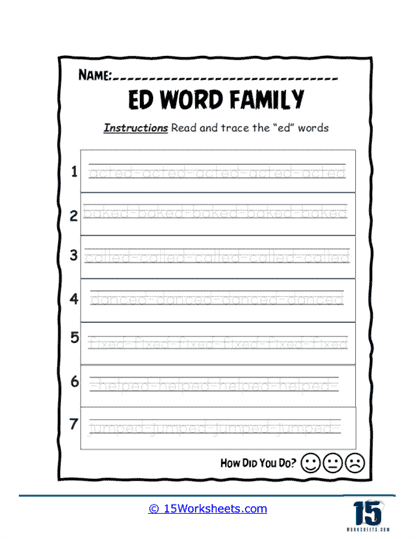
Trace and Practice – Acted Track
Students trace “-ed” words like acted, baked, helped, and jumped. Tracing builds muscle memory for handwriting. Repetition strengthens recognition of endings. Over time, students recall words automatically with confidence.
What Is the Ed Word Family?
The -ed Word Family is a group of words that all share the same ending-“ed.” Sometimes, it’s part of a simple word like bed, and other times, it’s part of a verb in the past tense like jumped. For beginning readers, spotting these patterns makes reading feel less like memorizing random letters and more like solving a fun puzzle.
It matters because the “-ed” ending is one of the most common chunks in English. Kids will see it constantly in books, instructions, and conversations. Learning to recognize and use it gives them a big boost in both reading and writing. It’s not just about rhyming words-it’s also about understanding how language shows time and action.
By practicing with these worksheets, students become familiar with how “-ed” works in everyday words. They learn to read and spell with greater confidence, and they also get an early introduction to verb tenses. Over time, the “-ed” family becomes second nature, making reading smoother and writing stronger. These sheets are a stepping stone toward real literacy growth.
Ed Word Family Word List
bed, bled, fed, fled, led, red, shed, shred, wed, baked, called, danced, fixed, helped, jumped, laughed, mixed, played, scared, stopped, walked, washed, yelled, acted, hurried, surprised, thrilled, tired
Example Sentences
The red balloon floated away while the kids laughed and jumped with excitement.
She baked cookies, then washed the dishes after her friends called.
The puppy played in the yard, then stopped and rested on his bed.
He hurried to school, walked into class, and acted in the play that thrilled everyone.
The bird fed its chicks, then quickly fled when the cat yelled and scared it.