
Ee Word Family Worksheets







About These 15 Worksheets
Learning the ee word family helps young readers recognize one of the most common long-vowel patterns in English. These worksheets give students repeated exposure to the ee sound through pictures, writing tasks, matching activities, puzzles, and more. By working with words like see, tree, green, sleep, and feet, children build confidence in identifying long-vowel patterns that appear often in early reading materials. The activities are designed to be fun, supportive, and developmentally appropriate for growing readers.
Each worksheet encourages pattern recognition by allowing students to connect sounds, spellings, and meanings. They get to color, sort, cut, assemble, trace, spell, search, and write, all while reinforcing the ee vowel pattern in meaningful ways. This variety keeps practice engaging and helps students see the ee pattern in multiple contexts. Whether used at home, in small groups, or during classroom centers, these worksheets strengthen decoding and comprehension skills.
As students become familiar with the ee pattern, they read more smoothly and confidently. They begin to apply their phonics knowledge to new and unfamiliar words, making reading less frustrating and more enjoyable. The ee family appears frequently in children’s books and everyday vocabulary, so mastering it sets the stage for long-term literacy success. These worksheets offer a strong foundation for independent reading growth.
About Each Worksheet
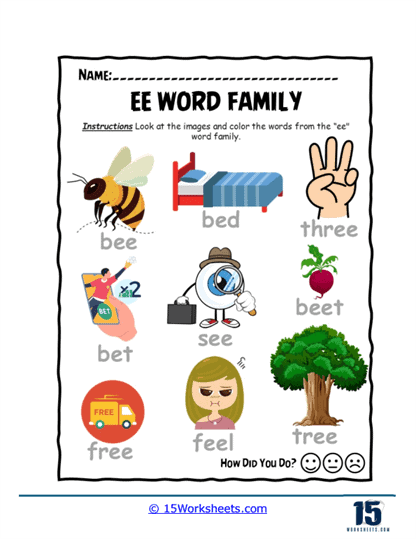
Buzzing Words
This worksheet introduces students to ee family vocabulary through clear and engaging pictures. Learners identify which images show words containing the ee sound and color only those pictures. The activity encourages careful visual scanning as students compare words that do and do not fit the pattern. It offers a playful way to explore phonics through picture-word connections. This sheet works well for centers, warm-ups, or quiet independent practice.
Royal Match
Students match ee words such as deer, queen, green, and teeth to their corresponding pictures. They rely on image clues to support their decoding and comprehension of the long-vowel pattern. The matching task deepens vocabulary understanding and reinforces the consistent ee spelling. This worksheet supports reading confidence by helping students connect words to meaning. It fits nicely into small-group lessons or literacy stations.
Picture Speller
Learners study each picture and independently write the correct ee word on the lines provided. Without a word bank, students rely on recall and phonics knowledge to generate the correct spelling. The worksheet strengthens both vocabulary memory and spelling confidence. Each image acts as a strong prompt for accurate decoding and writing. This sheet is ideal for building early writing fluency.
Snip Sorter
Students cut out picture tiles and paste them into boxes labeled with the correct ee word. The blend of hands-on work and phonics practice creates an engaging multi-sensory experience. Learners examine each image carefully to determine the correct match. The cut-and-paste structure supports organization and sorting skills. This worksheet is excellent for tactile learners and fine-motor development.
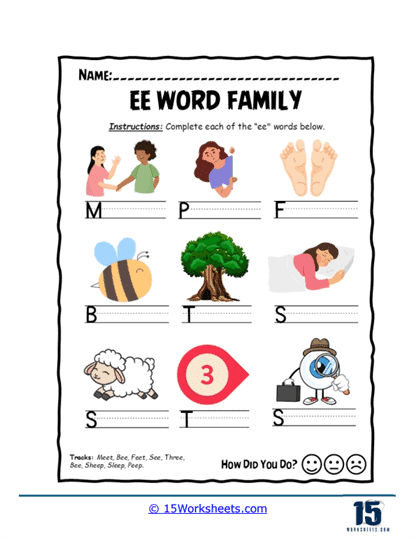
Letter Completer
This worksheet presents partially spelled ee words alongside helpful pictures. Students fill in the missing letters to complete words such as feet, tree, and sleep. The task encourages close attention to vowel patterns and spelling structure. Learners strengthen decoding skills as they supply the correct vowel team. This activity works well for reinforcing accuracy and phonics reasoning.
Word Matcher
Students match ee words like deep, knee, feel, teeth, and freeze to the correct images. By reading the words first and connecting them to illustrations, learners strengthen contextual understanding. The repetition supports vocabulary retention and phonics fluency. This worksheet encourages careful comparison and observation. It is a great tool for independent literacy time or review sessions.
Hidden Seekers
This worksheet challenges students to find multiple ee words in a word search grid. Words such as see, bee, free, green, and greed are hidden in different directions. Searching the grid strengthens visual tracking and pattern recognition. Learners enjoy the puzzle-style format while practicing phonics skills. It is well suited for early finishers or fun literacy challenges.
Image Namer
Students examine pictures and write the correct ee word beneath each one. Images like tree, bee, feet, and sleep help learners recall familiar vocabulary. The task supports independent spelling and reinforces phonics memory. Writing from picture prompts encourages thoughtful word production. This worksheet offers meaningful spelling practice for early readers.
Trace Train
Learners trace multiple ee words to build fluency and handwriting control. Each line features repeated model words for students to follow and rewrite. Tracing strengthens fine-motor skills and establishes strong spelling habits. The repetition deepens recognition of the ee vowel pattern. This worksheet is ideal for handwriting centers or beginning writers.
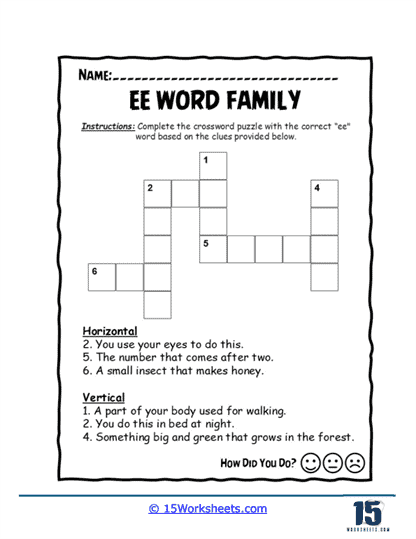
Clue Crosser
Students solve a crossword by reading clues and filling in ee word answers. Clues lead to words such as bee or three, prompting learners to apply vocabulary knowledge. The puzzle format encourages logical thinking and careful spelling. Completing the crossword builds comprehension and perseverance. It is a lively way to reinforce long-vowel patterns.
Clue Writer
This worksheet provides written clues, and students write the correct ee vocabulary word next to each one. Learners analyze descriptions of familiar items such as a honey-making insect or a tall forest plant. The activity blends phonics recall with comprehension. Writing each answer reinforces spelling accuracy. It serves as a strong bridge between reading clues and generating vocabulary.
Sentence Filler
Students complete sentences by writing the correct ee word that makes each statement meaningful. Pictures provide visual hints to support vocabulary choice. Learners use context clues to decide which word fits best. Writing the solution strengthens reading comprehension and phonics understanding. This worksheet is helpful for applying vocabulary in real language situations.
Match Makers
Students cut out halves of ee words and images, then reassemble them on a separate sheet. The task requires close comparison as learners match pieces that belong together. Rebuilding the complete words reinforces phonics and visual memory. The puzzle-style activity promotes problem-solving and attention to detail. It offers a hands-on way to explore word family patterns.
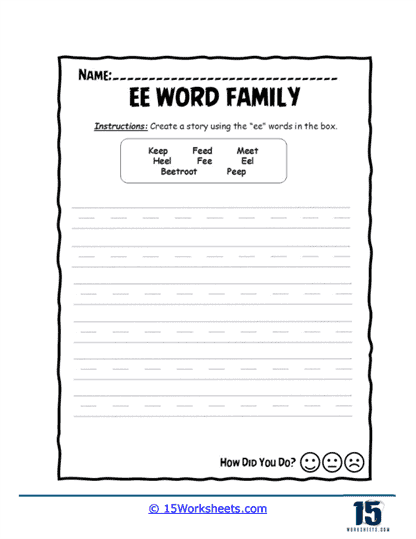
Story Builder
Students use a bank of ee words to write their own short story. They incorporate terms such as keep, heel, feed, meet, and beetroot into meaningful sentences. The activity supports creativity while reinforcing vocabulary comprehension. Writing stories helps students practice fluent expression and sentence structure. This worksheet encourages imaginative thinking along with phonics mastery.
Creative Chronicles
Learners write another short story using a fresh set of ee words. Words such as deep, knee, freeze, and seek expand the challenge and prompt creative application. Students practice organizing ideas and forming complete narratives. Writing with assigned vocabulary strengthens both spelling and comprehension. This activity promotes writing stamina and confidence.
What is the ee Word Family?
The ee word family is made up of words that use the vowel team ee to create a long e sound. Words like see, tree, sleep, and green all belong to this family because they share the same spelling pattern and vowel pronunciation. This makes the family easy for learners to recognize and decode. Once students understand that ee consistently makes the long e sound, their reading accuracy increases quickly.
Many ee words are common nouns and verbs that appear frequently in children’s books and early reading materials. Examples include feet, bee, three, and meet, each carrying a clear meaning that makes the word easy to visualize. Because the pattern remains consistent, students learn to rely on it when spelling and reading. The family provides an excellent bridge between simple phonics and more advanced vowel-team decoding.
The ee pattern has historical roots in English spelling, and its stability makes it one of the most reliable vowel teams for beginning readers. Students encounter this pattern in everyday language as well as in classroom texts, building confidence through repeated exposure. Seeing ee in many contexts helps learners become more independent readers. With regular practice, students use the ee pattern naturally in both reading and writing.
Word List for the ee Word Family
- bee
- beetroot
- deep
- deer
- feel
- feet
- feed
- freeze
- free
- green
- greed
- heel
- keep
- knee
- meet
- queue
- queen
- see
- seed
- seek
- sleep
- tree
- three
- teeth
Example Sentences
1. The bee flew around the tree while we tried to see where it would land.
2. Her feet felt freeze cold as she walked across the green grass.
3. We tried to keep the seed safe so it could grow into a tree one day.