
Eak Word Family Worksheets





About These 15 Worksheets
The -eak word family gives young readers a reliable pattern to spot and decode in words like beak, leak, and speak. Because the ending stays the same, students can swap beginning sounds to build many related words. Our activities turn this discovery into hands-on practice with coloring, matching, tracing, writing, and word searches. Each page blends visuals and phonics so learners connect what they see to what they hear and say. The result is smoother decoding, stronger spelling, and growing confidence.
These worksheets were designed to fit naturally into centers, small groups, or at-home learning. Clear images support comprehension while repetition cements the -eak pattern. Writing lines and tracing paths build fine-motor control and letter formation. Matching and search games promote visual scanning and attention to detail. Learners get consistent practice without it feeling repetitive.
As students master -eak, they notice helpful clues in new words, too. They’ll learn that most -eak words use the long /ēk/ sound (beak, leak), while a few common words like break are exceptions. Talking about this pattern-and its quirks-builds flexible readers who look for both sound and meaning. That flexible mindset powers progress across the rest of phonics.
About Each Worksheet
Color & Learn
Students color pictures with true -eak words, such as beak, bleak, freak, leak, and break. The activity blends sound recognition with visual context so the pattern sticks. Coloring keeps focus high while building fine-motor control. Learners practice sorting real -eak words from look-alikes. It’s a playful on-ramp to the unit.
Spot & Color
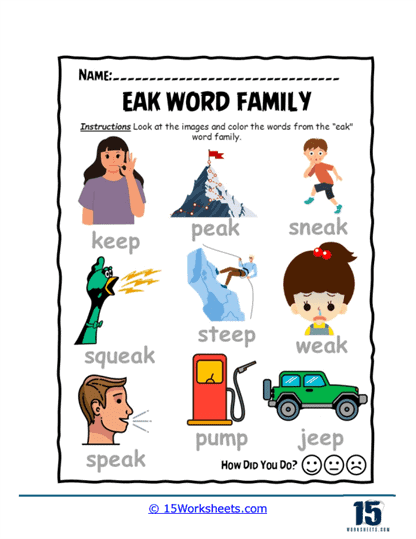
Learners scan a lively page to find and color -eak words like peak, speak, sneak, and weak among distractors. Friendly images provide meaning clues that support correct choices. The task sharpens attention to the shared ending while building vocabulary. Coloring adds a calm rhythm that encourages careful checking. Perfect for independent practice or centers.
Family Connection
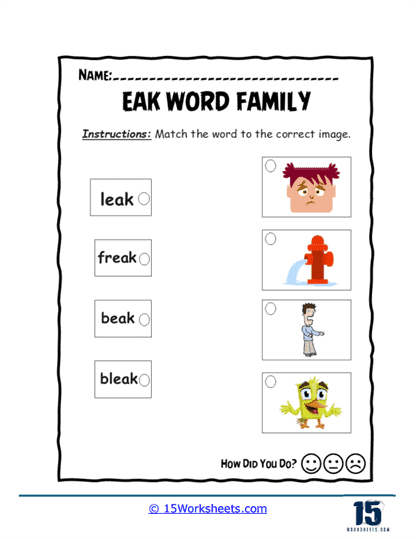
Students match words such as leak, freak, beak, and bleak to clear, supportive pictures. Matching ties print to meaning for quick recognition. The one-to-one format boosts decoding confidence. Repetition across several pairs reinforces the -eak pattern. Great for small-group review or partner work.
Peek into -eak
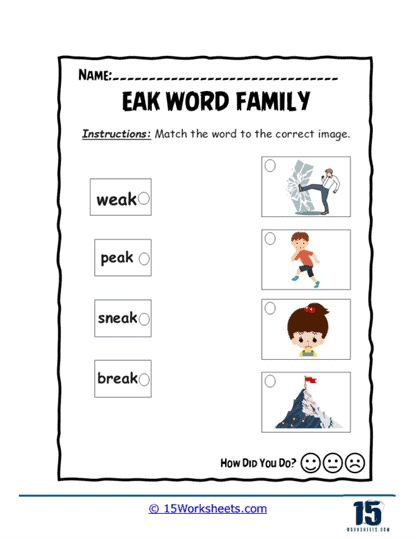
Learners continue matching with weak, sneak, break, and peak. Visual clues anchor meaning while students focus on the shared spelling. The page emphasizes observation, accuracy, and recall. It strengthens pattern recognition across varied starters. A simple, satisfying extension of the earlier match.
Letter Magic
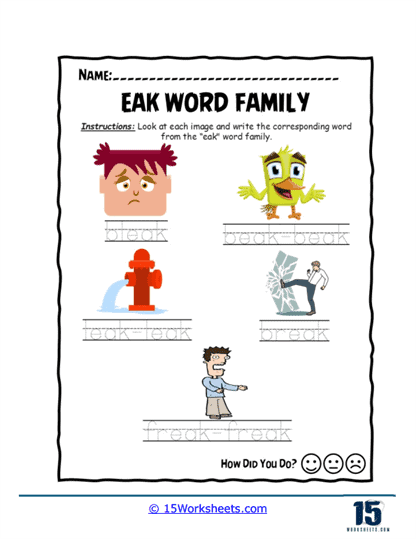
Students trace words like bleak, leak, beak, freak, and break beside picture prompts. Tracing builds letter formation and spelling automaticity. Saying words aloud links sound to print. The guided lines support neat handwriting and steady pacing. Ideal for handwriting routines with a phonics boost.
Trace Time
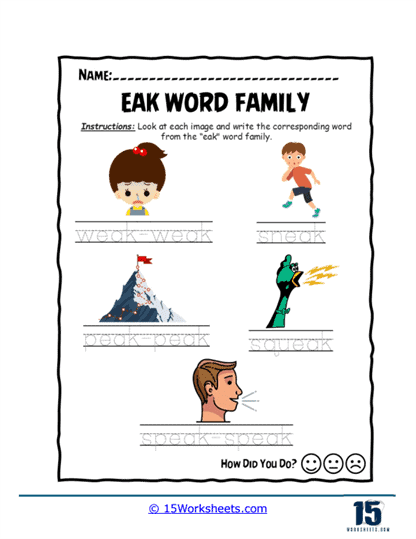
Learners trace and write weak, peak, squeak, speak, and sneak. Each illustration guides understanding so spelling feels purposeful. Repetition develops fluency with the -eak pattern. Students grow accuracy while building muscle memory. A calm practice page that delivers big gains over time.
Cut & Paste -eak
Students cut image tiles and paste them next to peak, speak, bleak, leak, and freak. The hands-on format cements sound-spelling links through movement. Sorting invites close observation and self-correction. It’s engaging, tactile, and memorable. Perfect for literacy centers and kinesthetic learners.
Sentence Gaps
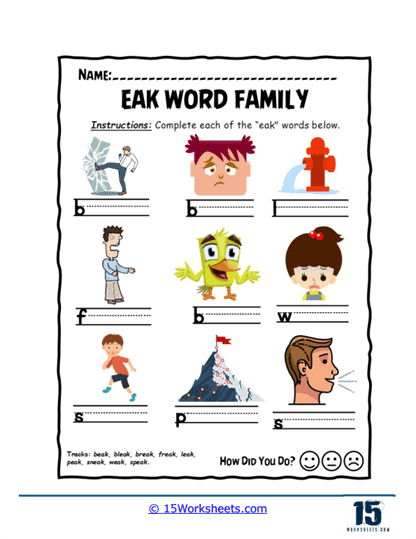
Kids complete missing letters to form beak, bleak, freak, speak, sneak, and peak. Picture clues point to the correct answer. The puzzle style encourages phonetic recall and problem-solving. Students notice how the stable ending combines with new starters. Great for independent application after modeling.
Write & Pair
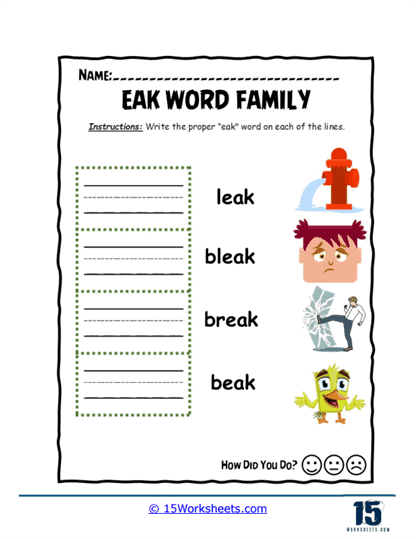
Learners write leak, bleak, break, and beak beside matching images. Writing turns recognition into long-term memory. The simple layout keeps attention on spelling accuracy. Each repetition strengthens decoding and meaning together. Use for quick checks, morning work, or homework.
Match Magic
Students write weak, peak, speak, and sneak next to their pictures. The tight focus builds automaticity with the shared ending. Linking words to images lifts comprehension and recall. Neat handwriting gets purposeful practice. An efficient page for targeted review.
Search & Circle
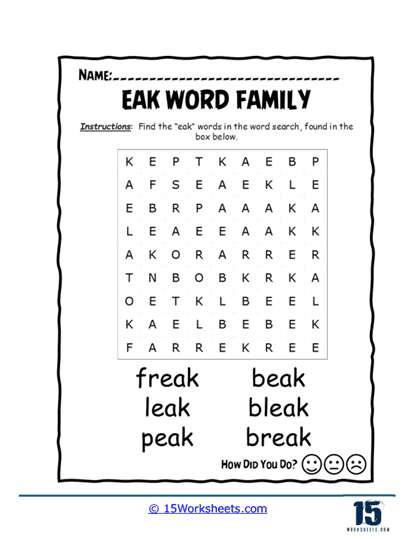
This word search highlights freak, leak, beak, bleak, peak, and break. Learners scan in multiple directions, building visual tracking. Each find reinforces the -eak pattern through repetition. The puzzle format keeps motivation high. A fun blend of logic and literacy.
Look & Find
Students hunt for weak, creak, speak, sneak, squeak, and streak. Including longer forms stretches decoding stamina. Repeated endings across varied starters deepen pattern awareness. The grid encourages patience and careful checking. Great bridge work toward more challenging texts.
Locate & Learn
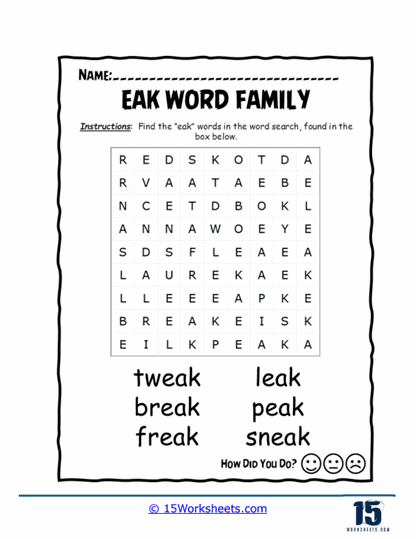
This advanced search features tweak, break, freak, leak, peak, and sneak. Variable word lengths raise the challenge just enough. Students rely on letter clusters and endings to succeed. The activity rewards persistence and sharp scanning. Ideal enrichment for confident readers.
Picture Word Match
Learners view images-a bird’s beak, a mountain peak, a leak, someone who can speak-and write the matching word. Visuals make meaning immediate and memorable. Writing reinforces spelling precision. Students connect print, sound, and real-world context. A strong comprehension-and-spelling combo.
Hunt & Highlight
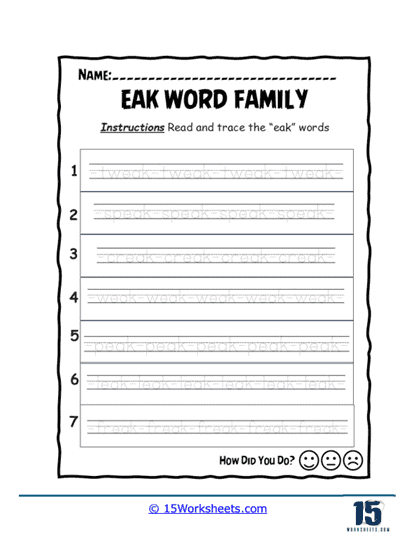
Students trace tweak, speak, creak, freak, leak, and peak repeatedly. Tracing builds steady rhythm and clean letter formation. Reading aloud during tracing strengthens the sound-symbol link. Repetition moves words from effortful to automatic. A soothing finisher that locks in the -eak pattern.
What is the -eak Word Family?
The -eak word family gathers words ending in -eak, most commonly pronounced /ēk/ as in beak, leak, and speak. Because the ending stays the same, readers can swap beginnings to build many words-sneak, freak, bleak, and more. This predictability helps students decode quickly and check for meaning with the picture or sentence. Word families also support spelling: once you know one, many others feel familiar. That familiarity speeds up fluent reading.
There are a few pronunciation quirks to notice. While most -eak words say /ēk/, a couple of high-frequency ones-break and steak-use the long /ā/ sound. Talking about these exceptions builds flexible readers who look and think, not just memorize. You can practice by sorting words into “sounds like /ēk/” and “sounds like /ā/.” Recognizing both the rule and the exceptions is part of real-world reading.
You’ll meet -eak words in many parts of speech: nouns (beak, leak, streak), verbs (speak, sneak, tweak, break), and adjectives (bleak, weak). They pop up in nature stories, science texts, and everyday talk: “the leak in the sink,” “a peak view,” “mice squeak.” Practicing this family strengthens phonics, vocabulary, and comprehension together. Once learners feel fluent with -eak, they’re ready to transfer the strategy to other endings with confidence.
Word List for the -eak Word Family
Word List
beak, bleak, break, creak, freak, leak, peak, speak, squeak, sneak, streak, tweak, weak
Example Sentences
The bird’s beak made a squeak on the glass by the tall peak.
We will speak about the leak and the thin, weak hose.
Do not sneak on the trail; a small break could spoil our streak.