
Est Word Family Worksheets






About These 15 Worksheets
The est word family is a wonderfully versatile group of words that young readers encounter often in early texts. Because these words share the same reliable spelling pattern, they give children predictable clues that support smoother decoding and more confident reading. Our collection brings this pattern to life through hands-on, playful, and visually engaging activities designed for both classrooms and homes. Each worksheet highlights the est ending in unique ways so students can build mastery through repetition and meaningful practice. Whether you’re a teacher planning small-group instruction or a parent supporting early literacy, these printables help make reading development feel natural and fun.
Students benefit greatly from working with word families because they learn to spot patterns instead of trying to memorize words one by one. Our est worksheets guide children to notice how letters work together to form familiar sounds and meanings. When students sort, match, trace, and write words from the same family, they build strong decoding habits that transfer to independent reading. The predictable structure of the est pattern helps beginning readers experience more success, boosting motivation and fluency. These structured experiences support children as they transition into reading longer and more complex words.
The est family pops up everywhere-in stories, poems, instructions, and everyday conversation-so giving kids repeated exposure to it is incredibly beneficial. As students work through the activities, they gain confidence recognizing and using words like best, guest, rest, test, chest, nest, and many others. Each worksheet blends phonics with vocabulary, spelling, handwriting, and visual cues to create a rich literacy experience. By the end of the collection, learners have practiced the pattern in many formats, strengthening memory and accuracy. This well-rounded approach helps build a strong foundation for future reading success.
About Each Worksheet
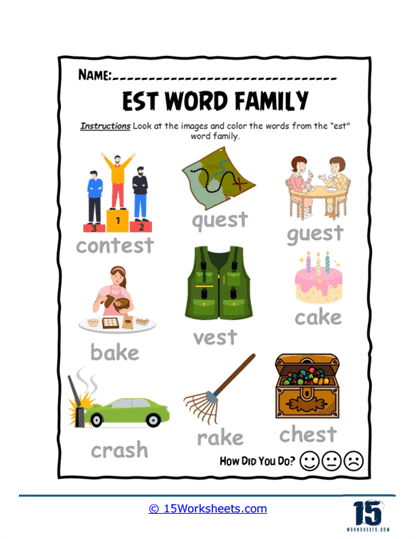
Color Quest
This worksheet invites students to color only the words ending with est, making it a playful introduction to the pattern. Children strengthen phonics awareness as they distinguish real est words from distractor words. The bright illustrations give students clues that help connect meaning to spelling. Because it’s visually engaging, this activity works great for early learners building attention to detail. It’s perfect for morning work, literacy centers, or at-home practice.
Sound Sorter
Students hunt for est words among picture prompts and color the ones that match the target pattern. This activity is designed to train the eye to notice spelling details while reinforcing sound-symbol understanding. Learners build confidence as they repeatedly identify est words in different contexts. The mix of correct and incorrect word choices encourages careful thinking. It’s well-suited for small groups or independent seatwork.
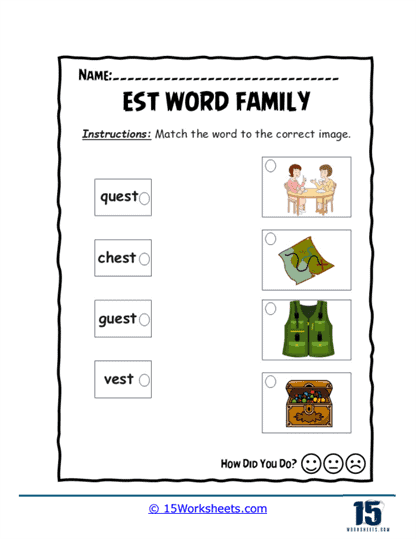
Match Quest
This worksheet has students match est words like quest, guest, vest, and chest to corresponding images. The format supports vocabulary development alongside phonics recognition. Kids practice observing picture clues to choose the correct word. This structured matching style makes the activity manageable for early readers while still challenging. Teachers can use it as a center activity or guided practice.
Picture Match
Learners continue developing word-to-picture connections with familiar est words such as best, rest, test, and nest. Each picture encourages students to think about meaning before selecting the correct word. This helps tie phonics patterns to real vocabulary use. The activity builds decoding skills, visual recognition, and comprehension all at once. It works well as a follow-up to other matching worksheets.
Write Match
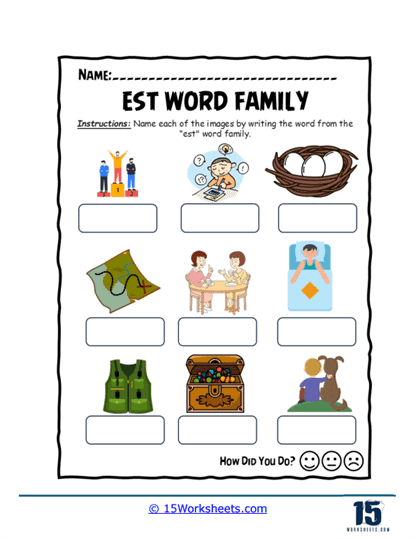
Students look at each picture and write the correct est word beneath it. Writing reinforces spelling and helps anchor the phonics pattern in memory. The tracing supports accurate handwriting for early writers. This worksheet encourages students to connect sound, meaning, and written representation. It’s ideal for handwriting practice during phonics lessons.
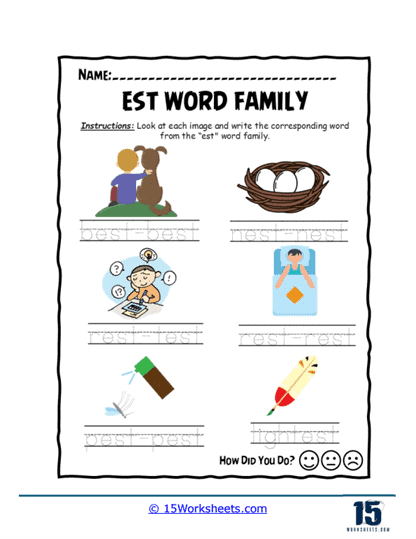
Picture Writers
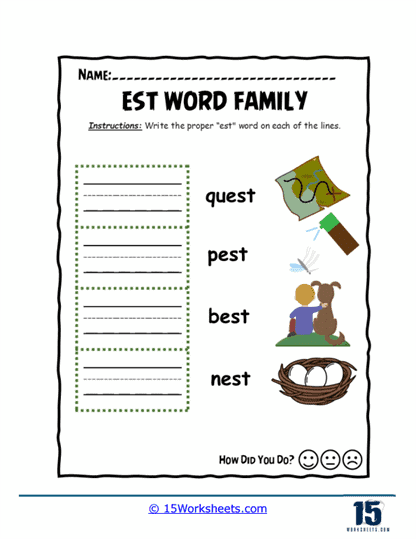
Here, students write est words like best, pest, rest, and nest using picture clues. The writing lines guide children toward neat and consistent letter formation. Decoding skills strengthen as they recall and spell each word independently. Meaning-based clues support vocabulary development while reinforcing the spelling pattern. This worksheet easily fits into writing centers or spelling practice sessions.
Cut Match
Students cut out pictures and paste them next to the corresponding est word. The hands-on format boosts engagement and fine motor skills. Matching encourages analytical thinking as children compare visual and written information. This activity reinforces the est pattern through active sorting and decision-making. It’s especially fun for centers or homework that feels like a craft.
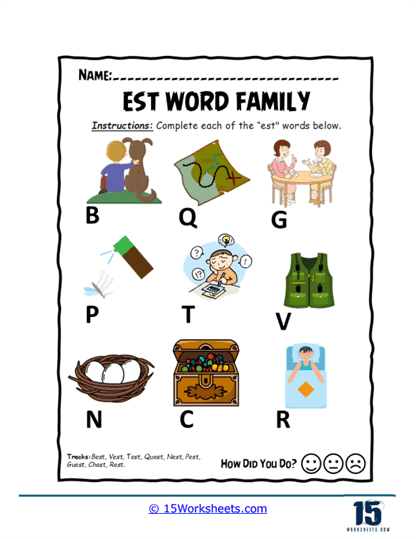
Fill Letters
Students complete each word by adding missing letters to form the correct est word. Pictures help them recall meaning while focusing on the shared word ending. This supports phonemic awareness as students link initial sounds to the est pattern. The structured blanks give just enough support without giving away the answer. It makes a great warm-up activity or independent review.
Line Writers
Learners write full est words such as quest, pest, best, and nest on handwriting lines. The repeated writing allows students to internalize both the pattern and letter formation. Visual prompts guide students toward choosing the correct word. This builds spelling fluency while reinforcing vocabulary. It works well for homework, early-finisher tasks, or one-on-one practice.
Word Practice
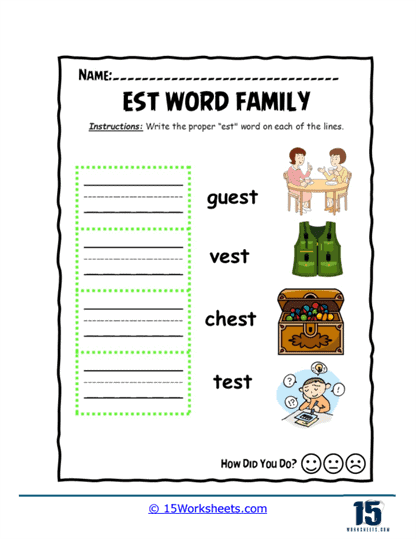
Students match pictures to est words like guest, vest, chest, and test and then write each one. Repeated writing helps strengthen memory of the word family. The picture cues support comprehension and decoding accuracy. Kids gain confidence as they see familiar words appear again in different contexts. This worksheet easily supports literacy centers or morning routines.
Word Searchers
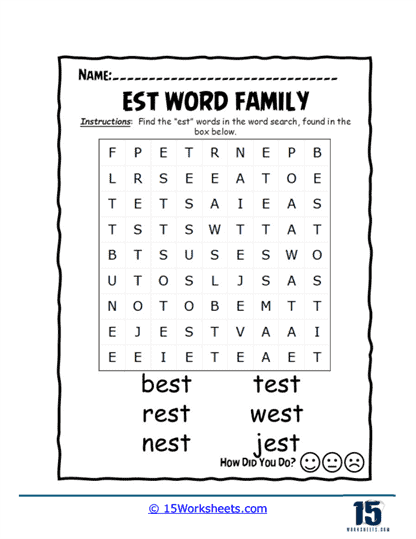
Students search through a grid to find est words such as best, rest, nest, and jest. This puzzle encourages scanning, attention to detail, and recognition of consistent spelling. Word searches help children engage with print in a relaxed but focused way. The familiar pattern boosts success as learners find repeated word endings. It’s a fun independent task or partner activity.
Puzzle Quest
Learners locate est family words like pest, zest, chest, crest, and quest in a letter grid. The variety of word lengths helps children apply the pattern flexibly. Searching strengthens visual discrimination skills. Students enjoy the challenge of finding hidden words while still practicing phonics. It’s an energizing way to end or review a lesson.
Hidden Hunt
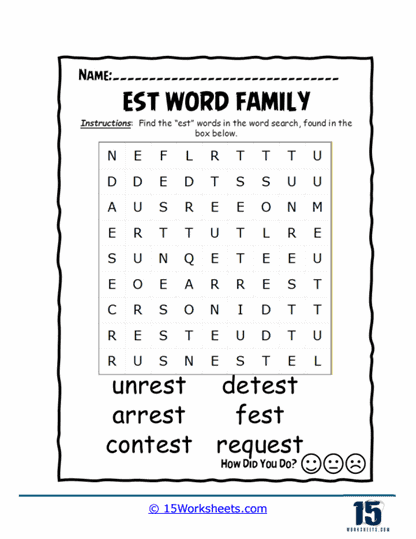
This worksheet introduces longer words containing the est pattern, such as unrest, contest, arrest, and request. Students must analyze bigger words to spot the smaller familiar pattern inside them. This deepens phonics understanding beyond single-syllable words. The puzzle format adds excitement while promoting persistence. It’s excellent enrichment for students ready for a challenge.
Image Labels
Students write est words like best, test, guest, and crest under the correct illustrations. The focus is on connecting meaning, spelling, and handwriting. Writing multiple times helps reinforce accuracy and fluency. Students gain practice recalling words independently rather than selecting from choices. This is a strong reinforcement activity for centers or home packets.
Trace Test
This worksheet provides tracing and writing practice with est words including best, rest, vest, guest, and quest. Tracing supports correct letter formation for young writers. Students then rewrite the words independently to show mastery. Repetition helps solidify phonics recognition and spelling skills. It’s great for handwriting practice, intervention groups, or warm-ups.
What Is the est Word Family?
The est word family is a group of words that all share the same ending spelling pattern: est. This ending creates a consistent sound that helps early readers decode words more quickly. Many est words represent everyday objects, actions, and descriptions that young learners encounter in stories and conversations. Because they are high-frequency and easy to blend, they help children build momentum in reading. Recognizing the pattern boosts confidence and supports fluency.
Words in this family include short, simple forms like rest, best, nest, and test, as well as longer words such as contest, request, and arrest. While the ending stays the same, the beginning letter or blend changes the meaning entirely. This helps children understand how small spelling alterations create new vocabulary. The family includes nouns, verbs, and adjectives, giving students broad exposure to language use. The versatility of these words makes them useful across reading levels.
Linguistically, est has an interesting place in English. In addition to being part of many base words, est can also act as a comparative suffix in other contexts, though that’s a different grammatical use. In the word-family sense, however, est simply forms a consistent phonics pattern that readers can rely on. Children learn to spot it quickly, which helps with decoding in unfamiliar texts. Sentences such as “The guest wore a vest on his quest” show how playful and meaningful these words can be.
Word List for the est Word Family
Word List (Alphabetical)
- arrest
- best
- chest
- contest
- crest
- detest
- guest
- jest
- nest
- pest
- quest
- request
- rest
- test
- unrest
- vest
- west
- zest
Example Sentences
1. The guest wore a vest as he went on a quest in the forest.
2. A pest sat in the nest, but the best bird chased it away.
3. We took a rest after the long test, and then planned a big contest.