
Eed Word Family Worksheets




About These 15 Worksheets
The eed word family helps students notice how a consistent spelling pattern can create a clear, strong long-e sound. These worksheets guide learners through words like seed, need, greed, and succeed, showing how the shared ending makes reading and spelling more predictable. Activities move from simple picture-coloring tasks to more advanced writing, matching, and puzzle challenges, so students can grow step by step. The collection is designed to build both confidence and accuracy in phonics.
Each page focuses on connecting the eed sound pattern to real vocabulary and meaningful visual clues. Learners color, match, cut, trace, and write, which keeps phonics practice active and engaging. They also meet longer, multi-syllable words like proceed, exceed, and succeed, helping them stretch their decoding skills beyond basic one-syllable terms. These varied formats work well in literacy centers, small groups, homework, or independent seatwork. Over time, students begin to spot the eed pattern quickly in books and everyday text.
By working repeatedly with the eed family, students strengthen their decoding skills, spelling accuracy, and vocabulary comprehension all at once. They learn to compare similar-looking words, tell them apart using sound and meaning, and apply that knowledge in real reading situations. The combination of visual cues, writing practice, and puzzles supports different learning styles. These worksheets lay a solid foundation for more advanced reading and writing success.
About Each Worksheet
Sound Sorter
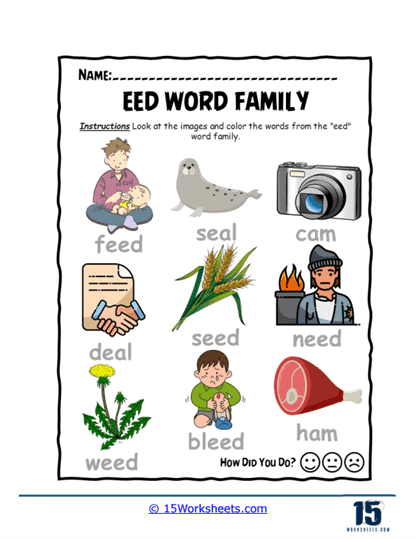
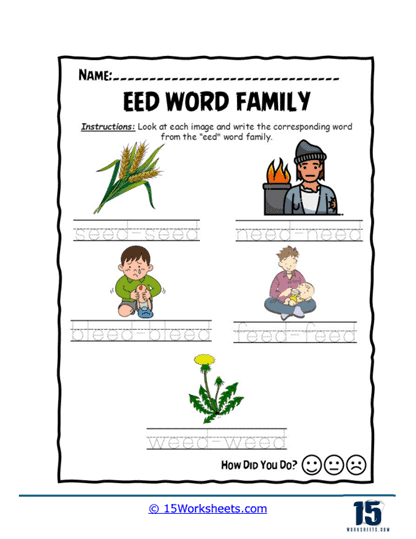
This worksheet has students color only the pictures whose names belong to the eed word family. They see familiar images such as seed, weed, bleed, need, and feed, along with distractors like seal, cam, and ham. Learners must listen for and think about the vowel sound to decide which words fit. The coloring element keeps the task playful while building focus and memory. This page is perfect for early phonics practice in centers or as an engaging warm-up.
Picture Picker
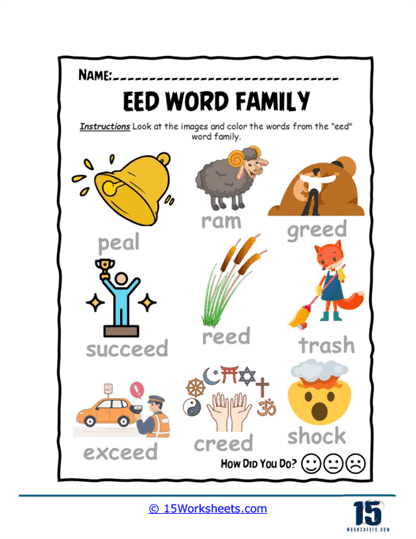
Learners look at a fresh group of images and color just the ones that match the eed sound. They meet words like greed, reed, succeed, and exceed alongside pictures that do not belong, such as ram or trash. Students compare sounds and meanings to decide which items belong in the word family. This worksheet shows how the eed pattern appears in longer, more complex vocabulary. It works well for stretching phonics skills with students who are ready for a challenge.
Match Master
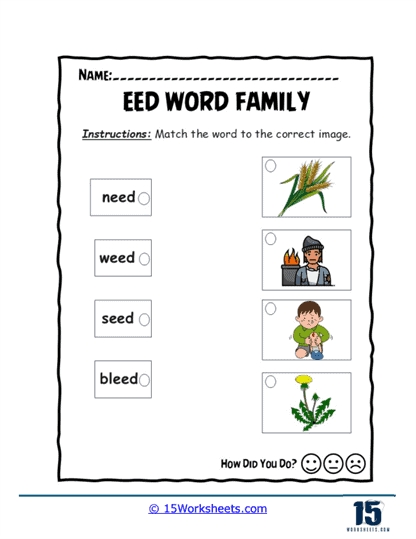
In this activity, students match eed words such as need, weed, seed, and bleed to their correct pictures. Each image gives a strong clue to the word’s meaning and sound. Learners draw lines or connect pairs to show they understand both vocabulary and phonics. The simple format keeps the focus on sound-letter patterns and word recognition. This worksheet is great for small-group review or quick independent practice.
Smart Matcher
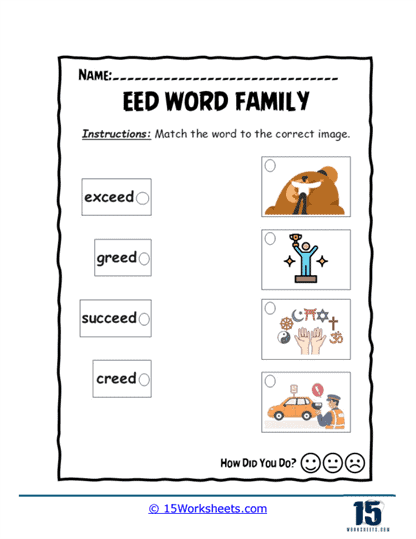
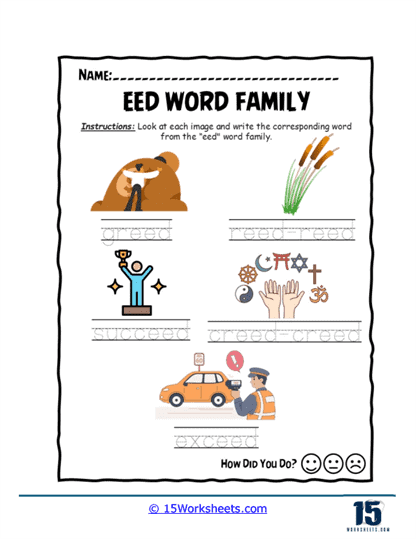
Students match longer eed words like exceed, greed, succeed, and creed to matching illustrations. The pictures show scenes or symbols that make each advanced word easier to understand. Learners must read carefully, notice the shared eed pattern, and then connect each term to its meaning. This activity stretches decoding skills into multi-syllable territory. It makes a strong bridge between basic phonics and more challenging vocabulary work.
Write Right
This worksheet asks students to look at pictures and write the correct eed word underneath, such as seed, need, bleed, feed, and weed. Learners may also trace the words first to build muscle memory and spelling confidence. Writing each word several times reinforces the sound pattern and its spelling. The pictures keep the task meaningful by tying words to real objects and actions. This page is ideal for handwriting and phonics practice combined.
Pattern Writer
Students write more advanced eed words like greed, succeed, reed, creed, and exceed under matching illustrations. There are no tracing lines, so learners must recall and spell each word independently. The images act as clues, helping students connect meaning with accurate spelling. This worksheet encourages careful thinking and shows who has mastered the eed pattern. It works well as a skill check or more challenging follow-up to earlier practice.
Cut Sorter
This worksheet invites students to cut out images and paste them into boxes labeled with eed words like seed, bleed, succeed, creed, need, greed, exceed, and feed. Learners must carefully match each picture to the correct vocabulary item. The cut-and-paste format adds a hands-on element that makes phonics feel more like a game. Students practice categorization as they place each picture where it belongs. This activity fits perfectly into a literacy center or small-group rotation.
Word Completer
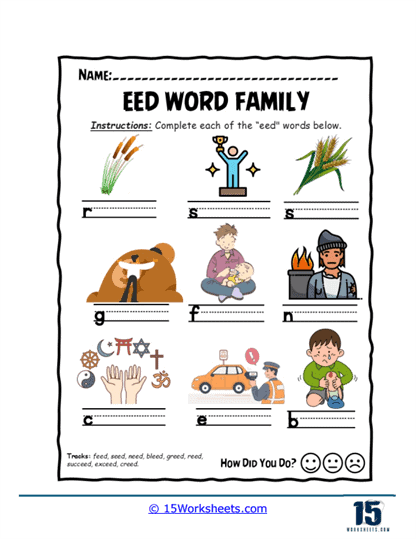
Students see partially spelled eed words paired with pictures and must fill in the missing letters. Each image, such as a bear for greed or a child for bleed, gives a context clue. Learners write the correct beginning or ending letters to complete the full eed word. The activity reinforces both decoding and spelling through focused practice. It is excellent for helping students notice how sounds map onto letters.
Line Writer
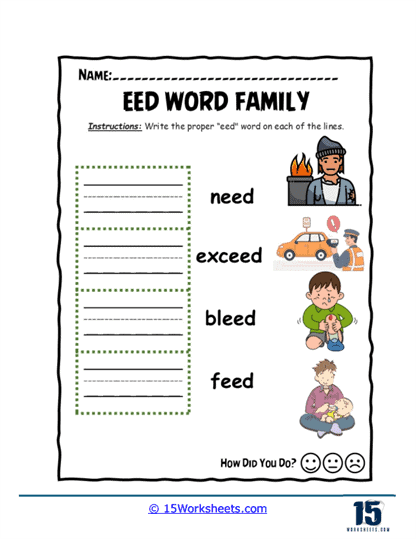
In this worksheet, students choose from words like need, exceed, bleed, and feed and write the correct one on each line. Clear illustrations help them identify which vocabulary matches the picture. Learners practice neat handwriting and correct spelling at the same time. Repeated writing strengthens both phonics recall and fine-motor coordination. This page is ideal for quiet independent work or targeted practice with a small group.
Practice Pages
Students get extra writing practice with eed words such as greed, seed, succeed, and reed. Each picture serves as a visual reminder of the word’s meaning. Learners write each word on the lines, focusing on spelling, spacing, and neatness. The repetition helps lock the eed pattern into long-term memory. This worksheet is a useful follow-up for students who need a bit more practice to feel confident.
Seek & Circle
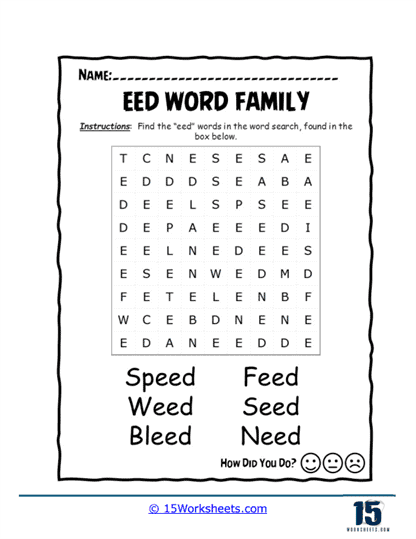
This word search asks students to find hidden eed words like speed, weed, bleed, feed, seed, and need in a grid. Learners scan carefully in different directions to locate each term. The puzzle structure keeps them motivated while reinforcing phonics patterns. Students improve visual tracking, attention to detail, and pattern recognition. This is a great choice for early finishers or as a fun review activity.
Puzzle Searcher
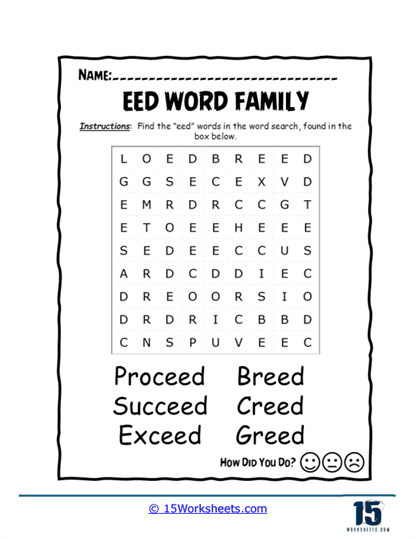
Students expand their vocabulary by searching for longer eed words such as proceed, succeed, exceed, breed, creed, and greed. The grid is packed with letters, so learners must focus closely on patterns to succeed. This word search encourages them to recognize the eed ending inside multi-syllable words. Repeated exposure to these advanced terms boosts decoding and vocabulary. The worksheet suits more experienced readers who are ready for a challenge.
Grid Finder
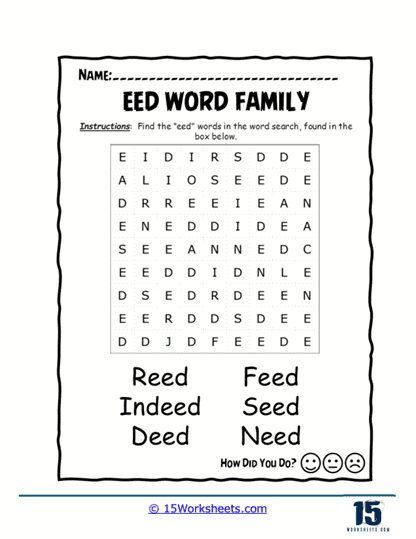
This worksheet provides another eed-themed word search using words like reed, deed, indeed, feed, seed, and need. Students search the grid to find each familiar pattern. The repetition helps reinforce spelling and strengthens recognition of the eed family. As learners work, they build patience and accuracy. This activity is a fun way to keep phonics practice fresh and engaging.
Name It!
Students look at a series of images and write the correct eed word underneath, including need, greed, seed, reed, creed, feed, succeed, and exceed. They rely on picture clues to connect meaning, sound, and spelling. Writing each answer strengthens vocabulary recall and phonics mastery. The exercise promotes independence as students choose the right word without a full word bank. It is a strong activity for checking understanding after earlier lessons.
Trace Trail
This worksheet provides traceable eed words for students to read and follow on each line. Learners trace and then may rewrite the words to practice proper letter formation. Tracing builds muscle memory and supports consistent handwriting. Repeated exposure to the eed pattern strengthens decoding and spelling recall. This page is perfect for handwriting practice that also reinforces phonics.
What is the eed Word Family?
The eed word family is made up of words that share the same ending spelling, e-e-d, and a long e sound followed by a /d/. Words like seed, need, feed, and weed all belong because they rhyme and follow the same pattern. This consistent ending makes it easier for students to decode new words once they know the sound. When children recognize that eed usually sounds like a long e plus d, they can read these words more quickly and confidently.
The eed family includes both simple and more advanced vocabulary. On the simpler side, there are everyday words such as reed, deed, and bleed that often appear in stories or informational texts for children. On the more complex side, learners encounter words like greed, succeed, exceed, proceed, and indeed, which show up in higher-level reading. Seeing the same pattern in both easy and challenging words helps students carry their phonics skills into more advanced reading.
Many eed words function as nouns and verbs, and some are used in common phrases. For example, readers may see expressions like “good deed,” “plant a seed,” or “succeed in school,” all of which help tie the pattern to real-life ideas. As students practice with the eed family, they strengthen both phonics and vocabulary at the same time. This combination supports better comprehension, smoother reading, and stronger writing as they move through elementary grades.
Word List for the eed Word Family
- bleed
- breed
- creed
- deed
- exceed
- feed
- greed
- indeed
- need
- proceed
- reed
- seed
- speed
- succeed
- weed
Example Sentences
1. I will plant a seed in the soil and make sure I feed it water when it is in need.
2. The reed by the pond swayed in the wind as we watched the dog run at full speed and almost bleed his knee.
3. We made a plan to proceed with our goal, succeed in our work, and avoid acting with greed as we followed our family creed.