
En Word Family Worksheets






About These 15 Worksheets
The -en word family is one of the most rewarding groups for early readers to explore. Words like hen, pen, ten, and men pop up everywhere in children’s stories, rhymes, and even math problems. Learning this family helps kids recognize patterns in spelling and sound, which makes reading smoother and more fun. With engaging activities, students gain the confidence to decode new words quickly.
Our -en worksheets provide plenty of hands-on practice with puzzles, stories, and matching games. Each activity encourages learners to see, say, and use -en words in context, so they aren’t just memorizing – they’re applying. The variety keeps things fresh: one day, a student may be solving a word search, and the next, they’re filling in a story about a snowy glen or a curious wren. By mixing visual, auditory, and written practice, the worksheets reach all learning styles.
Most importantly, these resources connect reading practice to real-world comprehension. Kids learn that the same -en sound links words about animals, numbers, places, and even feelings. By weaving phonics with storytelling, puzzles, and matching, the collection makes literacy not only effective but also enjoyable. Whether used at home, in class, or in small reading groups, the -en word family opens doors to both fluency and fun.
About Each Worksheet
Winter Glen
This worksheet presents a short winter story with blanks for -en words. Students choose from options like men, wren, den, and frozen to complete the tale. The activity blends vocabulary practice with storytelling. Kids learn to use context clues to select the right words. It’s great for building comprehension and fluency in small groups or at home.
Open Clock
Here, learners match words like glen, open, when, even, and wren with pictures. Each drawing illustrates the meaning of the word clearly. Students strengthen their word-picture connections. The exercise develops decoding and vocabulary skills in a visual way. It works perfectly for literacy centers or independent practice.
Hen Pen
Students complete five sentences by inserting the correct -en word. Choices include men, hen, den, ten, and pen. The activity reinforces word use through meaningful context. It encourages careful reading for comprehension. Teachers can use it for warm-ups, homework, or quick group review.
Ten Den
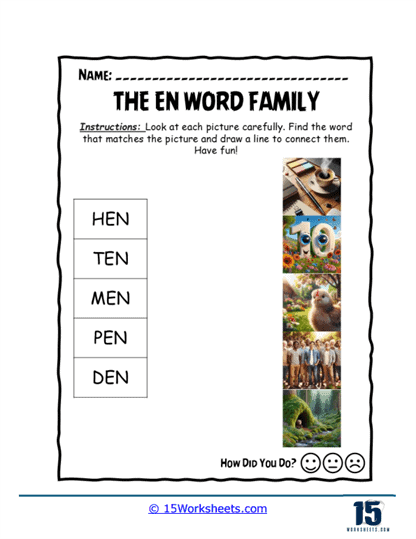
This worksheet asks students to match hen, ten, men, pen, and den to their pictures. Each image makes the word’s meaning concrete. Kids strengthen both decoding and visual recognition. The mix of phonics and imagery builds confidence. It’s ideal for centers, partner work, or home practice.
Frozen Seven
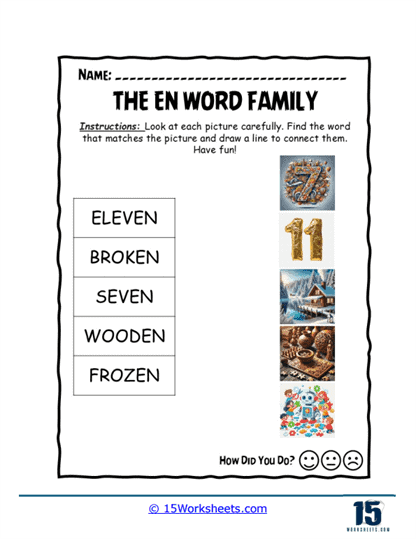
Students work with slightly longer words like eleven, broken, seven, wooden, and frozen. They match each term to its picture. This activity stretches vocabulary into multi-syllable territory. Learners practice seeing familiar endings in bigger words. It helps bridge simple phonics to more advanced reading.
Wooden Hunt
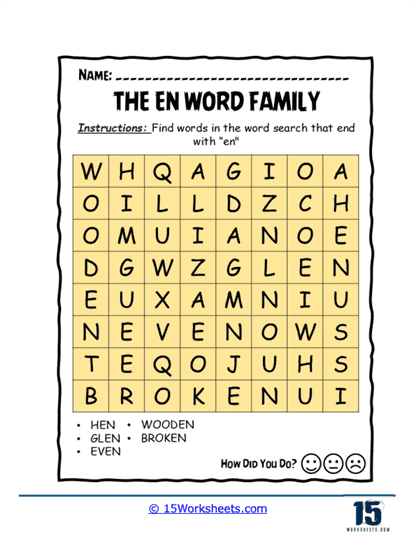
In this word search, students find -en words like hen, glen, wooden, broken, and even. They scan across directions to spot each word. The puzzle makes phonics playful and interactive. Kids improve spelling recall while practicing persistence. It’s a fun choice for early finishers or homework.
Pen Den
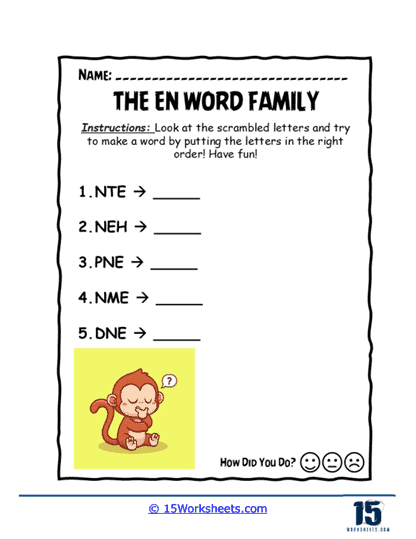
Scrambled letters challenge learners to form correct -en words. Examples include NTE and PNE. Kids rearrange them into ten and pen. The puzzle makes spelling practice engaging. It sharpens sequencing and flexible thinking in phonics.
Wren Open
This worksheet is another word search with ten, pen, open, wren, and frozen. Students locate each word in the grid. It combines short and longer -en words for variety. The hunt reinforces endings while encouraging focus. It’s a fun pick for literacy centers or rainy-day review.
Men When
Students search a grid for men, den, when, open, and seven. The repetition of puzzle practice builds mastery. Learners get extra spelling and recognition review. The playful format keeps motivation high. It’s great for independent or partner activity.
Mountain Wren
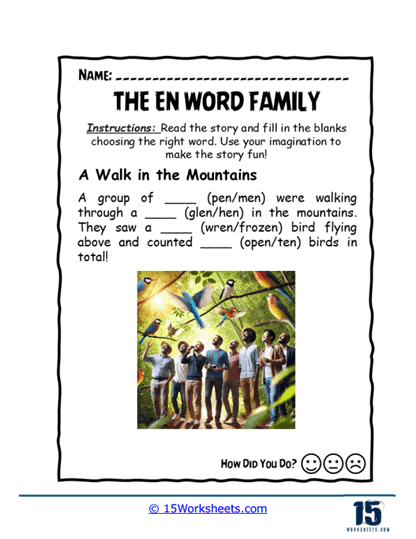
In this story passage, kids fill in blanks with words like men, glen, wren, and ten. Context clues guide them toward the correct choice. The activity links phonics to narrative reading. It strengthens comprehension and vocabulary together. It’s best used as a guided reading supplement.
Even Wren
Here, students unscramble mixed letters such as NEVE and ENWR. They rebuild them into words like even and wren. The challenge reinforces spelling memory. It builds flexible thinking in word recognition. This worksheet makes phonics feel like a puzzle game.
Frozen Glen
This activity features scrambled longer words like ZORFEN and NELG. Students reconstruct them into frozen and glen. The challenge steps up decoding practice. It requires close attention to letter order and patterns. It’s engaging and works well for advanced practice.
Wren Pen
Students complete short sentences with the correct -en word. Options include wren, glen, hen, when, and pen. The task focuses on comprehension in context. Learners use meaning to choose the right fit. It strengthens fluency through sentence-based practice.
Ten Men
This fill-in-the-blank worksheet uses choices like ten, den, glen, men, and pen. The sentences connect to everyday topics like counting or settings. The activity makes vocabulary meaningful and practical. It helps kids develop accuracy in word use. Teachers can assign it as homework or class practice.
Den Hen
Students fill in sentences using hen, when, men, pen, and den. The exercise blends phonics and comprehension practice. Learners reinforce both grammar and vocabulary. Context clues make word selection meaningful. It’s effective for building confidence in early reading.
What is the -en Word Family?
The -en word family is built around the shared ending -en, which gives words like ten, pen, hen, and men their rhyming sound. These short-vowel words are often some of the first real words children can read, because the sound pattern is predictable and easy to decode. In everyday life, kids hear these words constantly – whether counting “ten,” seeing a “hen” at the farm, or using a “pen” at school. This frequent exposure makes the family highly practical for early literacy.
The -en family also expands into longer words like seven, frozen, broken, and wooden. By recognizing the same ending sound in bigger words, students learn that phonics patterns carry across syllables. This builds confidence when approaching new vocabulary. The -en pattern shows up in nouns, verbs, and adjectives, so learners get exposure to multiple parts of speech. That variety strengthens both reading and writing.
From a linguistic perspective, -en has interesting roots. In Old English, -en was sometimes used as a suffix (as in golden or wooden) to make adjectives. Today, kids encounter it more often as a rhyming word family. Because these words are short, frequent, and useful, they appear often in beginner readers and children’s books. Understanding the -en family gives learners a stepping stone toward fluency, helping them read with both speed and joy.
Word List for the -en Word Family
broken • den • eleven • even • frozen • glen • hen • men • open • pen • seven • ten • when • wooden • wren
Example Sentences
The hen sat in the den while the men counted to ten.
We saw a wren in the glen and wrote it down with a pen.
The wooden toy was broken, but the seven kids still played.
Can you tell me when the eleven doors will finally be open?
It felt frozen outside, but we had an even bigger smile when we found the hen.