
Eg Word Family Worksheets




About These 15 Worksheets
The eg word family helps beginning readers notice how a short vowel and consonant work together to create a clear, repeatable pattern. These worksheets focus on words like beg, leg, keg, peg, and Meg, giving students many chances to read, write, and use them in context. Activities range from simple matching to story writing, so learners can grow steadily in confidence. The set is designed to support both early phonics practice and emerging reading comprehension.
Each worksheet connects eg words to strong picture clues, helping students link sound, spelling, and meaning. Learners trace, write, sort, cut, glue, search, and even build sentences and stories using the same core word family. This repeated exposure makes the pattern feel familiar and predictable. The activities fit easily into literacy centers, small-group lessons, homework, or independent practice. Over time, students start to recognize eg words more quickly in books and classroom print.
As children work through the collection, they strengthen decoding skills, spelling accuracy, and sentence-level understanding. Matching, crosswords, and word searches build careful visual tracking and attention to detail. Writing and story tasks help students move from recognizing eg words to using them clearly in their own sentences. These combined skills lay a strong foundation for future reading and writing success across all subjects.
About Each Worksheet
Match Map
This worksheet asks students to match simple eg words such as beg, leg, keg, peg, and Meg to their correct pictures. Learners examine each image closely and draw a line to the word that represents it. The activity helps children notice the shared eg pattern while connecting vocabulary to real objects or characters. It provides a gentle introduction to the word family in a clear, structured way. This page works well as an entry point for new readers or as a quick review.
Trace & Match
Students trace eg words like beg, leg, keg, peg, and Meg before matching them to pictures. The tracing lines support handwriting development and help learners feel how each word is formed. After tracing, students use visual clues to connect each word to the correct image. This blend of writing and matching reinforces spelling patterns and vocabulary understanding. It is an engaging activity for small groups, centers, or independent practice.
Choose Right
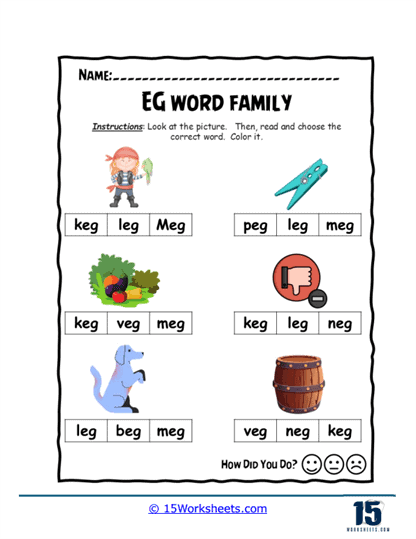
This worksheet shows pictures alongside three word options, and students choose the correct eg word to match each image. Learners must read all options carefully and circle or color the correct one. The multiple-choice format encourages reasoning as students compare similar-looking words. Repeatedly seeing the eg pattern helps strengthen decoding and visual recognition. This page is ideal for building accuracy and confidence with simple word choices.
Clue Crossword
Students complete a crossword puzzle using eg family words. Clues describe familiar items such as a wooden container for drinks, a person’s name, or a body part. Learners use these clues plus their phonics knowledge to fill in the correct eg words. The puzzle format adds a fun twist to practicing the word family. It helps build problem-solving skills and a deeper understanding of vocabulary in context.
Write Row
This worksheet has students write eg words such as Meg, beg, keg, and leg repeatedly along handwriting lines. Each word is supported by a picture above the writing space to reinforce meaning. The repetition builds spelling accuracy and strengthens letter formation. As learners copy each word several times, they internalize both its look and sound. This page is perfect for developing neat handwriting and solid phonics recall.
Search & Find
Students search a word grid for eg words like beg, keg, leg, Meg, veg, neg, and peg. They highlight or circle each word from the list as they find it. The word search encourages careful scanning and pattern recognition in a playful format. Repeatedly spotting eg words helps cement spelling and phonics patterns in memory. This worksheet is great for early finishers or as a fun review activity.
Build & Write
In this worksheet, students look at each picture, then cut out letter tiles to build the correct eg word. After assembling words like peg, keg, leg, and beg, they write the word clearly on the line below. The cut-and-build format gives learners a tactile way to experience word construction. Students practice decoding as they decide which letters belong in each word. This multisensory task supports strong word family mastery.
Story Filler
Students read a short story that uses picture icons in place of missing eg words. They must decide which eg word fits each picture and write it on the line provided. Words like Meg, beg, leg, peg, keg, and veg appear within the narrative. This activity blends phonics with sentence and story comprehension. It helps learners see how word families show up naturally in connected text.
Story Writer
This worksheet continues the story work by asking students to rewrite the full eg story using words instead of pictures. Learners carefully reread the story, recall the correct eg words, and transcribe the sentences onto lines. This task builds handwriting fluency and strengthens memory of both vocabulary and storyline. Students practice sequencing and attention to detail as they write. It is a strong bridge between decoding words and producing them in extended text.
Draw & Write
Students focus on the word peg by coloring it, drawing a picture to represent it, and then writing it repeatedly on the lines. The drawing element invites creativity and encourages students to visualize the word’s meaning. Repetitive writing helps build spelling accuracy and smooth letter formation. Learners connect sound, picture, and print in one simple activity. This worksheet is a nice choice for combining art with early literacy practice.
Choice Challenge
This worksheet presents multiple-choice questions that require students to choose the correct eg word based on a picture and short prompt. Learners identify words like Meg, keg, leg, beg, and peg by reading each clue and selecting the best option. The format encourages careful reading and comparison of similar spellings. It builds critical thinking as students interpret information before deciding. This activity supports strong phonics recognition and vocabulary mastery.
Picture Writer
Students observe each picture and write the correct eg word on the blank line below. Images stand for words such as Meg, keg, leg, peg, beg, and veg. Learners practice recalling vocabulary and spelling it accurately without tracing. The task reinforces the eg pattern through repeated writing and visual association. This worksheet fits well into handwriting practice or phonics review sessions.
Sentence Filler
This worksheet presents sentences with missing eg words and pictures as clues. Students fill in words like Meg, keg, leg, peg, beg, and veg, then read each completed sentence aloud. The activity blends phonics with sentence-level comprehension. Learners see how vocabulary functions in real language rather than in isolation. It is an effective way to build fluency, context understanding, and confidence.
Order Builder
Students rearrange mixed-up words to form correct sentences using eg vocabulary such as Meg, keg, and peg. Each jumbled sentence includes a picture clue to support meaning. Learners rewrite the sentence in the correct order on the line. This activity develops grammar awareness and strengthens sense of sentence structure. It also reinforces the eg word family through repeated exposure in meaningful contexts.
Jar Sorter
This worksheet shows a jar labeled eg words and asks students to place the correct eg words into numbered spaces using a word bank. Learners sort words like leg, beg, keg, Meg, and peg into the correct spots, often through cutting and gluing. The sorting task builds classification skills and strengthens phonics pattern recognition. Students also practice fine-motor control during the cut-and-paste steps. This page is a fun, hands-on way to review the entire eg word family.
What is the eg Word Family?
The eg word family is a group of short vowel words that share the same ending letters e and g. Words like beg, leg, keg, and peg all belong because they rhyme and follow the same spelling pattern. When students learn that e plus g usually makes the /eg/ sound, they can use that knowledge to read and spell many similar words quickly. This consistent pattern makes the eg family easy to recognize in early reading materials.
Most eg words in early literacy are simple nouns, verbs, or names that children can easily understand. For example, leg names a body part, beg describes a pleading action, keg is a type of barrel, and Meg is a proper name. The word veg appears in some contexts as a short form for vegetables, giving children another concrete meaning to connect to the pattern. These words are short, memorable, and helpful for practicing both reading and writing.
Because eg words are so short, they are excellent for teaching left to right decoding and blending skills. Students first say the beginning sound, then add the eg chunk to read the whole word. They see how changing just the first letter turns beg into peg or leg into keg, which teaches them how word families work. This understanding helps learners feel more confident when they encounter new words with familiar endings in books and classwork.
Word List for the eg Word Family
- beg
- keg
- leg
- Meg
- neg
- peg
- veg
Example Sentences
1. Meg hurt her leg and had to beg her friend to help her pick up the peg by the keg.
2. We will beg for one more keg of juice and share a little veg with Meg and her leg of the table.
3. He saw one loose peg in the leg of the chair and asked Meg to help him beg the teacher for a new keg of paint.