
Eep Word Family Worksheets






About These 15 Worksheets
The eep word family helps students hear and see how a repeated pattern can unlock many different words. These worksheets focus on words like beep, sleep, deep, cheap, and jeep, giving children lots of chances to practice the same sound in new contexts. With activities that include coloring, matching, cutting, tracing, writing, and puzzles, learners get to experience the eep pattern in fun, hands-on ways. The collection is designed to support both beginning readers who are just meeting eep words and more confident readers who are ready for longer words like oversleep and asleep.
Each page connects the eep sound to clear images so students can link what they hear, see, and say. Learners make decisions about which words fit the pattern, which builds stronger phonics awareness. They also write and trace words repeatedly, which strengthens spelling and handwriting at the same time. Whether used at home, in literacy centers, or during small-group lessons, these worksheets help children spot the eep pattern quickly in stories and other texts.
As students work through the set, they build confidence in decoding and encoding eep words. They learn to separate look-alike patterns and pay attention to the middle of the word, not just the first letter. Over time, this attention to detail supports smoother, more accurate reading. The eep family becomes a friendly pattern that students can rely on as they move into more complex reading and writing.
About Each Worksheet
Color Sort
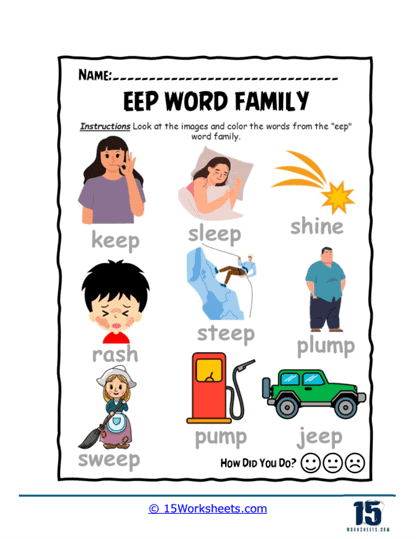
This worksheet introduces the eep word family by asking students to color only the pictures whose names contain the eep sound. Images like beep, cheep, deep, cheap, sweep, and jeep appear alongside unrelated words, so learners must think carefully before coloring. Students practice sorting based on sound and spelling, not just on what they see. The visual, hands-on format keeps engagement high while building important phonics skills. This page is great for centers, warm-ups, or independent practice.
Sound Seeker
Students look at a new set of pictures and decide which ones represent eep words such as keep, sleep, steep, and jeep. They color only the images that match the target sound pattern, leaving distractors uncolored. This encourages learners to listen closely to vowel sounds and notice how eep feels in their mouths when spoken. The activity also builds vocabulary as students connect each picture to a meaningful word. It works well as a follow-up to earlier eep lessons or as a review task.
Match Up
This worksheet has students match simple eep words like beep, deep, cheep, and bleep to their corresponding pictures. Learners draw lines between each word and the image that best represents it. The matching structure helps solidify the connection between sound, spelling, and meaning. Students practice careful observation and comparison as they decide which word fits each picture. It is a strong choice for small-group work or quick independent review.
Word Connector
Students match more eep words such as cheap, steep, keep, and jeep to illustrations that provide context clues. They must read the words, look at the pictures, and connect them based on meaning and sound. This activity broadens practice by including several kinds of eep words in one place. Learners see that the same pattern appears in many everyday words, not just one or two. The worksheet helps deepen word-family awareness and builds reading confidence.
Picture Writer
In this worksheet, students write eep family words like sleep, keep, sweep, jeep, and steep beneath matching pictures. Some models may be traceable to support developing writers, and students then write the words on their own. This repeated writing strengthens phonics understanding and spelling accuracy. Learners also build fine-motor skills as they form each letter carefully. The combination of visual cues and writing practice makes this page ideal for handwriting and phonics time.
Trace & Write
Students write the correct eep word under each picture using models such as cheap, beep, bleep, cheep, and deep. They first see the word, connect it to the picture, and then practice writing it on the lines. The repetition supports both memory and confidence in spelling. Learners move from tracing or copying to more independent writing as they progress down the page. This worksheet is excellent for reinforcing accurate formation of eep words.
Cut & Paste
This worksheet gives students eep picture tiles to cut out and paste into a grid of matching eep words. They must decide whether each tile represents bleep, beep, cheep, cheap, deep, jeep, keep, sleep, or sweep. The cut-and-paste format turns phonics practice into a hands-on sorting game. Learners strengthen decoding skills as they carefully match each image to its written word. This page is especially engaging for tactile learners and center time.
Word Builder
Students complete partially written eep words based on picture prompts in this activity. They fill in missing letters to form words such as beep, cheep, bleep, deep, sleep, steep, and sweep. Each picture nudges learners toward the correct spelling, so they must use both phonics and context. Completing the words helps students pay attention to letter order and pattern consistency. This worksheet supports decoding, spelling, and problem-solving all at once.
Line Practice
Learners practice writing eep words like jeep, sleep, sweep, and keep on handwriting lines. Each word is shown with a picture to reinforce meaning and guide recall. Students write the words multiple times to develop spelling fluency and muscle memory. The simple, focused design makes it easy for children to concentrate on neatness and accuracy. This worksheet works well for daily handwriting or phonics drills.
Write & Recall
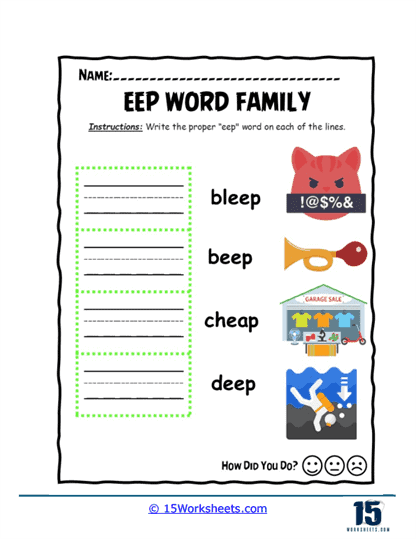
This worksheet asks students to write the correct eep word-bleep, beep, cheap, or deep-on lines beside each picture. The images give clear clues that help learners recall the matching vocabulary without a full word bank. Students write each chosen word more than once, strengthening both memory and spelling. The activity encourages them to think carefully about how each word sounds and looks. It is a helpful tool for checking understanding after earlier matching or coloring tasks.
Grid Searcher
Students solve a word search filled with eep words like cheep, deep, keep, beep, bleep, and cheap. They scan the grid in different directions to find each term from the list. The puzzle-style format keeps students engaged while they repeatedly see the same spelling pattern. Word searches like this build visual tracking, attention, and pattern recognition. This worksheet is perfect for early finishers or as a fun review.
Pattern Finder
Learners hunt for additional eep words such as peep, seep, sheep, sleep, steep, and sweep in another word search grid. They must look carefully to spot each word hidden among many letters. The repetition helps solidify the eep pattern and its spelling in long-term memory. Students also practice patience and systematic searching as they work. This activity supports reading fluency by strengthening visual scanning skills.
Word Explorer
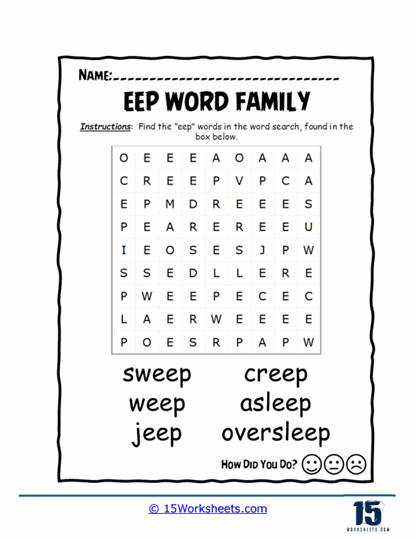
This worksheet widens the eep vocabulary set with words like sweep, creep, weep, jeep, asleep, and oversleep. Students search for each word in a letter grid, encountering both simple and multi-syllable eep terms. The puzzle encourages learners to notice that the eep pattern appears inside longer words, not just short ones. They build decoding skills as they track each word across different directions. This page is ideal for more advanced students who are ready for a challenge.
Picture Labeler
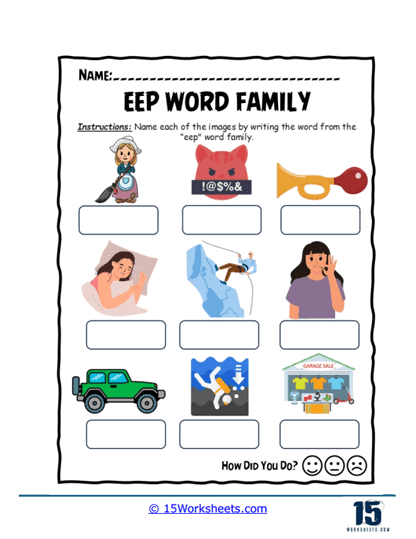
Students see pictures for words such as sweep, bleep, beep, sleep, steep, keep, jeep, cheap, and deep and then write the correct eep word underneath each one. The visuals make vocabulary meanings clear, while the writing lines encourage careful spelling. Learners must use both sound recognition and picture clues to make good choices. The act of labeling deepens the connection between word, sound, and image. This worksheet supports reading and writing fluency in a very direct way.
Trace Builder
In this worksheet, students read and trace eep words across several handwriting lines. Words such as oversleep, asleep, jeep, steep, sweep, and keep appear as models for learners to follow. Tracing builds muscle memory, which helps students write these words independently later. The repeated practice reinforces phonics patterns and spelling accuracy. This page is excellent for combining handwriting instruction with word-family review.
What is the eep Word Family?
The eep word family is a group of words that share the same ending letters e-e-p and the long e sound followed by /p/. Words like beep, sleep, deep, and jeep all belong because they rhyme and follow the same spelling pattern. When students learn the eep pattern, they can use it to decode many words quickly instead of sounding out each letter separately. This makes reading feel smoother and more predictable.
Many eep words are common, everyday vocabulary that children are likely to hear and use. For example, sheep and jeep show up in stories and picture books, while keep, sweep, and creep describe actions in real life. Some words like asleep and oversleep are a little longer but still rely on the same core eep sound. These longer words give students a chance to apply what they know about the pattern in more complex situations.
Because the eep pattern stays consistent, it is a friendly starting point for practicing vowel teams and word families. Students see how changing the first letter or letters creates a whole new word, such as moving from deep to sheep or from weep to creep. This helps them understand that words can be related by sound and spelling, even when their meanings are different. Over time, knowledge of the eep family supports stronger decoding, spelling, and comprehension in everyday reading.
Word List for the eep Word Family
- asleep
- beep
- bleep
- cheap
- cheep
- creep
- deep
- jeep
- keep
- oversleep
- peep
- seep
- sheep
- sleep
- steep
- sweep
- weep
Example Sentences
1. The sheep stood in the deep grass while we tried to keep the noisy jeep from making it beep and weep.
2. At night I sleep in my bed and oversleep if I do not keep my clock set before I fall asleep.
3. We will sweep the floor, creep down the hall, and then peep around the corner so we do not make the baby weep.