
Ancient Aztecs Worksheets


All About These 15 Worksheets
The Aztecs may not be around anymore, but their history is full of fascinating stories, inventions, and traditions that still capture kids’ imaginations today. These worksheets take that rich culture and transform it into fun, classroom-friendly activities. Students will get a chance to read, write, compare, draw, and even create their own versions of famous Aztec artifacts. It’s history made hands-on, approachable, and just the right amount of adventurous.
What makes this collection so useful is the variety of approaches it offers. Some worksheets focus on straightforward reading comprehension, while others ask for creative design or poetry, and still others encourage critical comparison with other civilizations. That mix means kids of different learning styles-whether they’re writers, artists, or fact-checkers-can find a way to connect with the material. It’s a clever way of sneaking literacy, geography, and cultural studies into one neat package.
On top of that, the worksheets make history feel alive by tying the ancient world to things students recognize today. From learning about chocolate to exploring the origins of Día de los Muertos, kids see how Aztec traditions still echo in modern life. The result? History doesn’t feel like a distant chapter in a dusty book-it becomes something they can taste, celebrate, and connect to their own world.
Have a Look Inside Each Worksheet
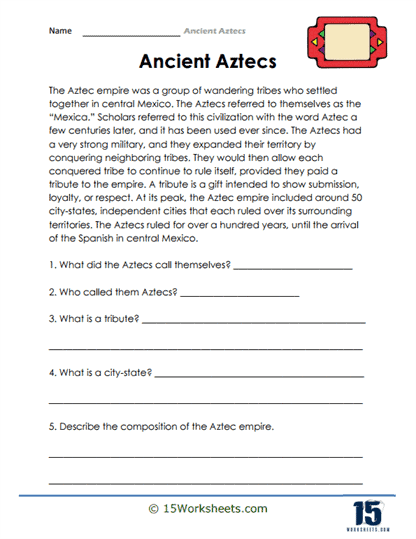
Ancient Aztecs Reading Comprehension
Students dive into a passage about Aztec civilization-touching on culture, history, or societal structure-and then answer comprehension questions. They’ll work on understanding context, grasping main ideas, and interpreting details. This cultivates reading fluency and analytical thinking in a historically rich context. It’s ideal for building both literacy skills and background knowledge about the Aztecs.
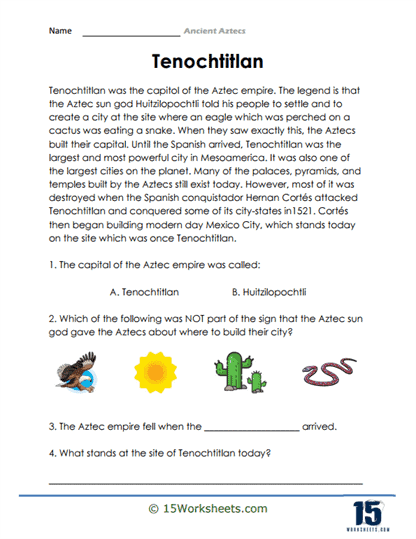
Tenochtitlan
This worksheet explores the Aztec capital, Tenochtitlan, probably through reading or diagram-based questions. Students engage with key facts like location, architecture, and engineering tricks (like causeways). It reinforces geographic awareness and historical thinking about urban planning. A great way to connect spatial reasoning with ancient world knowledge.
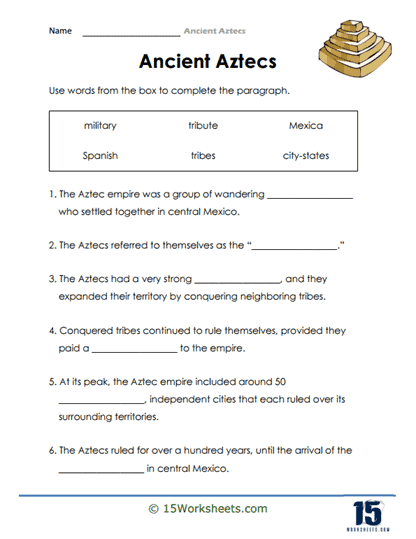
Aztec Empire Sentences
Learners fill in blanks in sentences related to the Aztec Empire’s features, achievements, or culture. This builds understanding of vocabulary and syntactic structure in a content-rich context. It reinforces retention of key historical terms and concepts. Plus, it’s a supportive scaffold for both reading and writing.
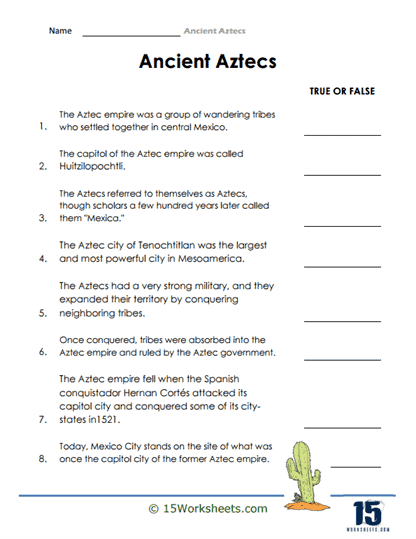
True or False
Students determine whether statements about the Aztec civilization are true or false. This sharpens critical thinking and factual recall. It allows learners to self-check comprehension while engaging with fascinating historical facts. A quick, interactive way to test knowledge and clear up misconceptions.
What’s It Mean?
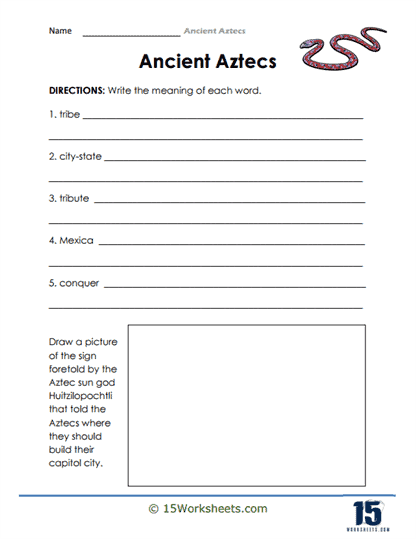
Learners write concise definitions for Aztec-specific terms or concepts. It deepens their vocabulary and conceptual clarity about Aztec culture. This builds the ability to explain terms like “chinampas,” “calendar,” or “religion” in their own words. Excellent for reinforcing both language skills and historical understanding.
The Sun Stone
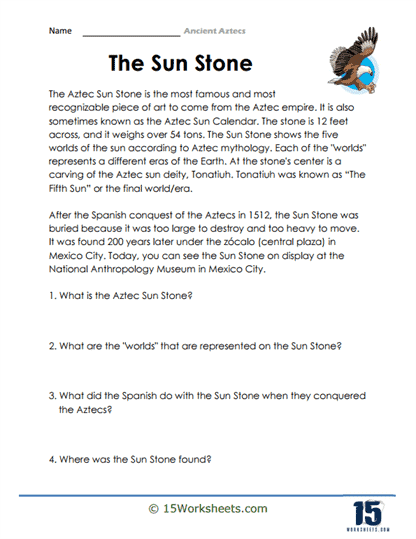
This one invites students to examine the iconic Aztec Sun Stone-likely through reading or a visual prompt-and answer related questions. They’ll explore symbolism, astronomical significance, or design features. It blends art history, astronomy, and cultural study. A beautiful way to connect visual literacy with historical inquiry.
Masters of Design
Learners look at examples of Aztec design-architecture, art, or artifacts-and analyze their characteristics. They’ll practice observation, descriptive language, and cultural interpretation. It nurtures visual analysis skills along with historical appreciation. Great for building art-history vocabulary and critical thinking.
Animals in Aztec Society
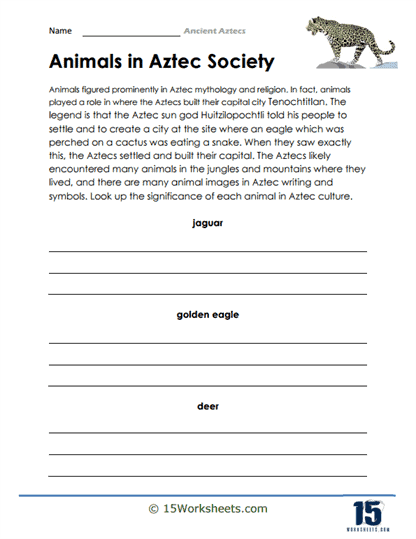
Students explore the roles of specific animals in Aztec culture-such as symbolism, mythology, or daily life. They’ll likely conduct independent research to understand each animal’s significance. This activity develops both informational research and writing skills. It’s a creative way to connect nature, belief systems, and cultural studies.
Chocolate
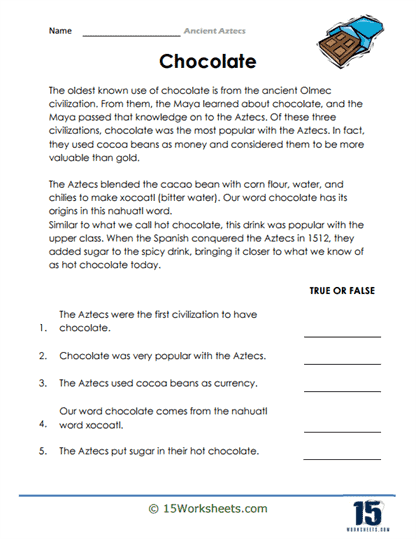
This worksheet focuses on chocolate-from cacao’s importance in Aztec society to its uses and trade. Kids learn about economics, agriculture, and daily life through this beloved commodity. It’s both engaging and culturally rich, tying a favorite food to historical context. A deliciously educational way to explore Aztec economics and customs.
Ancient Aztec Infographic
Students synthesize information about the Aztecs into a visual infographic-combining facts, symbols, and design. This hones their summarizing, visual communication, and creative design skills. It teaches them to prioritize key information and present it clearly. A modern, engaging way to demonstrate learning visually.
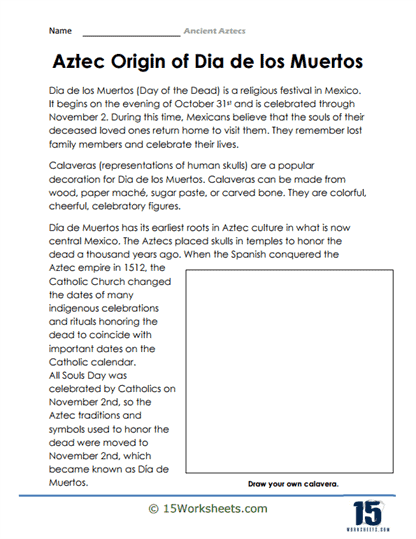
Aztec Origin of Dia de los Muertos
This worksheet explores how Aztec traditions contributed to what is now celebrated as Día de los Muertos. Students examine cultural continuity and adaptation across history. It builds awareness of how ancient beliefs shape modern traditions. Perfect for blending anthropology, cultural studies, and history.
Ancient Civilization Comparison
Learners compare the Aztecs with another ancient civilization-highlighting similarities and differences. This strengthens comparative analytical skills and broader historical context. It encourages critical thinking about cultural traits across societies. Great for deepening understanding of world history dynamics.
Create a Sun Stone
Students design their own version of the Sun Stone-employing creativity while reflecting cultural elements. They’ll apply what they know about symbolism and design in a hands-on way. It blends artistic expression with historical knowledge. A fun, immersive project that brings history to life.
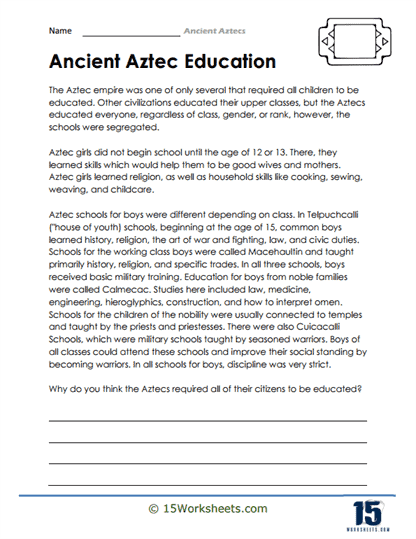
Ancient Aztec Education
This worksheet explores how education functioned in Aztec society-who learned what, how skills were passed on, and where. Students learn about social structure, learning practices, and cultural transmission. It deepens understanding of daily life and societal priorities. A fascinating peek into how the Aztecs prepared the next generation.
What Was the Aztecs Civilization?
The Aztecs were a Mesoamerican civilization that flourished from the 14th to the 16th centuries. Their capital city, Tenochtitlan, was located in what is now Mexico City. The Aztecs are known for their advanced agriculture, impressive architecture, intricate religious beliefs, and their practice of human sacrifice.
The Aztecs originally migrated from northern Mexico to central Mexico in the 13th century, and they established their capital city, Tenochtitlan, in 1325. The city was built on an island in the middle of a lake, and it was connected to the mainland by causeways. The Aztecs were skilled engineers and architects, and they built impressive structures, including temples, pyramids, and palaces.
The Aztecs had a complex religious system that was centered around the worship of many gods and goddesses. They believed that human sacrifice was necessary to keep the gods happy and prevent disasters from occurring. Sacrifices were performed in public ceremonies and were often accompanied by music, dancing, and feasting.
The Aztecs were also skilled farmers, and they developed advanced agricultural techniques, such as the use of chinampas, or floating gardens, to grow crops in the shallow waters of the lake. They grew a variety of crops, including maize, beans, squash, and tomatoes, and they also raised turkeys, dogs, and other animals for food.
The Aztecs were conquered by the Spanish in the early 16th century, and their civilization was destroyed. Many Aztec artifacts and buildings were destroyed by the Spanish, but some remnants of their culture remain today. The descendants of the Aztecs still live in Mexico and continue to celebrate their rich cultural heritage.
The Aztecs made several important discoveries and developments in various fields, including agriculture, architecture, mathematics, astronomy, and medicine. Here are some of their main discoveries and achievements:
Agriculture – The Aztecs were skilled farmers who developed advanced agricultural techniques, such as the use of chinampas, or floating gardens, to grow crops in the shallow waters of the lake. They also developed a sophisticated system of terraced farming on the steep slopes of the mountains.
Architecture – The Aztecs were skilled engineers and architects who built impressive structures, including temples, pyramids, and palaces. They also developed a unique architectural style that incorporated decorative elements, such as carved stone sculptures and brightly colored murals.
Mathematics – The Aztecs developed a sophisticated system of mathematics that included a place value system, the concept of zero, and the use of a base 20 counting system. They also developed a calendar system that was highly accurate and incorporated complex astronomical observations.
Astronomy – The Aztecs were skilled astronomers who developed a complex calendar system that included a solar calendar and a sacred calendar. They also studied the movements of the stars and planets and developed a system of astrology.
Medicine – The Aztecs developed a sophisticated system of medicine that included the use of herbal remedies, surgery, and bloodletting. They also developed a system of hygiene and sanitation that helped to prevent the spread of disease.
In summary, the Aztecs made significant contributions to human knowledge and culture, and their discoveries and achievements continue to influence modern society today.