
Foundational U.S. Documents Worksheets
All About These 15 Worksheets
This collection serves as a guided tour through the building blocks of America-from ancient ideas like the Magna Carta to guiding words like Lincoln’s Second Inaugural. Each worksheet invites students to connect ideals with history, strategy, language, and modern relevance. The mix of source study, reflection, and contemporary context makes learning feel meaningful and alive.
Whether they’re decoding the Declaration, tracing the flow from the Articles to the Constitution, or seeing former freedoms clash with modern news, students build both understanding and civic confidence. They’re not just learning facts-they’re thinking about how ideas shape society. These worksheets offer a bridge from past words to present questions.
Perfect for upper elementary to middle schoolers, this set works great for history units or civic lessons. Students gain critical thinking, historical empathy, and an appreciation for rights, law, and democracy. It’s history fluency in action.
Have a Look Inside Each Worksheet
Magna Carta
Students explore how the Magna Carta introduced ideas like limited government and individual rights. This connects ancient history to the U.S. legal tradition. It lays an early foundation for thinking about rights and the rule of law.
Mayflower Compact
Kids examine the Mayflower Compact’s role in early self-governance and the idea of majority rule. It highlights how cooperation and mutual consent guided early settlers. It shows how governance evolved from community agreement.
The Declaration of Independence
Learners delve into the Declaration’s key ideas of equality, rights, and the call for freedom. This document becomes a turning point in American independence. It anchors the beliefs the new nation was built on.
Creating Independence
Students look at events leading to independence and how ideas turned into action. It fills in the story between colonies being upset and breaking free. It maps out the path from grievance to liberty.
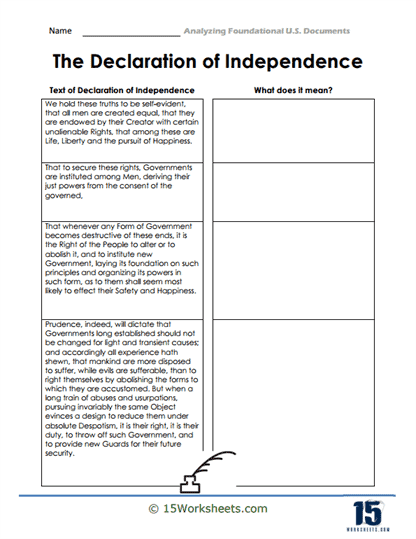
Text of the Declaration
This worksheet lets students closely analyze actual excerpts of the Declaration. They practice understanding just what the words ask and why. It deepens their grasp of revolutionary rhetoric.
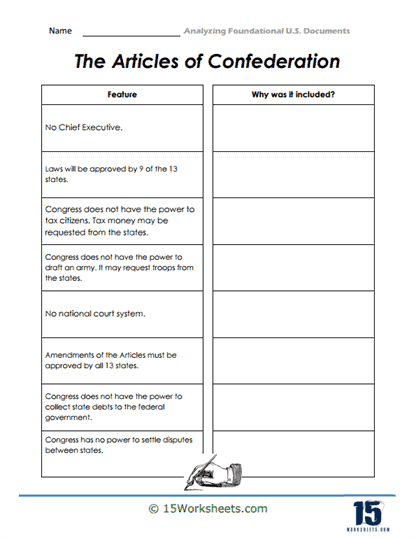
Articles of Confederation
Kids study America’s first attempt at a national government and its flaws. It’s a lesson in how systems evolve when they don’t meet people’s needs. It highlights why a stronger structure was needed.
Precursor to the Constitution
Students explore documents like the Articles and how they led to drafting a new Constitution. It traces the natural progression toward a more effective government. It shows how the Constitution built on earlier attempts.
Treaty of Paris (1763)
Learners investigate how this treaty ended the French and Indian War and shaped early boundaries. It set the stage for colonial expansion and American ambition. It ties diplomacy to early U.S. terrain.
Northwest Ordinance of 1787
Students explore how new territories became states and how slavery was restricted there. It shows early American ideas about order, rights, and expansion. The lessons include law built with values in mind.
Preamble to the U.S. Constitution
Kids unpack how the Preamble sets the tone for democracy, unity, justice, and welfare. It introduces what the Constitution aims to do. It frames the purpose of the entire system.
The Bill of Rights
Learners examine the first ten amendments, focusing on protecting individual freedoms. It’s where rights like speech, religion, and fair trial are listed. This sheet highlights why these rights matter today.
Lincoln’s 2nd Inaugural Address
Students reflect on Lincoln’s hope for national healing and unity at the Civil War’s close. It’s both history and heartfelt reflection. It offers emotional insight into one of America’s darkest times.
Use of Figurative Language
This worksheet analyzes how figurative language enhances the power and meaning of these documents. Students learn how metaphors, imagery, and rhetoric shape our understanding. It’s language craft as an emotional tool.
Article from the Constitution
Students focus on specific sections of the Constitution to analyze rights, structure, and meaning. It makes complex text more understandable. It shows how words govern everyday life.
Bill of Rights News
Learners connect historical freedoms to modern contexts and debates. It shows how these amendments still shape current events. It makes history feel alive and relevant.
What Are The Foundational U.S. Documents?
The foundational documents of the United States are a collection of historical writings that played a significant role in shaping the nation’s government, political philosophy, and principles. These documents laid the groundwork for the American political system and continue to inform the interpretation and understanding of the Constitution and the nation’s values.
American soil is rich with the history of many nations; before becoming the United States of America, the country had to undergo extreme changes that are documented in the form of foundational documents of the U.S. These are the five documents that changed the course of history for America.
The Declaration of Rights and Grievances
As the other half of the world, America was also divided into thirteen British colonies. The declaration of rights and grievances was composed by American colonists, known as Stamp Act Congress. The author was John Dickson from Pennsylvania, who wrote it on October 19th, 1765. This was written in retaliation against unfair taxes on the printable paper of the colonists. It declared that American colonists must use only the paper made in London for all types of printables such as newspapers, cards, playing cards, etc. The declaration of Rights and Grievances asked for representation in the parliament in return for paying taxes and equal rights between the colonists and the British citizens. Nine out of thirteen accepted this declaration.
Declaration and Resolves of the First Continental Congress
The Boston Tea Party, in which the sons of liberty spilled 342 crates of imported tea because of the earlier Tea Act of 1773, became the basis of the road to independence. Due to the events in Boston, the British imposed four acts to punish the Massachusetts and regain authority over all the colonies. These intolerable acts made twelve colonies come together and propose the declaration of rights 1774 on October 14th. It talked about boycotting British goods and laws until their concerns weren’t met, publicly addressing the British Americans and Britishers, and sending a petition to the King.
Declaration of Independence
“That these United Colonies are, and of Right ought to be Free and Independent States.” It is one of the lines from the declaration passed by thirteen colonies unanimously on July 4th, 1776. The Second Continental Congress in Philadelphia decided to make American colonies into independent states and break ties with the British claim and authority. The basis of independence was:
1. All men are equal in God’s eyes; they have rights to life, happiness, and liberty.
2. Government is only there to protect these rights
3. If the Government fails to do this, people have the right to revolt against it.
It is the primary foundational U.S document that is celebrated each year.
Articles of Confederation
The first constitution consisting of thirteen points made in November 1777, was sent to the original thirteen states. The first and the essential article was the country’s name, The United States of America. Under the Government, which was the Congress at the time, the country had the power to go to war, issue money, enter into treaties, settle debts, maintain armies and navies, etc. However, the confederation brought all the states under one article: “The combined states were responsible for helping to protect each other from attacks.” These were ratified in February 1781.
Constitution of the United States of America
It was the document created on September 17th, 1787, and was the first fundamental law of the country. It ensured how the nation was supposed to be governed in terms of the official offices, legislature, the fundamental rights of the citizens, and laws imposed. The constitution was ratified in March 1789. However, it has been amended many times over the past two centuries.
Bill of Rights
A document ratified in December 1791 had the first ten amendments to the constitution. It stated the rights of the people and each state’s rights, freedom of speech, religion, rights of the accused, and many other points were added to the constitution. It is one of the foundational U.S documents used to this date.