
Careers and Occupations Worksheets
All About These 15 Worksheets
Careers and occupations might sound like big, grown-up words, but really they’re just about what people do for work. Kids see jobs all around them-teachers, doctors, firefighters, bakers-but often don’t stop to think about what makes each role special. These worksheets give students a fun, structured way to explore the world of work and discover how many possibilities are out there. From guessing games to writing reflections, every page opens a door to new ideas about the future.
This collection combines creativity, problem-solving, and vocabulary practice. Some worksheets focus on matching tools to jobs, others encourage kids to write about dream careers, and some challenge them with riddles or descriptions. The variety means students stay engaged while strengthening reading, writing, and critical thinking skills. By exploring many different professions, learners also start to see how diverse and exciting the working world can be.
Beyond the classroom, these worksheets help kids make connections to real life. When they learn that doctors need stethoscopes, chefs use knives, or businesspeople wear specific attire, they begin to understand the bigger picture of how society works. More importantly, activities about dream jobs and future goals encourage self-reflection. Students see not just what jobs exist, but also where their own interests and skills might fit in.
Have a Look Inside Each Worksheet
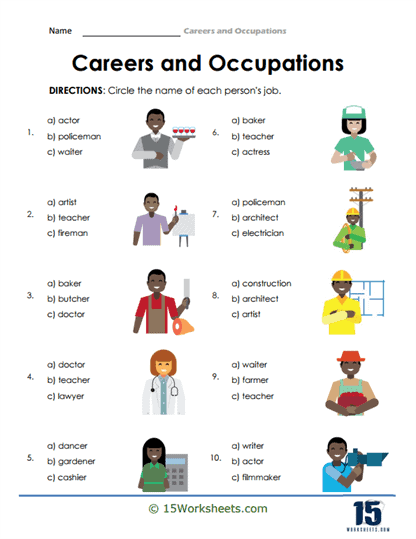
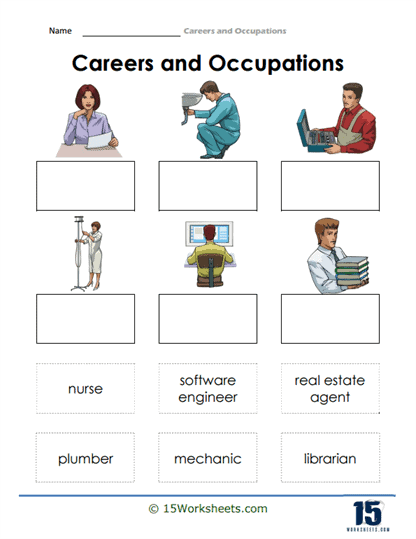
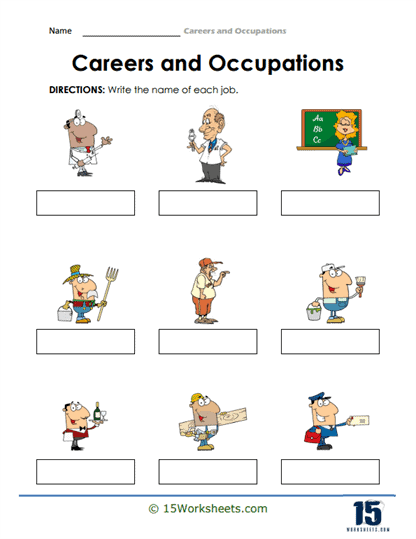
Name the Occupation
Students look at pictures of different workers and identify what job they do. It’s a fun way to connect visual clues with job titles. This builds vocabulary and helps kids recognize common occupations. The activity makes learning about careers both simple and engaging.
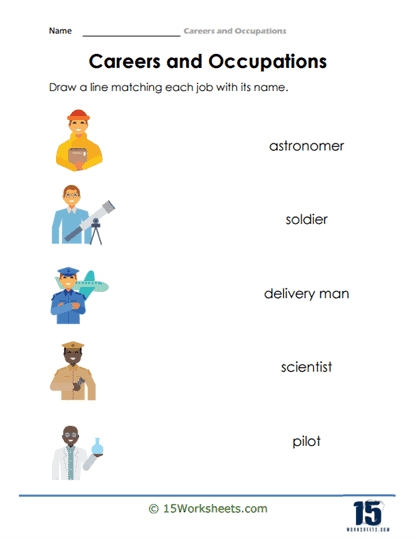
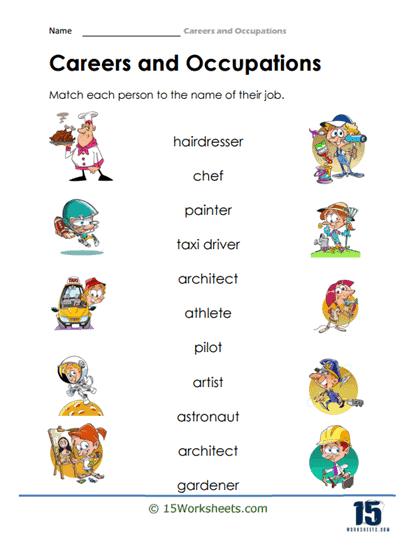
Matching Jobs
Learners pair each worker with the correct job description. The worksheet feels like a matching game but reinforces reading comprehension. It teaches kids how to connect tasks with professions. This boosts both career awareness and critical thinking.
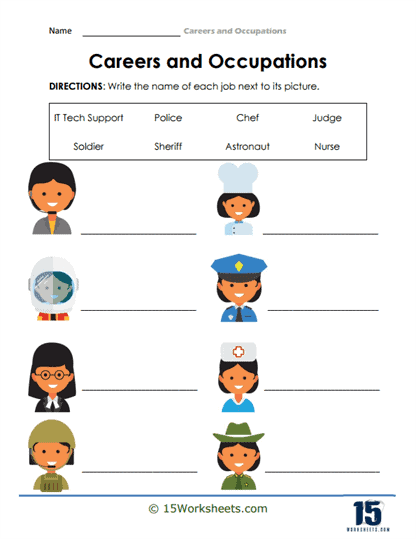
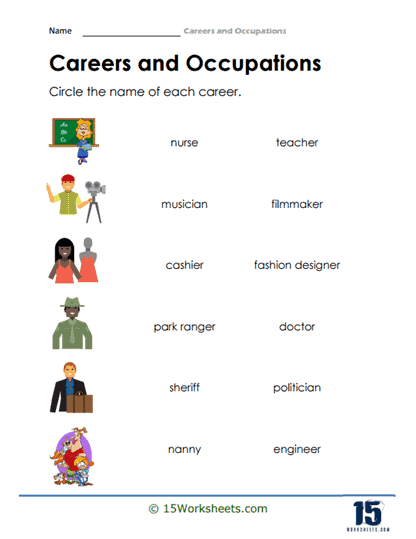
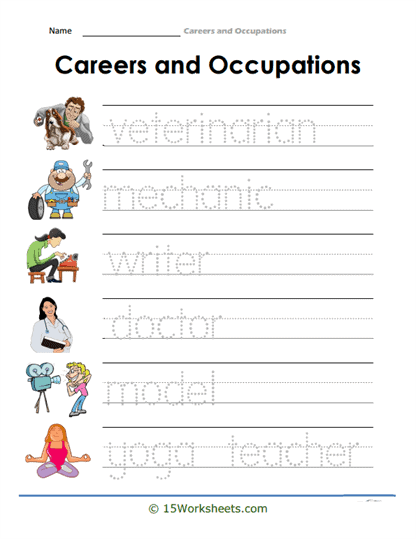
Career Naming
Students practice spelling and identifying job names. The worksheet mixes vocabulary building with real-world connections. It helps kids recognize a wide range of professions by name. The activity sharpens word knowledge while exploring future possibilities.
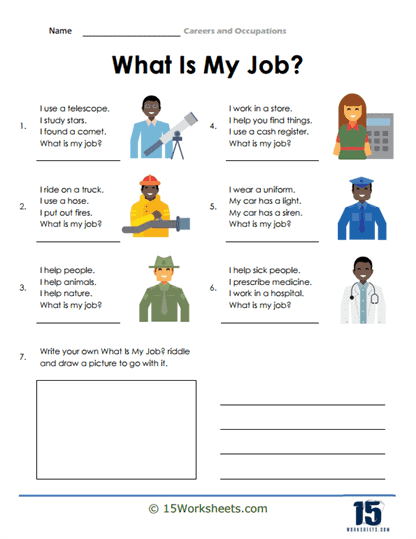
What Is My Job?
Kids read clues about responsibilities and figure out the correct occupation. It feels like solving riddles about real-life workers. The activity develops problem-solving skills while reinforcing job-related vocabulary. Students learn that every profession has unique roles.
My Profession
Learners describe different careers and what makes them special. The worksheet encourages writing practice alongside job recognition. Students reflect on the qualities and skills needed for various occupations. It supports self-expression while introducing career concepts.
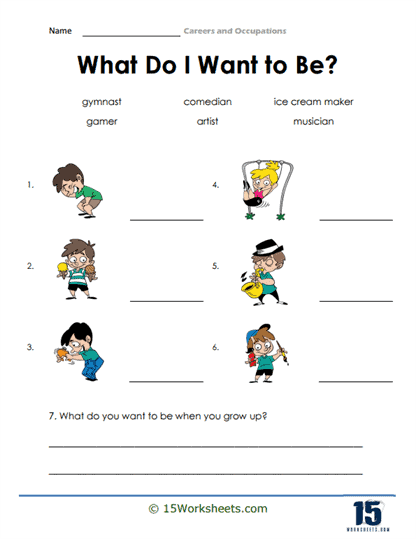
What Do I Want to Be?
This worksheet lets kids imagine their future career and write about it. It encourages self-reflection and goal setting. Students get creative about what they want to achieve when they grow up. It’s a fun way to link dreams with real occupations.
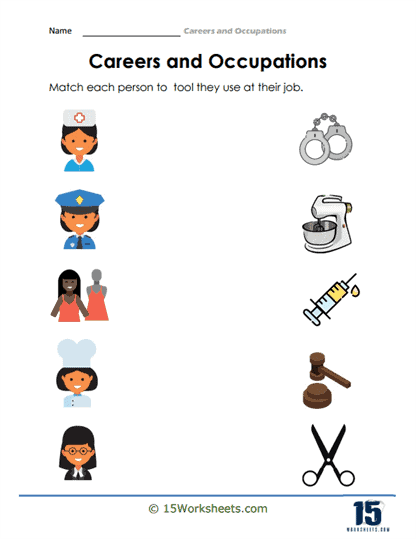
Tools For the Job
Students match workers to the tools they use. The activity connects objects with professions in a hands-on way. It makes learning interactive and practical. Kids understand that tools are an important part of every job.
Career Circles
Learners group different jobs into categories. The worksheet encourages organization and classification skills. It helps students see connections between professions. This activity strengthens both logic and career awareness.
Career Writing
Students write short passages about careers and their importance. It blends grammar practice with career exploration. The worksheet encourages kids to think critically about work in society. It’s a creative way to combine writing and career learning.
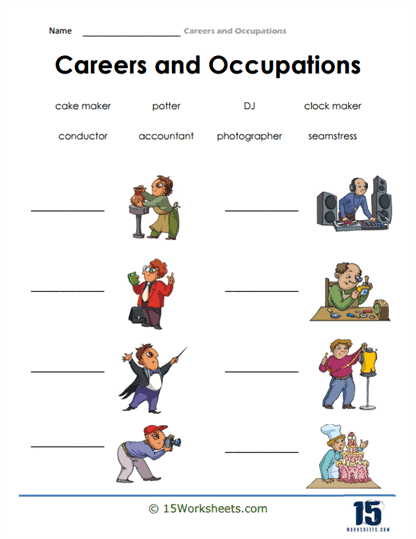
Respective Roles
This worksheet focuses on matching roles with responsibilities. Students practice connecting jobs with what workers actually do. It encourages careful reading and comprehension. The activity helps learners see how jobs contribute to everyday life.
Business Attire
Students explore what kinds of clothes professionals wear. The worksheet introduces the idea of dress codes in careers. It makes learning fun with visual clues and matching. Kids learn that appearance often connects to workplace expectations.
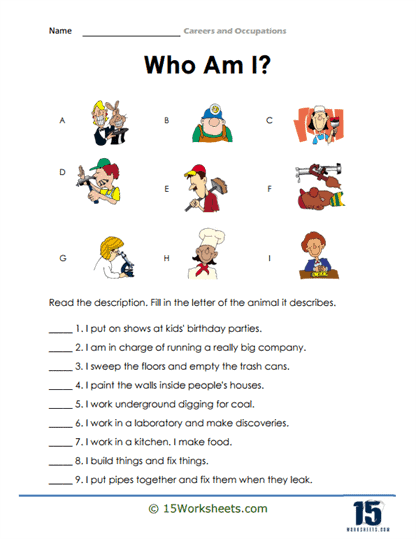
What’s the Occupation?
Kids use short descriptions to figure out which job is being described. It feels like a guessing game with a purpose. The worksheet builds vocabulary while training kids to use context clues. This keeps career learning lively and interactive.
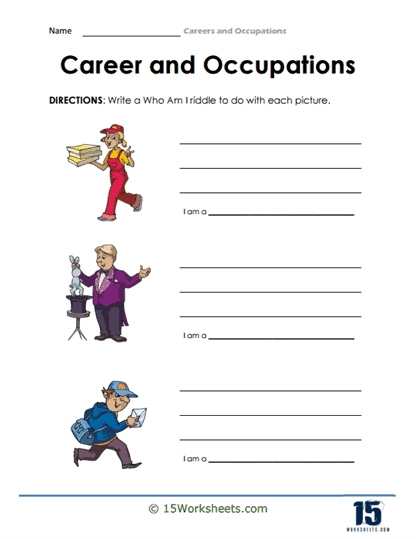
Who Am I Riddle
Learners create or solve riddles about different occupations. It’s a playful way to reinforce career vocabulary. The activity blends creativity with problem-solving. Kids stay engaged while learning more about job roles.
Associated Job Skills
Students connect different jobs to the skills they require. The worksheet highlights how talents match with professions. It makes career learning practical and inspiring. Kids see how skills they build today matter for tomorrow’s work.
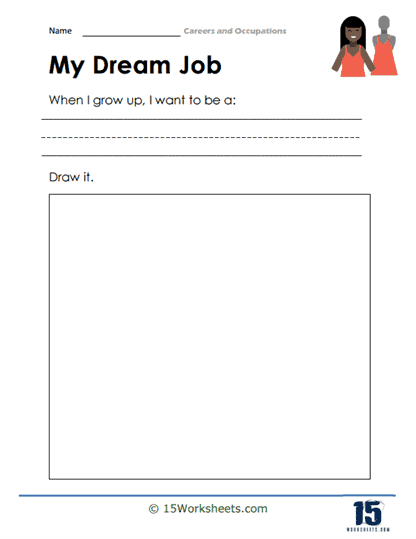
My Dream Job
This worksheet asks students to reflect on their future goals and write about their dream career. It encourages imagination and planning. Learners think about what excites them most about work. The activity blends creativity with future readiness.
What are Careers and Occupations?
People use the phrases careers, jobs, and occupations. While they overlap in meaning, important distinctions between them might aid in planning for each. Planning for both short- and long-term goals and preparing for changes in both are made possible by being aware of the distinctions. Understanding each can also assist you in deciding whether to concentrate on your profession or your career as a whole when making future plans.
What is a Career?
By choosing that career, you may choose the education and abilities you need to support a profession. Choosing your career carefully and thoughtfully can improve your chances of success. It might take some effort and research to select the ideal career.
There are two definitions of a career. A vocation, trade, occupation, or profession are all frequently referred to using the word “career.” What you do for a livelihood is defined by your job, ranging from occupations requiring advanced degrees to those that simply demand a high school certificate and a willingness to study.
However, there is another way to define a career. Additionally, it relates to the advancement and activities you have made throughout your working years, particularly as they pertain to your vocation. It consists of the many positions you have had, the titles you have obtained, and the work you have produced over a considerable amount of time. When regarded in this light, a career covers everything connected to your professional growth, such as your profession of choice and promotion. A single career may go in a number of distinct directions.
A career is a lifetime endeavor during which a person may take on various jobs or tasks. They grow in knowledge, ability, and experience within a certain industry to support themselves. Education, specialized training, and professional experience are all components of a career. It’s long-term and includes a variety of advantages, including forming relationships, studying, and using information for advancement and evaluations.
People may take on various positions within a single sector or business, or they may begin their careers in one domain before moving on to more sophisticated ones as their knowledge and competence grow. In other words, as long as a role supports a person’s overall professional goals, they are free to alter their career paths and advance in any position they want.
What is an Occupation?
Employers use a variety of words when discussing a candidate’s professional experience. As there are several methods to discuss experience, it is crucial to comprehend what the word “occupation” means to properly describe your own.
The definition of occupation and how it varies from other types of professional experience are covered in this article. Additionally, we give instances of many professions and related tasks. A generic phrase for the industry or area you work in or the type of employment you are interested in is “occupation.” It could also be referring to your place in the company. Disclosing your line of work at an interview has consequences for your employment, your profession, and your career as a whole.
A person with a particular field of interest and unique abilities useful in that field has an occupation. If the occupation needs licensure and certification, the individual may choose to pursue it as a profession. They may be interested in finding employment within a certain occupation.
A general phrase used to define a professional interest is “occupation.” The U.S. Bureau of Labor Statistics separates occupations into 23 categories that offer employment, vocations, and professions in a variety of work settings. On the other hand, a career is a broad term that describes the assortment of jobs you’ve had during your working life.
A career frequently develops inside a single field. However, employment experience in other industries can also help develop a broad career. For instance, a person with expertise in recruiting for a proprietary institution may be able to apply that knowledge to manage volunteers for a charity. Despite being in two distinct businesses, the two job experiences demonstrate a promising future in recruitment.
What Are The Most Popular Dream Jobs?
The world is evolving, and so are our expectations for the future. The advancement in technology has launched new fields and created admirable jobs many dream to attain.
What people thought were dream jobs a few decades ago might no longer be what new generations consider prime careers. As priorities change, the economy fluctuates, and new advancements are made, so do people’s perspectives.
Today’s youth carries a more realistic perspective; they work hard to achieve their passions without falling for the rat race that drove older generations.
Scientist
Nowadays, science enthusiasts (children and adults alike) dream of inventing something new and exciting. Scientists leave a mark on the world with their inventions, and they help humanity improve its standard of life. This is why jobs and education in STEM fields have become the source of many people’s aspirations.
Detective
You’d be surprised by the number of people who dream of becoming detectives and solving significant cases, which they do with zeal and effort. Detectives lead a dangerous life, but the dynamics of their job seem very exciting.
Writer
Writing has become a sought-after career due to the freedom of expression it offers. You can write about anything you want, and there will be an online and offline audience willing to read and appreciate your work. Not only that, you can work remotely and still get paid more than most people working hard in offices. You can also experiment with different modes of writing and publication to find what works for you.
Entertainer
Actors, singers, and dancers entertain millions of people with their movies and performances, which draws more people into the entertainment industry. The glamorous, rich lifestyle these entertainers lead often blinds people from the hard work they put into their jobs. After all, making people happy isn’t a piece of cake. But, entertainment will always be a dream career for many.
Doctor
Who doesn’t love doctors? These individuals work day and night to help other people heal. Doctors will always be admired for their work, which is why the medical field is a career many aspire to follow.
Technology Expert
Recent advancements in technology revealed several tech geniuses who work hard but play harder. Tech giants who make it big with their inventions lead a very wealthy life, attracting several dreamers to find their way in this field. However, individuals with natural talent and passion for technology are the ones who achieve success.
Fitness Coach
A fitness coach enjoys a trendy dream job because everyone wants to look good and make money by helping others achieve their best potential. Fitness coaches lead very healthy lifestyles, so many dreamers admire their job. In modern times, being a fitness coach is equivalent to being a guru who helps you reach self-actualization. After all, fitness coaches push you to be your best self.
At the end of the day, it doesn’t matter whether your dream job has landed on this list. What matters is how passionate you are and how hard you’re willing to work to succeed because you can make your dreams and realize them too.