
Words Ending in ER Worksheets
About Our Words Ending in ER Worksheets
Words ending in -er appear everywhere in everyday reading and writing. Sometimes -er creates the name of a person who performs an action, like teacher, builder, or writer, while other times it forms entirely different kinds of words. Our Words Ending in ER Worksheets help students understand how these words are built, when spelling changes are needed, and how to use them confidently in meaningful contexts. Through engaging activities, learners strengthen both their spelling skills and their understanding of how English words are formed.
This collection explores -er words through a variety of interactive challenges and real-world themes. Students build worker words from action verbs, match root words with their derived forms, solve riddles, navigate mazes, proofread sentences, complete paragraphs, unscramble vocabulary, and apply spelling rules involving doubled consonants and dropped silent e letters. Along the way, they discover that adding -er often changes a verb into the name of someone who performs that action, while also learning the spelling rules that make those new words correct. The wide variety of activities provides repeated practice while keeping students actively engaged.
Understanding words ending in -er helps students become stronger readers, writers, and proofreaders. They learn how words are connected through common roots, recognize familiar spelling patterns, and expand their vocabulary with useful everyday terms. These worksheets strengthen spelling accuracy, grammar, morphology, reading comprehension, and word analysis while encouraging students to think carefully about how words are constructed. By mastering -er word patterns, learners develop language skills they can apply across many different subjects and writing situations.
About Each Worksheet
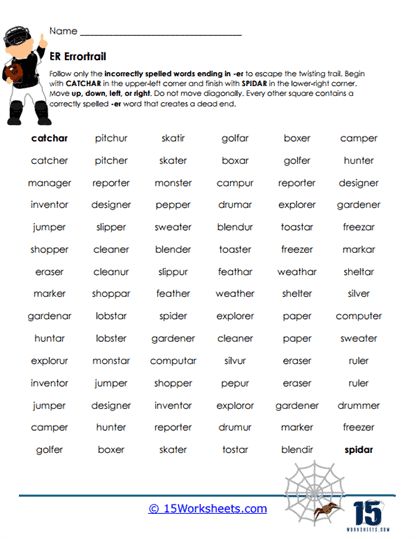
Spider Escape
Students wind through a tricky maze by following only the incorrectly spelled -er words hiding along the trail. Every wrong turn becomes a lesson in spotting common spelling mistakes before they sneak into everyday writing.
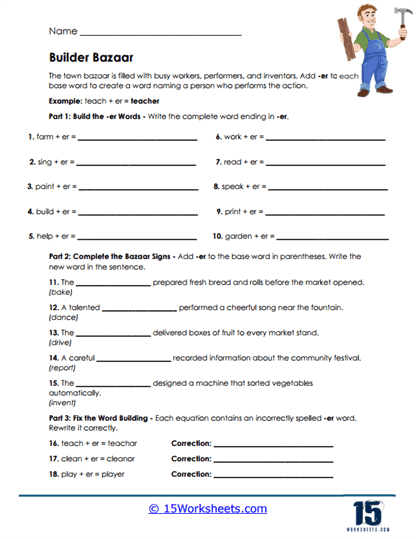
Builder Bazaar
Students transform action words into worker words as they explore a bustling marketplace full of busy jobs. Building and correcting -er words helps show how spelling rules create meaningful new vocabulary.
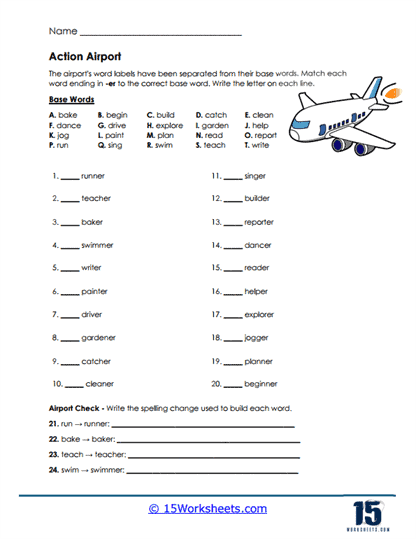
Airport Match
Students reconnect separated root words and their matching -er forms before takeoff. Comparing both versions side by side makes spelling changes much easier to understand.
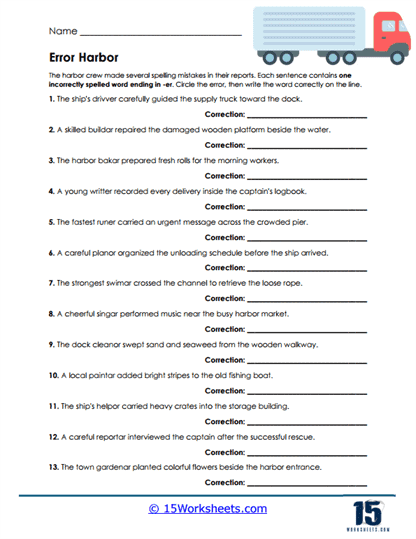
Harbor Repairs
Busy harbor workers accidentally leave spelling mistakes behind for students to repair. Proofreading complete sentences helps learners practice accurate spelling in realistic situations.
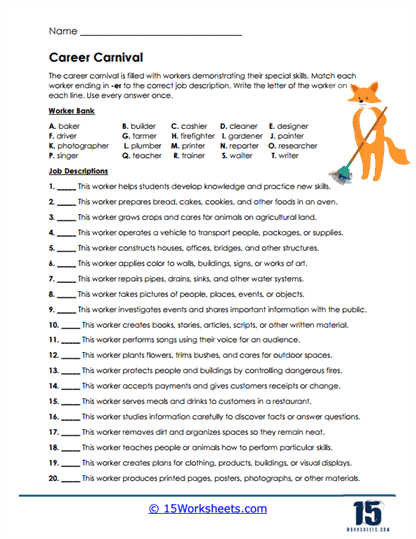
Career Carnival
Job descriptions become clues as students match careers with the correct -er worker names. The activity blends career exploration with practical vocabulary building.
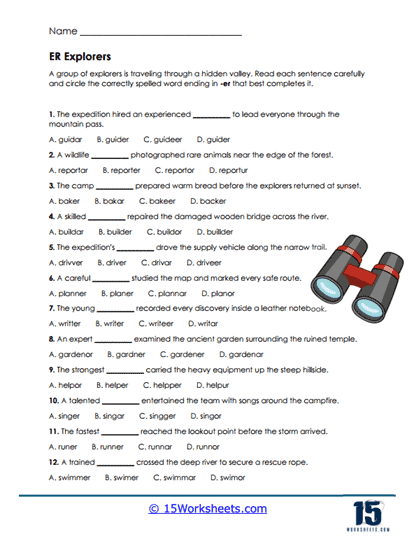
Valley Explorers
An expedition through a hidden valley challenges students to choose the correctly spelled -er word every step of the way. Sentence clues encourage careful reading alongside careful spelling.
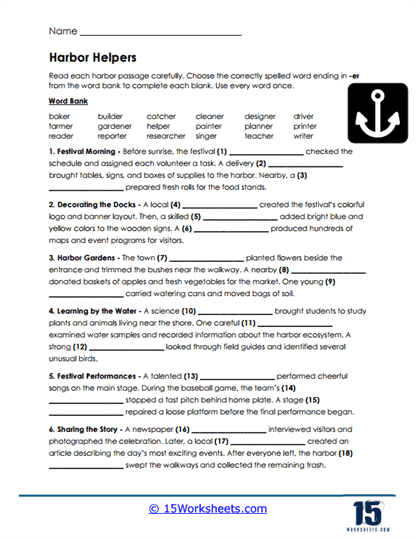
Harbor Helpers
Students complete connected harbor stories using correctly spelled worker words from a shared word bank. Reading entire passages helps vocabulary feel much more natural than isolated lists.
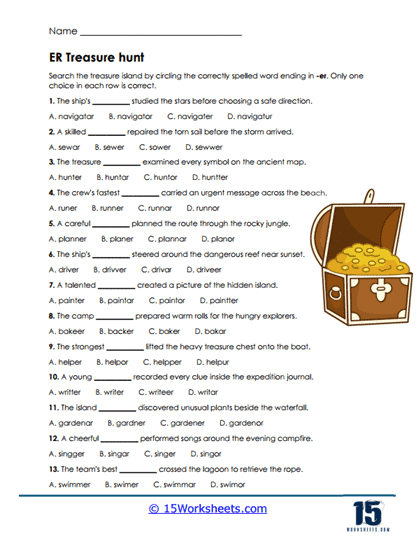
Treasure Workers
Treasure hunters rely on correctly spelled worker words to complete each stage of their adventure. Comparing similar spellings helps students become more confident proofreaders.
Suffix Workshop
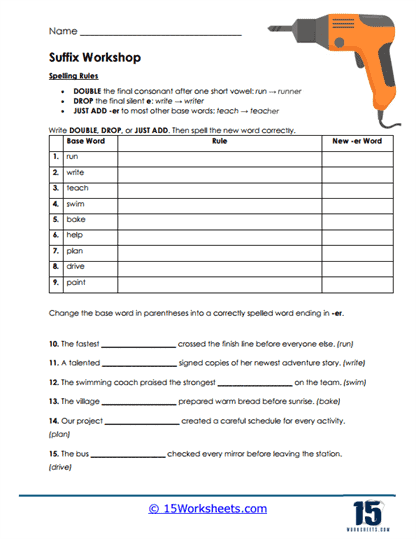
Students become spelling engineers as they decide whether to double a consonant, drop a silent e, or simply add -er. Explaining each rule helps turn memorization into real understanding.
Job Scramble
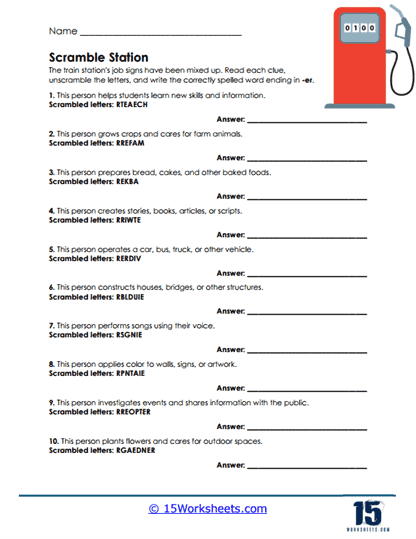
Mixed-up letters hide familiar careers that students must rebuild using helpful job clues. Unscrambling each worker word strengthens both spelling memory and vocabulary.
Pattern Pavilion
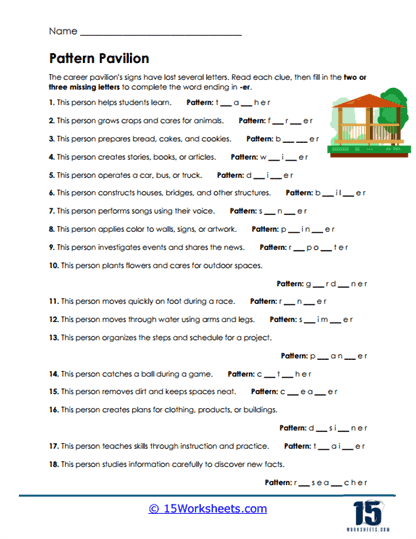
Students restore missing letters to complete familiar -er words describing a wide variety of jobs. Using clues and spelling patterns together makes each solution easier to discover.
Root Raceway
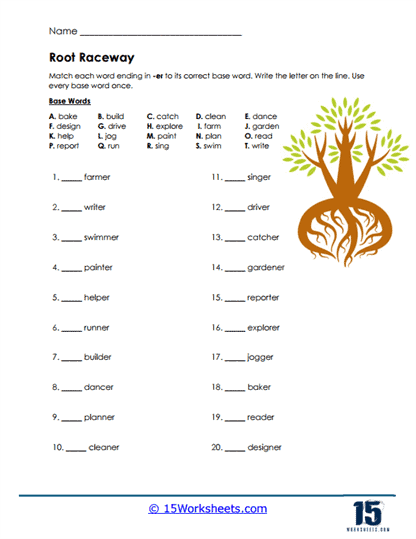
Students race to match root words with the -er forms built from them. Watching how words change reinforces spelling rules while strengthening word-family knowledge.
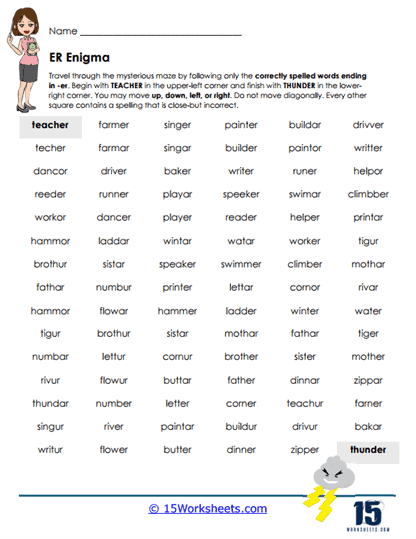
Thunder Maze
A giant maze challenges students to follow only correctly spelled -er words while avoiding look-alike distractions. Every decision rewards careful observation and strong proofreading skills.
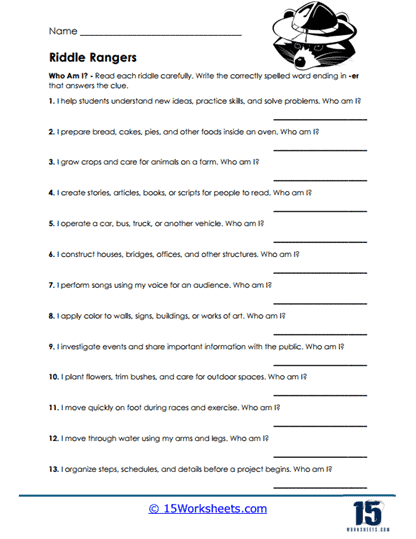
Worker Riddles
Students solve “Who am I?” riddles by recalling correctly spelled worker words without any word bank for support. The guessing game makes vocabulary review feel both challenging and rewarding.
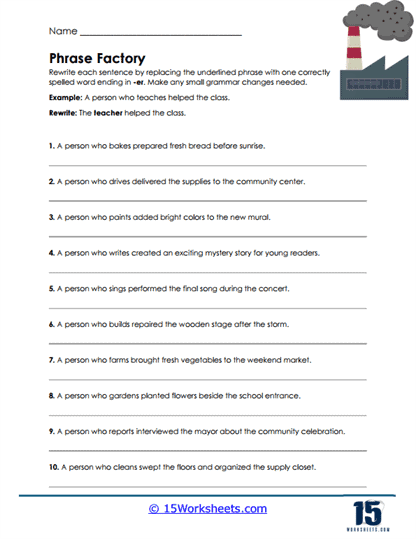
Phrase Factory
Long descriptions such as “a person who writes” are transformed into single -er words through sentence rewriting. The activity demonstrates how one well-chosen word can make writing clearer and more concise.
What are Words Ending in ER?
Words ending in -er are common English words that often describe a person who performs an action or a particular job. For example, when -er is added to the verb teach, it becomes teacher, and write becomes writer. In many cases, adding -er changes an action into the name of someone who regularly performs that action. Learning this pattern helps students understand how new words are created from familiar base words.
Adding -er sometimes requires spelling changes before the suffix is attached. Some words simply add -er, while others drop a final silent e or double the last consonant first. For example, write becomes writer, run becomes runner, and help becomes helper. Recognizing these spelling patterns allows students to build new words more accurately and confidently.
Understanding -er words strengthens much more than spelling alone. Students develop stronger vocabulary because they begin recognizing relationships between action words and the people who perform those actions. They also improve reading comprehension, grammar, proofreading, and word analysis by seeing how English words are connected. As learners master these patterns, they gain valuable language skills that support success in both reading and writing.