
Spelling Review Tests Worksheets
About Our Spelling Review Tests Worksheets
Reviewing spelling doesn’t have to mean memorizing endless word lists. Our Spelling Review Tests Worksheets give students the opportunity to apply everything they’ve learned through engaging assessments that combine spelling, vocabulary, proofreading, sentence writing, and word analysis. Instead of testing isolated words, these activities encourage learners to recognize correct spellings, repair mistakes, and use vocabulary in meaningful contexts. Each worksheet provides a well-rounded snapshot of a student’s spelling skills while keeping practice interesting and purposeful.
This collection includes spelling review tests for learners from kindergarten through high school. Younger students build confidence by matching words, filling in missing letters, choosing correct spellings, and completing simple sentences, while older students tackle proofreading passages, correcting advanced vocabulary, explaining spelling patterns, and recalling challenging academic words independently. Many activities combine spelling with grammar, reading comprehension, and vocabulary so students can demonstrate how well they apply their knowledge in authentic writing situations. The varied formats make these reviews useful as classroom assessments, independent practice, or end-of-unit checkups.
Regular spelling reviews help students identify strengths, recognize areas for improvement, and reinforce words they use every day. By revisiting important vocabulary through different kinds of activities, learners strengthen spelling accuracy, proofreading habits, reading fluency, and written communication. These worksheets encourage careful thinking rather than quick guessing, helping students build confidence with words at every grade level. Whether used for review, assessment, or extra practice, this collection supports steady growth in spelling and language skills.
About Each Worksheet
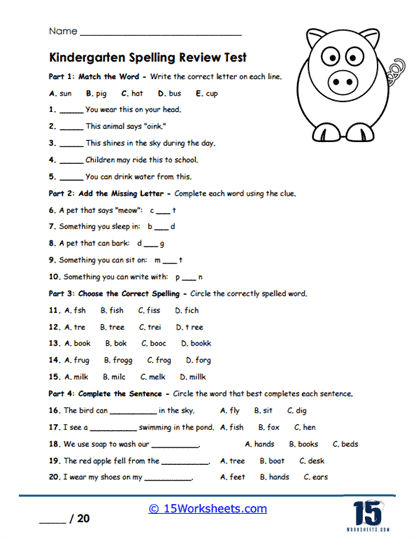
Kindergarten Check
Young learners match, build, choose, and use familiar words in a friendly four-part spelling review. The variety of activities helps children demonstrate what they know without making the assessment feel overwhelming.
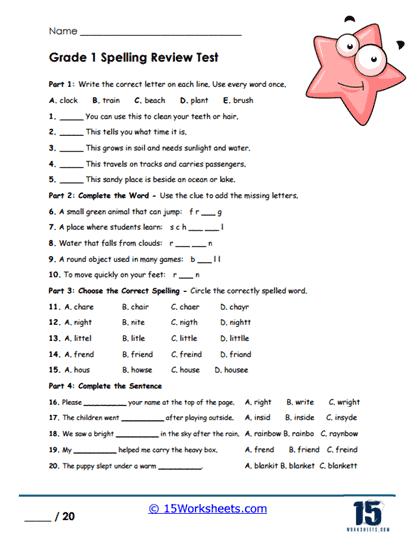
First Checkpoint
Students move through matching, word building, multiple-choice questions, and sentence completion using common first-grade vocabulary. The gradual increase in difficulty makes it easy to spot growing spelling skills.
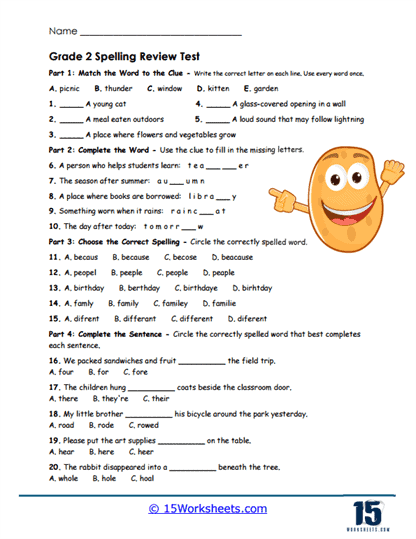
Second Checkpoint
Students rebuild words, compare similar spellings, and complete sentences using familiar second-grade vocabulary. Every section encourages careful thinking while reinforcing everyday words used in reading and writing.
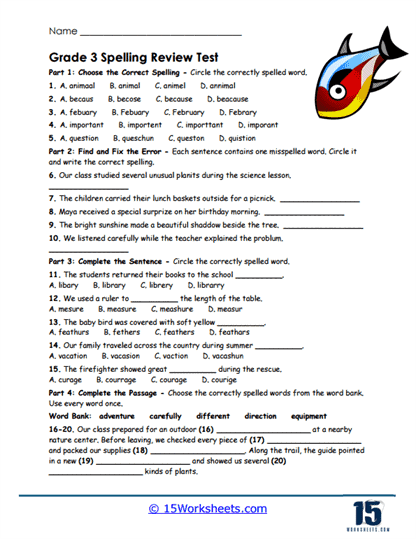
Third Challenge
This review combines spelling choices, proofreading, sentence work, and a short reading passage into one engaging assessment. Students show they can recognize, correct, and apply important third-grade words in context.
Fourth Challenge
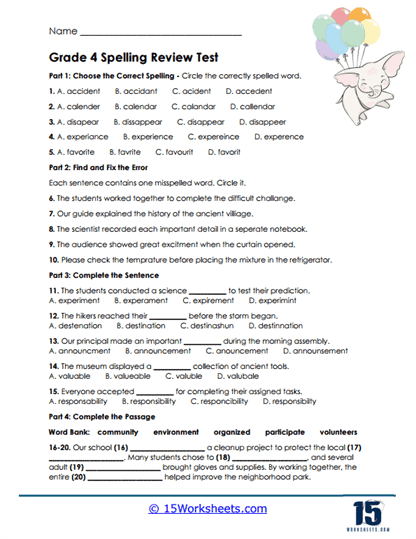
Students proofread sentences, complete paragraphs, and select correctly spelled words throughout a variety of activities. The connected tasks help measure both spelling accuracy and reading comprehension.
Fifth Challenge
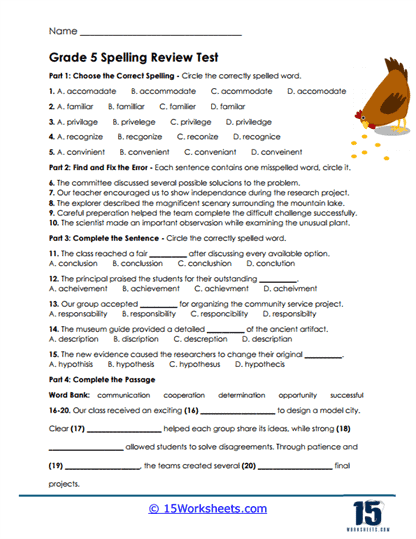
Students review advanced elementary vocabulary through proofreading, sentence completion, and a classroom-themed passage. The mix of activities helps reinforce spelling while encouraging thoughtful word choice.
Sixth Analysis
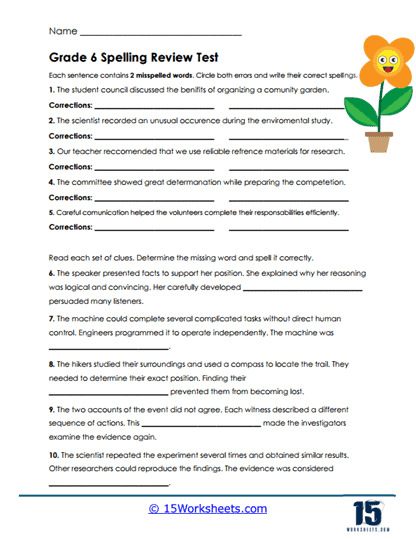
Students search for multiple spelling mistakes before using definition clues to recall academic vocabulary independently. The combination of editing and vocabulary work creates a meaningful middle school review.
Seventh Precision
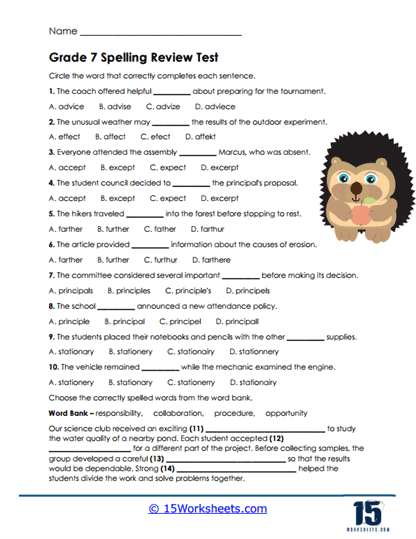
Students distinguish between commonly confused words before applying advanced vocabulary in a connected paragraph. Careful reading becomes just as important as careful spelling throughout the assessment.
Eighth Analysis
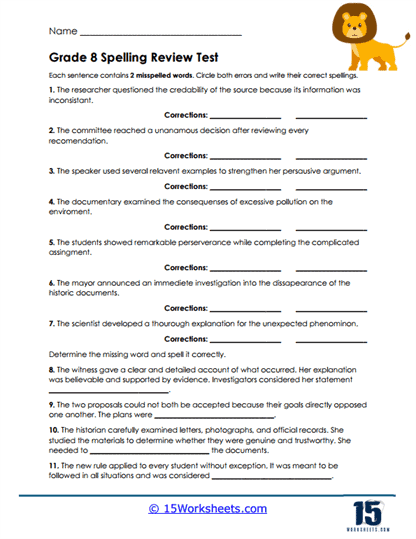
Students proofread challenging sentences and supply advanced vocabulary using definition clues. The two-part format strengthens both independent recall and careful editing skills.
Ninth Reasoning
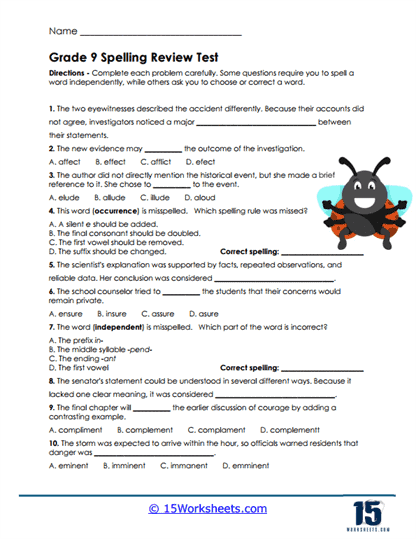
Students explain spelling patterns while correcting advanced academic words and choosing vocabulary that best fits each sentence. Looking beyond memorization helps build a deeper understanding of English spelling.
Tenth Reasoning
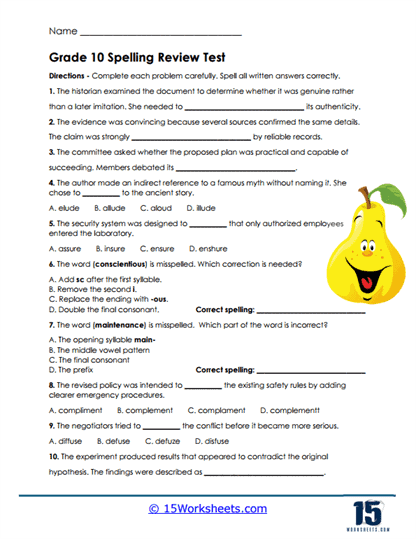
Academic vocabulary takes center stage as students analyze spelling mistakes and complete challenging context-based questions. The review encourages careful observation and precise language use.
Eleventh Logic
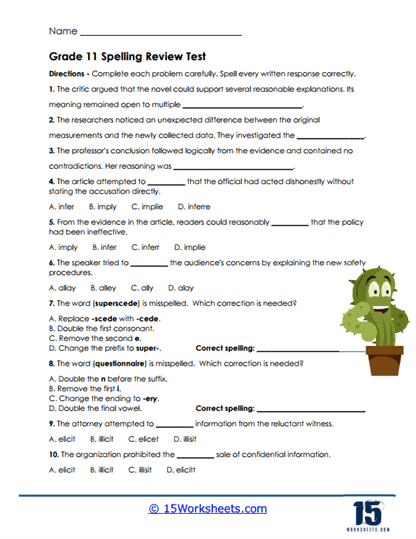
Students apply advanced vocabulary while correcting words with unusual spelling patterns and borrowed origins. The thoughtful questions prepare learners for more demanding academic writing.
Twelfth Recall
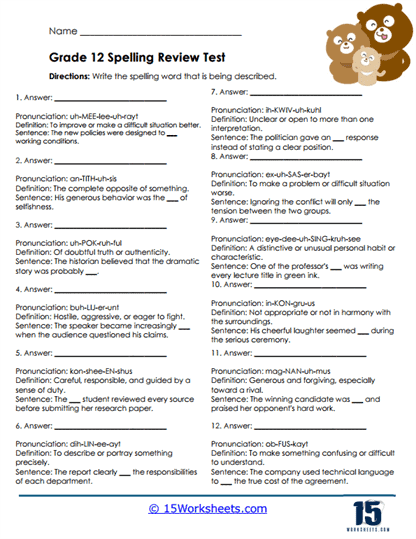
Students rely on pronunciation clues, definitions, and example sentences to recall advanced vocabulary without a word bank. The independent format encourages strong long-term spelling memory.
Elementary Review
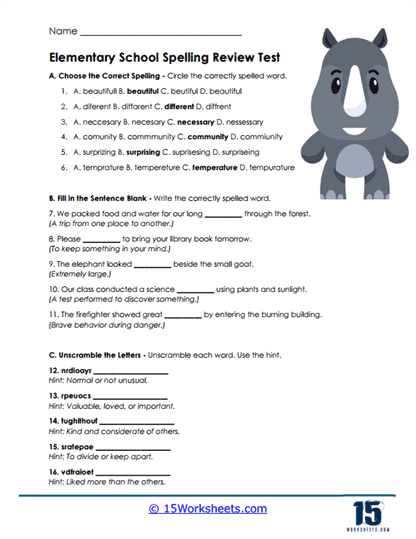
This broad review brings together multiple elementary spelling skills through word choices, sentence work, and unscrambling activities. The varied tasks provide a well-rounded picture of overall spelling development.
Middle Review
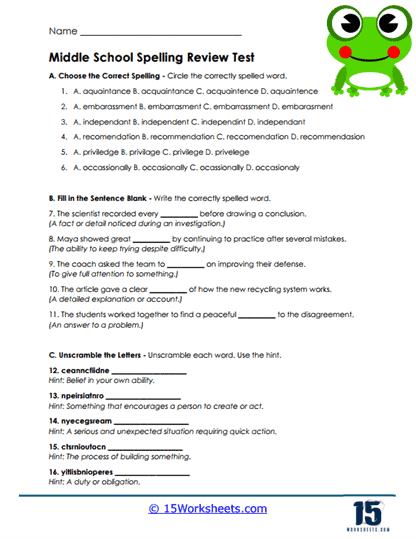
Students strengthen difficult middle school vocabulary through multiple-choice questions, sentence completion, and scrambled-word challenges. The combination of recognition and recall makes for a thorough and engaging review.
What are Spelling Review Tests?
Spelling review tests are assessments designed to help students revisit and apply spelling words and patterns they have already learned. Rather than introducing new concepts, these reviews reinforce previous instruction by asking students to recognize correct spellings, correct errors, complete sentences, proofread passages, and use vocabulary in meaningful contexts. Many review tests also combine spelling with reading comprehension, grammar, and vocabulary to measure how well students apply their knowledge. This provides a more complete picture of spelling ability than traditional word lists alone.
Effective spelling reviews include a variety of question types because spelling is about more than memorizing words. Students may match definitions, rebuild incomplete words, identify misspellings, edit sentences, solve word puzzles, or recall vocabulary independently. Using different formats encourages learners to think about word meaning, spelling patterns, and grammar together instead of treating each word as an isolated challenge. This repeated exposure strengthens long-term retention and improves overall language skills.
Regular spelling review tests help students build confidence while preparing them for future learning. They give teachers, parents, and students valuable feedback about which spelling patterns have been mastered and which ones need additional practice. Strong spelling also supports better writing, reading fluency, proofreading, and vocabulary development across every subject. By revisiting important words through engaging review activities, students strengthen the language skills they use every day in school and beyond.