
Spelling Patterns Worksheets
All About These 15 Worksheets
These worksheets focus on helping students see, use, and internalize the recurring spelling patterns in English-word families, vowel teams, blends, prefixes/suffixes, etc. By working with many different patterns, and doing activities like matching, missing-letter, fill-in, sorting, and comparing, learners strengthen both their recognition and production of correct spellings. Over time, they build flexibility so that when they see a new word, they can often guess how to spell it based on known patterns rather than just memorization.
Through these worksheets, students learn not only what the patterns are but also where they occur in words (beginning, middle, end), how to choose among similar patterns (e.g. “ai” vs “ay” vs “a_e”), and how to maintain pattern consistency in spelling. They also practice filling in missing parts, comparing patterns, and correctly placing letters, which reduces common spelling mistakes. This kind of pattern-based practice helps with generalization: when students encounter unfamiliar words, they can lean on pattern knowledge to spell them more accurately.
These resources are useful for teachers and parents who want to help students grow into confident, capable spellers. Pattern practice supports many of the hardest parts of English spelling, like tricky sounds, silent letters, and similar word endings. As students build these skills, they become better prepared for more advanced spelling worksheets that require greater accuracy and understanding. Over time, this kind of practice strengthens reading fluency, improves writing clarity, and helps students become more independent learners.
Have a Look Inside Each Worksheet
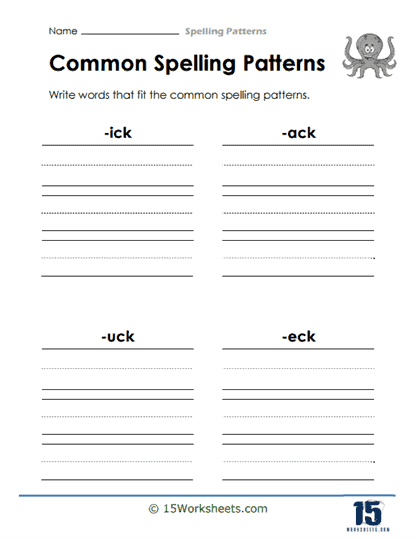
Common Patterns
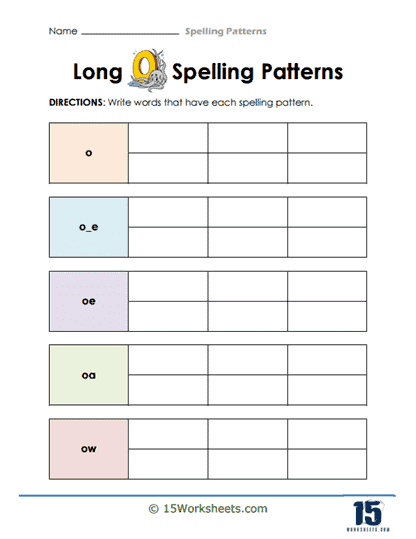
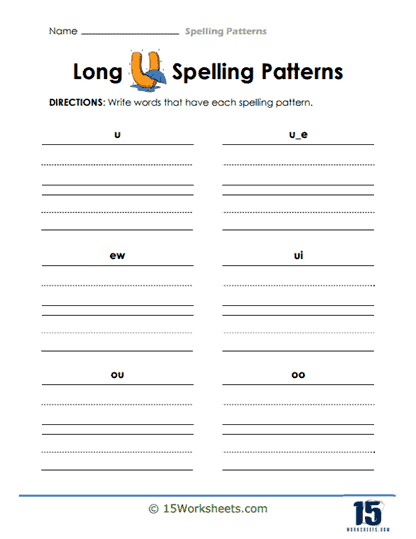
Students practice spelling words that follow very common spelling patterns, such as word families or vowel teams. This helps them see recurring structures across different words rather than treating each word as totally unique. By recognizing those patterns, spelling becomes easier and more predictable.
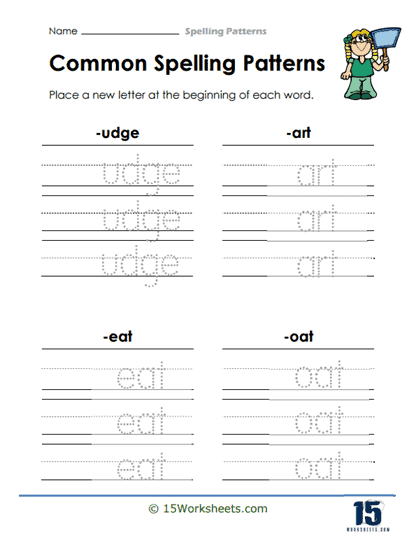
Missing Beginnings
Learners are given words with their beginnings (prefixes or first letters) removed and must supply the missing part. This focuses attention on how words start and reinforces understanding of common prefixes or initial sound chunks. It also helps with decoding words and improving spelling accuracy.
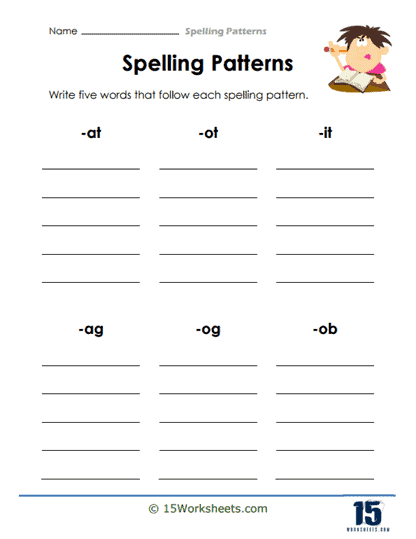
Five Words
In this worksheet, students work with five words that share a specific pattern and are asked to spell them correctly. The limited set lets them concentrate on one pattern and reinforce it. This kind of focused drill helps with pattern internalization and retention.
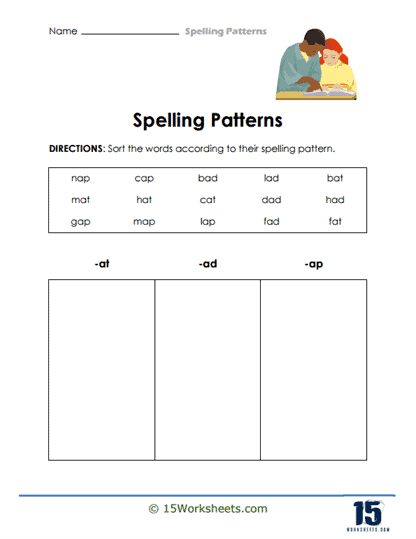
Which Column
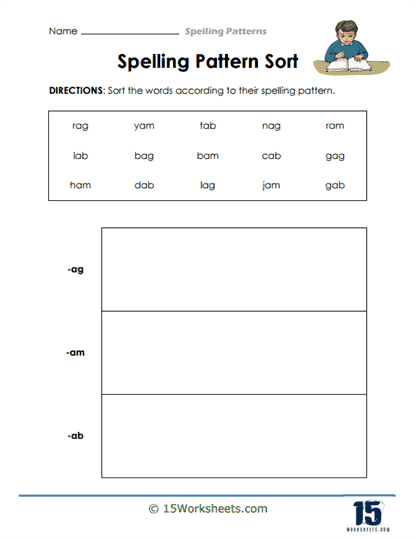
Students sort words into different columns based on their spelling pattern (for example, “ai”, “ay”, “a_e”, etc.). They must recognize which pattern each word uses and place it correctly. Sorting aids in visual discrimination of patterns and makes the rule differences clearer.
Match the Box
Here, words are presented in boxes or grouped formats and students match words that follow the same pattern. The matching format helps engage students as games rather than pure drills. It supports memory by associating similar-spelling words together.
Words that Follow
Learners are shown a pattern and asked to choose or list words that follow that pattern from a given set. This gives practice in both recognizing the pattern and applying it. It reinforces transfer: seeing the pattern, then producing matching spellings.
Two Word Patterns
This worksheet has two different patterns, and students have to work with both, perhaps comparing or alternating between them. That forces learners to switch thinking and distinguish the patterns more sharply. It helps build flexibility in recognizing multiple patterns in words.
a_e, ay, and ai Patterns
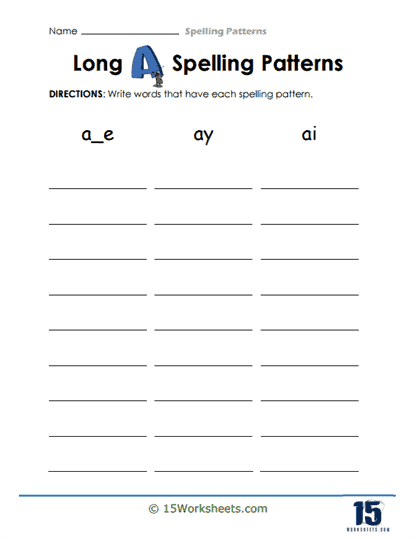
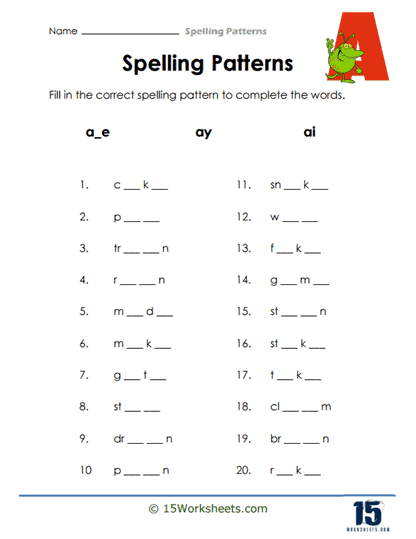
Students see words that use the “a_e”, “ay”, and “ai” vowel-team patterns and must sort, spell, or complete words accordingly. This comparison shows how different patterns can make similar vowel sounds. It deepens understanding of English spelling variation.
Match the Pattern
Learners match words to given patterns, likely by pairing words with their correct pattern names or grouping them. Recognition is key here, as is being able to see differences between similar patterns. Matching builds confidence in spotting patterns in new words.
Fill the Position
In this activity, students fill missing letters in words so the correct pattern is preserved. That demands understanding not only which pattern is used but exactly where in the word it appears. It helps with both pattern recognition and correct spelling of whole words.
Complete the Blanks
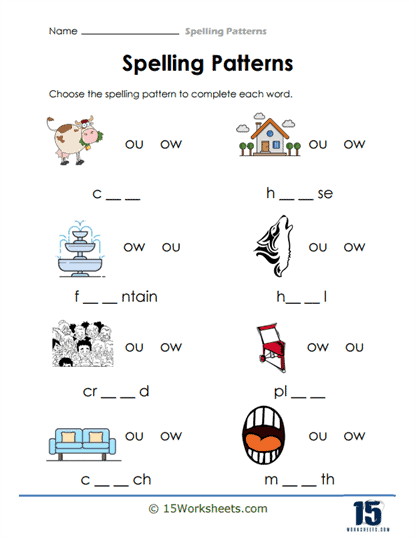
This worksheet gives words with blanks where letters are missing and students must supply the correct pattern to fill them. This reinforces knowledge of how patterns map to sounds and ensures students attend to the spelling details. It also helps catch common errors when pattern placement goes wrong.
Missing Letters
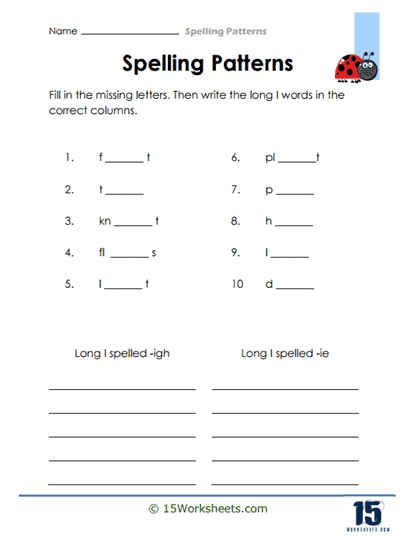
Learners are presented with words missing specific letters, often those that define the pattern (vowel teams, blends, etc.), and they must fill them in correctly. This demands attentive listening/reading to ensure the right pattern is used. It helps with both recognition and production of patterned spellings.
Complete the Word
This one provides partial words or stems, and students must finish the word using the right pattern (vowel team, diphthong, etc.). It often includes clues such as pronunciation or a matching group to guide them. It reinforces both decoding and spelling for pattern mastery.
aw or au Middles
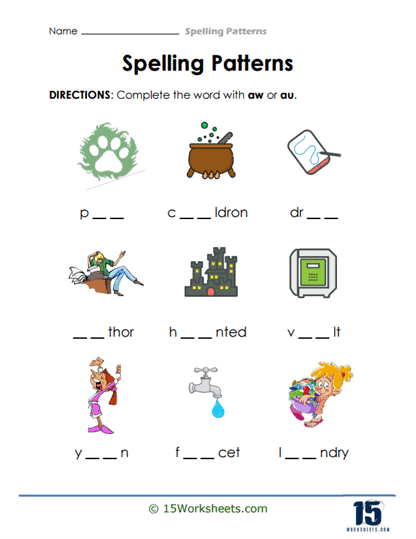
In this worksheet, students focus on distinguishing between “aw” and “au” in the middle of words and use the correct one. They learn which words follow each pattern and must apply that to spelling correctly. This refines their sense for similar-sounding vowel patterns that are spelled differently.
Identifying Patterns
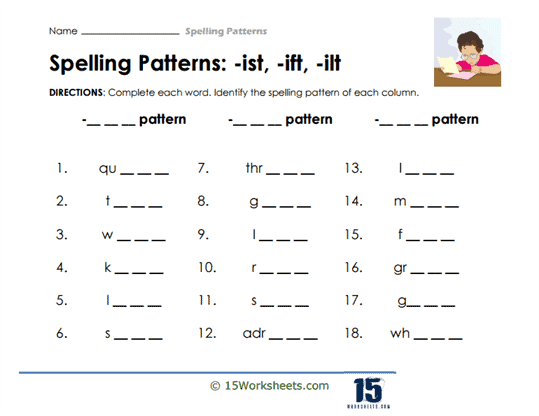
Students examine a set of words and identify the spelling pattern each word follows. They have to articulate or select the pattern name (or description). This builds meta-awareness of spelling structure and helps with spotting new patterns when reading or writing.
What Are Spelling Patterns?
Spelling patterns are the repeating “blueprints” in English that show us how sounds and letters usually go together in words. For example, if you’ve learned the “-ight” pattern from words like light, bright, and night, it’s much easier to spell a new word like sight. These predictable patterns give students confidence, because instead of memorizing every single word in the language, they can lean on patterns they already know.
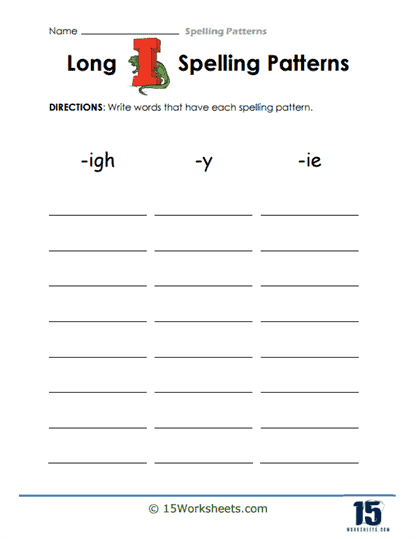
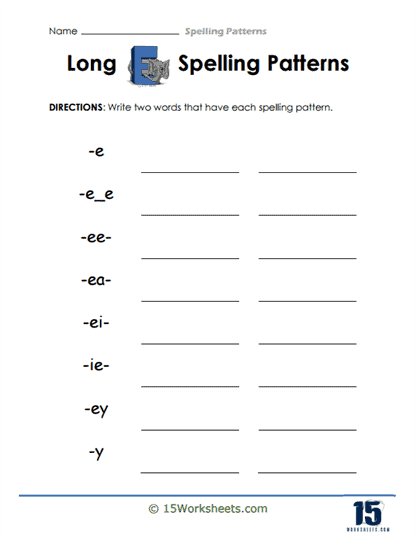
Think about how many ways we spell the long “a” sound: cake (a_e pattern), rain (ai pattern), and day (ay pattern). Or consider double consonant patterns, like in butter, dinner, and happy, where knowing when to double a letter makes spelling less confusing. Even tricky vowel teams follow patterns, such as ea in read, ee in tree, and ie in piece. By practicing these, students start spotting connections that make English a little less chaotic.
There are also patterns with prefixes and suffixes. For instance, words with un- often mean “not,” like unhappy or unclear, while -ful adds the idea of “full of,” as in joyful or helpful. Recognizing these affix patterns doesn’t just help with spelling-it also boosts vocabulary. And then you’ve got the “silent e” pattern, which turns mad into made and hop into hope, changing both spelling and meaning with a single letter.
Altogether, spelling patterns act like shortcuts for students navigating English. Instead of guessing, they can ask: “Which pattern fits here?” These worksheets give plenty of practice with common ones like -tion (action), -ck (duck), -dge (bridge), or oo (moon vs. book). The more examples kids see, the faster they’ll learn to apply patterns to brand-new words, turning them into stronger spellers and more confident readers.