
The Giver Worksheets





About Our The Giver Worksheets
Lois Lowry’s The Giver takes readers into a world that looks calm, safe, and perfectly organized-but underneath that peaceful surface is a society missing something essential: freedom, individuality, and true emotion. Students are instantly drawn into Jonas’s journey as he learns what his community has hidden from him and discovers the weight of memory, pain, and choice. It’s a story that feels futuristic yet timeless, asking readers to think about what makes life meaningful.
This worksheet collection breaks the novel into approachable, engaging activities that help students grasp its big ideas while strengthening reading skills. From vocabulary builders and character maps to theme trackers and comparison charts, each worksheet is designed to guide learners step by step. Whether they’re exploring symbolism, analyzing the ending, or debating sameness versus freedom, students build critical thinking skills while staying connected to the story.
And because The Giver deals with real-world questions about conformity, individuality, and memory, these worksheets also encourage reflection beyond the page. Students get to compare Jonas’s choices to their own, consider how language shapes perception, and even explore how the book connects to its film adaptation. In short, this collection doesn’t just help with reading comprehension-it opens the door to thoughtful conversations about humanity itself.
About Each Worksheet
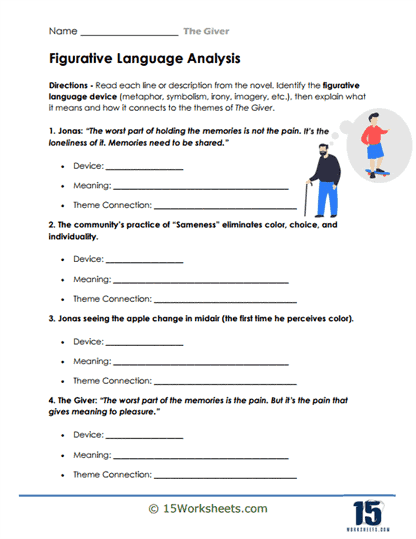
Memory Metaphors
This worksheet spotlights figurative language in The Giver, focusing on Jonas’s and the Giver’s words. Students identify metaphors, symbolism, and imagery, then explain how they shape meaning. By tying language to themes of memory, pain, and individuality, they see how words carry more than surface value. The activity builds close reading and critical thinking skills. It’s like peeking behind the curtain to see how Lowry makes her language work double duty.
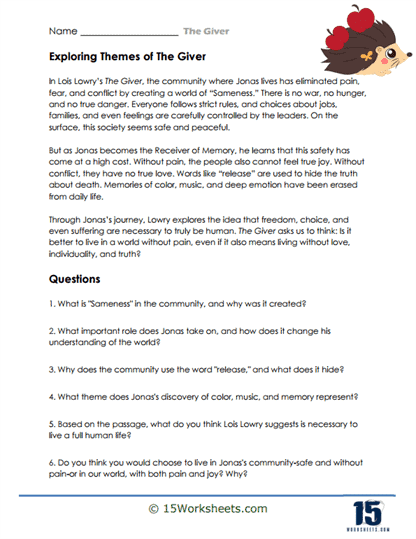
Sameness vs. Freedom
Here, students wrestle with the novel’s central question: is safety worth the cost of freedom? By comparing a world of sameness to one filled with choice, they reflect on what makes life meaningful. The worksheet encourages both critical analysis and personal reflection. Students practice connecting abstract concepts like freedom and individuality to concrete story moments. In the end, they’ll be debating whether “perfect peace” is really perfect at all.
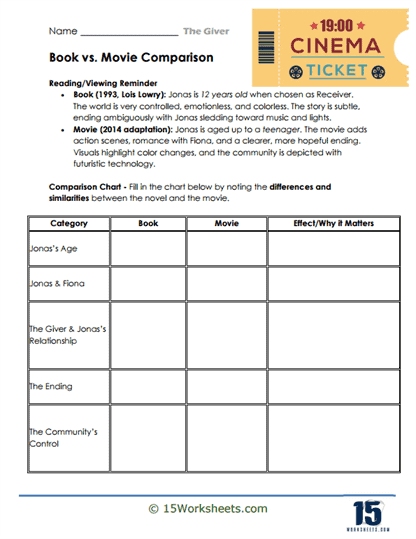
Vision Shift
This activity compares the novel with its 2014 film adaptation. Students note key changes-like Jonas’s age, his relationship with Fiona, or the altered ending-and analyze their effects. The chart format makes similarities and differences easy to track. By reflecting on adaptations, students develop media literacy alongside literary analysis. It’s a fun way to see how the same story can look very different on screen.
Utopia Vision
Students define utopia and analyze how The Giver fits into the genre. They identify three elements of utopian fiction and apply them to the novel. The activity sparks discussion about whether the community is really “perfect” or just appears that way. It deepens understanding of how authors build societies in literature. Students come away questioning whether utopia is ever truly attainable.
Dystopia Traits
This worksheet flips the script by focusing on the dystopian side of The Giver. Students identify four traits of dystopias and show how they appear in the story. It emphasizes how societies that look flawless can hide oppressive realities. By comparing utopian ideals to dystopian outcomes, students sharpen analytical thinking. It’s a lesson in how appearances can be deceiving.
Hero Focus
Students take a close look at Jonas, tracing his growth from ordinary boy to extraordinary Receiver. They explore his personality, motivations, and relationship with the Giver. The questions highlight how Jonas changes as he uncovers the truth about his community. The activity strengthens character analysis and comprehension. It’s a chance to see Jonas’s journey as both personal and heroic.
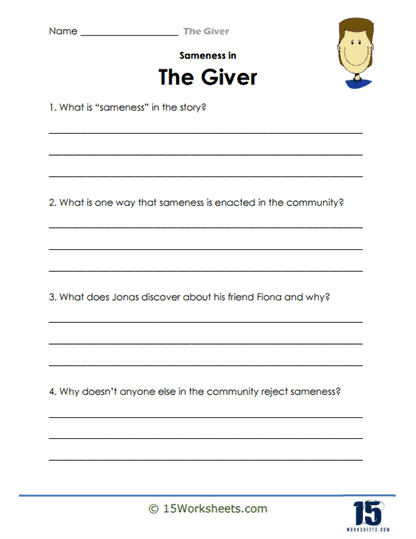
Sameness Study
This worksheet digs into the theme of sameness, asking students to define it, give examples, and analyze its consequences. They consider why some characters accept it while Jonas begins to question it. The activity ties abstract ideas like conformity and individuality to specific scenes. By reflecting, students build critical thinking about independence and freedom. It’s a thoughtful look at what happens when everyone is forced to be the same.
Setting Scene
Here, students describe the community’s setting and how it shapes tone, mood, and family life. They reflect on how daily routines define the society and influence characters’ actions. The activity highlights how environment is more than just backdrop-it’s part of the story itself. Students strengthen setting analysis while building evidence-based reasoning. By the end, they’ll see how “where” a story happens matters just as much as “what.”
Character Map
This worksheet helps students track six main characters by summarizing their roles and relationships. The chart format makes it easy to visualize connections. It reinforces recall and helps students stay grounded in a complex narrative. Organizing information strengthens comprehension and memory. It’s a handy reference tool for essays, discussions, or tests.
Narrative Lens
Students analyze the novel’s third-person limited narration and how it shapes perspective. They consider why Jonas’s viewpoint is essential to the story. The worksheet builds awareness of how point of view affects meaning. It also encourages students to justify their answers with reasoning. It’s a close look at how storytelling choices change what we see-and what we don’t.
Euphemism Hunt
In this activity, students collect examples of euphemisms like “release” and explain their meanings. They analyze how softened language hides harsh realities in the community. The worksheet highlights how words can control thought and perception. It strengthens vocabulary, interpretation, and critical thinking. Students end up seeing how power can be hidden in everyday language.
Symbol Quest
This worksheet asks students to unpack symbols like Gabriel, the sled, and the river. They cite passages, quote text, and interpret meaning. By linking details to big ideas, they build literary interpretation skills. The activity reinforces evidence-based reasoning. It’s like discovering the hidden keys that unlock the story’s depth.
Climax Moment
Students zoom in on the turning point of the novel and its consequences for Jonas and the community. They identify the climax, predict what comes next, and map the falling action. The exercise strengthens narrative analysis and comprehension. It also highlights how tension builds toward resolution. It’s a perfect practice in recognizing the dramatic heart of a story.
Plot Path
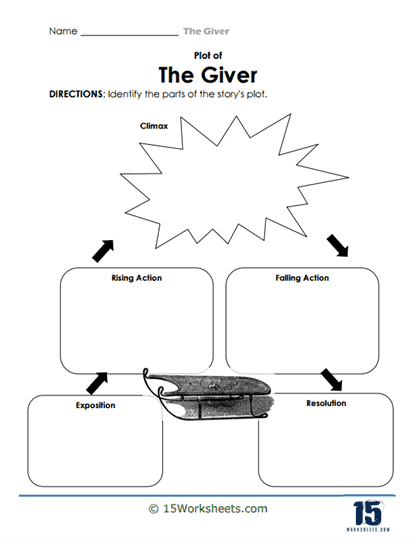
This worksheet guides students through the story’s exposition, rising action, climax, falling action, and resolution. The visual organizer helps them see how the narrative unfolds step by step. It sharpens sequencing and organization skills. Students practice breaking down complex plots into clear stages. The result is a bird’s-eye view of The Giver‘s structure.
Ending Mystery
The novel’s ambiguous ending is the focus here. Students reflect on why it leaves questions unanswered and predict possible futures for Jonas and Gabriel. The worksheet builds inference and interpretation skills. It shows that sometimes literature’s power lies in not having a single answer. Students get to exercise both critical reasoning and creative imagination.
Word Bank
This vocabulary activity asks students to define terms like “release,” “receiver,” and “precision of language.” They connect words directly to the novel’s events and context. The worksheet builds familiarity with Lowry’s unique world-building language. It strengthens vocabulary and comprehension simultaneously. It’s a word workout that makes the story’s language stick.
Motif Tracker
Students select motifs like vision, nakedness, or release and trace them through the novel. They cite passages, summarize, and explain how each motif reinforces a theme. The activity sharpens close reading and pattern recognition. It also supports essay-level analysis with textual evidence. Students come away seeing how repetition builds meaning.
Quote Quest
This worksheet features powerful quotes about memory, suffering, and wisdom. Students explain their significance to the story and connect them to broader themes. The activity emphasizes how small details reveal big truths. It builds interpretive writing and evidence-based analysis. Students leave with a deeper sense of the novel’s message.
What is The Giver?
The Giver is a novel by Lois Lowry that drops us into a community where everything is controlled-no pain, no fear, no choices, and no true feelings. At first, it looks like a peaceful utopia, but as Jonas is chosen to be the new Receiver of Memory, he discovers what his society has sacrificed for safety. Suddenly, colors, music, love, and even suffering take on new meaning, and Jonas must decide what freedom is worth.
The book isn’t just science fiction-it’s also a thought experiment about humanity. It asks tough questions: would you give up love to live without pain? Would you trade freedom for peace? By exploring memory, individuality, and conformity, Lowry gets readers to reflect on their own world, not just Jonas’s.
For students, The Giver builds critical reading and thinking skills while sparking meaningful discussions about values and choices. It connects to themes in history, philosophy, and even today’s debates about technology and society. In the end, it’s more than just a story-it’s a journey into what it means to be fully human.