
Romeo and Juliet Worksheets





About Our Romeo and Juliet Worksheets
Romeo and Juliet is one of Shakespeare’s most famous plays, and for good reason-it’s packed with romance, family drama, daring risks, and tragic twists that still capture audiences today. For students, though, this whirlwind of Elizabethan language and timeless themes can sometimes feel a little overwhelming at first glance. That’s where this collection of worksheets comes in: each one breaks the play into approachable pieces while keeping the spark and drama alive.
By working through these worksheets, students can untangle Shakespeare’s characters, themes, and conflicts in a fun, engaging way. The mix of quizzes, charts, writing prompts, and text analysis activities ensures that learners build strong comprehension while also practicing deeper skills like analysis, comparison, and critical thinking. Each worksheet is designed to make the play feel not just like an assignment, but like a story worth exploring.
And because Romeo and Juliet isn’t just about star-crossed lovers but also about timeless questions of loyalty, fate, and family, these worksheets connect Shakespeare’s words to real life. Students get to see how a centuries-old play still sparks conversations about identity, choices, and consequences today. In other words, this collection doesn’t just teach Shakespeare-it helps students recognize the bigger world of storytelling and human experience that he helped shape.
About Each Worksheet
Tragedy Toolkit
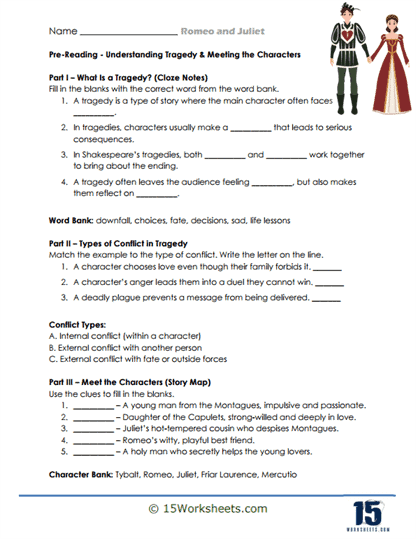
This worksheet introduces students to the idea of tragedy and the conflicts that drive stories like Romeo and Juliet. They’ll learn about different types of struggles-internal and external-and match examples to categories while also mapping out the main characters. The activities give students a strong foundation before they even dive into the play. By practicing conflict-spotting and character-mapping, they’ll feel prepared to understand the story on a deeper level. It’s like packing a backpack with the right tools before heading into Shakespeare’s dramatic world!
Feud Finder
Here’s a playful personality quiz that helps students decide if they’re more of a Montague, a Capulet, or somewhere in the middle. By answering questions about loyalty, risk-taking, friendship, and love, they’ll see how their own traits connect with the famous family feud. This makes the story more personal and relatable, while also sparking fun conversations. The quiz connects Shakespeare’s big themes to everyday choices students face. In the end, everyone discovers which “side” of Verona they’d fit into!
Star-Crossed Summary
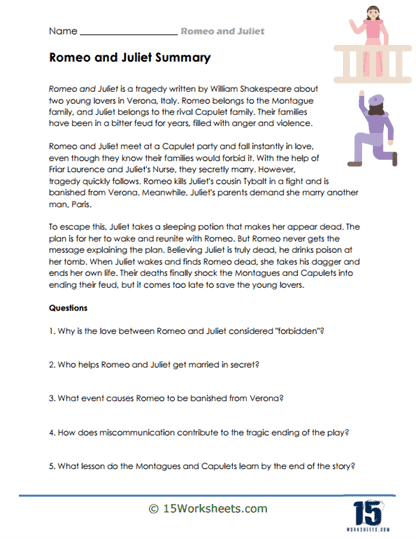
This worksheet retells the entire story of Romeo and Juliet in a clear, easy-to-follow way. Students get a guided tour through the whirlwind romance, the feud, the secret plots, and the tragic finale. The comprehension questions encourage them to think about major themes like fate, miscommunication, and forbidden love. It’s a perfect way to preview or review the play’s events. Plus, it sets the stage for meaningful discussions about how choices lead to consequences.
Tragic Turns
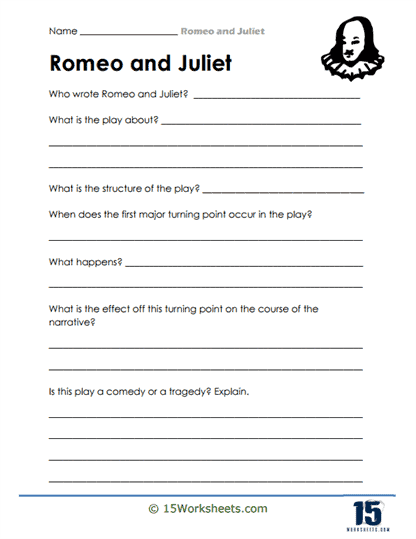
Students begin by recalling who wrote Romeo and Juliet and outlining the play’s main storyline. Then they zoom in on the first major turning point in the drama and analyze how it changes everything. The worksheet pushes them to think about cause-and-effect in storytelling. Finally, they decide if the play is a comedy or a tragedy-and justify why. It’s like solving a dramatic puzzle with Shakespeare’s storytelling as the guide.
Prologue Power
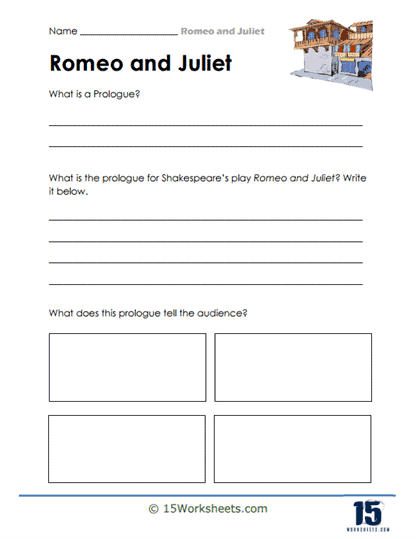
This activity zeroes in on the famous prologue that kicks off Romeo and Juliet. Students define what a prologue is, then analyze what Shakespeare reveals about the story before it even begins. By breaking the text into parts, they’ll uncover foreshadowing, tone, and theme. This helps them see how much power is packed into an introduction. It’s like learning to read the play’s “trailer” with a critic’s eye!
Character Chart
This worksheet is all about keeping track of who’s who in Verona. Students record names, roles, and short descriptions for each major character. The chart format makes it easy to see connections and conflicts at a glance. It’s a great resource to have nearby while reading the play. By the end, no one will confuse Mercutio with Benvolio ever again!
Tragedy Contrast
Here, students compare Romeo and Juliet with Shakespeare’s other tragedies. They’ll think critically about what makes this play unique while still fitting into the tragic category. By supporting their answers with details, they sharpen their evidence-based reasoning. The activity feels like detective work across Shakespeare’s works. In the process, students see how different plays approach fate, character flaws, and dramatic structure.
Irony Insights
This worksheet challenges students to hunt down examples of verbal irony in the play. They’ll need to cite act, scene, and line numbers, then explain how the irony works. This builds attention to Shakespeare’s clever use of language and layered meaning. It’s a deep dive into words that say more than they seem. Students may even find themselves grinning at Shakespeare’s sly wit.
Comic Contrast
Even in tragedy, Shakespeare slips in moments of humor, and this worksheet shines a light on them. Students track down comic scenes that lighten the mood before the drama turns heavy. By analyzing these moments, they see how contrast keeps audiences engaged. The exercise makes it clear that Shakespeare understood timing as well as tragedy. And who doesn’t love discovering the jokes hidden inside a “serious” play?
Name Meaning
Students analyze Juliet’s famous “What’s in a name?” line to uncover figurative language and character motivation. They’ll explore how names and identity play into the central conflict. The worksheet turns a poetic moment into a springboard for deeper discussion. By writing about metaphor and meaning, students sharpen their critical thinking. It’s proof that a single line of Shakespeare can hold a whole world of ideas.
Catharsis Check
This worksheet explores the emotional release (catharsis) in Romeo and Juliet. Students reflect on when it happens, how it works, and why it matters. By analyzing emotional responses, they connect dramatic structure with audience experience. It’s a thoughtful look at how Shakespeare pulls on heartstrings. In the end, students see that tragedy isn’t just about characters-it’s about how it makes us feel.
Irony Finder
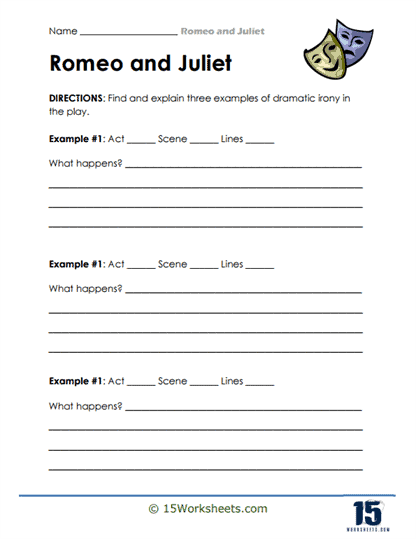
Focusing on dramatic irony, this worksheet helps students identify where the audience knows more than the characters. By citing details and explaining the effect, they’ll uncover how tension and suspense build. It’s a reminder that Shakespeare loved keeping his audiences on edge. The activity sharpens analysis skills and close reading. Students come away with a better appreciation for Shakespeare’s storytelling tricks.
Motif Map
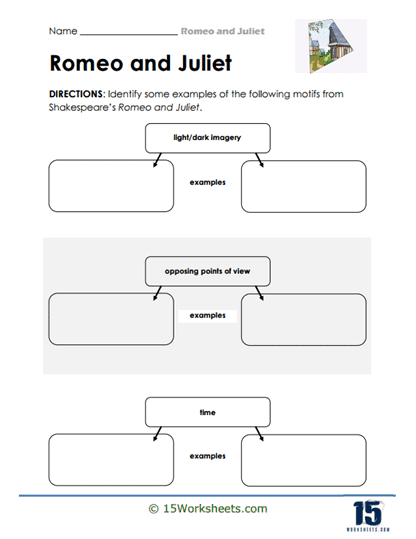
In this activity, students track recurring motifs like light/dark imagery, time, and opposing viewpoints. The chart format makes it easy to collect and organize evidence. This encourages big-picture thinking about theme and symbolism. By spotting patterns, students learn how Shakespeare wove meaning through repetition. It’s like discovering hidden threads stitched into the play’s fabric.
Ending Echoes
This worksheet asks students to reflect on the play’s ending and whether it feels fitting. They describe the denouement, analyze Shakespeare’s choices, and connect the resolution to the story’s themes. The activity strengthens evaluation and reasoning skills. It’s also a chance to think about how tragedy resonates beyond the final curtain. Students leave with a stronger sense of how endings shape entire stories.
Fateful Foreshadowing
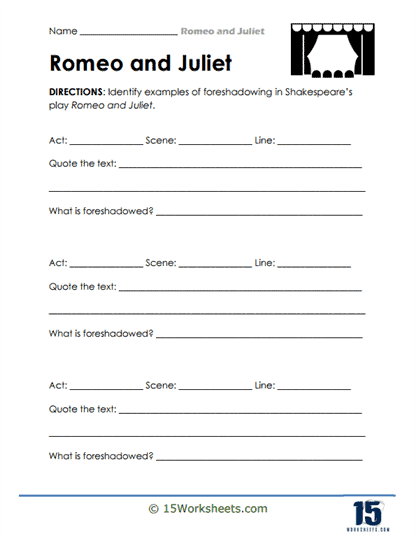
Here, students gather examples of foreshadowing from throughout the play. They practice precise quoting and close reading while explaining what each moment hints at. This builds suspense awareness and sharp interpretive skills. Shakespeare loved to plant hints, and students will uncover just how often he did. It’s like being a literary detective spotting clues to the future.
Story Shift
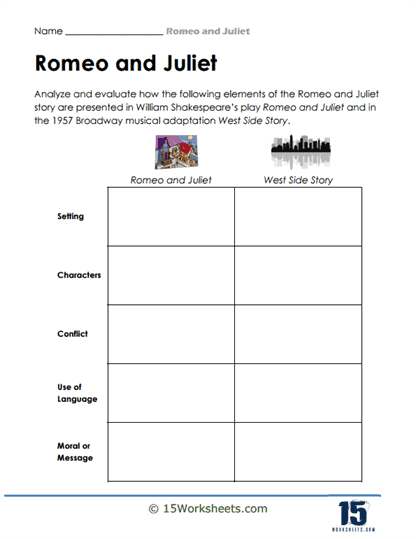
Students compare Romeo and Juliet with West Side Story in this worksheet. By looking at characters, settings, conflicts, and themes, they see how timeless stories get reimagined. The side-by-side chart makes similarities and differences clear. It’s a great way to connect Shakespeare with modern culture. Suddenly, a 16th-century play feels right at home on Broadway.
Solo Spotlight
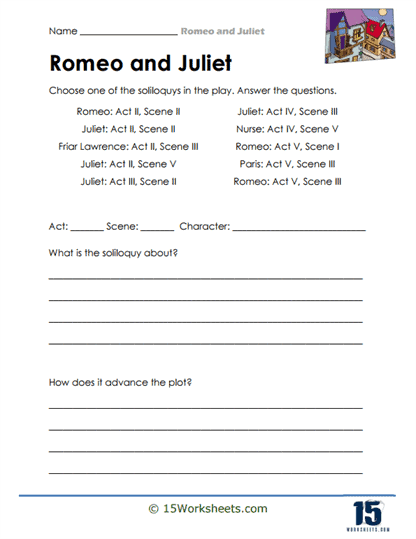
This activity zooms in on Shakespeare’s soliloquies. Students pick one, analyze what it reveals, and explain how it moves the plot forward. They’ll see how monologues open windows into characters’ hearts and minds. The worksheet develops close reading and dramatic interpretation. It’s like giving each character their own one-person show.
Modern Mirror
This worksheet bridges Shakespeare’s classic play with modern young adult retellings. Students analyze how themes of love, conflict, and identity are reimagined today. It’s a thoughtful way to show how timeless stories evolve over time. By comparing settings, language, and morals, students see connections between past and present. It proves that Shakespeare’s influence is still alive and well in today’s bookshelves.
What is Romeo and Juliet?
Romeo and Juliet is a famous play by William Shakespeare that tells the story of two teenagers who fall in love despite their families’ bitter feud. At its core, it’s a mix of romance, danger, and heartbreak, with twists that keep audiences hooked even after hundreds of years. It’s also one of the best examples of how love can be both powerful and risky when mixed with secrets, pride, and fate.
But Romeo and Juliet isn’t just about two star-crossed lovers. It’s also about how family, society, and personal choices collide in ways that shape our lives. From the humorous banter of servants to the poetic soliloquies of the lovers, Shakespeare packs the play with voices that feel both timeless and real. Readers and audiences connect with it because it raises questions about loyalty, passion, forgiveness, and the consequences of impulsive decisions.
Studying Romeo and Juliet also builds bigger skills in reading, writing, and communication. By analyzing themes, characters, and language, students strengthen their ability to think critically and express themselves clearly. Plus, it shows them how stories can cross centuries, still sparking new ideas and emotions today. In other words, reading Romeo and Juliet isn’t just about Shakespeare-it’s about learning how literature connects us all.