
The Crucible Worksheets


About Our “The Crucible” Worksheets
Arthur Miller’s The Crucible isn’t just a play about witches-it’s a powerful story about fear, reputation, and what happens when truth gets tangled up in lies. Set against the backdrop of the Salem witch trials, it captures the intensity of suspicion and hysteria in a small town. For students, this drama is both gripping and thought-provoking, but its depth can feel a little heavy without the right tools to explore it.
That’s where our Crucible worksheet collection comes in! Each activity is designed to help students unpack the play’s characters, language, and themes in a way that feels both clear and engaging. From moral dilemmas to motif mapping, the worksheets encourage close reading, critical thinking, and real-world connections. They also balance structure with creativity, so learners can both analyze and imagine themselves inside Miller’s world.
And because The Crucible isn’t just about the 1600s-it’s about timeless questions of justice, fear, and truth-these worksheets help students see its connections to history and today. Whether they’re comparing it to McCarthyism, reflecting on modern witch hunts, or making personal moral choices, learners discover that Miller’s story is more than a play: it’s a lens for understanding human nature.
About Each Worksheet
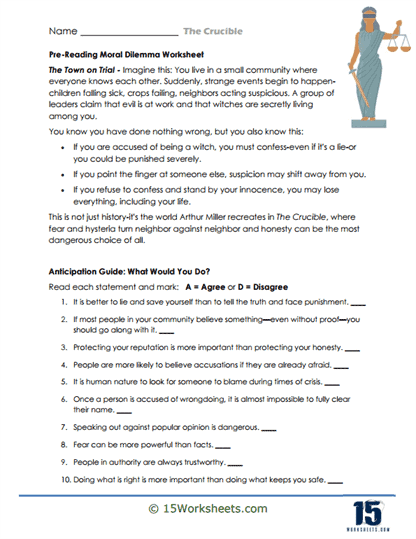
Moral Crossroads
This pre-reading activity invites students to wrestle with moral dilemmas before meeting Salem’s characters. By agreeing or disagreeing with statements about truth, fear, loyalty, and authority, they put themselves in the shoes of those under pressure. It helps them see how difficult choices drive the story’s tension. The worksheet sparks lively discussion and primes learners for the play’s conflicts. It’s like giving students a “moral compass test” before stepping into Salem!
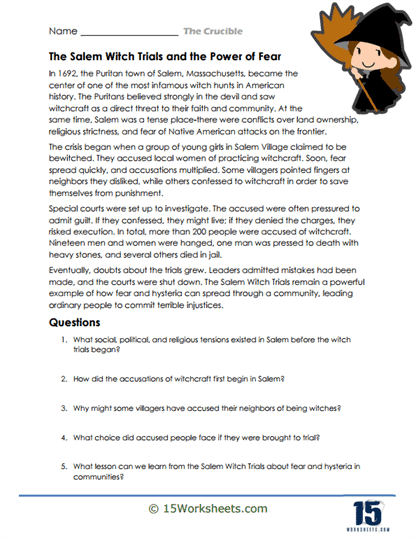
Fear’s Fire
Here, students dive into the historical Salem witch trials and their connection to Miller’s play. They’ll learn how fear spread, accusations multiplied, and injustice took hold. The questions guide them to see parallels between past hysteria and modern issues. This worksheet builds strong historical context while boosting comprehension. Students come away understanding how fear can ignite-and destroy-a whole community.
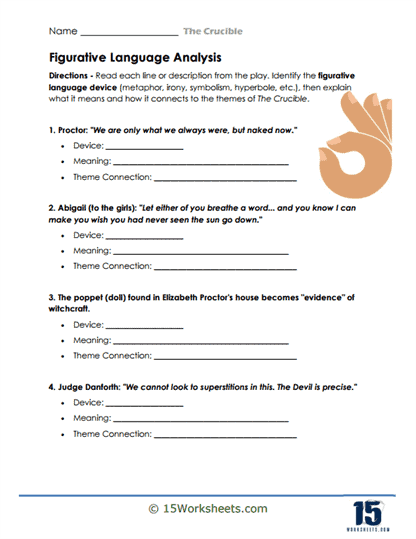
Figurative Flames
This worksheet highlights how Arthur Miller’s figurative language powers the play. Students analyze quotes for irony, symbolism, and hyperbole, then connect them to themes like truth and fear. By breaking down literary devices, they learn how words carry meaning beyond the surface. It’s a great way to sharpen close reading and critical thinking. Plus, students get to see how Miller’s “flames” of language light up the drama.
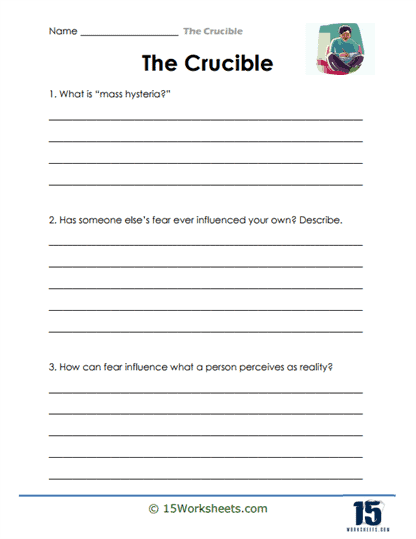
Fear Factor
Students explore the theme of fear by defining mass hysteria and reflecting on real-life experiences of being influenced by others’ emotions. They then connect these ideas back to the play’s characters and events. The worksheet encourages personal reflection alongside literary analysis. It deepens understanding of how fear clouds judgment and shapes human behavior. In the end, students see fear not just as an emotion, but as a force that can rewrite history.
Title Truths
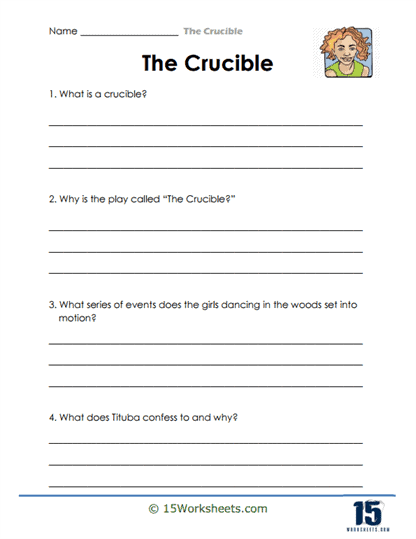
What’s in a title? This worksheet asks students to unpack the meaning of “The Crucible.” They connect the literal definition of a crucible to the figurative trials faced by Salem’s townspeople. By linking the title to events in the play, they uncover themes of transformation and testing. It’s a simple but powerful way to explore symbolism. Students leave with a fresh appreciation for Miller’s title choice.
Symbolic Stage
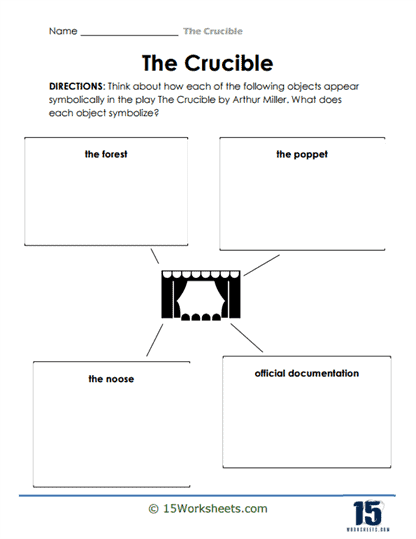
This activity challenges students to decode objects in the play as symbols-like the poppet, the forest, or the noose. By identifying what each stands for, they learn how Miller used tangible details to represent abstract ideas. The exercise pushes them beyond surface-level reading into thematic analysis. It’s like turning stage props into puzzle pieces of meaning. Students realize that every detail in Salem carries weight.
Character Sketch
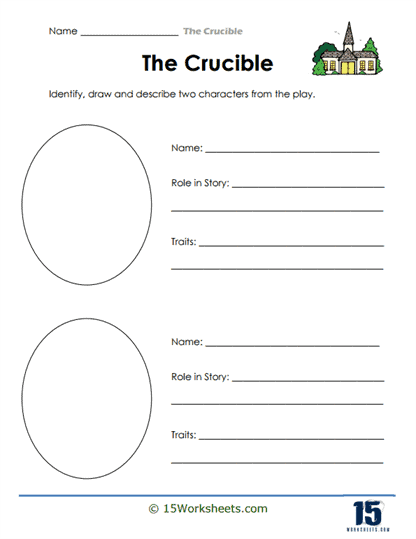
In this worksheet, students select two characters to describe, analyze, and even sketch. They record each one’s role, traits, and motivations while comparing how they fit into the story’s conflicts. The creative drawing option adds a fun, visual twist. This helps cement character details in memory. By the end, students have both portraits and insights into Salem’s biggest personalities.
Word Web
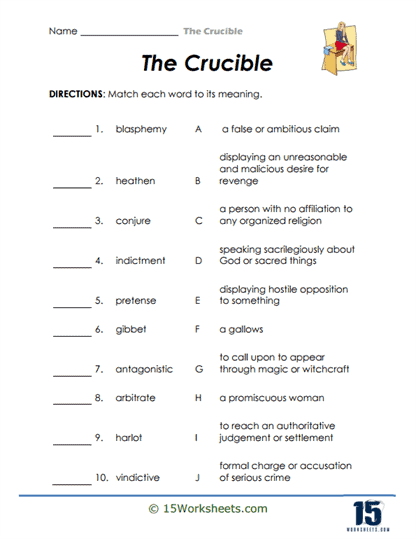
This vocabulary activity introduces key terms like “blasphemy,” “vindictive,” and “gibbet.” Students match words to definitions and connect them to the play’s context. The exercise builds comprehension of the intense language used in court and accusations. It strengthens word recognition and analysis across the play. And who knows-students may even surprise themselves by slipping “antagonistic” into everyday conversation!
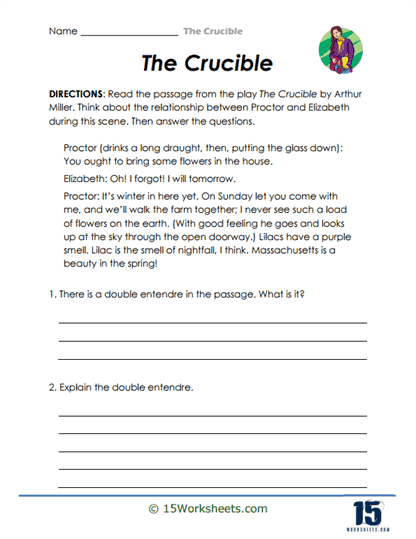
Double Meanings
This worksheet zooms in on layered dialogue, especially between John and Elizabeth Proctor. Students identify double entendres and explain how they reveal both surface meaning and hidden emotions. It’s a lesson in paying attention to subtext and nuance. The activity builds interpretive reading and critical thinking. Students walk away realizing that in Salem, words often mean much more than they seem.
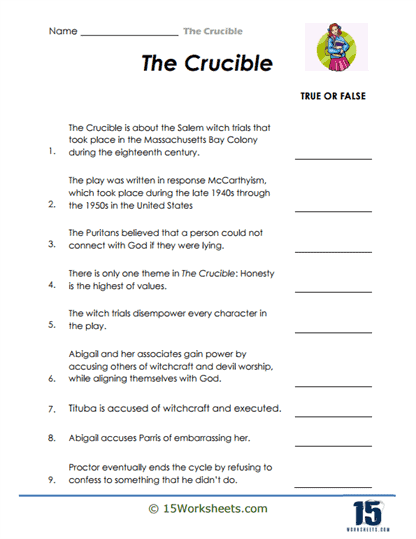
Truth Test
Students tackle a series of true/false statements about the play’s characters, themes, and context. From Tituba’s role to Proctor’s final stand, they check their understanding while spotting misconceptions. The worksheet doubles as a review and confidence-builder. It strengthens recall and comprehension with quick, focused practice. Think of it as a Salem “fact check” with high stakes-but no gallows.
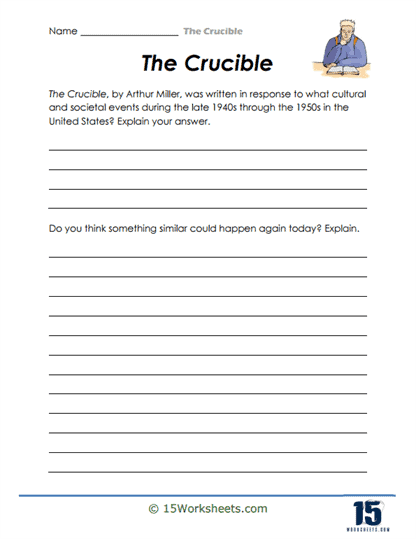
Modern Mirror
This worksheet connects The Crucible to McCarthyism and asks students to consider whether similar witch hunts could happen today. They reflect on cultural and political parallels across history. The prompts encourage critical thinking about fear-driven injustice. Students see literature not just as a story, but as a mirror for society. It’s the kind of activity that makes Miller’s play feel urgently relevant.
Plot Map
A graphic organizer helps students chart the play’s key events, characters, and themes. This visual tool makes it easier to see how everything connects. It’s perfect for review before a test or essay. Students strengthen their ability to summarize and organize information clearly. With this map, they won’t get lost in Salem’s tangled web of accusations.
Witch Hunt
This worksheet takes a historical dive into the real Salem trials. Students learn who was accused, what punishments were given, and how the hysteria eventually ended. By connecting fact to fiction, they see where Miller stayed true and where he adapted events. The activity blends history and literature in one neat package. It’s a reminder that sometimes truth is just as chilling as drama.
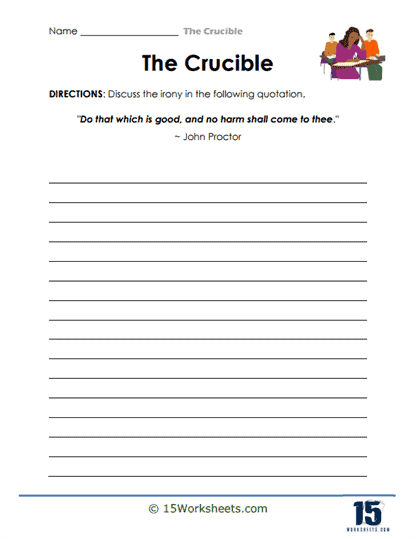
Irony Insight
Students reflect on Proctor’s ironic statement: “Do that which is good, and no harm shall come to thee.” They analyze why it’s ironic and connect it to his fate. This sharpens their ability to spot literary devices and explain their impact. The worksheet promotes deeper engagement with character motivations and consequences. It’s a small quote that opens big doors for analysis.
Motif Mapper
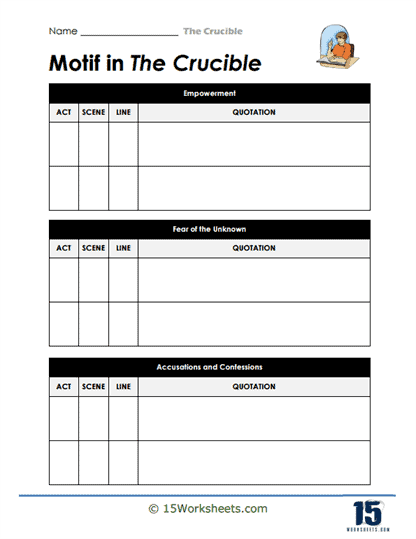
Recurring motifs like confession, fear, and empowerment take center stage here. Students hunt for textual evidence to illustrate how Miller reinforces ideas throughout the play. This sharpens close reading and supports essay-ready analysis. By mapping motifs, students see the hidden patterns holding the story together. It’s like tracing threads through Salem’s chaotic tapestry.
Theme Tracker
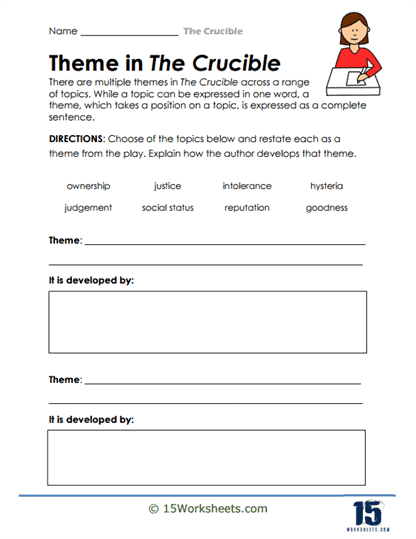
This activity moves students beyond naming topics to writing full theme statements. They explain how Miller develops themes like reputation, hysteria, and justice across the play. The guided structure makes abstract ideas more concrete. Students sharpen interpretive and writing skills at the same time. It’s a surefire way to boost literary analysis confidence.
Character Canvas
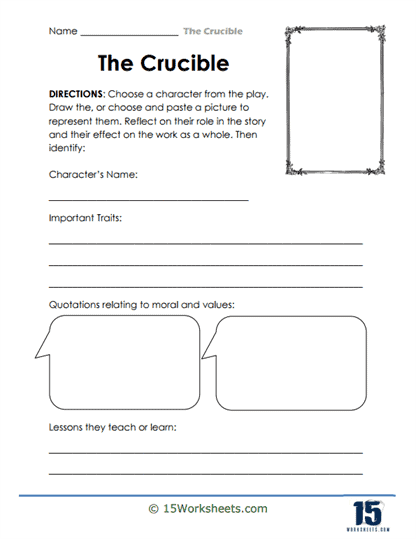
Students choose one character to analyze in depth, pairing quotations with traits and moral lessons. They also get creative by adding an illustration or visual element. The blend of analysis and artistry makes for memorable learning. It’s a chance to see how individual choices shape the entire story. By the end, every character feels like more than just a name on a page.
Confession Choice
This worksheet puts students right into Salem by asking: would you sign a false confession to save your life? They must explain and defend their choice, connecting it to the play’s moral dilemmas. The task sparks empathy and ethical reflection. It also builds persuasive writing and reasoning skills. Suddenly, Miller’s story isn’t just history-it’s personal.
What is The Crucible?
The Crucible is a play written by Arthur Miller in the 1950s, but it’s set in Salem, Massachusetts during the witch trials of the 1600s. At first glance, it’s about accusations of witchcraft-but underneath, it’s about fear, lies, and the choices people make when their reputation is on the line. The story follows ordinary townspeople swept up in extraordinary hysteria, as truth and justice become dangerously hard to find.
Miller wrote the play as an allegory for McCarthyism, when Americans were accused of being communists with little or no evidence. That connection makes The Crucible not just a history lesson, but a cautionary tale about the dangers of mass fear and scapegoating. It reminds us how quickly communities can unravel when fear takes control and truth becomes negotiable.
For students, studying The Crucible means more than reading an old play-it’s a chance to think critically about truth, morality, and courage. It strengthens skills in reading, writing, and interpretation while encouraging reflection on society today. And it proves that literature isn’t just about the past-it’s about understanding ourselves and the choices we face, even now.