
The Great Gatsby Worksheets






About Our “The Great Gatsby” Worksheets
F. Scott Fitzgerald’s The Great Gatsby is more than a glamorous story about jazz-age parties-it’s a sharp look at wealth, ambition, love, and the American Dream. Set in the Roaring Twenties, it paints a vivid picture of a society chasing glitter and success while struggling with emptiness beneath the sparkle. Students love the drama of Gatsby’s mysterious life and Daisy’s choices, but they also discover a novel packed with symbolism and themes that still resonate today.
This worksheet collection helps readers dive deeper into Fitzgerald’s masterpiece with activities that break down the novel’s setting, language, and big ideas. From vocabulary practice and character charts to motif tracking and foreshadowing hunts, every worksheet is designed to build stronger comprehension and analytical skills. Students will practice close reading, critical thinking, and creative reflection while connecting to the novel’s characters and themes.
And because The Great Gatsby isn’t just about the 1920s-it’s about timeless questions of love, class, success, and disillusionment-these worksheets encourage learners to think about the novel’s connections to their own world. By analyzing quotes, exploring symbolism, and even comparing book and film versions, students build both academic skills and personal insights. This collection turns Gatsby’s story into a pathway for learning, reflection, and lively discussion.
About Each Worksheet
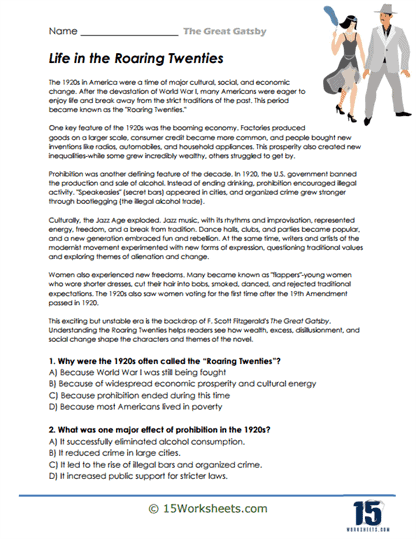
Roaring Realities
This worksheet introduces students to the energy of the 1920s: prohibition, jazz, flappers, and the rise of consumer culture. It shows how this backdrop shapes the characters’ lives and ambitions in The Great Gatsby. Students answer questions that connect historical events to the novel’s themes of wealth, disillusionment, and excess. It builds both comprehension and critical thinking by linking story to setting. It’s like stepping into the roaring decade before opening the novel itself.
Ledger of Luxury
Students compare Jay Gatsby’s lavish lifestyle with Fitzgerald’s own financial habits. Both reveal the risks and illusions behind wealth and extravagance. The worksheet encourages reflection on what it really means to live a “rich” life. Students also consider how they’d use wealth if they had it. It’s a thought-provoking blend of biography, literature, and personal values.
Gatsby’s Clues
This activity treats figurative language like a mystery to solve. Students analyze key images-like the green light, Daisy’s voice, or Dr. Eckleburg’s eyes-and explain their symbolic meaning. By linking these clues to broader themes, they discover Fitzgerald’s deeper messages about hope, illusion, and materialism. It sharpens their close-reading and interpretation skills. Think of it as literary detective work in Gatsby’s glittering world.
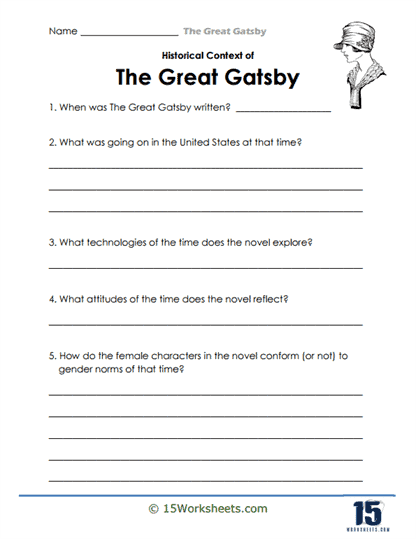
Gatsby Timeline
Here, students explore the historical moment when Fitzgerald wrote his classic. They connect the novel’s themes to real events of the 1920s, including technology, shifting gender roles, and social change. The worksheet highlights how literature reflects its time. It builds historical literacy alongside literary analysis. Students finish with a stronger sense of how Gatsby’s story grew out of its era.
Word Power
This vocabulary activity gives students a list of challenging words from the novel. They write definitions, gaining a clearer understanding of Fitzgerald’s style and tone. The focus on rich adjectives and verbs builds comprehension of mood and character. Students improve vocabulary skills while deepening their reading confidence. It’s a language workout that makes tackling classics less intimidating.
Word Match
Students practice matching Gatsby-era vocabulary with its definitions. The activity reinforces memory and comprehension by asking them to think critically about word meanings. It also sharpens language precision. By mastering key terms, students better grasp Fitzgerald’s atmosphere and themes. It’s a quick but powerful boost for literary reading.
Egg Contrast
This worksheet asks students to compare East Egg and West Egg-two settings that symbolize wealth and class. They identify differences and similarities while connecting them to themes of privilege and ambition. The activity strengthens comparative analysis and setting study. It shows how geography becomes a metaphor for identity. Students realize that in Gatsby’s world, where you live says who you are.
Character Sketch
Students summarize the six major characters and their roles in the story. The chart format gives space for short descriptions or even drawings. It organizes relationships and motivations in a clear, visual way. The activity supports memory and comprehension of character dynamics. It’s a handy tool for navigating Gatsby’s tangled social web.
Narrator Lens
This worksheet explores Nick Carraway’s role as narrator. Students analyze why his perspective matters and how it shapes the story. The activity highlights issues of reliability and subjectivity. It builds interpretive and critical thinking skills. Students leave questioning how much of Gatsby’s tale is filtered through Nick’s own lens.
Theme Tracks
Here, students focus on three central themes: the American Dream, love and marriage, and class. They describe how each is developed through events, symbols, and character choices. The activity deepens thematic analysis while encouraging evidence-based reasoning. It connects plot details to universal ideas. It’s a big-picture look at why the novel still resonates today.
Symbol Hunt
Students identify symbols like Gatsby’s mansion, the green light, and the Valley of Ashes. They explain what each represents and how it connects to themes of wealth, hope, and decay. This encourages deeper reading beyond surface-level events. It builds skills in symbolism analysis and critical thinking. Every object in the novel becomes a doorway to meaning.
Climax Focus
This worksheet highlights the novel’s turning point and resolution. Students describe the climax, evaluate the denouement, and reflect on whether the ending is fitting. It strengthens their understanding of story structure. They practice evaluative and critical thinking about endings. It’s an activity that makes them consider why stories resolve the way they do.
Future Hints
Students track Fitzgerald’s use of foreshadowing throughout the novel. They identify real and false hints, analyzing how suspense is built. The activity sharpens attention to detail and predictive reasoning. It shows how authors plant seeds of meaning early on. Students finish with a deeper appreciation for Fitzgerald’s layered storytelling.
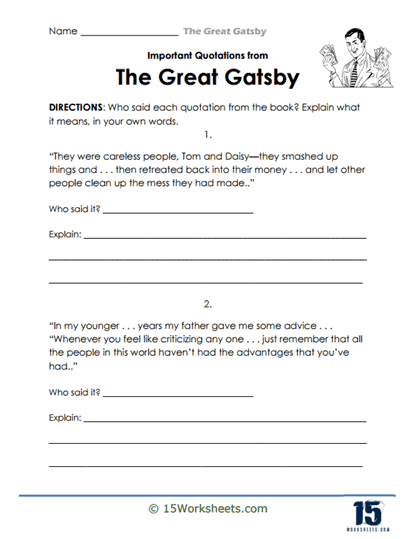
Quote Quest
This worksheet asks students to analyze iconic quotations from the novel. They identify speakers, explain meaning, and connect lines to themes of wealth and morality. The activity builds comprehension and interpretive skills. Explaining quotes in their own words develops clarity and critical thinking. Students discover that even a single line can hold an entire theme.
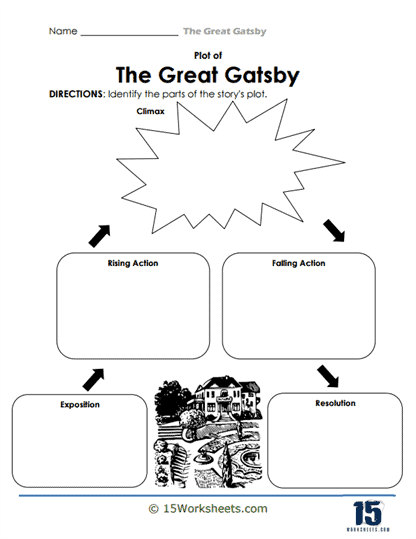
Plot Map
Students chart the novel’s structure by filling in exposition, rising action, climax, falling action, and resolution. The graphic organizer makes the story’s flow clear. It builds sequencing and organizational skills. Students learn how tension rises and resolves in narrative form. It’s a visual way to master plot analysis.
Motif Tracker
This worksheet focuses on motifs that run throughout the novel. Students trace one motif, citing pages and quotes, then explain how it builds meaning. The exercise encourages pattern recognition and thematic thinking. It strengthens evidence-based reasoning for essays. Students see how repetition shapes the novel’s depth.
Media Match
Here, students compare Fitzgerald’s novel with its film adaptations. They analyze differences in language versus visuals like lighting and sound. The activity builds media literacy and comparative analysis. It sparks discussion about adaptation choices. Students decide which version they prefer-and why.
Final Reflection
This worksheet zeroes in on the novel’s famous closing lines about boats against the current. Students reflect on what the passage suggests about the story and its themes. It encourages deep, personal interpretation. Writing responses strengthens analytical and reflective skills. It’s a memorable way to close the study of Gatsby’s world.
What is The Great Gatsby?
The Great Gatsby is a novel by F. Scott Fitzgerald, published in 1925, and set in the glittering world of the Jazz Age. It tells the story of Jay Gatsby, a wealthy man who throws extravagant parties to win back his lost love, Daisy Buchanan. Narrated by Gatsby’s neighbor, Nick Carraway, the novel explores themes of wealth, ambition, love, and the elusive American Dream. Beneath the sparkle of champagne and jazz lies a critique of excess, illusion, and emptiness.
The novel matters because it captures both the excitement and disillusionment of the 1920s. It reflects the cultural changes of the Roaring Twenties while asking timeless questions about success, morality, and desire. Its symbols-like the green light at the end of Daisy’s dock-still resonate with readers as images of hope and longing.
For students, The Great Gatsby is a chance to build reading and analysis skills while exploring universal human themes. It develops comprehension, critical thinking, and interpretive writing. And it connects literature to history, culture, and even today’s world of ambition and excess. In short, it’s a story about dreams, love, and what it really means to chase success.