
Number 8 Worksheets
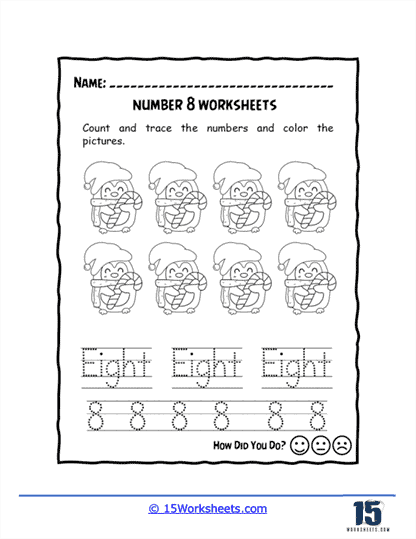
About These 15 Worksheets
These worksheets are all about helping kids understand the number 8 in lots of playful, varied ways. They mix tracing, counting, coloring, thematic pictures, and even mazes so students don’t just memorize the symbol “8,” but really grasp what “eight items” means. The variety helps learners stay interested-unicorns, trees, hot dogs, mazes-so everything isn’t just the same old “write the number” activity. That helps with retention and confidence.
As students work through them, they build number sense with 8: recognizing the numeral, counting up to eight, grouping things in sets of eight, seeing eight in different contexts, and understanding “eight” in both symbolic and concrete forms. They’ll also refine fine motor skills (tracing, writing), visual discrimination (counting, finding the right sets), and following instructions. By mixing easier tasks (trace, count) with slightly harder ones (mazes, counting in scenes), the worksheets scale in difficulty gently.
In real-life, understanding “eight” matters: eight fingers (minus thumbs), eight objects, eight of something in a set, telling time, counting, early addition/subtraction all build from knowing numbers 1-10 solidly. These worksheets help children make that leap: seeing that “8” isn’t just a symbol on a page but something you can count, group, compare, and use. With consistent practice, kids will not only know “8” but feel comfortable using it in all sorts of situations.
Have a Look Inside Each Worksheet
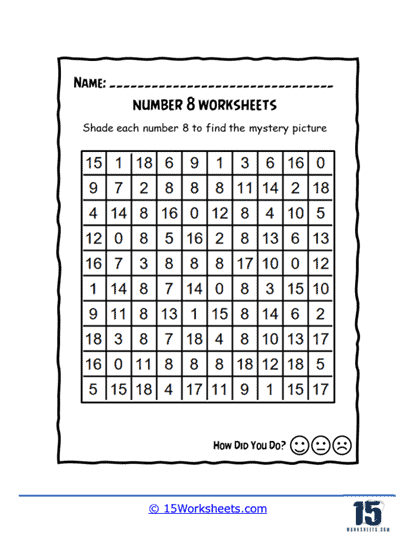
Mystery Picture
Students complete a mystery picture-probably by coloring or connecting dots-revealing a hidden image once all the parts with the number 8 are done. Builds number-recognition and attention to detail. Feels like uncovering a secret picture. Helps kids associate “8” with fun and with visual work.
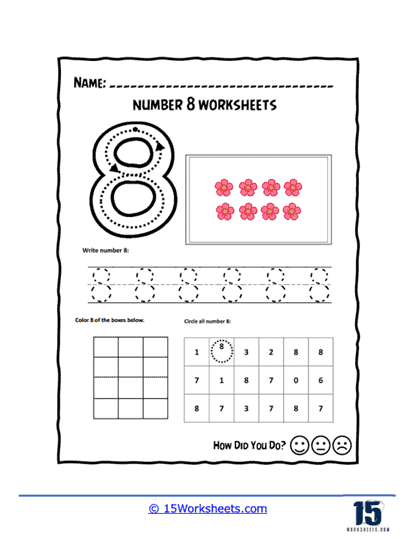
8 Review Sheet
A general review page all about the number 8: tracing, writing, counting, maybe matching, etc. Reinforces multiple skills around “8.” Good for checking what’s been learned so far. A bit of everything so nothing gets forgotten.
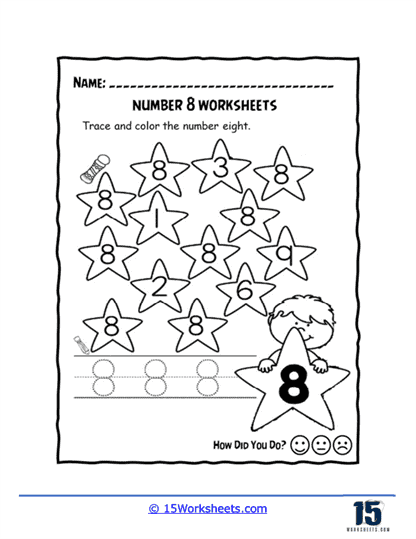
Stars of 8
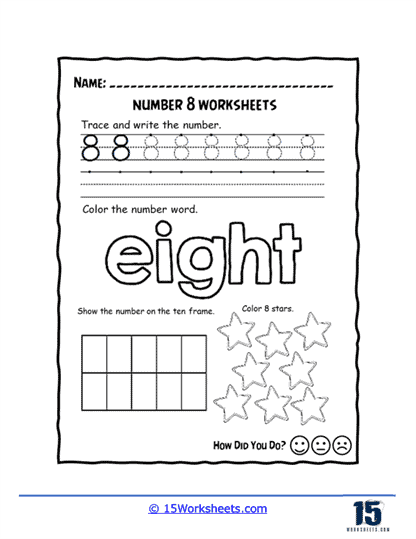
Possibly involves counting or coloring eight stars or sets of stars. Helps build counting and one-to-one correspondence. Visual and concrete. Great for seeing “8” as a set, not just the symbol.
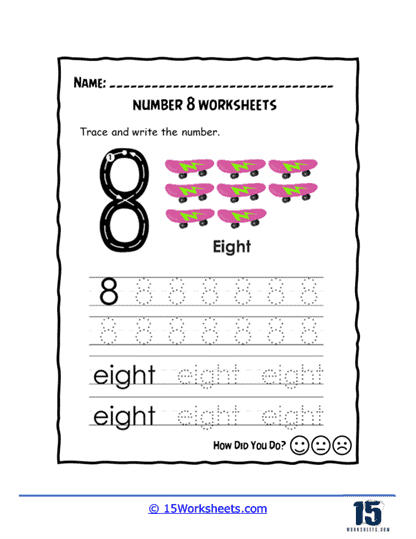
Skateboard
Likely a themed worksheet: perhaps counting objects related to skateboards, tracing number 8, or decorating skateboard with eight items. Adds interest with theme. Helps children stay engaged. Connects number 8 to everyday things.
Review Sheets
More than one “review” exercise: revisiting what students have done with “8” in tracing, counting, writing. Good reinforcement. Builds confidence through repetition. Ensures number‐8 understanding is solid.
Number 8 Maze
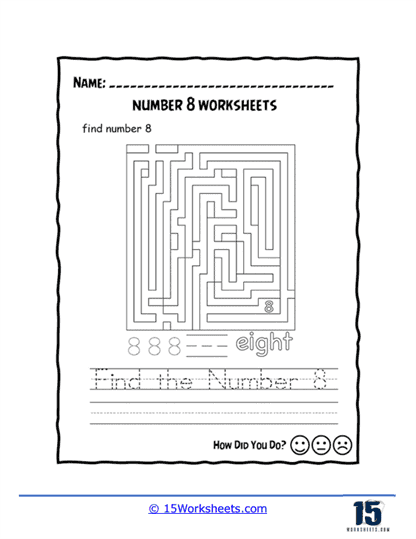
A maze activity where correct paths or choices are made by recognizing or following the number 8. Combines problem solving and number recognition. Fun challenge feel. Helps children persist in tasks and think through decisions.
Unicorn and Rainbow
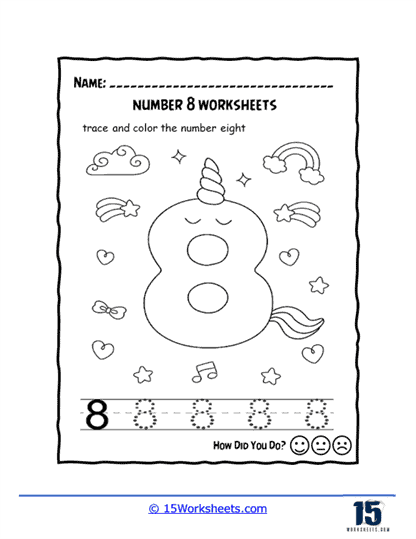
Probably asks the student to count or color eight items in a unicorn/rainbow scene. Makes learning whimsical. Combines art + number sense. Helps children connect “8” with quantity in fun contexts.
Eight on the Fingers
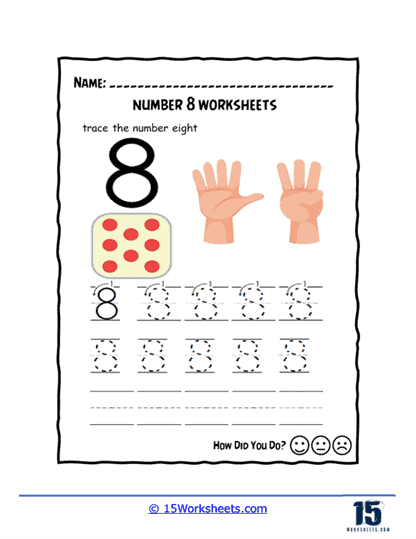
Shows fingers up to 8, or image of eight fingers, or asks how many fingers make 8. Reinforces counting with body/familiar reference. Hands are great visual aids. Supports number sense and subitizing.
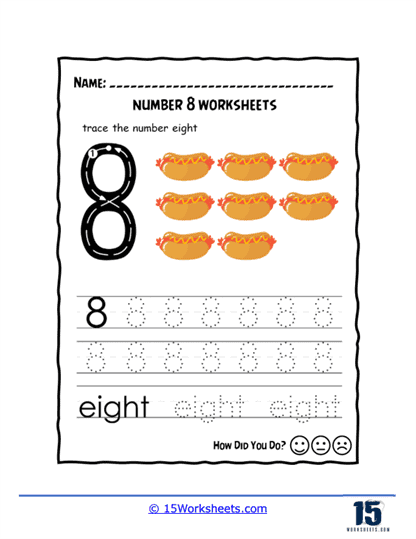
Hot Dog of 8
Maybe images of hot dogs or items grouped in eights. Might have students trace/draw 8 hot dogs or count pieces. Adds food theme to keep interest. Helps start to see number in groupings.
Tracing 8s
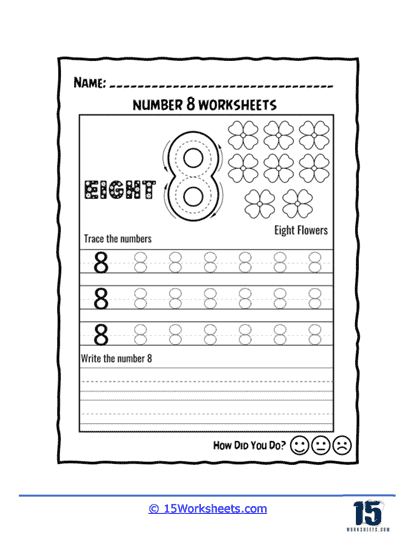
Students practice writing (tracing) the numeral “8.” Builds number formation skills. Crucial early motor skills + symbol recognition. Helps learner get familiar with writing the digit correctly.
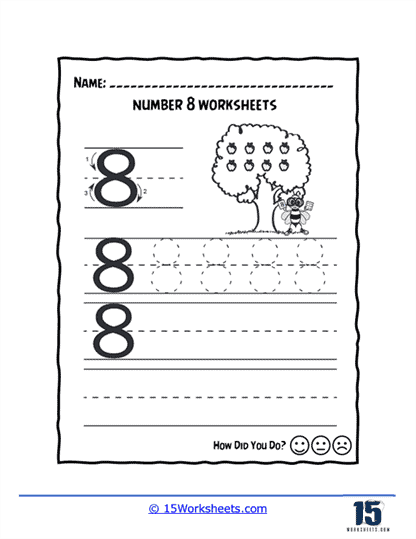
Falling of the Tree
Probably a scene of a tree losing objects (leaves, fruit) and counted in sets of eight; maybe pick out eight or count fallen objects. Adds seasonal / nature theme. Useful for counting and quantity with realistic scenes.
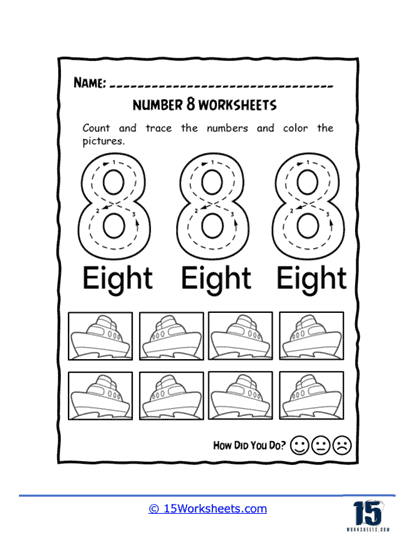
Boating Eights
Maybe boats or objects on water in sets of eight; count, color eight boats, etc. Theme for variety. Visual and contextual counting. Helps reinforce “eight” in different settings.
Counting on Color
Color items up to 8, maybe color “eight of something” or color based on number. Helps with number quantification and recognizing “how many.” Also reinforces following directions and color recognition.
Carrots of Eight
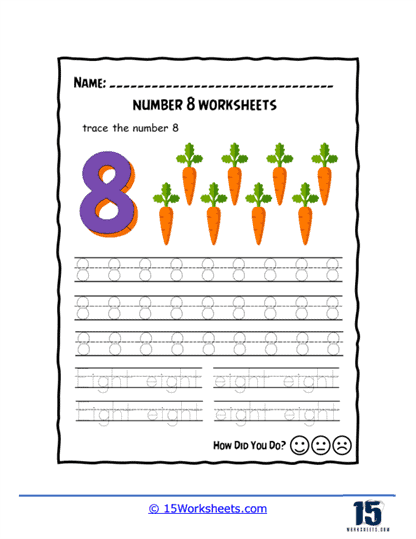
Carrot images in sets of eight; maybe counting carrots or coloring eight carrots. Garden/vegetable theme. Hands‐on counting, quantity recognition. Good for thematic engagement.
Numbers of Cloves
Probably involves cloves of something (garlic or “clove” parts) grouped or counted to eight. Theme adds novelty. Helps learners see number 8 in less usual contexts. Builds counting skill + variety.
Fun Facts About the Number 8
The number 8 has long captured the imagination of cultures, scientists, and even casual observers. It’s a number steeped in mystery, significance, and fascinating trivia. Although it may appear unassuming at first, the number 8 holds a special place in the realms of mathematics, culture, nature, and science. Let’s dive into some of the most compelling facts about the number 8, and explore why this figure is far more than just another number.
To begin with, 8 is the only cube found in the Fibonacci sequence, a mathematical series that has intrigued mathematicians and nature enthusiasts alike. The Fibonacci sequence follows a pattern where each number is the sum of the two preceding ones. Starting from 0 and 1, it continues as 0, 1, 1, 2, 3, 5, 8, 13, and so on. Interestingly, the number 8, being a cube (2 x 2 x 2 = 8), stands out uniquely within this naturally occurring sequence. The Fibonacci sequence itself mirrors patterns found in nature, from the spiral arrangements of sunflower seeds to the branching of trees, making the presence of 8 all the more intriguing. It represents both simplicity and complexity in one mathematical stroke, revealing the elegance of numbers within our universe.
In Chinese culture, the number 8 is revered for its auspicious symbolism. Pronounced “ba” in Mandarin, it sounds remarkably close to the word for ‘wealth’ or ‘prosperity’ (“fa”). As a result, 8 is viewed as the luckiest number, influencing everything from business deals to personal choices. During the 2008 Beijing Olympics, the opening ceremony was deliberately scheduled for 8:08 p.m. on August 8 (8/8/08), to harness the positive energy associated with this powerful number. The allure of 8 is so profound that people often go to great lengths to incorporate it into their lives, even paying a premium for phone numbers, addresses, or license plates that feature the number. In Chinese society, the number 8 is not just a numeral but a gateway to prosperity and success, embodying a cultural belief in the mystical power of numbers.
Visually, the numeral 8 is a marvel of symmetry. With its perfectly balanced loops, it is the only Arabic numeral that remains unchanged whether it is rotated, flipped, or mirrored. This symmetry is not just a matter of aesthetics; it symbolizes balance, unity, and continuity. When the number 8 is laid on its side, it transforms into the infinity symbol (∞), a representation of boundlessness and eternal cycles. This connection to infinity imbues the number with a philosophical dimension, hinting at concepts of endless possibilities and the perpetual flow of time. It’s a small visual twist that invites deeper reflection on the cyclical nature of life and the universe.
In our own Solar System, the number 8 shows up once again in a significant way. Earth is the eighth largest planet, a fact that places our home planet within a broader cosmic context. Although Earth is not the eighth planet from the Sun, its ranking in terms of size adds another layer of intrigue to the many ways 8 appears in the natural world. Similarly, 8 is the atomic number of oxygen, one of the most essential elements for life on Earth. Without oxygen, the very air we breathe would not sustain us, underscoring how integral this number is to the foundation of life itself. The number 8, in this sense, is not just an abstract figure-it’s tied directly to our existence.
In geometry, the octagon-a shape with eight sides-illustrates how the number 8 contributes to the structure of our world. Perhaps the most recognizable octagon is the stop sign, an essential symbol in everyday life. The eight-sided design of a stop sign is unique because it allows drivers to recognize the sign from either side, making it universally understood. The shape itself is a reminder of how mathematical forms can be practical, functional, and integral to our safety and communication.
The world of animals also holds a special relationship with the number 8. Creatures like spiders, octopuses, and scorpions are all notable for having eight legs. This anatomical feature, particularly in spiders, has fascinated biologists and arachnophobes alike for centuries. The octopus, with its eight limbs, is among the most intelligent of invertebrates, using its legs for locomotion, camouflage, and problem-solving. The number 8 in the animal kingdom often signifies resilience, adaptability, and the intricate designs of evolution.
In the realm of music, the concept of an octave is a cornerstone. An octave represents the interval between one musical pitch and another with either double or half its frequency. The name “octave” comes from the Latin “octavus,” meaning “eighth,” as it spans eight notes in a diatonic scale. Musicians around the world rely on octaves to create harmony and depth, with the octave forming the basic building block for scales and chords. The number 8 here symbolizes a return to the beginning, yet on a higher level, much like the endless loops of the infinity symbol.
The number 8 continues its omnipresence in technology and modern life. In computer science, one byte is made up of 8 bits, which serve as the foundation of data processing in digital systems. The byte has revolutionized the way we store and communicate information, making 8 integral to the functioning of everything from smartphones to supercomputers. Moreover, in digital displays, such as those found on calculators and watches, the digit 8 is often displayed because its configuration allows for the formation of nearly every other number. This versatility further elevates the status of 8 as a figure of adaptability and utility.
Even in everyday measurements, the number 8 holds significance. In the U.S. liquid measurement system, there are 8 pints in a gallon. This simple fact ties the number into practical matters of daily life, from the amount of milk in your fridge to the volume of water in a jug. The number 8, in this context, brings order and clarity to the way we measure and understand the world around us.
The number 8 is a symbol of balance, harmony, and continuity across multiple disciplines and cultures. Whether it’s embodying infinite potential in its sideways form, appearing in the Fibonacci sequence, or representing wealth and prosperity in Chinese culture, 8 is far more than just a digit. It weaves itself into the fabric of our lives, influencing the way we think, live, and even dream. The number 8 reminds us of the interconnectedness of all things-whether in mathematics, nature, or culture-and encourages us to recognize the hidden patterns that shape our reality.