
Number 50 Worksheets



About These 15 Worksheets
Learning the number 50 is more than just counting-it’s about building number sense, recognition, and writing skills. This collection of worksheets introduces fifty through tracing, coloring, puzzles, and playful themes like gumball machines, balloons, and rain drops. By practicing in so many different formats, kids get repeated exposure to the number in ways that keep learning fun and memorable.
The worksheets start with basics like tracing and writing the number, then expand into counting, coloring, and even representing fifty in different forms like tally marks and words. Themes like horses, apples, and race tracks give students a sense of story and excitement while reinforcing the math. The variety ensures every learner, whether visual, hands-on, or language-oriented, finds something that clicks.
And because 50 is a milestone number, these worksheets also help kids understand bigger ideas like grouping by fives and tens. From everyday counting to early multiplication concepts, practicing fifty sets the stage for more advanced math. By the end, students won’t just recognize 50-they’ll feel comfortable using and writing it in all sorts of ways.
Have a Look Inside Each Worksheet
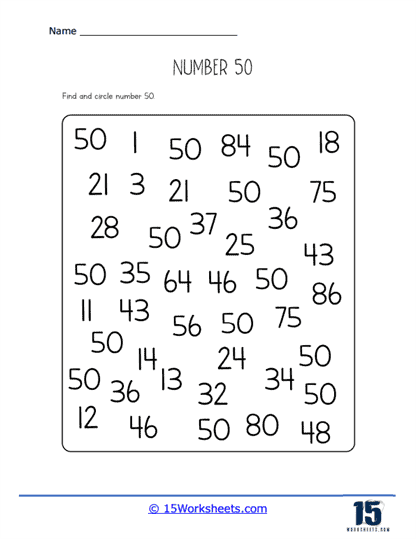
50 Soup
Students search for and color the number 50 hidden in a soup of numbers. It’s like a number-themed word search puzzle. The activity builds recognition skills in a fun way. Perfect for early learners practicing number spotting.
Rows and Columns
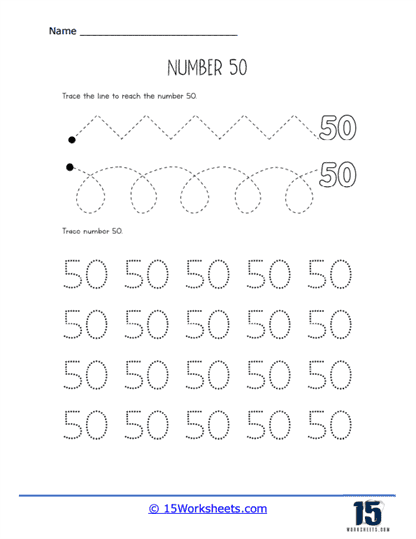
Kids practice writing the number 50 in neat rows and columns. This reinforces handwriting, spacing, and repetition. The format builds confidence in writing larger numbers. It also strengthens fine motor control.
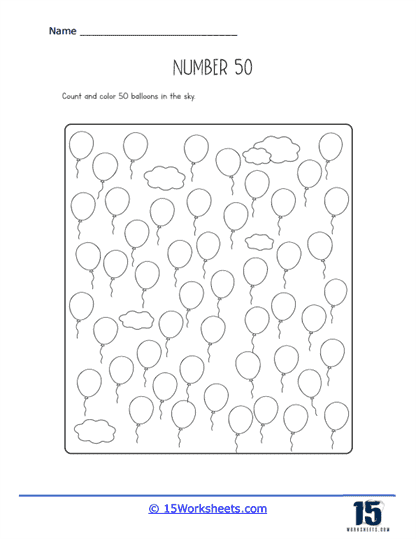
Lost Balloons
Students count and color balloons, making sure groups add up to 50. The activity mixes counting with visual recognition. It ties numbers to a playful theme. A cheerful way to reinforce number sense.
The Race Course
Learners trace along a number path leading to 50. This makes number sequencing exciting. It feels like moving along a track toward a finish line. Great for building forward counting skills.
Gumball Machine
Kids count gumballs to reach 50 inside a fun picture. The theme adds excitement to basic counting practice. It turns math into a playful activity. Students see numbers represented visually.
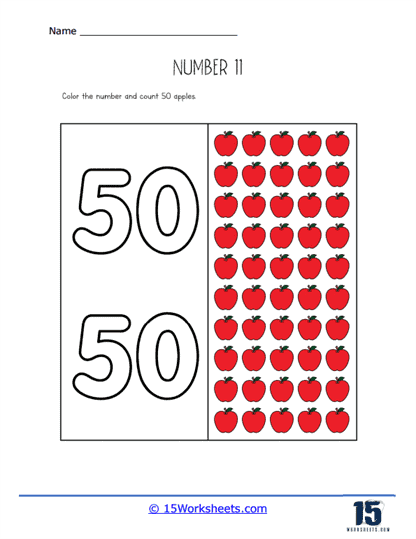
50 Apples
Students count apples to build up to 50. The activity mixes fruit imagery with math practice. It encourages grouping and tallying. Perfect for reinforcing sets and totals.
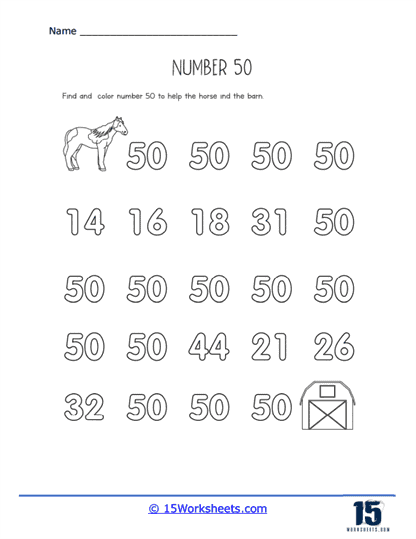
Horse to the Barn
Kids guide a horse along a counting path to reach the barn at 50. This worksheet ties sequencing to a story-like theme. It helps learners practice number order. The visual journey makes learning engaging.
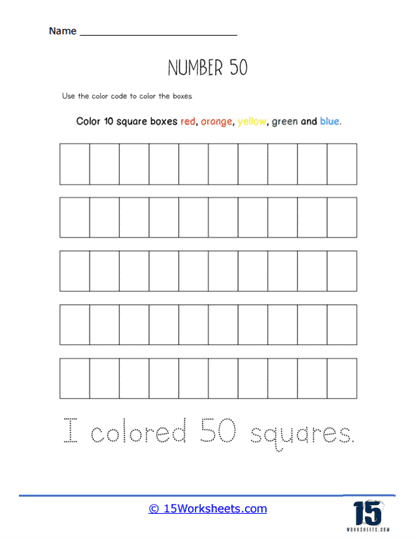
I Colored Squares
Students color in 50 small squares on a grid. The task reinforces one-to-one correspondence. It combines number recognition with coloring fun. A hands-on way to practice careful counting.
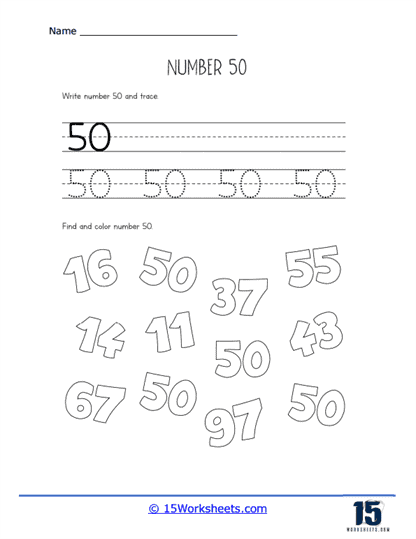
Find and Color
Learners find and color all instances of the number 50 on the page. It’s a focused recognition exercise. The task trains attention to detail. A quick and interactive review.
50 Rain Drops
Students count and color 50 raindrops in a picture. The playful weather theme keeps interest high. It combines visual counting with number recognition. A seasonal and fun way to practice.
Inside and Trace
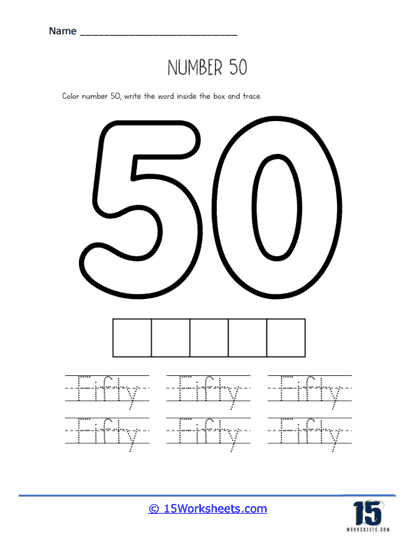
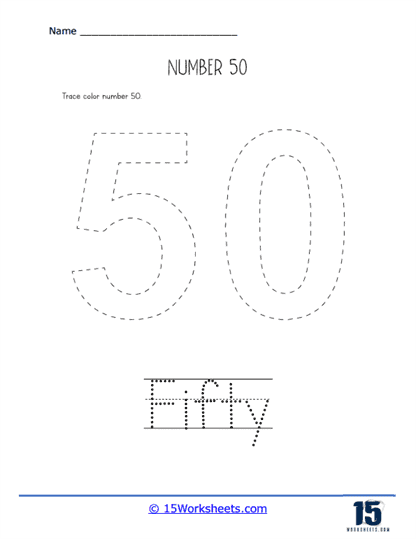
Kids trace the number 50 repeatedly inside outlined shapes. This reinforces handwriting and muscle memory. The repetition helps students master writing larger numbers. It’s especially useful for early writers.
Fifty Ways
Students explore different ways to represent the number 50 (tally marks, words, digits, etc.). It broadens number sense by showing multiple forms. This encourages flexible thinking about numbers. A strong foundation for future math.
Pencil Warmups
Learners trace and write the number 50 as a fine motor warmup. It doubles as both handwriting and math practice. Simple repetition builds mastery. A helpful daily starter activity.
5 Points
Students use points or dots to count up to 50. It emphasizes grouping in sets of five. This strengthens skip-counting skills. A stepping stone toward multiplication concepts.
Practice Words
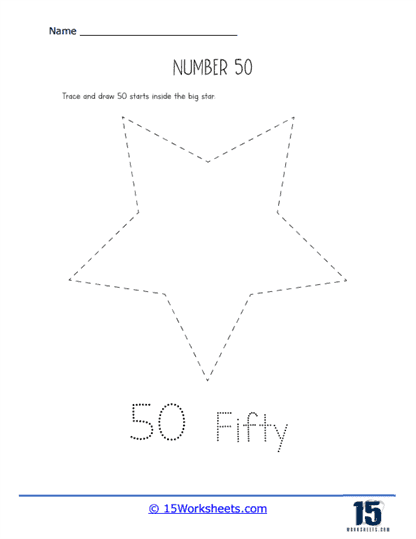
Kids write the word “fifty” along with the numeral 50. It reinforces spelling and number recognition together. The activity blends literacy and math. Great for cross-skill learning.
Fifty: The Half-Century Marvel
1. Golden Jubilee
A 50th anniversary is called a golden jubilee, a term often used to mark major milestones like marriages, reigns, or institutions. Gold symbolizes endurance, prosperity, and timeless value, making it the perfect representation of 50 years. Reaching this point is considered rare and remarkable, which is why it is celebrated with such grandeur.
2. Roman Power
In Roman numerals, 50 is represented by the letter L. Beyond being a number, “L” has taken on symbolic meaning in modern culture, often used to signify “large,” “luxury,” or even “legendary.” This dual life-ancient numbering and modern slang-makes 50 both classical and contemporary.
3. Half a Hundred
Fifty sits at the midpoint between zero and one hundred, making it a natural milestone of achievement. Humans often measure progress in halves and wholes, which is why 50 feels like a powerful marker of being “halfway there.” Whether it’s age, scores, or percentages, reaching 50 is psychologically significant.
4. Spherical Symmetry
In geometry, the icosidodecahedron-a fascinating polyhedron-has exactly 50 vertices. This links the number 50 to deep mathematical beauty and three-dimensional symmetry. Its presence in complex structures shows how 50 naturally fits into the language of shapes and balance.
5. U.S. Stars
The flag of the United States contains 50 stars, each representing one of the 50 states in the union. This makes the number 50 not only a mathematical figure but also a powerful cultural and national symbol. Every time the flag is raised, the number 50 stands for unity and identity.
6. Prime Mystery
Fifty has intriguing connections to prime numbers. For example, it is the sum of two primes-47 and 3-showing that even composite numbers have hidden ties to the prime world. These relationships make 50 a number with subtle mathematical depth beyond its straightforward appearance.