
Ice Word Family Worksheets





About These 15 Worksheets
The ice word family introduces students to a clear, consistent spelling pattern that appears in many early-reading vocabulary words. Because the ending stays the same, students can decode new words more confidently by applying familiar phonics knowledge. These worksheets provide a wide variety of activities-coloring, matching, tracing, writing, cutting, and searching-to ensure deep engagement with the ice pattern. Whether used in classrooms or at home, these activities help young readers gain fluency while having fun. The mixture of simple and more advanced words helps support learners at multiple stages of development.
Working with word families builds essential decoding skills by teaching students to recognize predictable spelling structures. As children encounter the ice pattern across many different worksheets, they strengthen both visual recognition and phonemic awareness. This leads to smoother reading and better comprehension as they begin to apply these skills independently. By repeating the pattern in multiple contexts, learners grow more confident in decoding unfamiliar words. These foundational skills prepare students for success with longer and more complex texts.
The ice family appears frequently in everyday language, stories, and informational texts. Words like ice, mice, slice, rice, dice, and many others occur often enough that mastery of the pattern pays off quickly. These worksheets help children make meaningful connections between spelling, sound, and real-world vocabulary. With repeated exposure, learners begin to see word families as helpful tools that make reading easier. This structured practice lays a strong foundation for future literacy success.
About Each Worksheet
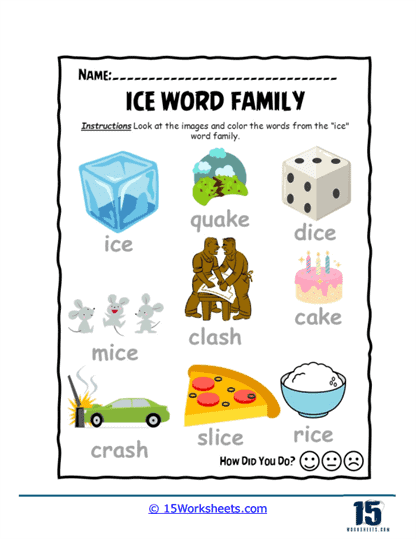
Color Ice
Students color only the words that belong to the ice word family, distinguishing them from unrelated words. The mix of correct and distractor words helps sharpen visual scanning and phonics discrimination. Each illustration provides clues that support meaning and pattern recognition. The coloring aspect keeps students engaged and encourages thoughtful examination. This worksheet works well for warm-ups, centers, or quiet practice.
Find Family
Students sort through mixed words and choose only those containing the ice ending. The activity introduces words like lice, spice, twice, and device, alongside distractors. This reinforces careful comparison and strengthens phonics accuracy. Learners develop stronger decoding strategies as they filter for the target spelling pattern. It is ideal for literacy centers or independent practice.
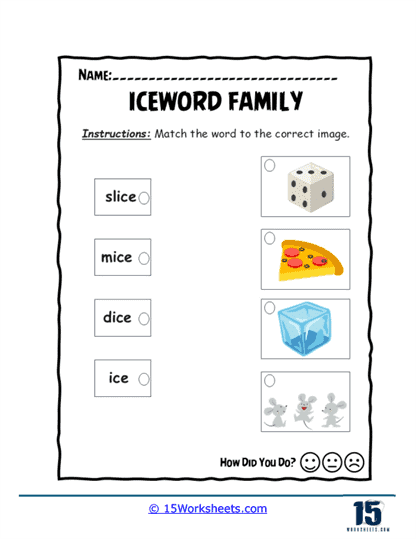
Match Slice
Students match ice family words such as slice, mice, dice, and ice to their correct images. Picture clues help reinforce meaning and phonics simultaneously. The simple layout supports early readers who are developing confidence. Marking the correct matches strengthens association between spelling and vocabulary. This worksheet fits well into small-group instruction or skills review.
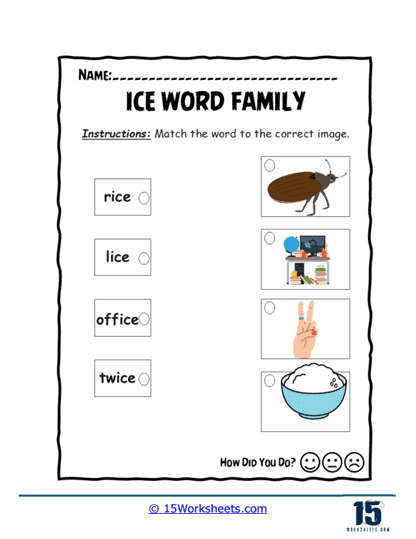
Picture Match
Students match rice, lice, office, and twice to the correct image. Each picture prompts students to use both phonics and meaning to choose accurately. The format encourages active decision-making and deeper thinking. Learners practice distinguishing similar-looking words as they solidify the pattern. This worksheet strengthens reading accuracy and comprehension.
Write Spice
Students trace and write ice family words such as spice, lice, device, office, twice, and advice. The guided tracing supports correct handwriting habits. Repetition helps students internalize the spelling pattern. Learners gain encoding practice, improving spelling and writing fluency. This activity fits well in writing centers or intervention sessions.
Write Ice
Students identify images of ice, mice, slice, dice, and rice, then write the correct word beneath each one. They trace first and then write independently to reinforce accuracy. Visual cues make decoding easier for developing readers. Repeated writing builds fluency and strengthens understanding of the ice pattern. This worksheet is perfect for handwriting and phonics practice combined.
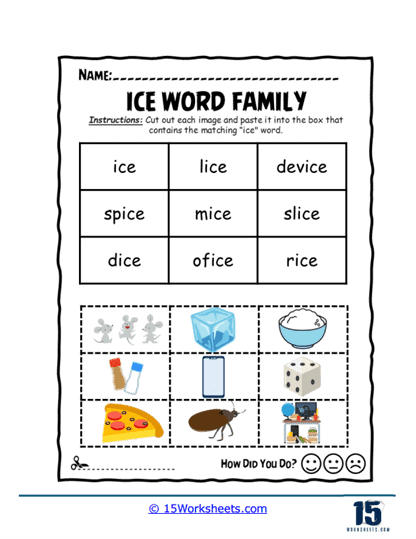
Cut Sort
Students cut out image tiles and paste them next to the matching ice word, including ice, lice, device, spice, mice, slice, dice, office, and rice. The hands-on approach increases engagement and retention. Sorting strengthens comprehension of the spelling pattern through multisensory learning. Students build confidence as they categorize and compare words. This activity works great for centers or small groups.
Fill Words
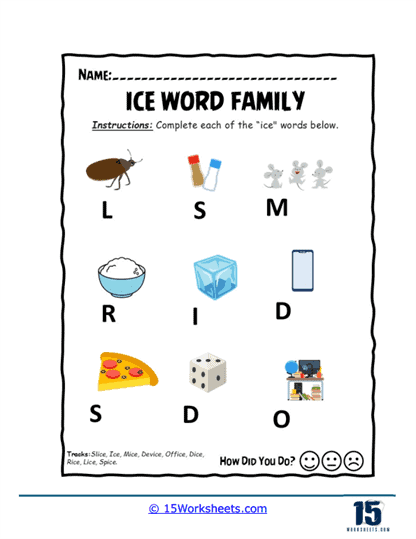
Students complete partially written ice family words using picture clues. Words such as lice, spice, mice, ice, device, dice, rice, slice, and office appear with missing letters. Students supply the correct ending to complete each word. This reinforces phonics knowledge while supporting accurate spelling. The format is excellent for independent practice.
Write Lines
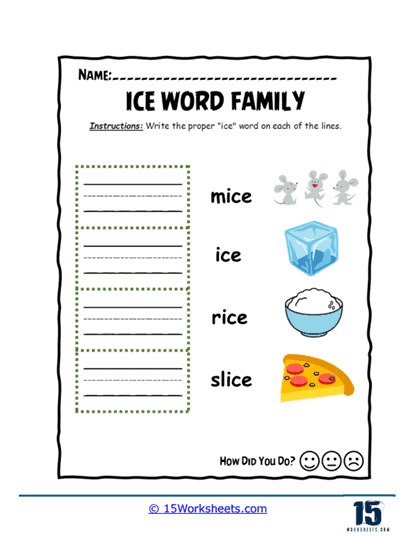
Students write mice, ice, rice, and slice next to matching pictures. The lined spaces support neat handwriting and repeated writing. Visual prompts guide learners toward accurate decoding. The simple structure helps early writers develop spelling confidence. It pairs well with morning practice or homework.
Word Lines
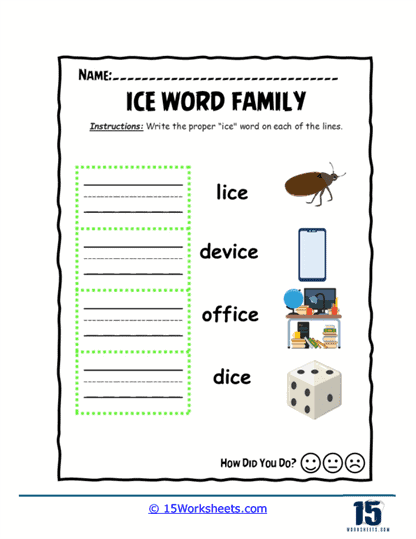
Students write lice, device, office, and dice beneath corresponding images. The repeated writing strengthens both vocabulary and phonics precision. Guided lines encourage neat, consistent handwriting. Learners become more fluent with the ice pattern as they write multiple times. This worksheet reinforces spelling during independent or small-group work.
Ice Search
Students locate ice, dice, mice, nice, rice, and slice in a word-search grid. The puzzle format adds excitement and boosts motivation. Scanning for familiar endings strengthens visual discrimination. Students develop better attention to spelling patterns as they search for grouped words. It makes an excellent early finisher or literacy center activity.
Advanced Search
Students search for more complex ice pattern words such as spice, twice, advice, device, entice, and office. The dense letter grid encourages strategic scanning. Learners build stamina as they work through longer, multisyllabic words. The activity deepens understanding of how patterns appear inside complex vocabulary. This helps prepare students for more advanced reading tasks.
Word Hunt
Students search for higher-level words containing the ice pattern, including practice, prejudice, service, sacrifice, lice, and vice. The mixture of long and short words increases challenge and strengthens analysis skills. Learners notice how familiar patterns appear in larger word structures. The hunt encourages persistence and flexible decoding strategies. It is ideal for enrichment or advanced readers.
Picture Write
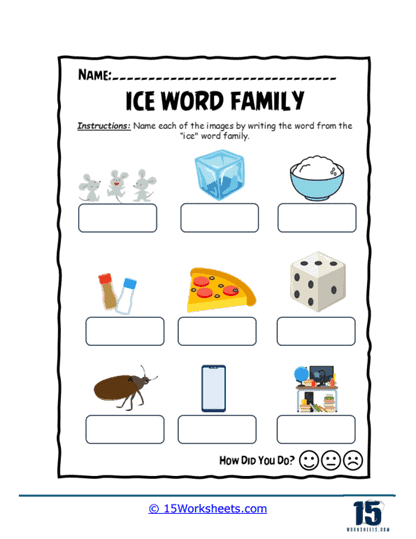
Students identify and write ice family words such as mice, ice, rice, spice, slice, lice, device, and office using picture clues. The blank lines allow for independent spelling and handwriting practice. Visual cues support vocabulary comprehension. Repeated writing reinforces orthographic patterns and increases fluency. This worksheet supports foundational spelling skills.
Trace Ice
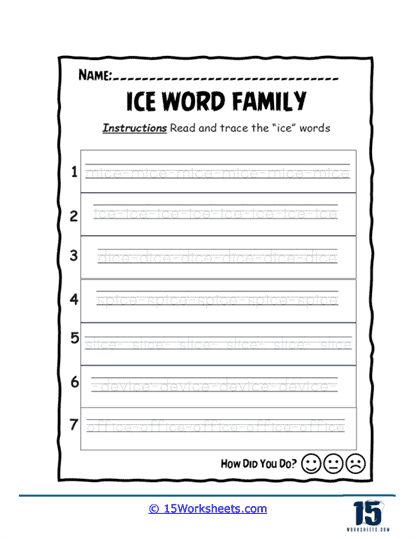
Students trace and write ice family words like slice, ice, spice, office, device, and twice. The tracing lines guide correct letter formation. Writing independently afterward reinforces spelling accuracy. Learners build fluency as they repeat the pattern across several words. This worksheet is useful for handwriting practice and phonics warm-ups.
What Is the ice Word Family?
The ice word family is a set of words that share the same ending spelling pattern: ice. This predictable pattern helps young readers decode words more easily by focusing on a familiar chunk. Many ice words represent concrete nouns or everyday vocabulary, making them accessible and meaningful for early learners. Because the ending remains the same, readers can quickly apply phonics knowledge when encountering new words. This boosts accuracy, fluency, and overall reading confidence.
Common words in this family include ice, mice, dice, slice, rice, spice, twice, device, office, and many more. While the ending stays consistent, the beginning blends and letters modify the meaning, offering great variety for vocabulary development. Students encounter nouns, verbs, and even adjectives within this word set, helping them recognize the pattern across multiple language uses. This range makes the ice family especially valuable for building flexible decoding skills. Exposure to both simple and multisyllabic examples deepens understanding.
The ice pattern also appears inside larger or more complex words, showing students how word families extend beyond simple forms. For example, words like practice, sacrifice, prejudice, and service contain the recognizable sound or letter sequence, even though the pronunciation shifts. Seeing familiar chunks within longer vocabulary helps students become stronger, more strategic readers. Sentences such as “The mice shared their rice after the slice fell on the floor” show how playful and functional this pattern can be.
Word List for the ice Word Family
Word List (Alphabetical)
- advice
- device
- dice
- entice
- ice
- lice
- mice
- nice
- office
- practice
- prejudice
- rice
- sacrifice
- service
- slice
- spice
- twice
- vice
Example Sentences
1. The mice shared their rice after a slice of bread fell on the floor.
2. She rolled the dice twice before giving helpful advice.
3. The ice looked nice, so we added spice to the warm rice for dinner.