
Ight Word Family Worksheets



About These 15 Worksheets
The ight word family is packed with vivid, high-interest words that kids see in stories, poems, and even nighttime scenes. Words like light, night, bright, and fight are fun to say and full of meaning, which makes them perfect for phonics practice. This collection uses coloring, matching, cutting, tracing, writing, and word searches so students can explore the ight pattern in many different ways. Learners move from simple recognition to confident reading and writing of these patterned words. Whether you’re teaching in a classroom or working with a child at home, these worksheets make long vowel and complex pattern practice feel approachable and engaging.
Word-family work helps students shift from sounding out each letter to recognizing bigger spelling chunks. As they meet ight words again and again, learners start to see the ending as a familiar unit they can rely on. These pages ask students to pick out correct words, ignore distractors, and link spellings to pictures and contexts. That kind of repetition and decision-making builds strong phonics foundations. Over time, students begin to read new ight words more quickly and accurately, even in longer texts.
This collection also introduces more advanced words such as spotlight, moonlight, midnight, twilight, and sunlight, so learners see how the same pattern appears inside bigger words. The variety of activities supports visual, auditory, and kinesthetic learners through puzzles and hands-on cut-and-paste tasks. Visuals help anchor vocabulary, while tracing and writing build spelling and handwriting fluency at the same time. Together, these 15 worksheets form a mini-unit that strengthens decoding, spelling, and comprehension with the ight word family. They also prepare students to tackle other tricky patterns and silent-letter combinations with confidence.
About Each Worksheet
Bright Search
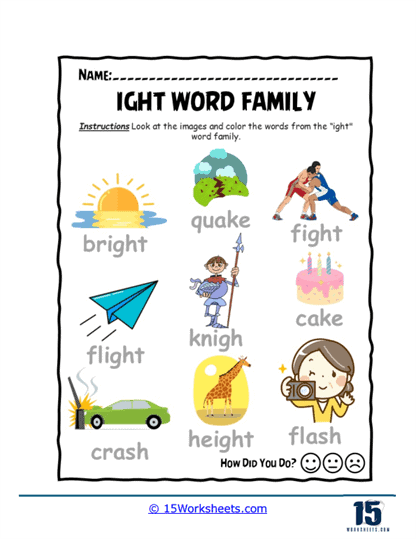
Students look over a page of illustrated words and color only the ones that belong to the ight word family, such as bright, fight, flight, height, and knight. Distractor words are mixed in, so learners must read closely before they color. This selective task strengthens visual discrimination and careful decoding. The coloring element keeps engagement high while encouraging slow, thoughtful reading. It’s an excellent warm-up or literacy center activity for practicing the ight pattern.
Light Search
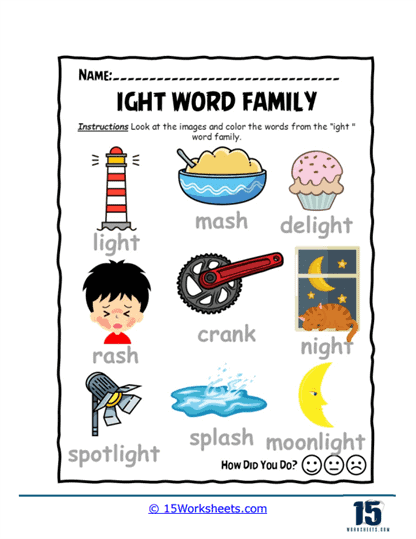
Learners examine another set of pictures and choose only true ight words like light, delight, night, spotlight, and moonlight. They must avoid distractor words that do not share the target ending. This sorting task reinforces both vocabulary meaning and phonics accuracy. Students grow more confident differentiating correct word-family spellings in busy contexts. It’s ideal for independent practice or partner work during a word-family unit.
Knight Match
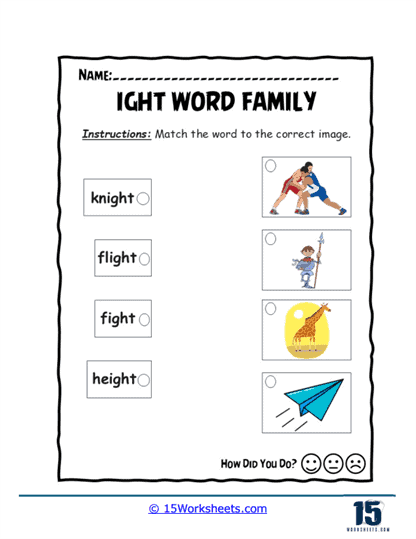
Students match ight words such as knight, flight, fight, and height to corresponding images. Some pictures are similar or action-based, so learners must pay close attention to details. Matching encourages students to read each word carefully and think about its meaning. This process strengthens the link between the ight spelling pattern and real-world vocabulary. It’s a great worksheet for building both decoding and comprehension skills.
Night Match
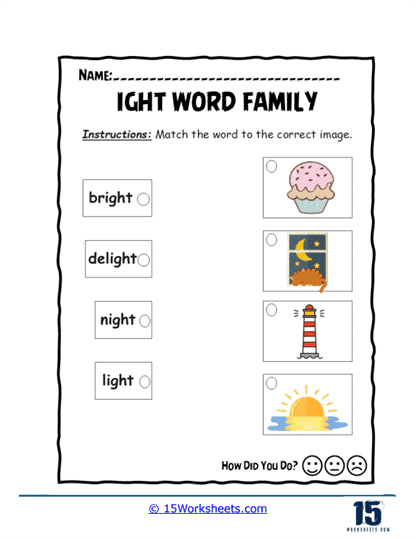
In this worksheet, students match bright, delight, night, and light to vivid images. While all the words share the ight ending, their meanings differ, so learners must use context clues. This helps students see that the same pattern can appear in many different words. Matching improves memory, spelling, and word recognition. It’s especially helpful for visual learners and for practicing subtle differences in meaning.
Write Bright
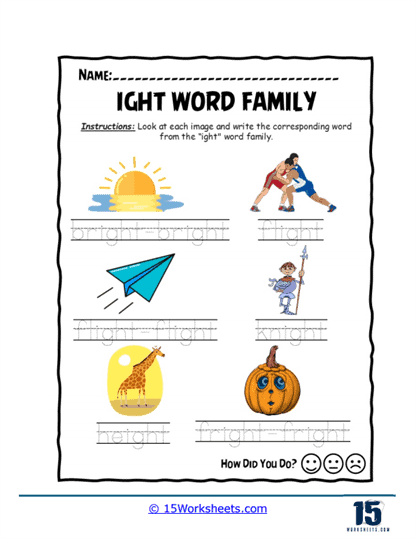
Students write the correct ight word-bright, fight, flight, knight, or height-beneath each picture. A tracing component provides guided support before they write independently on the lines. This repeated encoding practice helps students internalize the ight spelling pattern. Writing also builds fine-motor skills and handwriting fluency. The worksheet is perfect for blending phonics, spelling, and handwriting in one activity.
Light Write
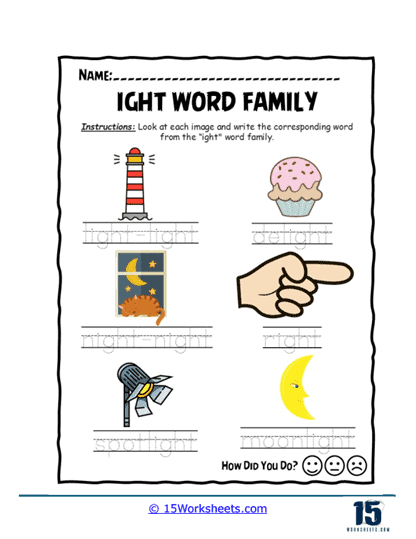
Learners write ight words such as light, delight, night, spotlight, and moonlight under matching images. Tracing models help them get used to the tricky sequence of letters. The pictures make each word’s meaning clear and memorable. Students connect sound, spelling, and meaning, which deepens understanding. This worksheet is ideal for practice with both simple and compound ight words.
Ight Cutouts
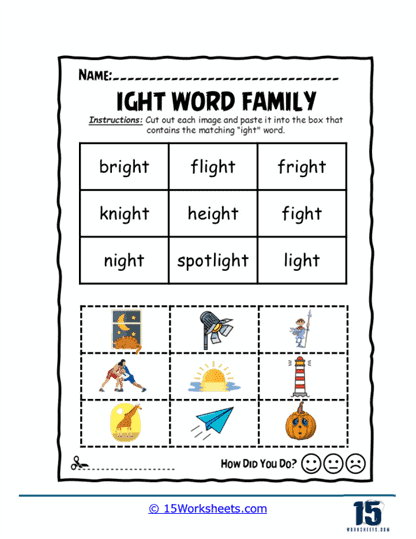
Students cut out images and paste them into boxes labeled with ight words like bright, flight, fright, knight, height, night, spotlight, and light. The cut-and-paste format adds a tactile, hands-on dimension to phonics practice. Matching pictures to words reinforces decoding and vocabulary recall. Sorting tasks like this strengthen executive-function skills while focusing on word patterns. It’s a highly engaging activity for centers or small-group lessons.
Word Finish
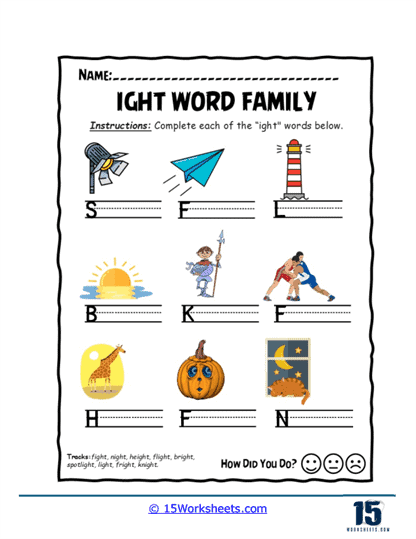
In this worksheet, students complete partially spelled ight words using image clues. Words include spotlight, flight, lighthouse, bright, knight, fight, height, and night. Learners must use both the picture and the visible letters to finish each word correctly. This puzzle-style task encourages active problem-solving and flexible decoding. It’s a fun way to deepen spelling accuracy with the ight pattern.
Write Flight
Students write flight, bright, spotlight, and height on lines beside matching images. The layout provides generous space for neat handwriting and repeated spelling. This repetition builds orthographic memory for the ight chunk. Linking each word to a visual scene strengthens vocabulary understanding. The worksheet works well as homework, seatwork, or extra practice for early finishers.
Night Write
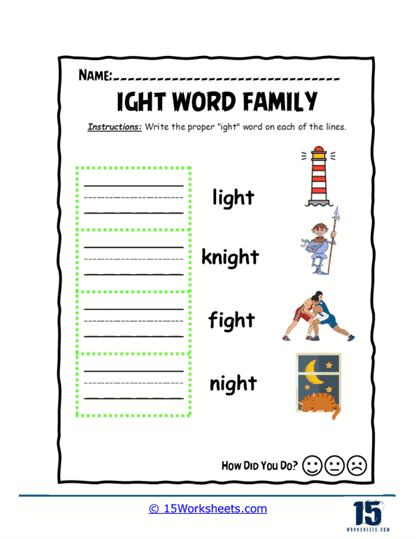
Learners write light, knight, fight, and night next to corresponding pictures. This set introduces a silent-k word while keeping the shared ight ending consistent. Students see that even with extra letters at the beginning, the final pattern still guides pronunciation. Writing the words multiple times improves spelling memory for both regular and irregular structures. This worksheet is especially helpful for tackling tricky silent-letter words.
Battle Lights
This worksheet is a word search focused on ight words like bright, fight, flight, fright, height, and knight. Students scan the grid horizontally, vertically, and diagonally to find each word from the list. The puzzle requires close letter-by-letter tracking and careful attention to patterns. Repeatedly seeing the ight chunk embedded in different words reinforces phonics knowledge. It’s a motivating, game-like way to review the word family.
Night Sight
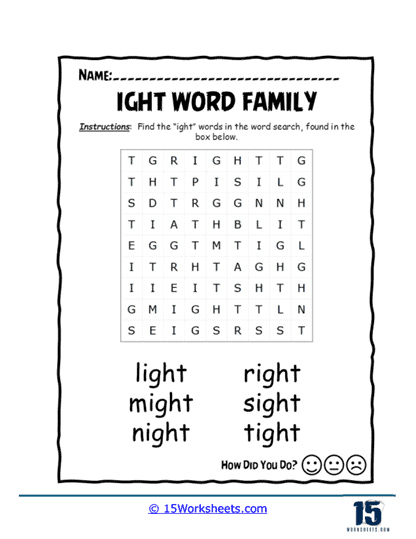
Students complete another ight word search featuring words such as light, might, night, right, sight, and tight. They must scan rows and columns, noticing how letters join to form familiar endings. This activity deepens recognition of the ight pattern across multiple high-frequency words. Word-hunting also builds visual scanning and tracking skills important for fluent reading. The puzzle format keeps learners engaged while they practice.
Moonlit Words
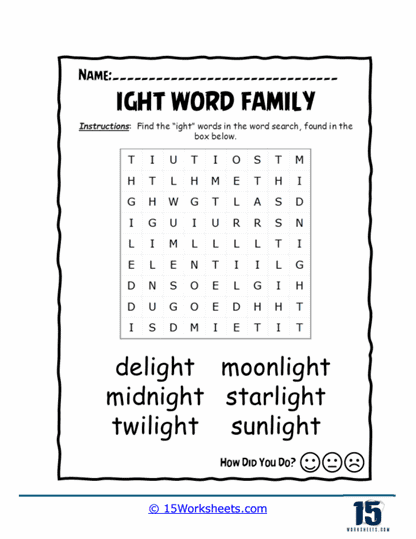
This word search focuses on longer compound and multi-syllabic ight words such as delight, midnight, twilight, moonlight, starlight, and sunlight. Students must search for longer strings of letters, adding an extra challenge. They see how light combines with other parts to form new, meaningful words. Recognizing familiar chunks inside larger words builds morphological awareness. This is a strong step toward decoding more advanced vocabulary.
Picture Ights
On this worksheet, students label pictures such as a lighthouse, paper airplane, moon, pointing hand, sunrise, knight, and more with matching ight words like light, flight, delight, fight, night, right, bright, knight, and height. Each image has a blank box beneath it for the correct word. Learners must recall both meaning and spelling to complete the labels accurately. Writing the words provides extra encoding practice and reinforces letter order. It’s a rich blend of phonics, vocabulary, and handwriting.
Trace the Light
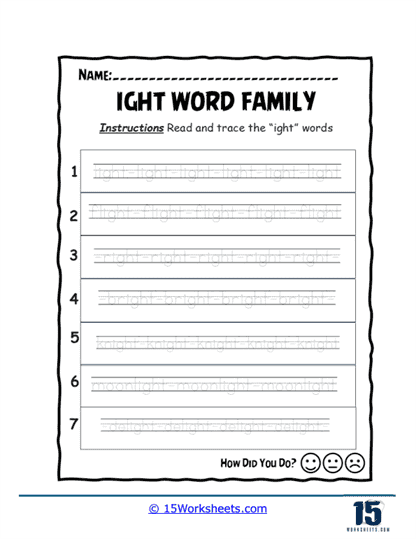
Students read and trace a series of ight words along handwriting lines, such as light, bright, right, fight, knight, moonlight, sunlight, and height. The tracing models help them form each word carefully and consistently. Repetition builds muscle memory for these common patterns. As students read and say the words while tracing, they connect sound, print, and movement. This worksheet is especially useful for learners needing extra support with neatness and accuracy.
What Is the ight Word Family?
The ight word family is a group of words that all share the same ending spelling pattern: ight. In most of these words, the letters igh work together to represent a long i sound, followed by the consonant t. Words like light, night, and bright are common in children’s books, poems, and everyday language. Because the pattern is consistent, it gives young readers a reliable chunk they can recognize quickly. Learning this word family helps students see that some sounds are represented by letter teams rather than single letters.
Within the ight family, students encounter many different parts of speech and meanings. There are nouns like night, knight, and height, verbs like fight and light (as in “light the candle”), and adjectives like bright and right. They also meet compound and multi-syllabic words such as moonlight, sunlight, twilight, and midnight, where light or night combine with other meaningful parts. This variety shows learners that the same pattern can appear in simple and more complex words. It also helps them see how word parts can be reused to create new vocabulary.
The ight pattern is especially useful for teaching about silent letters and tricky spellings. For example, in knight the k is silent, yet the ight ending still guides pronunciation. When students recognize the ight chunk automatically, they can decode unfamiliar words like twilight or starlight more easily. Sentences such as “The knight rode through the night with a bright light” highlight how several ight words can work together naturally. Over time, this word-family knowledge supports smoother, more confident reading and spelling across many texts.
Word List for the ight Word Family
Word List (Alphabetical)
- bright
- delight
- fight
- flight
- fright
- height
- knight
- light
- lighthouse
- might
- midnight
- moonlight
- night
- right
- sight
- spotlight
- starlight
- sunlight
- tight
- twilight
Example Sentences
1. The knight rode through the night carrying a bright light to guide his flight of birds.
2. We saw the moonlight and starlight at midnight, and it felt just right instead of giving us fright.
3. From the tall lighthouse at that great height, you can see the sunlight shine so bright over the night sea.